
Claiming a pension in Spain: combining Jubilación as an expat
Anyone who has worked for years in Germany and Spain, or who lives as a retiree on Mallorca, faces a question that many people underestimate: how do I correctly apply for a pension in Spain – and how do I combine this with my German pension without losing entitlements or being taxed twice? Spain and Germany are both EU members, which simplifies many things, but by no means regulates everything automatically. This guide explains which authorities are responsible, how the aggregation of insurance periods works, what documents you need, how payment to a Spanish account is processed, and what to expect in terms of taxation. You will also learn how to use the S1 form for health insurance – and which mistakes expats on Mallorca make time and again.

Are you planning your retirement on Mallorca and want to know whether your pension entitlements are truly secure?
- 📩 Submit a personal enquiry — individual assessment for your situation
- Everything you need to know about taxes as a resident — IRPF obligations for retirees
European pension law: the foundation for expats
Spain is an EU member. This means that the European coordination regulations (currently Regulation (EC) No. 883/2004 and Implementing Regulation No. 987/2009, which replaced the older Regulations No. 1408/71 and No. 574/72) ensure that insurance periods in different EU countries are aggregated. Not a single year is lost.
As an expat, the following applies to you:
- If you have only worked in one EU country, your pension is calculated according to the law of that country – regardless of where you now live.
- If you have worked in several EU countries, you will receive a pension from each country in which you meet the respective minimum requirements.
- The pensions are calculated separately and paid out separately – there is no joint "EU pension".
Please note: Your place of residence in Spain has no effect on the amount of your German pension. As an EU citizen, you will receive your German pension in full, paid directly into a Spanish account.
The German pension abroad: what changes and what does not
If you live permanently on Mallorca, the Deutsche Rentenversicherung (DRV) will continue to recognise your German contribution periods and pay out your pension – provided you notify them of your new place of residence.
What you must inform the DRV about:
- New residential address in Spain
- Bank details for the international transfer: IBAN and BIC of the Spanish account (or a German account can be retained)
- A payment declaration confirmed by the bank
| Item | Details |
|---|---|
| Responsible authority | Your current DRV provider (DRV Bund, DRV Bayern Süd, etc.) |
| Payment abroad | Possible to a German or foreign account |
| Required details | IBAN, BIC, bank-confirmed payment declaration |
| EU legal basis | Regulation (EC) No. 883/2004, Implementing Regulation No. 987/2009 |
| Pension reduction upon moving within the EU | No, full payment |
Note: Transfer fees for international transfers within the SEPA zone are legally capped at the same level as domestic transfers — you will generally incur no additional costs.
The Spanish pension (Jubilación): Who is entitled?
The Spanish old-age pension (pensión de jubilación contributiva) is administered by the Instituto Nacional de Seguridad Social (INSS). It is contribution-based — meaning you must have paid contributions into the Spanish Seguridad Social.
Minimum requirements for the contributiva:
| Criterion | Requirement |
|---|---|
| Minimum age (standard) | Dependent on contribution years, being gradually raised in Spain |
| Minimum contribution years (general) | 15 years (of which 2 must fall within the last 15 years before retirement) |
| Responsible authority | INSS (Instituto Nacional de Seguridad Social) |
| Application | At the INSS at your place of residence or in your country of origin |
Have you less than 15 years worked in Spain, the EU aggregation rule applies: the INSS adds your German insurance periods to determine whether you meet the minimum qualifying period. However, the pension amount is then calculated on a pro-rata basis according to your actual Spanish contribution years (cálculo pro rata temporis).
Non-contributory pensions (pensiones no contributivas) also exist. They do not require contributions, but do require long-term legal residence in Spain and are means-tested.
Applying for your pension: the single-application principle
A key principle of EU pension law: you only need to submit a single application – in the country where you are living at the time of application. The competent authority in that country will automatically forward the application to all other countries concerned.
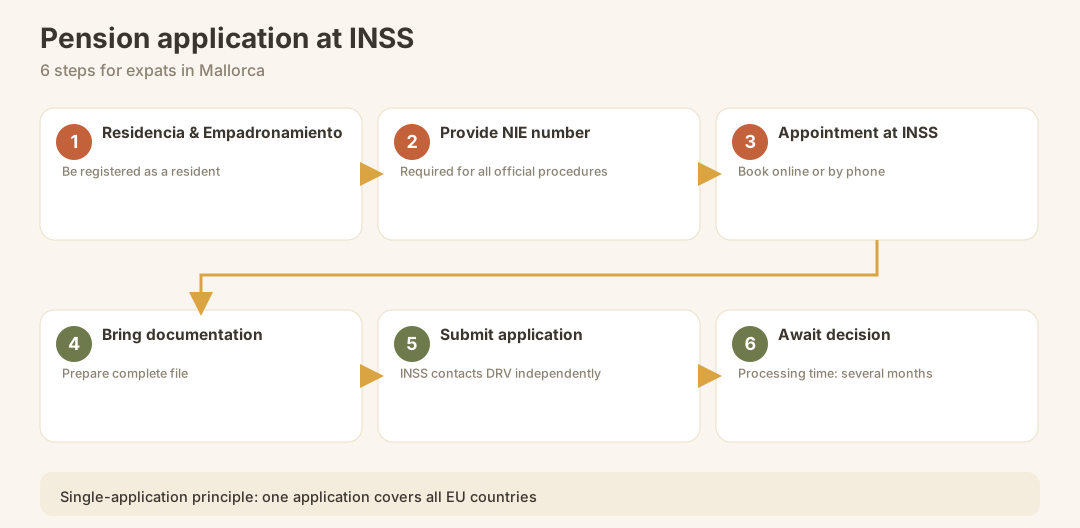
If you live on Mallorca: Submit your application to the INSS. If you still live in Germany: Submit your application to your DRV pension provider – they will notify the INSS.
Step by step: applying in Spain (INSS)
- Residencia and Empadronamiento – ensure these are in order, as you must be registered as a resident. Find out more in the Residencia guide.
- NIE number – required for all official procedures in Spain. Apply for your NIE number.
- Appointment at the INSS – book either online via the INSS website or by telephone.
- Bring your documents (see the next section).
- Submit your application – the INSS will then contact the DRV independently.
- Await the decision – the processing time can take several months.
Note: The INSS uses standardised EU forms for coordination with German authorities (formerly E-forms, now SED forms). You do not need to obtain these yourself.
Documents required for the pension application with the INSS
Prepare the following documents. The more complete the file, the faster the processing:
| Document | Purpose |
|---|---|
| Valid passport or national identity card | Proof of identity |
| NIE number | Required for all Spanish administrative procedures |
| Empadronamiento (registration certificate) | Proof of residence in Spain |
| Residencia / TIE card (if applicable) | Proof of residence for EU citizens |
| Spanish social security number (NSS) | For the INSS file |
| Proof of employment in Spain (employment contracts, payslips, Vida Laboral) | Proof of contribution periods in Spain |
| Proof of employment in Germany (insurance record from the DRV) | Proof of contribution periods in Germany |
| Bank details (IBAN, BIC) | For payment |
| Birth certificate (with certified translation if required) | Civil status |
Your insurance record from the DRV can be requested free of charge online via the Deutsche Rentenversicherung portal or in writing from your responsible DRV provider.
Pension amounts in 2026: what you can realistically expect
From 1 January 2026, new pension values apply in Spain in accordance with Real Decreto-ley 16/2025 of 23 December 2025:
| Type of pension | Change in 2026 |
|---|---|
| Contributory pensions (contributivas) | +2,7 % |
| Minimum pensions (with dependent spouse) | +11,4 % |
| Widow's pensions with family dependants | +11,4 % |
| Non-contributory pensions (no contributivas) | +11,4 % to €8.803,20 per year (€629 / month in 14 payments) |
| Maximum pension | €3.359,60 / month (€47.034,40 / year) |
| Maximum contribution base | €5.101,20 / month (+3,9 %) |
The Complemento de brecha de género (supplementary benefit to reduce the gender pension gap) was increased in 2026 by 2,7 % to €36,90 per month per child. The extraordinary additional increase of 10 % that applied in 2024 and 2025 will no longer apply from 2026.
Aggregation of insurance periods: the pro-rata principle
Anyone who has worked in both Germany and Spain benefits from EU coordination – but must understand how the pension amount is actually calculated.
Simplified example:
- 30 contribution years in Germany, 10 contribution years in Spain = 40 years in total
- Spain first checks whether you are entitled on the basis of 10 Spanish years alone (no, as this falls below the minimum contribution period of 15 years)
- Through aggregation: 40 years → entitlement exists
- Spain calculates a notional full pension on the basis of 40 years
- However, only the Spanish share is paid out = 10/40 of the notional full pension (pro rata)
- Germany calculates separately based on 30 German years
Note: If you have enough Spanish contribution years to qualify for a standalone entitlement (15+), the so-called national pension is calculated in addition. The expat then receives the higher of the two amounts (national or pro-rata pension) – the EU coordination rules ensure that you are no worse off than someone who has worked in only one country.
S1 Form: Health insurance for retirees on Mallorca
As a statutory health insurance member in Germany, you are entitled to access the Spanish healthcare system as a retiree on Mallorca – but only if you apply for the correct form.
The S1 form (formerly E121) certifies to the Spanish healthcare system that your health insurance costs are covered by your German insurer.
S1 process for retirees:
- Apply for the S1 from your German health insurer (free of charge)
- Submit the S1 to the INSS in Spain and have it registered there
- Tarjeta Sanitaria Individual (TSI) – your Spanish health insurance card
- This gives you access to the Spanish public healthcare system (the Sistema Nacional de Salud)
You can find detailed information about the process in the Guide to the S1 form in Spain.
Please note: Care-in-kind benefits from the German long-term care insurance do not apply abroad. The care allowance continues to be paid and can be used to fund care services locally – however, organising that care is your own responsibility.
Tax: Where is the pension taxed?
This is the question that preoccupies expats most frequently. The answer depends on where you are tax resident.
| Situation | Place of taxation | Basis |
|---|---|---|
| Tax residence in Spain (Resident) | Generally Spain for all pensions | Double Taxation Agreement Germany–Spain |
| German state pension (from the general DRV) | Spain (as a Resident) | DTA Art. 17 (retirement income from private employment) |
| German civil service pension (Ruhegehalt) | Germany (source state principle) | DTA Art. 19 |
| Spanish pension | Spain | Spanish IRPF law |
As a tax resident in Spain, you are generally subject to unlimited tax liability from the point at which you have spent more than 183 days in the calendar year in Spain, and must declare your worldwide income — including your German pension — in your Spanish IRPF return. German income is not subject to double taxation as a matter of principle (credit method under the DTA).
More on the tax implications: Paying tax on your German pension in Spain and IRPF deductions in the Balearic Islands.
Most common mistakes when applying for a pension in Spain
In practice on Mallorca, the same stumbling blocks come up time and again:
1. Residence not registered The DRV must be informed of the move to Spain. Anyone who forgets this risks payment interruptions or problems with the tax certificate.
2. Application submitted too late The Spanish pension is paid at the earliest from the month in which the application is submitted — generally without backdated payment. Submit your application in good time before your planned retirement date.
3. Vida Laboral not to hand The Spanish employment history record (Informe de Vida Laboral) is the central document for the INSS. It is available free of charge via the Seguridad Social portal — but many people are unaware of it.
4. S1 form forgotten Without an S1 there is no access to the Spanish healthcare system at the expense of the German insurer. Anyone who applies for it too late must provide proof of private health insurance — a requirement for the Residencia.
5. Tax residency not sorted Anyone living in Spain without having officially deregistered in Germany may be liable to pay tax in both countries. This can be avoided – but only through proactive planning.
6. Civil service pension declared incorrectly Civil service pensions continue to be taxed in Germany under the double taxation agreement – even if you live in Spain. They must be declared in Spain, but are exempt from taxation there (subject to the progression clause).
What comes next? Authorities, accounts & everyday organisation
Once both pensions are being paid, a number of organisational steps are advisable:
- Open a Spanish bank account for INSS payments and ongoing costs in Spain → Open a bank account in Spain
- Certificado Digital apply for one: this allows you to handle INSS queries, tax returns and dealings with authorities online → Apply for a Certificado Digital
- Gestoría engage one: a Spanish gestoría handles the annual tax return (IRPF) and can coordinate communication with INSS and DRV → Gestoría Spain
- Plan care needs early: care allowance continues to be paid from Germany, but care-in-kind benefits do not transfer → think ahead about housing options and outpatient care on Mallorca
- Modelo 720 check: anyone who is a tax resident and holds foreign assets above certain thresholds must report them → Modelo 720 reporting obligation
Checklist: applying for a pension in Spain
- Notify DRV of your move, submit new bank details (IBAN/BIC)
- NIE number in place and valid
- Empadronamiento completed in your municipality on Mallorca
- Residencia (certificate as an EU citizen) applied for or already held
- Vida Laboral (Spanish employment record) retrieved from INSS or online
- German pension insurance record requested from DRV
- S1 form applied for from your German health insurance provider
- S1 registered with INSS, Tarjeta Sanitaria applied for
- Appointment booked with INSS, all documents complete
- Tax residency in Spain arranged (check deregistration in Germany)
- Engaged a gestoría or tax adviser for the IRPF declaration
- Opened a Spanish bank account for pension payments
- Applied for a Certificado Digital for online dealings with the authorities
- Planned care arrangements and health insurance for emergencies
Conclusion
The combination of a German and a Spanish pension on Mallorca works – reliably, thanks to EU coordination law, and without any loss of insurance periods. The key lies in the correct order: Residencia and Empadronamiento first, then the application to the INSS, don't forget the S1 form, and clarify tax residency. Anyone who submits their application in good time and provides complete documentation can approach their retirement on Mallorca in a well-organised manner. The cost of living on Mallorca is often considerably lower than in major German cities – which makes two pensions even more enjoyable.
Official Sources
- Deutsche Rentenversicherung – Pension Abroad: https://www.deutsche-rentenversicherung.de/DRV/DE/Rente/Ausland/Rente-im-Ausland/rente-im-ausland-antrag-detailseite
- Deutsche Rentenversicherung – Booklet "My Time in Spain" (9/2025): https://www.deutsche-rentenversicherung.de/SharedDocs/Downloads/DE/Broschueren/international/europaeische_vereinbarungen/meine_zeit_spanien.pdf
- INSS – Instituto Nacional de Seguridad Social: https://www.seg-social.es/wps/portal/wss/internet/InformacionUtil/44539
- Real Decreto-ley 16/2025 (pension adjustment 2026): BOE, 23 December 2025
- German Consulate Palma – As a Pensioner in Spain: https://spanien.diplo.de/es-de/service/2565300-2565300
- EU Coordination Regulation VO (EG) Nr. 883/2004: https://eur-lex.europa.eu/legal-content/DE/TXT/?uri=CELEX%3A32004R0883
- ATIB – Agència Tributària de les Illes Balears (for IRPF Balearen): https://www.atib.es
- AEAT – Agencia Tributaria (IRPF tax return): https://www.agenciatributaria.es