Registering a car in Spain: process, costs and deadlines for Mallorca
Anyone who has built their daily life on Mallorca or elsewhere in Spain will sooner or later need to register their German car in Spain – this is not merely a recommendation, but a legal obligation. The rules are clear: residents are not permitted to drive vehicles with foreign number plates within the country, and even non-residents quickly find themselves in a grey area if their German car has been on the island for more than half a year. This guide explains when the obligation to re-register actually kicks in, which authorities and documents you will need, which taxes become due, and how to avoid the most common mistakes. You will find everything explained step by step – from the ITV through to the import tax and the deregistration of the German number plates.

Would you like to know what re-registration will cost in your specific case and how to go about it as efficiently as possible?
- 📩 Submit a personal enquiry — we will help you find the right gestoría partner and tax adviser on Mallorca
- Converting your driving licence to a Spanish one — the next logical step after re-registering your vehicle
When are you obliged to re-register?
The decisive question is not whether you have a registered address in Spain, but whether you actually live here. Spanish law (Real Decreto Legislativo 6/2015, Art. 68) expressly prohibits residents and companies based in Spain from driving vehicles with foreign number plates within the country. What matters is your actual living situation, not a formal document such as a residencia.
A different rule applies to non-residents: anyone who stays in Spain for more than six consecutive months must also register their vehicle. The clock runs regardless of whether you are officially registered or not.
| Category of person | Obligation to re-register | Legal basis |
|---|---|---|
| Residents (permanent domicile) | Immediately upon taking up residence | Art. 68 RDL 6/2015 |
| Non-resident, stay ≤ 6 months | No obligation | Residence principle |
| Non-resident, stay > 6 months consecutively | Obligation | Residence principle |
| Companies with registered office in Spain | Immediately | Art. 68 RDL 6/2015 |
Warning: On Mallorca, vehicles with German number plates are checked on a regular basis. Seizures and substantial fines are not the exception – they are documented practice. Do not wait to be told to act – be proactive.
What you will need: all documents at a glance
Before you make your first visit to the authorities, you should have all your documents complete. Missing paperwork in Spain almost always means a second, and sometimes a third, appointment.
| Document | German designation | Note |
|---|---|---|
| Vehicle registration certificate Part I | Fahrzeugschein | Original |
| Vehicle registration certificate Part II | Fahrzeugbrief | Original |
| EC Certificate of Conformity | COC (Certificate of Conformity) | Alternative: Ficha reducida |
| NIE Number | Tax identification number | Mandatory requirement |
| Proof of Spanish address | Empadronamiento or Residencia | For registration in your own name |
| Valid ITV certificate | Spanish vehicle roadworthiness test | Must be passed before registration |
| Proof of taxes paid | Modelo 576 + Modelo 030 | Before submission to Tráfico |
The COC document is usually obtained from the manufacturer or the German dealer. It confirms that your vehicle meets EU operating standards. If it can no longer be found, a Spanish engineer can alternatively produce what is known as a Ficha reducida — this is a bureaucratic workaround, but by no means an insurmountable obstacle.
Your NIE number is the absolute basic requirement. Without it, you cannot register a vehicle in your name in Spain.
Step by step: the re-registration process
The process follows a clear sequence. Anyone who tackles the steps in the wrong order will waste time and money.
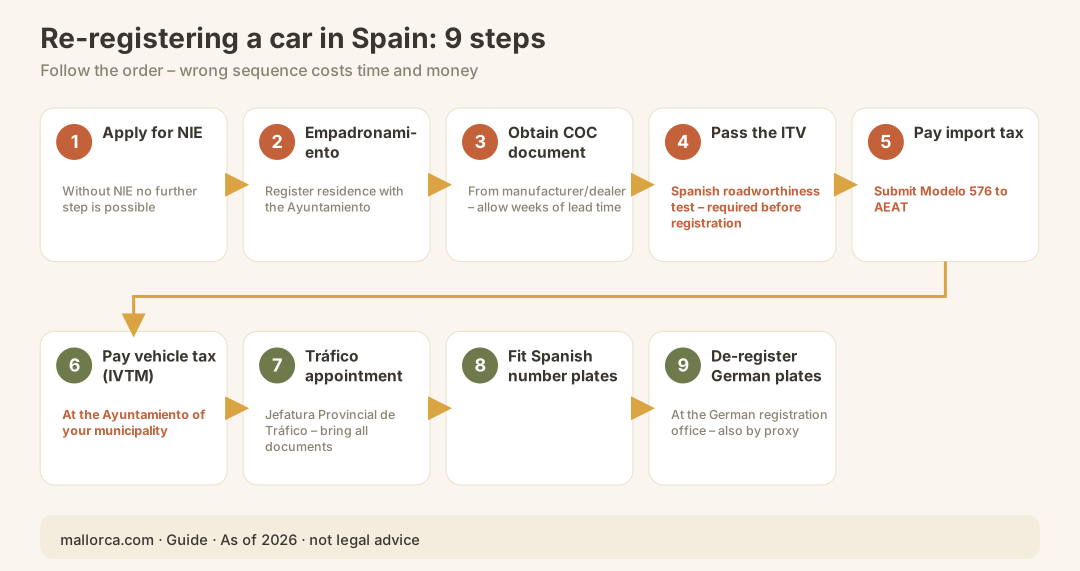
- Apply for your NIE (if you do not already have one) — without a NIE, no further step is possible
- Empadronamiento (residents' registration) — register your address at the Ayuntamiento
- Obtain the COC document — request it from the vehicle manufacturer or dealer
- Book and pass your ITV appointment — the vehicle must undergo the Spanish roadworthiness test
- Calculate and pay the import tax (Impuesto de Matriculación) — via Modelo 576 at the tax authority AEAT
- Pay the vehicle tax (Impuesto Municipal de Circulación / IVTM) at the Ayuntamiento — at your municipality of residence
- Registration at the Jefatura Provincial de Tráfico — with all documents and proof of payment
- Attaching Spanish number plates
- De-registering the German number plates in Germany – at the relevant German vehicle registration office
Note: Many residents on Mallorca engage a Gestoría – a Spanish administrative service provider – to handle the entire process. This comes at an additional cost, but saves considerable time and minimises errors arising from unfamiliarity with local procedures.
ITV: The Spanish vehicle roadworthiness inspection
The ITV (Inspección Técnica de Vehículos) is the Spanish equivalent of the German TÜV. For imported vehicles it is a mandatory requirement prior to registration – without a passed ITV there is no registration, no exceptions.
The ITV covers the following checks:
- The vehicle documents and their correspondence with the actual vehicle
- The technical condition (brakes, lighting, emissions, suspension)
- Emissions and safety standards in accordance with European norms
On Mallorca there are several ITV stations, including in Palma and Inca. Appointments can generally be booked online or by phone. Allow sufficient lead time – appointments are scarce, particularly during the high season.
Everything about the ITV on Mallorca – stations, inspection intervals, and what happens if faults are found – can be found in our separate guide.
The costs in detail: what you will actually incur
The total costs of registering a vehicle in Spain are made up of several items. Some are fixed; others depend heavily on the vehicle.
1. Import tax (Impuesto Especial sobre Determinados Medios de Transporte)
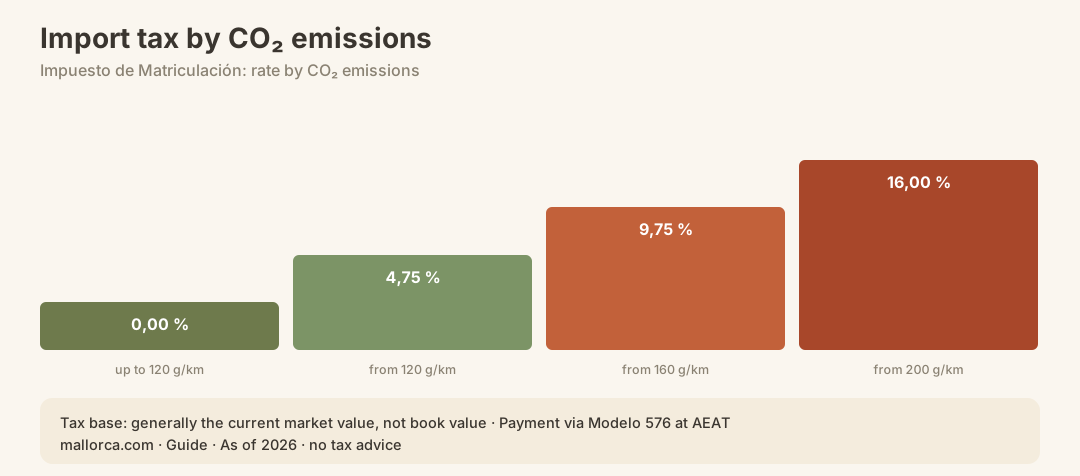
This tax – colloquially referred to as the "luxury tax" or "Matriculación" – is based on the CO₂ emissions of the vehicle. The assessment basis is the purchase price of the vehicle.
| CO₂ emissions (g/km) | Tax rate |
|---|---|
| Up to 120 g/km | 0,00 % |
| From 120 g/km | 4,75 % |
| From 160 g/km | 9,75 % |
| From 200 g/km | 16,00 % |
A fuel-efficient petrol car emitting 115 g/km therefore pays no import tax at all. A powerful SUV or an older diesel emitting 175 g/km, on the other hand, attracts close to 10 % on top of the purchase price – which on a vehicle value of 30.000 € can quickly amount to 2.925 €.
Caution: Even if your vehicle has already been fully depreciated or you purchased it second-hand, the currently assessed market value is generally used as the assessment basis, not the original purchase price.
2. Further Costs at a Glance
| Cost Item | Amount (approx.) | Note |
|---|---|---|
| ITV Fee | depending on station and vehicle type | Based on vehicle class |
| Vehicle Tax (IVTM, first instalment) | depending on municipality and engine output | Paid at the Ayuntamiento |
| Registration Fee (Tráfico) | statutory administrative fee | Currently available via the DGT website |
| Gestoría Fee | depending on provider and complexity | Obtain several quotes — the range is wide |
| COC Procurement from the Manufacturer | varies by make | Sometimes free of charge, sometimes subject to a fee |
| Ficha reducida (if no COC available) | Engineer's Fee | Only if COC cannot be obtained |
Special Case: Vehicle from Switzerland
Anyone importing their car from Switzerland faces an additional step: as Switzerland is not an EU member state, customs and import regulations apply that do not apply to EU vehicles. The process is broadly similar, but considerably more bureaucratic. Make sure you consult a Gestoría or a tax adviser in advance.
Reducing Import Taxes Legally: The Removal Goods Approach
Those who permanently relocate their habitual residence to Spain and import the vehicle as part of their removal goods may, under certain conditions, benefit from an exemption from import tax. The conditions for this are strictly defined:
- The vehicle must have been in your possession for at least six months prior to the change of residence
- You must be able to demonstrate that it is being imported as removal goods
- The application must be submitted before the actual registration — a retrospective application is not possible
If you wish to take this route, you should absolutely before entry prepare the relevant documents and ideally engage a gestoría. A misjudgement here can be costly.
Deregistering the German number plate
Once your car has been registered in Spain, you must deregister the German number plate. This is generally done at the German registration office where the vehicle was originally registered – either by proxy through a person resident in Germany, or in some cases by post. The Spanish registration certificate serves as proof for the deregistration.
Don't overlook this step: as long as the vehicle is officially registered in Germany, the German motor insurance obligation and, where applicable, vehicle tax continue to apply.
Motor insurance: sort it out before registration at the latest
You cannot register your car in Spain without a valid Spanish motor insurance policy. Therefore, take out the insurance before your ITV appointment, or at the latest before your Tráfico appointment. You can find everything about providers, rates, and the difference between third-party and fully comprehensive cover on Mallorca in our guide to motor insurance in Spain.
The most common mistakes when re-registering
A clear pattern emerges from the typical questions and problems that foreigners encounter when registering a vehicle in Spain:
- Waiting too long – Keeping the German number plate on the island because you are 'not yet officially a resident' offers no protection against checks. What counts are the actual circumstances.
- Not obtaining the COC document in time – With some manufacturers, sourcing this document can take weeks. Sort it out before tackling the other steps.
- Wrong order of steps – Anyone who goes to the Tráfico without having paid the taxes and passed the ITV will be turned away.
- Underestimating the taxable value – Many people assume their vehicle is 'worth nothing any more'. The Spanish tax authority uses market value lists – not the residual book value.
- No Spanish insurance – Without proof of insurance, there is no registration.
- German number plate not deregistered – In the worst case, this results in double taxation.
- Forgetting the empadronamiento – Without proof of a Spanish address, registration in your own name is not possible.
Checklist: everything at a glance
- NIE number obtained
- Empadronamiento (registration of residence) completed
- Vehicle registration certificate Parts I and II to hand
- COC document obtained (or ficha reducida commissioned)
- ITV appointment booked and inspection passed
- Import tax (Modelo 576) calculated and paid
- Vehicle tax (IVTM) paid at the Ayuntamiento
- Spanish motor insurance policy in place
- Registration with the Jefatura Provincial de Tráfico completed
- Spanish number plate fitted
- German number plate deregistered in Germany
What comes next?
With the Spanish registration sorted, you're not quite done with the bureaucratic marathon of emigrating – but you've got one of the most tedious steps behind you. Bear in mind:
- Convert your driving licence: As a resident, you are required to exchange your German driving licence for a Spanish one after a certain period. Full details in our guide Converting your driving licence in Spain.
- Keep to ITV intervals: Your vehicle must now be inspected according to the Spanish ITV intervals. Everything about the ITV on Mallorca.
- Tax implications of residency: As a resident in Spain, your entire tax situation changes. Make sure you inform yourself in good time about Taxes as a resident (IRPF) and Taxes & finances on Mallorca.
Conclusion
Registering your car in Spain is no dark art – but it does have its pitfalls. Anyone who knows the correct order of steps, gets the documents together in good time, and doesn't underestimate the taxes will get through the process without any nasty surprises. Those who drive around Palma on German plates for too long and hope nobody will notice, on the other hand, risk having their vehicle seized and facing hefty fines. Investing in a good gestoría is almost always worthwhile – at least the first time around.
Official sources
- Real Decreto Legislativo 6/2015, Art. 68 – Prohibition on foreign number plates for residents: boe.es
- Dirección General de Tráfico (DGT) – Registration procedure, forms, fees: dgt.es
- Agencia Estatal de Administración Tributaria (AEAT) – Import tax, Modelo 576: aeat.es
- Govern de les Illes Balears – Local administration and ITV stations on Mallorca: caib.es
- Jefatura Provincial de Tráfico Baleares – Responsible registration authority for Mallorca: sede.dgt.gob.es