
Renting a flat in Mallorca as a foreigner: applications, documents and what really helps
Renting a flat in Mallorca as a foreigner is perfectly achievable – but the market offers no second chances. Demand chronically outstrips supply, Palma records average rents of around 18,70 €/m² and annual price increases of six to eight per cent. Those arriving on the island fresh from Germany, Austria or Switzerland face a structural disadvantage: no Spanish credit history, often no local bank account, and no Nómina payslip in the Spanish sense. This guide walks you through step by step which documents you need, how to put together an application pack that convinces a landlord, what deposits and utility costs will actually set you back – and the mistakes foreigners make most often. You will also learn the difference between a long-term tenancy and a seasonal rental, what must be included in a tenancy agreement, and how to register your address correctly once you have moved in.

Looking for a long-term rental and not sure where to start?
- 📩 Submit a personal enquiry — We connect you with vetted estate agents and relocation experts in Mallorca
- Everything about living and day-to-day life in Mallorca
The rental market in Mallorca: what to expect
Mallorca is no ordinary rental market. The island has experienced massive population growth since 2000 – between 2000 and 2020 alone, the number of residents rose by around 50 per cent. At the same time, international demand is booming while the supply of long-term rental properties remains limited.
Rental prices 2026 by flat size in Palma
| Flat size | Average rent Palma |
|---|---|
| 1-bedroom flat | approx. 1.000 €/month |
| 2-bedroom flat | approx. 1.400 €/month |
| 3-bedroom flat | approx. 1.750 €/month |
| Average per m² | 18,70 €/m² |
Outside Palma – for example in the centre of the island or the north-east – prices are generally somewhat lower, though they can rise considerably again in sought-after coastal locations (Andratx, Port Pollença, Santa Ponsa).
Annual rental price growth is quoted at six to eight per cent. There is no rent-control cap in Mallorca – the market is free. There are tax incentives for landlords who forgo rent increases, but no statutory price limit.
Please note: A good flat in Palma rarely stays listed for more than a few days. Hesitate and you lose out. That applies to locals – and even more so to foreigners who still need to gather their documents.
Long-term tenancy vs. seasonal rental: the crucial difference
Before you start searching, you need to know which type of tenancy agreement you are aiming for. This has significant legal and practical consequences.
| Criterion | Long-term tenancy (arrendamiento de vivienda) | Seasonal rental (arrendamiento de temporada) |
|---|---|---|
| Purpose | Permanent primary residence | Time-limited stay (studies, work, season) |
| Statutory minimum term | 5 years (private landlord) / 7 years (companies as landlord) | No minimum term, but clearly fixed-term |
| Tenant rights | Strongly protected (LAU) | Less protection, greater contractual freedom |
| Agency fee | Borne by the landlord | Varies depending on agreement |
| Suitable for | Residents, expats | Overwintering, trial period, transitional solution |
If you want to apply for residencia on Mallorca and settle long-term, you will need a regular long-term tenancy agreement. The statutory minimum rental period of five years (for private landlords) protects you as a tenant: the landlord cannot simply give you notice after one year.
Please note: Some landlords attempt to classify long-term tenancy agreements as a 'seasonal let' in order to circumvent tenant protection rules. This is legally problematic. Have every contract reviewed before signing.
Documents you will definitely need as a foreign national
The most common reason landlords reject foreign applicants is not nationality — it is lack of preparation. A complete, professionally presented application file is your most important tool.
Required documents for a rental application
| Document | What for? | Where to apply? |
|---|---|---|
| NIE number | Identification and tax number, required for almost all contracts | Policía Nacional, consulate |
| Passport or EU identity card | Proof of identity | — |
| Spanish bank account (IBAN) | SEPA direct debit for rent; signals seriousness | Spanish bank (e.g. CaixaBank, Bankinter, BBVA) |
| Proof of income (nómina or similar) | Creditworthiness vis-à-vis the landlord | Employer or tax adviser |
| Most recent tax return | Supplementary proof of income | AEAT / tax adviser |
| Reference letter from previous landlord | Shows payment history | Previous landlord |
On the NIE number: it is non-negotiable. Without an NIE you cannot sign a tenancy agreement in Spain, open a bank account, or register for utilities. You can find out how to apply for an NIE in our guide to the NIE number in Mallorca.
The Nómina proof: what landlords really want to see
The Spanish term Nómina refers to an employee's monthly payslip. For landlords it is the most important creditworthiness signal – and this is precisely where many foreigners run into difficulties: they are self-employed, receive a German pension, live off savings, or work remotely.
Alternatives to the Nómina – what landlords will accept
| Situation | Possible proof |
|---|---|
| Employed in Germany (remote) | Employment contract + recent payslips (last 3 months), in Spanish or with a translation |
| Self-employed / autónomo in Spain | Tax returns (IRPF), bank statements, proof of regular income |
| Retiree | German pension notice, where applicable the S1 form, bank statements |
| Investment income / capital | Bank statements, portfolio statements, proof of ongoing returns |
| Beckham Law / high earners | Tax assessment, employment contract with a Spanish employer |
The rule of thumb cited by many landlords and estate agents: the monthly net income should be at least three times the net rent. For a 1,400-euro flat that would mean 4,200 euros net per month as a benchmark. This is not a legal requirement, but widely accepted practice.
Please note: If your proof of income is not in Spanish, a certified translation is recommended (sworn translator). The investment can make the difference between acceptance and rejection.
Anyone working as an autónomo in Spain will find all relevant information on contribution obligations in the guide to Cuota Autónomo Spanien.
Deposit, additional guarantee and agency fees: what does moving in really cost?
One-off costs at the start of a tenancy
| Cost item | Amount | Legal basis |
|---|---|---|
| Deposit (fianza) | 1 month's rent (net cold rent) | Legally required, LAU |
| Additional guarantee (garantía adicional) | Up to 2 further months' rent possible | Contractually negotiable |
| Agency fee | €0 for the tenant | Law obliges the landlord (since the Housing Act 2023) |
| First month's rent in advance | 1 month's rent | Standard practice |
In the worst case, you will therefore pay up to four months' rent in one go when you move in: first month's rent + statutory deposit + two months' rent as additional guarantee. For a €1,400 flat, that would mean €5,600 in upfront capital just to move in.
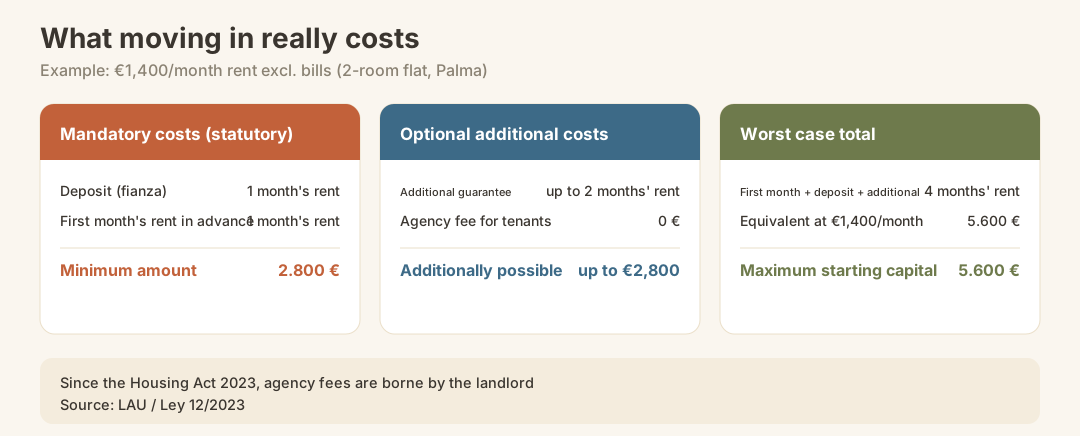
Please note: If an estate agent demands a commission from you as a tenant for a long-term rental property, this has not been permissible since 2023. The costs are borne by the landlord. You do not have to pay this.
How to put together your application file
A professional application file is no luxury on Mallorca — it is standard practice. Landlords frequently consider several applicants at the same time. Whoever has everything ready wins.
- Cover sheet with a brief profile: Who are you, how long do you want to stay, why Mallorca? Two or three sentences in Spanish or English — a human touch opens doors.
- Copy of passport / identity card (both sides)
- NIE proof (Asignación de NIE or provisional document)
- IBAN / bank statement – the first page of a bank statement is sufficient, showing a Spanish IBAN
- Proof of income – Nóminas from the last three months, pension notice, or bank statements showing regular incoming payments
- Tax assessment or IRPF from the previous year
- Reference letter from the last landlord (in English or Spanish, with a translation if necessary)
- Proof of insurance (liability or household contents insurance demonstrates a sense of responsibility)
Bring everything compiled into a single PDF and printed out – this makes you appear well-prepared and professional.
Additional costs at a glance: what comes on top of the rent?
Even if the base rent seems reasonable, additional costs can noticeably increase your monthly budget. Here is a realistic assessment based on the 2026 rental market.
Typical monthly additional costs for a flat in Palma
| Cost item | Who pays? | Amount (guideline) |
|---|---|---|
| Comunidad de propietarios (service charge) | Usually landlord | Governed by contract |
| IBI (property tax) | Usually landlord | Governed by contract |
| Rubbish collection fees (tasa de basura) | Often passed on to the tenant | 50–150 €/year |
| Electricity (Luz) | Tenant | Depending on consumption |
| Water (Agua) | Tenant | Depending on consumption |
| Heating / air conditioning | Tenant | 60–300 €/month depending on the system |
| Internet | Tenant | Depending on provider |
For a couple in a 75-m² flat in Palma, total costs of around 3,030 euros per month are cited as realistic – base rent plus all additional costs. For a family in the centre of the island with 150 m², the benchmark figure is around 3,560 euros per month.
You can find information on registering for electricity and water in our guides to registering for electricity in Spain and registering for water in Mallorca. A detailed assessment of living costs can be found in our overview of cost of living in Mallorca.
What must be included in the tenancy agreement
Spanish tenancy agreements are governed by the Ley de Arrendamientos Urbanos (LAU). Before signing, you should check that the following points are clearly set out:
- Names and identity details of both parties (including the landlord's NIE)
- Precise description of the rental property (address, size, fixtures and fittings)
- Monthly base rent and due date
- Amount of the deposit and terms of repayment
- Arrangement of additional costs – who pays what?
- Rental duration and renewal options
- Indexation (which index is the rent linked to?)
- Condition of the property – a handover report with photos is recommended
- Responsibility for repairs – minor repairs are typically the tenant's responsibility, while larger maintenance falls to the landlord
- Pet clause (if relevant – more on this in the guide Pets on Mallorca)
Important: Read the contract in full in Spanish. If you don't speak Spanish, engage a Gestor or solicitor to review it. The costs are manageable and will protect you from expensive surprises. Find out more about the gestoría in Spain in our Gestoría guide.
The winter problem: damp, mould, and heating
A topic hardly anyone mentions before moving in – and one that surprises expats on Mallorca every year: the damp problem in winter.
Mallorca's humidity in winter is often above 80 per cent. Many older buildings are constructed from local Mares stone, which is porous and absorbs moisture. Without active heating and proper ventilation, mould develops – often within just a few weeks.
What actually helps:
- Heat regularly, even when it feels mild outside – the recommendation is a minimum indoor temperature of at least 16–18 °C
- Cross-ventilate several times a day, even in winter
- Use a dehumidifier, particularly in bedrooms and bathrooms
- Before moving in, photograph any existing damp damage and mould spots, and record them in the handover report
Heating costs vary considerably: using an air-conditioning unit for heating is cost-effective, while central heating can cost 60 to 300 Euro per month. Our guide Heating on Mallorca goes into the topic in greater depth.
After moving in: steps you must not overlook
The tenancy begins – and with it, the bureaucracy really gets going. These steps are either mandatory or strongly recommended:
- Empadronamiento (municipal registration of residence): obligatory for everyone living on Mallorca – at the Ayuntamiento of the relevant municipality. Without empadronamiento there is no Residencia, no school place, and no access to public healthcare. Full details in the guide Empadronamiento Mallorca.
- Apply for Residencia (for EU citizens after three months at the latest): registration in the foreigners' register is a legal requirement. More information in the guide Residencia Spanien.
- Transfer electricity and water contracts into your name.
- Set up internet – waiting times can be several weeks depending on the provider. Our guide Internet Mallorca will help.
- Apply for a Certificado Digital – essential for all online dealings with the authorities. Details in the guide Certificado Digital.
- Clarify your tax status: As a resident spending more than 183 days in the country, you become liable to pay tax in Spain. More information in the guide Steuern als Resident (IRPF).
The most common mistakes when searching for a property as a foreigner
These are the mistakes newcomers make time and again – and as a result they lose good properties or find themselves in legal difficulties.
- Not having a NIE number at the first viewing. Without a NIE you cannot sign anything. Apply for one before you even begin your search.
- No Spanish bank account. Many landlords do not accept foreign direct debits. An IBAN with a Spanish bank is a practical prerequisite.
- Documents in German with no translation. German payslips or pension statements are simply incomprehensible to many Spanish landlords. A certified translation is the cheapest investment you can make.
- Taking too long to decide. Good properties in Palma are often taken within 24–48 hours. If your documents are not ready immediately, the property will be gone.
- Accepting a seasonal rental contract as a long-term solution. Anyone living permanently on Mallorca and signing a seasonal rental contract has significantly less tenant protection. If in doubt, always seek legal advice.
- Paid commission to an estate agent. Since 2023, the landlord bears the estate agent's fee for long-term rental contracts. Any tenant who has paid a commission can reclaim it.
- Damp damage not documented. Anyone who fails to take photos on moving in may be held liable for pre-existing damage when moving out.
- Empadronamiento forgotten. Anyone who fails to register has no access to public health insurance – a costly mistake.
Checklist: Renting a flat on Mallorca as a foreigner
- NIE number applied for and received
- Spanish bank account opened
- Proof of income for the last 3 months compiled (Nómina, pension notice, bank statements)
- Most recent tax assessment prepared
- Reference letter obtained from previous landlord
- Documents officially translated with certified translation where required
- Application portfolio ready as PDF and in hard copy
- Budget planned for start-up costs (up to 4 months' rent payable at once possible)
- Rental contract checked for contract type (long-term vs. seasonal)
- Handover report with photos completed
- Empadronamiento applied for after moving in
- Electricity, water, internet registered in own name
- Residencia application prepared (EU citizens: at the latest after 3 months)
What comes next?
With the rental contract in hand, real life on Mallorca begins. The next logical steps:
- Authorities & Registration: Residencia, Empadronamiento, NIE – everything at a glance
- Health insurance in Spain: Who is covered by the statutory scheme, and who needs a private policy?
- Opening a bank account in Spain: Which banks are suitable for expats, and what does an account cost?
- Cars & transport on Mallorca: Driving licence, ITV, imports – everything about driving
- Schools for children on Mallorca: International school, state school – what suits your family?
Conclusion
Renting a flat on Mallorca as a foreigner is entirely doable – if you come prepared. The market is competitive and the requirements are high, but by no means insurmountable. The decisive factors are: apply for your NIE in good time, be able to show a Spanish bank account, provide convincing proof of income, and act quickly. Anyone who ticks these four boxes and submits a professional application file stands a good chance – even without a local credit history or years of rental history in Spain. Once you've moved in, remember: don't forget your empadronamiento, apply for residencia in good time, and tackle the bureaucracy consistently. Mallorca is well worth the effort.
Official sources
- Ley de Arrendamientos Urbanos (LAU): boe.es – Ley 29/1994
- Ley por el Derecho a la Vivienda 2023: boe.es – Ley 12/2023
- AEAT (Agencia Estatal de Administración Tributaria) – NIE and tax registration: aeat.es
- Govern de les Illes Balears – Housing (Habitatge): ibanat.caib.es
- Policía Nacional – NIE application: policia.es
- Consell de Mallorca: conselldemallorca.net