
Civil-service pension Spain tax: tax trap and all-clear for postal and railway civil servants on Mallorca
Anyone who, as a retired civil servant of Deutsche Post or Deutsche Bahn, relocates their centre of life to Mallorca occupies a special position under tax law: the civil service pension Spain tax question is fundamentally settled in favour of those affected – the German-Spanish double taxation agreement (DTA) assigns the right of taxation exclusively to Germany under Article 18 paragraph 1. However, in December 2025 a directive issued by the Oberfinanzdirektion Düsseldorf caused considerable upheaval: suddenly, a portion of these pensioners was set to become liable to tax in Spain – with tangible financial consequences. At the end of March 2026, the all-clear was given. This guide explains what happened, why you should still take action, and how the DTA works in your favour under normal circumstances.

Are you a retired civil servant planning a move to Mallorca – or are you already registered there?
- 📩 Submit a personal enquiry — Individual assessment of your tax situation by specialists with Mallorca experience
- Taxes as a resident on Mallorca — IRPF basics for all residents
The double taxation agreement and the source-state principle
The German-Spanish double taxation agreement (DTA) determines which country holds the right of taxation for particular types of income. For pensioners, there is a crucial distinction:
| Type of income | Right of taxation under the DTA | Article |
|---|---|---|
| Statutory pension (Deutsche Rentenversicherung) | Spain (state of residence) | Art. 17 |
| Civil service pension from a public fund | Germany (source state) | Art. 18 Abs. 1 |
| Private pension / occupational pension | Spain (state of residence) | Art. 17 |
The so-called source-state principle stipulates: where a pension is paid from a public fund of a contracting state, that state – and that state alone – holds the right of taxation. For classic federal civil servants, this is unambiguously Germany.
The practical consequence: anyone who, as a retired civil servant residing on Mallorca, receives exclusively a civil service pension is not required to file an income tax return (IRPF) in Spain and pays their taxes in Germany – including the relevant allowances applicable there.
Please note: This rule applies only to pensions paid from a public fund. Anyone who additionally receives a statutory pension from the Deutsche Rentenversicherung or has private income must have their legal position examined separately.
What happened in December 2025: the OFD directive
In December 2025, the Oberfinanzdirektion Düsseldorf issued an administrative directive that caused considerable unease. The crux of the matter: for retired civil servants of certain formerly state-owned companies – specifically Deutsche Post and Deutsche Bahn – the source-state principle was held to no longer apply. The reasoning, in essence, was that following their privatisation, Post and Bahn no longer constituted a "public fund" within the meaning of the DTA.
The consequences would have been severe: this group would henceforth have had to pay tax on their pension in Spain – at Spanish IRPF rates, which can rise progressively to as much as 47 %, and without the German allowances such as the age relief amount (Altersentlastungsbetrag) or the basic personal allowance (Grundfreibetrag).
What the OFD ruling would have meant in practice
| Situation | Tax outcome under the OFD ruling |
|---|---|
| Pension up to approx. 12.000 Euro/year (single) | Taxable in Spain, but below the allowance threshold |
| Pension 20.000 Euro/year (single) | Spanish IRPF tax, no German basic personal allowance |
| Pension 30.000 Euro/year (married couple) | No German income-splitting benefit, higher overall tax burden |
| Those already in receipt of an amended assessment | Objection required within the appeal deadline |
Please note: The ruling came without prior notice and caught many of those affected completely off guard. Anyone who had already received an amended tax assessment was required to respond within the prescribed deadline.
The all-clear: ruling revoked (March 2026)
At the end of March 2026, the Mallorca Zeitung reported on the revocation of the ruling – according to follow-up coverage, it was the ruling of the Oberfinanzdirektion Köln that was revoked. The outcome is the same: the original regulation applies once again.
Retired civil servants from Post and Bahn who have their centre of life and tax residence in Spain remain subject exclusively to German tax law under Article 18 Absatz 1 DBA. They therefore benefit from:
- the German basic personal allowance (Grundfreibetrag) (2026: 12.096 Euro for single persons, 24.192 Euro for married couples filing jointly)
- the German age relief amount (Altersentlastungsbetrag)
- the German married couples' income-splitting scheme (Ehegattensplitting)
Please note: Anyone who received an amended tax assessment in the interim, issued on the basis of the OFD ruling, should — despite the general all-clear — have it checked whether a formal objection is still necessary. Assessments are not corrected automatically.
Who is actually affected? Post, Bahn and other civil servants
The debate surrounding the OFD ruling concerned above all civil servants who had been employed by Deutsche Post or Deutsche Bahn – both companies that were once state-owned and have since been privatised. Their civil servants are, however, still federal civil servants whose pension payments are made through government bodies (in particular the Bundesanstalt für Post und Telekommunikation, BAnst PT).
| Type of pension | Paying authority | DTA classification |
|---|---|---|
| Pension from federal civil service employment (general) | Federal Treasury / responsible authority | Public fund → Art. 18 para. 1 |
| Pension of former postal civil servants | Bundesanstalt für Post und Telekommunikation (BAnst PT) | Previously disputed, now again Art. 18 para. 1 |
| Pension of former railway civil servants | Responsible pension office | Previously disputed, now again Art. 18 para. 1 |
| Statutory pension (DRV) | Deutsche Rentenversicherung | Art. 17 → taxed in Spain |
| Private/occupational pension | Insurer / pension fund | Art. 17 → taxed in Spain |
Note: Anyone who receives both a civil service pension and a statutory pension has a split tax liability: the pension is taxed in Germany, and the statutory pension is taxed in Spain. This generally requires tax returns to be filed in both countries.
Tax residency in Spain: when does this actually affect you?
The DTA question only arises if you are actually considered tax resident in Spain . Spanish tax law (Article 9 of the IRPF Act, Law 35/2006) sets out several criteria — any one of them is sufficient:
- 183-day rule: You spend more than 183 days in the calendar year (1 January to 31 December) in Spain. The days do not need to be consecutive.
- Economic centre of interests: The main part of your economic interests is located in Spain.
- Family centre of interests: Your spouse (provided you are not living separately) or minor children are resident in Spain.
Please note: Anyone who spends fewer than 183 days in Spain but has their permanent centre of life on Mallorca (family, home, bank account) may still be considered tax resident. The 183-day threshold is just one of several tests.
Those who qualify as non-residents — that is, who genuinely spend fewer than 183 days in Spain and have no permanent centre of life there — are not subject to IRPF but instead to the non-resident income tax (IRNR). However, this is generally not the case for full-time emigrants to Mallorca. More on this in the guide on Non-Resident Tax in Spain.
The practical tax situation for civil-service pensioners on Mallorca
For civil-service pensioners residing on Mallorca, the current legal position is as follows:
Step by step: tax classification
- Check tax residency: Do you live on Mallorca for more than 183 days per year, or is it your centre of life? → Yes: you are tax resident in Spain.
- Determine the type of income: Do you receive exclusively a civil-service pension from Germany? → In that case, Article 18, paragraph 1 of the double taxation agreement applies.
- Tax liability in Germany: Your pension is taxed in Germany at the Finanzamt Neubrandenburg (the office responsible for taxpayers living abroad).
- Tax liability in Spain: In principle, there is no IRPF filing obligation in respect of the pension (provided there is no other income taxable in Spain).
- Check for mixed cases: Do you also receive a statutory pension, rental income, or other income? → A separate assessment is required — consult a tax adviser.
- Review tax assessments: Has an amended assessment already been issued during the OFD administrative phase? → Check whether an objection can be lodged.
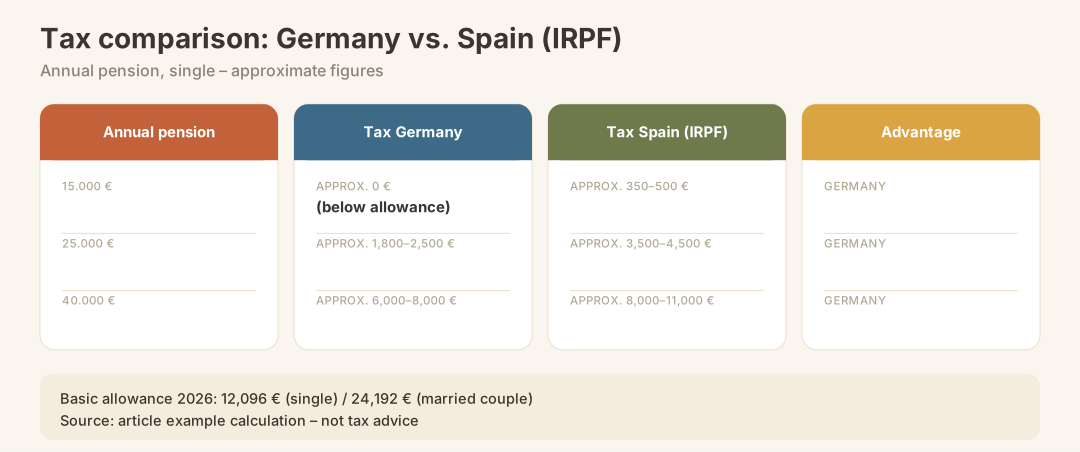
Comparison: taxation of a pension in Germany vs. IRPF in Spain (worked example)
| Annual pension (single) | Tax in Germany (approximate) | Tax in Spain IRPF (approximate) | Advantage |
|---|---|---|---|
| 15.000 Euro | Approx. 0 Euro (below the allowance of 12.096 + age relief) | Approx. 350–500 Euro | Germany |
| 25.000 Euro | Approx. 1.800–2.500 Euro | Approx. €3,500–4,500 | Germany |
| €40,000 | Approx. €6,000–8,000 | Approx. €8,000–11,000 | Germany |
Note: These figures are highly simplified approximations for illustrative purposes. Your actual tax liability depends on additional income, deductions, marital status and the basis of calculation. Please seek advice from a tax adviser with experience in double taxation agreements.
Registration obligations and dealings with the authorities: what you need to sort out in Germany and Spain
Even if your tax liability remains in Germany, there are administrative obligations on both sides.
In Germany
- Finanzamt Neubrandenburg is responsible for retirees and civil-service pensioners residing abroad who receive income from Germany.
- You will continue to file a German income tax return.
- You must notify the tax office of your change of residence to Spain and be able to provide a certificate of fiscal residence (Certificado de Residencia Fiscal).
- Formally deregistering your German address is necessary in order to exit unlimited German tax liability – but it does not automatically resolve all tax matters.
In Spain
- Empadronamiento (registration with the local municipality) – the essential foundation for everything else. More on this: Empadronamiento Mallorca
- Residencia (NIE + right of residence as an EU citizen) – apply for this. More on this: Residencia Spanien
- Certificado de Residencia Fiscal – apply for this from the Spanish tax authority; this proof is important for the German tax office.
- IRPF declaration: If your only income is your civil-service pension and this is taxed in Germany, there is generally no obligation to file a return in Spain. However, if you have also received Spanish income (e.g. rental income), a declaration may become necessary.
| Authority | Responsibility | Jurisdiction |
|---|---|---|
| Finanzamt Neubrandenburg | German tax return for pensioners living abroad | Germany |
| Agencia Tributaria (AEAT) | Spanish tax authority | Spain |
| Ayuntamiento (town hall) | Empadronamiento | Mallorca |
| Policía Nacional | Residencia / NIE | Mallorca |
Modelo 720 and further reporting obligations in Spain
Anyone who is tax-resident in Spain may be subject to additional Spanish reporting obligations — even if their pension is taxed in Germany.
- Modelo 720: Foreign assets (bank accounts, securities, properties outside Spain) exceeding 50.000 euros per category must be declared. More on this: Modelo 720 reporting obligation
- Wealth tax (Impuesto sobre el Patrimonio): As a tax resident with a high overall net worth, the Spanish wealth tax may become relevant.
- German tax liability remains: Anyone who was subject to unlimited tax liability in Germany and merely deregisters their residence without meeting all the necessary conditions may find themselves subject to extended limited tax liability.
Please note: The German Foreign Tax Act provides for retrospective taxation in certain cases when you move to a low-tax country. However, Spain is not automatically classified as a low-tax country within the meaning of this provision. Even so, please have your individual situation reviewed before you move.
The most common mistakes regarding civil service pensions and Spain
This section is not a theoretical box-ticking exercise — it reflects the questions that come up time and again in practice.
- "I no longer pay tax in Germany because I live in Spain." Incorrect: civil service pensioners continue to pay their tax in Germany — to the Finanzamt Neubrandenburg.
- "Post and railway civil servants are different from ordinary civil servants." This was briefly disputed but has now been clarified again: they too fall under Article 18 paragraph 1 of the DBA.
- "I don't need to file a tax return in Spain." That holds true for the pension itself – but not if there are additionally Spanish-taxable income streams or mixed cases.
- "The OFD assessment didn't affect me, so I don't need to do anything." Check nonetheless whether your tax assessment was altered during the transitional period December 2025 to March 2026. Amended assessments are not automatically reversed.
- "Modelo 720 doesn't apply to me because I'm taxed in Germany." Wrong: Modelo 720 is a Spanish reporting obligation for tax residents, regardless of where you pay income tax.
- "The DBA fully protects me from double taxation." The DBA allocates the right to tax, but does not prevent you from having reporting obligations in Spain or mixed cases becoming complicated.
- "My wife has a statutory pension – that doesn't change anything." It does: statutory pensions are taxed in Spain under Article 17 of the DBA. For couples with mixed income types, two separate tax systems must be dealt with.
What comes next? Topics closely related to the pension
The taxation of the pension is just one component of your tax and legal situation on Mallorca. The following topics are directly adjacent:
- Taxing a German pension in Spain: If you have a statutory pension in addition to your civil-service pension, different rules apply. Taxing a German pension in Spain
- IRPF deductions in the Balearen: Even if you are not liable for IRPF on the pension, other income may be affected. IRPF deductions Balearen
- Health insurance in Spain: As a retiree from Germany you may be able to use the S1 form. S1 form Spain
- Spanish will: Cross-border inheritance matters should be settled. Spanish will
- Gestoría: Many of these tasks can be handled by a local gestoría. Gestoría Spain
Checklist: civil-service pensioner relocating to Mallorca
Use this checklist as a starting point – it is no substitute for individual advice, but it provides a structured overview.
Before the move
- Clarify the DBA classification of your own pension (public sector yes/no?)
- Identify mixed cases (statutory pension, private pension, rental income)
- Deregister your German residence and notify the tax office
- Apply for Finanzamt Neubrandenburg as the competent tax office
- Engage a tax adviser with DBA expertise
After the move
- Apply for empadronamiento in your municipality on Mallorca
- Apply for Residencia / NIE
- Apply for a Certificado de Residencia Fiscal from the AEAT
- Check Modelo 720 (foreign assets exceeding €50,000 per category)
- Review any existing tax assessments from the period Dec. 2025 – March 2026
- Ensure health insurance cover (S1 form or private health insurance)
- Have a Spanish testament drawn up
Conclusion
The good news predominates: following the revocation of the OFD ruling, the source-state principle applies once again without restriction to former postal and railway civil servants. A retired civil servant living on Mallorca pays income tax on their pension in Germany – including the basic personal allowance and the age relief amount, which in 2026 stand at €12,096 (single) and €24,192 (married couple, splitting) respectively. For most pension levels, this is considerably more favourable than taxation under the Spanish IRPF system.
The episode of the OFD ruling shows, however, how quickly administrative instructions can change – and how important it is to monitor your own tax assessments actively. Anyone who received an amended assessment during the transitional period (December 2025 to March 2026) should not rely on the matter resolving itself automatically.
And: as soon as additional sources of income come into play alongside the pension – statutory pension, rental income, investment returns – the situation quickly becomes complex. Seek individual advice before you complete your move or receive the first Spanish letter from the tax authorities.
Official sources
- German-Spanish double taxation agreement (DBA): Artikel 17 (pensions) and Artikel 18 (retirement pay/public service) — https://www.bundesfinanzministerium.de
- IRPF Act Spain (Ley 35/2006), Artículo 9: Tax residence — https://www.boe.es
- Agencia Tributaria (AEAT): Spanish tax authority, responsible for IRPF and Modelo 720 — https://www.agenciatributaria.es
- Finanzamt Neubrandenburg: The competent tax office for non-resident pensioners/retirees in Germany — https://www.finanzamt-neubrandenburg.de
- Bundesanstalt für Post und Telekommunikation Deutsche Post (BAnst PT): Pension authority for postal civil servants — https://www.banst-pt.de
- Mallorca Zeitung – Original article on the OFD ruling (March 2026): https://www.mallorcazeitung.es/geld/2026/03/22/auswandern-nach-mallorca-steuerfalle-fur-128157214.html
- Mallorca Zeitung – All-clear (March 2026): https://www.mallorcazeitung.es/geld/2026/03/31/auswandern-nach-mallorca-entwarnung-fur-128620161.html