
Tax Residence in Spain: The 183-Day Rule, Centre of Life and Dual Residency
Anyone who spends more than a few months on Mallorca or elsewhere in Spain will sooner or later face this question: am I actually liable to pay tax here? The answer depends on tax residence in Spain — the 183-day rule — and on two further criteria that are frequently overlooked. The devil is in the detail: the day of arrival and the day of departure both count, sporadic stays in third countries can be attributed to you, and even if you narrowly miss the 183 days, your economic centre of interests can still trigger tax liability. Conversely, making proper use of the double taxation agreement (DTA) between Germany and Spain can prevent you from being taxed in both countries. This guide explains the three statutory criteria, shows how days of presence are counted, sets out the tie-breaker rules, and gives you a clear checklist for changing your tax residence.

Are you unsure whether you are already tax-resident in Spain — or whether you will be soon?
- 📩 Submit a personal enquiry — We connect you with vetted tax advisers specialising in Spain
- All tax topics for residents at a glance
The three statutory criteria: when does Spain count as your tax domicile?
The Spanish Income Tax Act (LIRPF) defines in Article 9 three independent grounds. It is sufficient for one of them to be met — and each one individually triggers unlimited tax liability on worldwide income.
| # | Criterion | Explanation |
|---|---|---|
| 1 | 183-day stay | More than 183 days in the calendar year in Spain; intermittent periods of stay are added together |
| 2 | Economic centre of interests | The majority of investments, business activities or income is located in Spain or managed from there |
| 3 | Family ties | Spouse and/or minor children are habitually resident in Spain — rebuttable presumption |
Important: These three criteria are alternatives, not cumulative requirements. A buyer on Mallorca whose wife and children live permanently on the island may be tax-resident even if they themselves spend only 120 days a year there — unless they actively rebut the presumption.
The consequences of Spanish tax residence are far-reaching: in addition to income tax (IRPF), you will also be subject to wealth tax as well as unlimited inheritance and gift tax liability. On the other hand, as a resident you benefit from considerably more favourable tax treatment than a non-resident — for example on the sale of your primary residence.
How are the 183 days counted? Case law provides clarity
The LIRPF itself does not set out in detail how days of presence are to be determined. The supreme Spanish tax court (TEAC, Tribunal Económico-Administrativo Central) has provided clarity through landmark rulings (published in early 2024). The court distinguishes three categories of days of presence:
| Category | Definition | Burden of proof |
|---|---|---|
| Proven presence | Day of stay evidenced by documentation (doctor's appointment, credit card payment, hotel bill, etc.) | With the tax authority |
| Presumed presence | Days logically assumed between two evidenced stays | With the taxpayer (rebuttal possible) |
| Sporadic presence | Stays in third countries where no other 183-day residency exists | With the taxpayer |
What does this mean in practice?
- Arrival and departure days count in full, regardless of how many hours you were actually in Spain.
- Stays need not be consecutive – a January holiday on Mallorca plus an autumn stay are added together.
- Presumed days in between: If you can be proven to have been in Spain on 1 March and on 20 March, the authorities will assume you were also there in between – you must prove otherwise.
- Sporadic third-country days: If you do not spend 183 days in any single country but spend the most days in Spain, stays in third countries can be counted towards your Spain tally. You could therefore theoretically become tax-resident in Spain without formally reaching the 183-day threshold.
Please note: The tax authority is increasingly making use of digital data – mobile phone location tracking, social media activity, credit card statements and entry records. Keeping a carefully maintained log of your stays with supporting documentation is not paranoia, but a thoroughly sensible precaution.
The centre of economic interests: the underestimated second criterion
Many people focus exclusively on the 183-day count – and in doing so overlook the fact that Spain can become your tax domicile even when the main focus of economic activity is in the country.
Specifically, this criterion is met when:
- the majority of investments or business activities is concentrated in Spain,
- assets are managed from Spain, or
- the majority of income originates in or from Spain.
Practical example: An entrepreneur registered in Hamburg who manages a rental portfolio of several Mallorca apartments from the island and generates the majority of their rental income there may become subject to unlimited tax liability in Spain under this criterion – even with fewer than 183 days of physical presence.
The third criterion: family as a tax trap
If your spouse and/or your minor children have their habitual residence in Spain, the Spanish tax authorities presume that you are also tax-resident there. This presumption is rebuttable, but the burden of proof lies with you.
To rebut the presumption, you must generally demonstrate:
- that you yourself were present in Spain for fewer than 183 days, and
- that you are demonstrably tax-resident in another country (e.g. by means of a certificate of tax residence issued by the tax authorities of that country).
Anyone who moves their family to Mallorca whilst "commuting" themselves should therefore be aware of this connection. See also our guide to Residencia in Spain.
Dual residence: what happens if both Germany AND Spain claim you?
It is quite common for two countries to simultaneously claim tax residence over the same person. This is precisely what the double taxation agreement (DTA) between Germany and Spain is designed to address. It contains so-called tie-breaker rules (based on Article 4, paragraph 2 of the OECD Model Convention) which resolve, according to a defined order of priority, which country holds the right to tax.
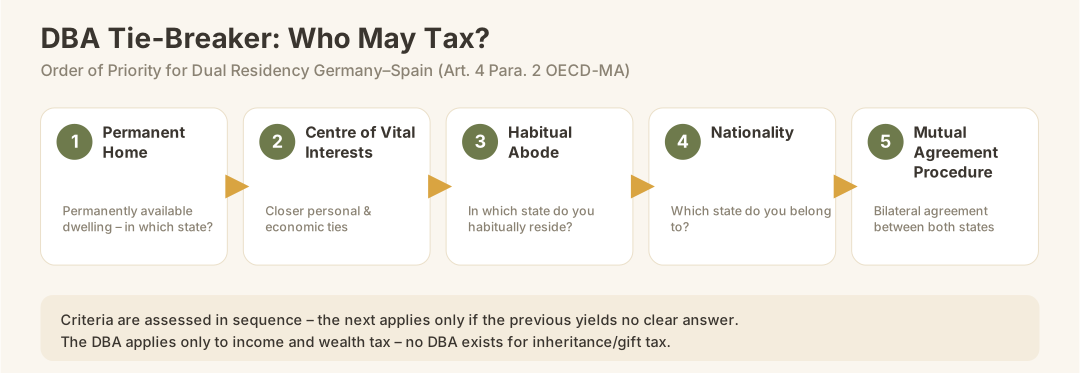
| Rank | Tie-breaker criterion | Explanation |
|---|---|---|
| 1 | Permanent place of residence | In which country do you have a permanently available home? If in both: proceed to tier 2 |
| 2 | Centre of vital interests | Where are your closer personal and economic ties stronger? |
| 3 | Habitual abode | In which country do you habitually reside? |
| 4 | Nationality | Which country do you belong to? |
| 5 | Mutual agreement procedure | Both countries reach a bilateral agreement |
The criteria are applied in sequence Only when tier 1 yields no clear answer does tier 2 come into play — and so on.
Please note: The DTA applies only to income tax and wealth tax. For inheritance tax and gift tax, there is no DTA between Germany and Spain — the limited credit principle applies instead. This can lead to considerable double taxation.
Worldwide taxation: what are you liable for as a resident?
Once you are tax-resident in Spain, you must declare your entire worldwide income under the Spanish income tax system (IRPF) — regardless of whether you receive rental income from a German property, dividends from an Austrian investment account, or income from a British pension. This is the fundamental difference from non-resident tax (IRNR), which only captures income earned in Spain.
| Status | Tax liability | Relevant tax |
|---|---|---|
| Tax resident | Worldwide income | IRPF (income tax) + wealth tax if applicable |
| Non-resident with income from Spain | Income from Spain only | IRNR (non-resident tax) |
You can find out more about taxation as a resident in our guide to Taxes as a resident (IRPF). If you do not yet have resident status but own Spanish property, please read the article on Non-resident tax in Spain.
How the tax authority checks: data sources and control methods
The Spanish tax authority Agencia Tributaria (AEAT) is no sleepy bureaucracy. In recent years it has considerably expanded its auditing methods and now makes use of, among other things:
- Automatic exchange of information (CRS/FATCA) with German and other European financial institutions
- Mobile phone data and location data on border crossings
- Credit card and bank account transactions in Spain
- Social media activity (location data in posts, check-ins)
- Land registry and cadastre
- Empadronamiento (residents' register) and residency applications
Anyone who fails to document their days of presence risks the authority making a judgement based on assumed figures — and the burden of proof is reversed. You should therefore proactively keep a travel log with supporting documents (boarding passes, hotel receipts, medical appointments, fuel receipts). The rule is simple: those who document, protect themselves.
The difference between civil-law and tax residency
An important detail: tax residency and civil-law residency are not the same thing and are governed by different sets of rules.
| Dimension | Type of residency | Criteria |
|---|---|---|
| Registration | Civil law / Administrative law | Empadronamiento, Residencia registration |
| Income tax | Tax law | Art. 9 LIRPF (183 days / centre of economic interests / family) |
| EU right of residence | Administrative law | TIE / NIE / EU registration |
You can be registered on Mallorca for civil-law purposes and enrolled as a resident without being tax-resident there — and vice versa. Tax residency arises by operation of law as soon as any one of the three LIRPF criteria is met, entirely regardless of whether you have applied for residency or not.
For the practical side of registration, we recommend our guides on Empadronamiento on Mallorca and on Authorities & registration in general.
Special regime: Beckham Law as an alternative to regular residency
Those who move to Spain for the first time and meet certain requirements can apply under the so-called Beckham Law (Régimen Especial para Trabajadores Impatriados) for a flat-rate taxation on Spanish income, instead of being taxed on worldwide income at the regular progressive rate. The regime has a maximum duration and is subject to strict conditions.
Whether this is an option for you depends on your income profile, your nationality and your visa status. Find out more in our guide on the Beckham Law Spain.
Most common mistakes when changing tax residency
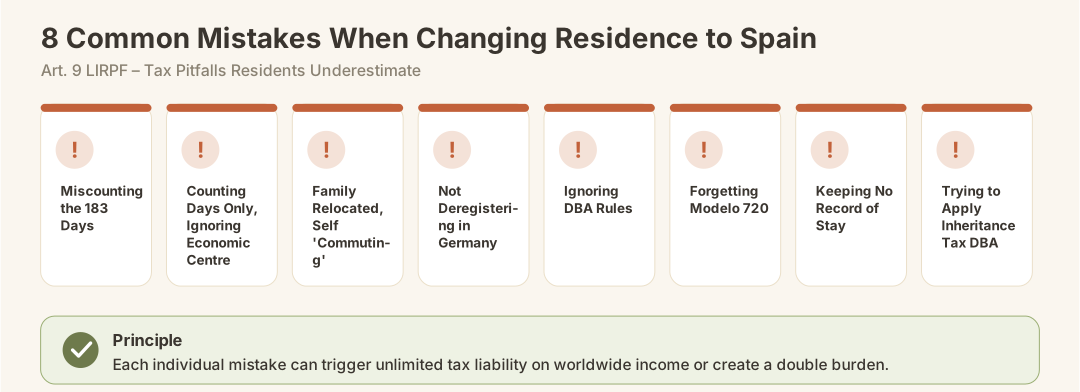
- Miscounting the 183 days — forgetting arrival and departure days, ignoring deemed days of presence.
- Focusing solely on the number of days — overlooking the centre-of-economic-interests criterion.
- Moving the family, but only 'commuting' yourself – Not having the centre-of-vital-interests criterion on your radar.
- Failing to deregister in Germany – Anyone who does not deregister with the residents' registration office and the tax authority risks remaining subject to unlimited tax liability in Germany.
- Ignoring double taxation agreement rules – Assuming you can simply 'pay something in both countries'.
- Forgetting Modelo 720 – As a resident with foreign assets above certain thresholds, there is a reporting obligation. Details in the guide to the Modelo 720.
- Keeping no record of days of presence – In the event of a dispute, the burden of proof lies with the taxpayer.
- Wanting to apply an inheritance tax double taxation agreement – There is none between Germany and Spain. Early estate planning is essential; more on this in the guide to the Spanish Will.
What comes next? Obligations as a tax resident
Once you are tax resident in Spain, specific ongoing obligations arise:
- IRPF return: Annual tax return on worldwide income (filing deadline generally by 30 June of the following year).
- Modelo 720: Reporting obligation for foreign assets above certain thresholds (bank accounts, real estate, securities).
- Wealth tax: Depending on the level of assets and the autonomous community.
- Social security: If self-employed: Cuota Autónomo; if a pensioner: check the S1-Formular Spanien where applicable.
- NIE number: The basis for all tax and administrative procedures – NIE Number Mallorca.
- Certificado Digital: Essential for electronic communication with the AEAT – Apply for a Certificado Digital.
Checklist: Transferring Tax Residence to Spain
- Retroactively document days of presence for the current and previous year
- Check whether any of the three LIRPF criteria is already met
- Apply for or present your NIE number
- Initiate empadronamiento and residencia registration
- Prepare deregistration from the German residents' registration office and tax authority
- Obtain a certificate of tax residence from Germany (for proof under the DBA)
- Inform your German tax adviser of your departure – check exit taxation if applicable
- Engage a Spanish tax adviser / gestoría for IRPF registration (Gestoría Spain)
- Check Modelo 720 obligation (foreign assets)
- Create a travel log with supporting documents for future years
- Open a bank account in Spain (Bank Account Spain)
- Clarify health insurance status (Health Insurance Spain)
Conclusion
The 183-day rule is the best-known, but not the only, route into Spanish tax liability. Article 9 LIRPF recognises two further criteria – the centre of economic interests and family residence – which apply independently of the length of stay. Case law from the TEAC has clarified that both arrival and departure days count in full, that presumed days must be rebutted by the taxpayer, and that sporadic stays in third countries may be attributed. Anyone wishing to avoid dual residence must be familiar with and actively apply the tie-breaker rules of the DBA between Germany and Spain. The key message is: document your presence consistently, act proactively with qualified advice, and deregister and register with the relevant authorities in both countries in good time.
Official Sources
- Ley 35/2006 – LIRPF, Article 9 (Tax residence of natural persons): https://www.boe.es/buscar/act.php?id=BOE-A-2006-18764
- Agencia Tributaria (AEAT) – Residencia de personas físicas: https://sede.agenciatributaria.gob.es/Sede/no-residentes/residencia-personas-fisicas-juridicas.html
- OECD Model Tax Convention on the Avoidance of Double Taxation, Article 4: https://www.oecd.org/tax/treaties/
- BOE – Convention between Spain and Germany for the avoidance of double taxation (DTA Germany–Spain): https://www.boe.es/buscar/doc.php?id=BOE-A-1968-841
- TEAC – Central Economic-Administrative Court (case law on days of presence): https://www.mef.gob.es/es/ministerio/organismos/teac.html