
Tax return Spain: The Renta step by step
Anyone – German, Austrian or Swiss – who relocates the centre of their life to Mallorca or mainland Spain cannot avoid the Spanish tax return – the "Renta", officially known as the Declaración de la Renta (Modelo 100). Unlike with the German tax office, in Spain you won't receive a reminder or an invoice: the so-called Holschuld (obligation to obtain information yourself) applies. Anyone who misses the deadline or fails to declare foreign assets risks late-filing surcharges and penalty interest. In this guide, we show you step by step how to find out whether you are tax resident, which deadlines apply for the 2026 tax return in Spain, how the Modelo 100 works, and what self-employed people (autónomos) and non-residents additionally need to bear in mind.

Resident or non-resident? The 183-day rule decides
Days spent in Spain
Explanation
Days of presence are every day you were in Spain, including days between two documented stays unless you can prove you were abroad. Arrival and departure days each count in full.
Explanation
Sporadic absences (“ausencias esporádicas” — short trips abroad) are days not included in the figure above. The law adds them rather than subtracting them.
Explanation
A tax residence certificate (“certificado de residencia fiscal”) is confirmation from a foreign tax authority that you are tax-resident there; it is valid for one year. It excludes only sporadic absences, not your presence in Spain.
Based on your entries, neither criterion is met.
Interim result: the calendar year is still in progress.
- Total residence days counted
- 150 days
- Statutory threshold (more than)
- 183 days
150 = 150 days
Days needed to cross the threshold: 34.
Legal status: 1 January 2007
This calculation is provided for guidance only and is not a substitute for tax or legal advice in specific cases.
Before you start thinking about forms and deadlines, you need to clarify your tax status. Spanish tax law (Art. 9 Ley 35/2006) draws a strict distinction between those who are tax resident (residents) and non-residents – and these criteria apply regardless of whether you are registered as a resident with the immigration authorities or not. It is enough for one of the following criteria to be met.
| Criterion | What it means |
|---|---|
| 183-day rule | You spend more than 183 days in the calendar year on Spanish soil (counted together even with interruptions) |
| Centre of economic interests | Your main field of activity or the core of your economic interests lies in Spain |
| Centre of family life | Spouse and/or minor children have their habitual residence in Spain (rebuttable presumption) |
Careful:Even if you only own a holiday property and don't rent it out, you are still liable for tax as a non-resident – via the non-resident tax. Many owners are unaware of this and fall straight into this trap.
You can find more on the exact calculation of days of stay in our guide to the 90/180-day rule as well as in our basic article on Residencia.
Who has to file the Renta for 2025/2026?
As a tax resident, you must in principle declare your worldwide income in Spain – including German pensions, rental income from Germany, dividends and investment income. At the same time, the double taxation agreement between Germany and Spain applies, so that income is not taxed twice. Non-residents, on the other hand, generally only pay tax in Spain on income earned there, for example from renting out or personal use of a property.
| Status | What is taxed | Form |
|---|---|---|
| Resident (>183 days) | Worldwide income (Germany + Spain) | Modelo 100 |
| Non-resident with property | Rental income or personal use | Modelo 210 |
| Resident with foreign assets >50,000 € | Reporting obligation (no tax amount) | Modelo 720 |
| Self-employed (Autónomos) | Business income + IVA | Modelo 100 + Modelo 303 |
The key deadlines for 2026 at a glance
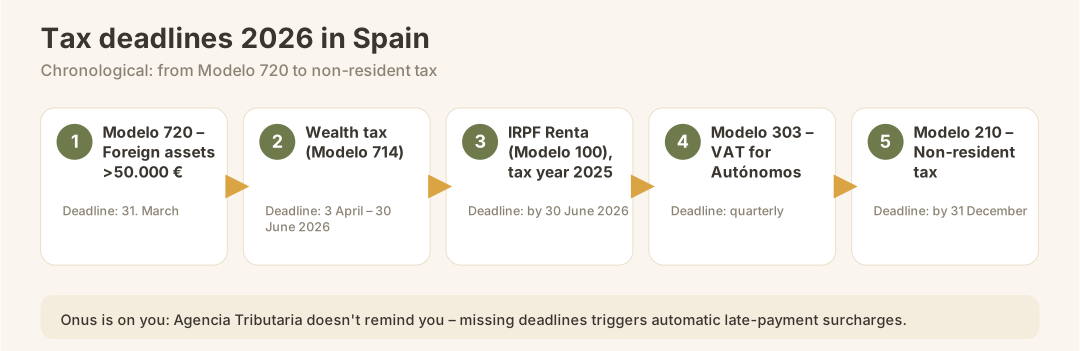
The deadlines of the Spanish tax campaign are final and – unlike in Germany – are generally not extended on an individual basis. Anyone who files late risks automatic late-filing surcharges.
| Tax / Form | Deadline 2026 | Applies to |
|---|---|---|
| IRPF – Income Tax (Modelo 100), tax year 2025 | until 30 June 2026 | Tax residents |
| Wealth Tax (Modelo 714), tax year 2025 | 3 April to 30 June 2026 | Residents and non-residents with assets in Spain |
| Modelo 720 – Reporting of foreign assets >50,000 € | until 31 March | Tax residents |
| Modelo 210 – Non-resident tax (personal use) | until 31 December | Non-residents with property in Spain |
| Modelo 303 – VAT (IVA) | quarterly | Self-employed (Autónomos) |
Note: Anyone who hasn't yet taken action should do so now – the deadline of 30 June 2026 for the Renta 2025 is final and cannot be extended.
Details on the reporting obligation for foreign assets can be found in the guide on Modelo 720, information for property owners without residency in the article on non-resident tax in Spain.
Modelo 100 Step by Step: How to Proceed
- Check your tax liability. Use the 183-day rule and the other criteria to determine whether you count as a resident or non-resident.
- Gather your documents. These include Spanish and German proof of income, pension statements, rental agreements, bank statements and, if applicable, evidence of deductible expenses.
- Obtain access credentials. To file via the AEAT platform, you'll need a Cl@ve-PIN or a Certificado Digital.
- Check the pre-filled draft (Borrador). The Agencia Tributaria provides a draft in many cases – but it is rarely complete, particularly when it comes to foreign income.
- Add worldwide income and apply the DBA. Foreign income must be added and, where in doubt, credited according to the double taxation agreement.
- Submit the Modelo 100 and complete it by 30 June 2026. In the case of additional payment, instalment payment in two parts is also possible under certain conditions.
It's best to set up digital access to the tax authority early on – more on this in the guide on Certificado Digital & Cl@ve.
Worldwide Income and the Double Taxation Agreement
The most common misconception among German expats: "I already pay tax in Germany on my pension or rental income." As a Spanish tax resident, you must nevertheless declare your worldwide income in the Renta – the double taxation agreement between Germany and Spain merely prevents the same income from being taxed twice, but does not replace the obligation to declare it. Correctly applying the agreement is particularly complex for German pensions, as different rules apply depending on the type of pension (statutory pension, civil servant pension, company pension).
Note: We explain in detail how German pensions are specifically taxed in Spain in the guide Taxing a German Pension in Spain.
New for 2025/2026: What's Changing with the Renta
Spanish tax law was amended for the 2025 tax year by several laws, in particular by Ley 7/2024, Real Decreto-ley 3/2025 and Real Decreto-ley 2/2026 of 3 February 2026. Two changes are particularly relevant for private individuals.
| Change | Details |
|---|---|
| New tax relief for low earners | Relief of up to €340 for gross annual salaries up to €16,576; this reduces gradually up to €18,276; additional income must not exceed €6,500 (Art. 80 bis LIRPF) |
| Higher tax rate on capital income | Interest, dividends and capital gains above €300,000 are taxed at an increased rate |
In addition, the practice regarding the combined ceiling on Income Tax and Wealth Tax has changed for non-residents with assets in Spain. The Supreme Court ruled in judgments 1372/2025 of 29 October 2025 (case no. 4701/2023, ECLI:ES:TS:2025:4849) and 1402/2025 of 3 November 2025 (case no. 7626/2023, ECLI:ES:TS:2025:4846) that habitual residence does not justify unequal treatment: restricting the ceiling under Art. 31.Uno of the Wealth Tax Act to residents only is discriminatory and unjustified.
The wording of the law itself has not changed — Art. 31.Uno still refers only to those subject to unlimited tax liability (obligación personal). What has changed is how it is applied: the Ministry of Finance amended Form Modelo 714 through Orden HAC/277/2026 of 25 March 2026, removing the restrictive wording; for the Solidarity Tax on Large Fortunes, Orden HAC/652/2026 of 26 June 2026 followed, after the TEAC had adopted the same interpretation on 18 December 2025.
In practice, this means that from the tax return for the 2025 tax year onward, you apply the ceiling directly on the form. For earlier years, the way forward is to file an application to correct the self-assessment (Art. 120.3 of the Ley General Tributaria) together with a refund claim; the limitation period is four years. The calculation itself is tricky — it is capped at 60 % of the sum of the Income Tax assessment bases, and the Wealth Tax may be reduced by no more than 80 % as a result. Neither the judgments nor the form regulations explain how this reference figure is to be determined for someone who, in Spain, is not subject to IRPF but to the Non-Resident Income Tax; have this calculated on a case-by-case basis by a tax advisor.
Wealth Tax: who is affected?
In addition to income tax, depending on your assets, you may also need to file a Wealth Tax return (Modelo 714). For the 2025 tax year, this runs from 3 April to 30 June 2026 and applies to both residents and non-residents with assets in Spain, provided the respective tax-free allowances are exceeded. In light of the ruling mentioned above, it is now worthwhile for many non-residents to recalculate their previous tax burden.
Self-employed (Autónomos): IRPF and VAT
If you work as an autónomo in Mallorca, separate rules apply to you in addition to the Renta. The income tax return for 2025 must likewise be submitted by 30 June 2026, regardless of whether you also have rental income or capital gains – it is worth taking a careful look at all types of income together.
Many everyday business expenses are tax-deductible, including:
- Travel costs
- Office supplies
- Mobile phone contracts used for business purposes
- Professional literature
In each case, the requirement is that the business connection can be clearly demonstrated.
Please note – VAT exemption not yet in force:EU Directive 2020/285 was intended to allow micro-businesses with an annual turnover below €85,000 to be exempt from VAT liability from 1 January 2025. Spain has not yet transposed this directive and has missed the EU deadline – the European Commission has therefore taken Spain to the European Court of Justice. Until further notice, as an autónomo you must continue to charge IVA and file quarterly returns via Modelo 303. At best, the new rules might come into force from 2027, but with further delays in the parliamentary process, 2028 is realistically more likely.
You can find everything about ongoing bookkeeping and quarterly filings in our guide Modelo 303 & 130.
Non-residents: Modelo 210 and Modelo 720
If you own a property in Spain without being tax-resident there, you must file an annual non-resident tax return via Modelo 210, regardless of whether the property is rented out – the deadline for this is 31 December. If, on the other hand, you are a resident and hold assets abroad (accounts, property, securities) totalling more than €50,000, you are additionally subject to the reporting obligation via Modelo 720, with a deadline of 31 March.
| Form | Target group | Deadline |
|---|---|---|
| Modelo 210 | Non-residents with property ownership in Spain | 31 December |
| Modelo 720 | Residents with foreign assets >€50,000 | 31 March |
Most common mistakes in the Spanish tax return
- The belief that no tax is owed without renting out the property. Even purely personal use of a property as a non-resident is subject to tax.
- Missing Cl@ve/Certificado Digital. Without digital access, submission is unnecessarily delayed.
- Forgetting foreign income. German pensions, rental income and capital gains must be fully declared as a resident.
- Overlooking Modelo 720. The reporting obligation for foreign assets is independent of the actual tax return and has its own, earlier deadline.
- Missed deadlines. Since there is no reminder from the authority (obligation to act on one's own initiative), being late automatically leads to surcharges.
What happens after submission?
After submitting the Modelo 100, the Agencia Tributaria reviews your details. In the case of refunds, payment is usually made automatically to the specified account; for additional payments, instalment payment in two parts is possible under certain conditions. Keep all receipts and proof of submission for several years, in case the authority raises queries or initiates an audit.
Checklist: Tax return Spain 2026
- Tax status clarified (resident vs. non-resident)
- Cl@ve PIN or Certificado Digital set up
- All proof of income (Spain + abroad) gathered
- Double taxation agreement for pensions/rentals checked
- Modelo 720 completed by 31 March (if foreign assets >€50,000)
- Modelo 100 submitted by 30 June 2026
- For autónomo status: don't forget quarterly Modelo 303
- Wealth Tax (Modelo 714) checked, if relevant
Conclusion
The Spanish tax return is no bureaucratic formality, but above all requires one thing: acting in good time. Anyone who clarifies their tax status via the 183-day rule, gathers their documents early and keeps an eye on the deadlines of 30 June 2026 (Renta) and 31 March (Modelo 720) avoids the most common and most costly mistakes. Especially with cross-border income such as German pensions or capital gains, it is worth working with an experienced, German-speaking tax adviser on the ground – the finer points of the double taxation agreement and the most recent legislative changes are barely fully comprehensible for laypeople.
Official sources
- Agencia Tributaria (AEAT) – Campaña de la Renta: https://sede.agenciatributaria.gob.es
- Ley 35/2006, de 28 de noviembre, del Impuesto sobre la Renta de las Personas Físicas (BOE): https://www.boe.es/eli/es/l/2006/11/28/35
- Real Decreto-ley 2/2026, de 3 de febrero (BOE): https://www.boe.es
- Ley 7/2024 and Real Decreto-ley 3/2025 (BOE): https://www.boe.es
- Tribunal Supremo, rulings 1372/2025 of 29 October 2025 (ECLI:ES:TS:2025:4849) and 1402/2025 of 3 November 2025 (ECLI:ES:TS:2025:4846) on the combined tax cap for non-residents — the doctrine is quoted verbatim in the preamble to Orden HAC/652/2026 (BOE): https://www.boe.es/eli/es/o/2026/06/26/hac652
This guide provides a general overview of the legal position and does not replace legal or tax advice on your individual circumstances. Laws and deadlines may change; the linked official sources are authoritative.