
Modelo 303 and Modelo 130: VAT and Income Tax as an Autónomo in Spain
As an autónomo in Spain, you'll encounter two forms as regularly as the quarterly filing itself: the Modelo 303 for IVA (Spanish VAT) and the Modelo 130 for the quarterly income tax advance payment (IRPF). Both are mandatory – regardless of whether you made a profit in a given quarter or not. Anyone who misses a deadline won't receive a friendly reminder from the Agencia Tributaria, but will automatically incur a surcharge. This guide explains how both forms work, exactly what you enter, how to calculate the amounts, and the mistakes beginners most commonly make – with concrete figures, deadlines and examples for 2026.

Wondering whether your autónomo setup is truly correct?
- 📩 Submit a personal enquiry — We'll connect you with experienced gestorías on Mallorca
- An overview of taxes as a resident in Spain
What autónomos can expect tax-wise: an overview
As a self-employed person in Spain, you are registered with two authorities: the Agencia Tributaria (AEAT, also known as "Hacienda") for taxes and the Seguridad Social (RETA) for social security. The tax obligations covered in this article are handled entirely through the AEAT.
The Spanish tax year is divided into four quarters. For each quarter, you generally submit two forms:
| Form | Tax type | Purpose |
|---|---|---|
| Modelo 303 | IVA (VAT) | Remit the difference between IVA collected and IVA paid |
| Modelo 130 | IRPF (income tax) | Advance payment towards the annual tax bill |
| Modelo 390 | Annual IVA summary | Summary of all four Modelo 303 |
| Modelo 100 | Annual IRPF return | Annual settlement, Renta declaration |
Both quarterly forms must be submitted even if the result is zero or negative. The AEAT refers to this as a nil-return obligation – anyone who fails to submit faces surcharges.
Note: Since 9 February 2025, the previously available alternative Modelo 037 has been abolished. All new registrations and amendments have been processed exclusively via the Modelo 036.
Modelo 303: How the IVA declaration works
What IVA actually is
IVA is the Spanish equivalent of VAT. As an autónomo, you are generally required to add IVA to your invoices, collect it from your clients, and remit the difference between the IVA collected and the IVA you have paid yourself (on purchases and business expenses) to the AEAT on a quarterly basis. This effectively makes you a tax collector on behalf of the state.
The three IVA rates
| Rate | Designation | Typical areas of application |
|---|---|---|
| 21 % | Tipo general | Most services, goods, and commercial lettings |
| 10 % | Tipo reducido | Food (excluding basic staples), hospitality, passenger transport |
| 4 % | Tipo superreducido | Basic staples (bread, milk, vegetables), books, medicines |
Most freelancers – translators, designers, consultants, IT service providers – invoice at the standard rate of 21 %.
How the Modelo 303 works: the principle
The form follows a straightforward logic:
- IVA repercutida (IVA charged): IVA that you have invoiced to your clients
- IVA soportada (IVA borne): IVA that you have paid on business expenses, purchases, rent, etc.
- Difference: What you remit (or carry forward as a credit)
Sample calculation for a quarter:
| Item | Amount |
|---|---|
| Invoices issued (net) | 8.000 € |
| IVA on outgoing invoices (21 %) | 1.680 € |
| Operating expenses (net, with IVA) | 1.500 € |
| IVA on incoming invoices (21 %) | 315 € |
| IVA payable (1.680 – 315) | 1.365 € |
Negative result: credit or refund?
If the IVA soportada exceeds the IVA repercutida — for example because you have made significant investments in a given quarter — a negative balance arises. You can carry this forward to the next quarter or, at the end of the year (via the Modelo 390), apply for a refund.
Please note: Anyone who applies for an IVA refund should be prepared for the AEAT to request a tax audit and to ask for all outgoing and incoming invoices for the year. Many gestorías therefore recommend carrying the credit forward in the first instance.
From February 2026: new fields in the Modelo 303
The AEAT updated the Modelo 303 on 1 February 2026. New fields have been added for reporting advance payments and prepayments in connection with the non-customs warehouse regime for fuels (petrol, diesel, biofuels). The total number of reportable line items increased from 1.523 to 1.528. For most standard freelancers, this change makes no difference to the filing process.
Modelo 130: how the IRPF advance payment works
What the Modelo 130 is
You calculate your final annual income tax (IRPF) using the Modelo 100 (Renta), which you submit by 30 June of the following year. However, so that the tax authority does not have to wait a full year for the tax, as an autónomo you make quarterly advance payments — this is the Modelo 130.
The method used by the vast majority of autónomos is known as Estimación Directa (direct profit assessment). Under this method, you calculate your cumulative profit since the start of the year and pay a flat 20 % of that amount as an advance payment — less any payments already made in previous quarters.
Calculation scheme Estimación Directa
| Step | Description |
|---|---|
| 1 | Add all net income since 1 January (cumulative) |
| 2 | Subtract all deductible business expenses since 1 January (cumulative) |
| 3 | Result = cumulative net profit |
| 4 | 20 % thereof = theoretical total advance payment |
| 5 | Less Modelo 130 amounts already paid during the year |
| 6 | Result = amount now due |
Concrete example for Q3 (9 months):
| Item | Amount |
|---|---|
| Cumulative income (Jan–Sep) | 36.000 € |
| Cumulative expenses (Jan–Sep) | 12.000 € |
| Cumulative profit | 24.000 € |
| 20 % thereof | 4.800 € |
| Already paid (Q1 + Q2) | 3.200 € |
| Amount now due Q3 | 1.600 € |
Note: The advance payment rate of 20 % is set by law and cannot be adjusted individually. Unlike IVA, no tax rate is calculated on individual invoices here; instead, the cumulative annual profit is always used as the basis.
What happens at the end of the year?
The Modelo 130 payments made during the year are fully credited against the Modelo 100. If you have paid too much in total, you will receive a refund of the difference. If you have paid too little — for example because Q4 was particularly strong — you pay the difference with your Renta declaration.
The deadlines: when what is due
This is the point that causes the most problems for newcomers. The quarterly deadlines are fixed — and they do not shift, not even for public holidays.
| Quarter | Period | Submission deadline | Deadline with direct debit (domiciliación) |
|---|---|---|---|
| Q1 | January–March | 20 April | by 15 April |
| Q2 | April–June | 20 July | by 15 July |
| Q3 | July–September | 20 October | by 15 October |
| Q4 | October–December | 20 January | by 15 January |
Please note: The deadline applies to both Modelo 303 and Modelo 130. Those who have the payment collected by direct debit (domiciliación) from their Spanish bank account generally have less time and must submit the return earlier. For negative Modelo 130 returns in Q4, an extended submission deadline applies according to AEAT guidance; if in doubt, check the current deadlines on the Sede Electrónica.
Step by step: submitting via the AEAT website
Both forms are submitted online through the portal of the Agencia Tributaria. To do so, you will need either a Certificado Digital (FNMT) or Cl@ve identification.
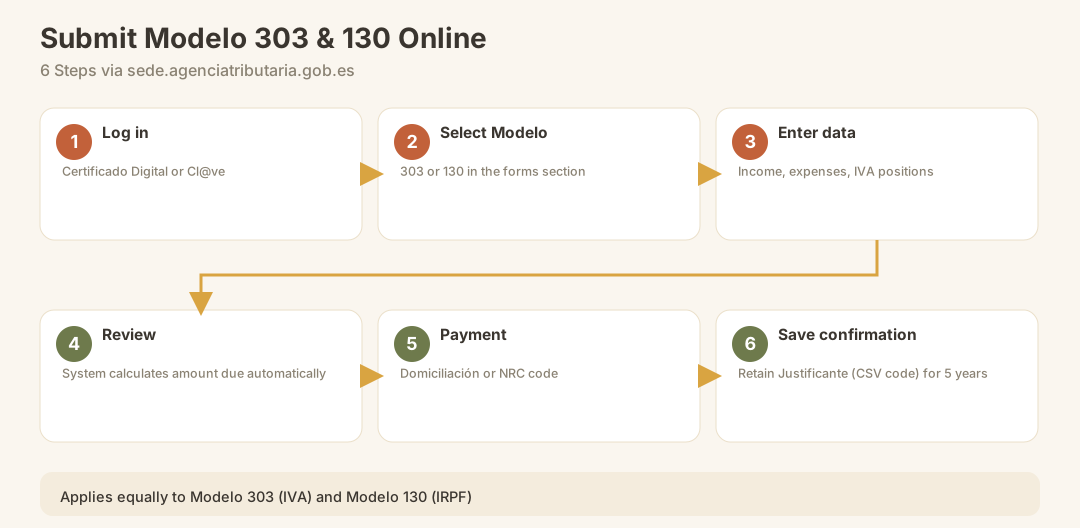
- Log in at sede.agenciatributaria.gob.es with Certificado Digital or Cl@ve
- Select the Modelo: Search for "Modelo 303" or "Modelo 130" in the forms section
- Fill in the data: Enter income, expenses, and IVA items (the portal guides you through each field)
- Review: The system automatically calculates the amount due
- Payment: Either directly via Domiciliación (direct debit) or via your bank's NRC code
- Save the confirmation: Make sure to download the Justificante (confirmation document) with its CSV code and keep it for at least five years
Please note: Without a Certificado Digital or Cl@ve, online submission is not possible. You can find out how to obtain both in our Apply for Certificado Digital guide.
What is tax-deductible? Business expenses in Modelo 130
Only expenses that are genuinely related to your self-employed activity may be entered as deductible expenses in Modelo 130. Typical categories:
| Expense category | Deductible? | Notes |
|---|---|---|
| Gestoría / tax adviser | Yes | 100 %, if professionally incurred |
| Office supplies, software subscriptions | Yes | 100 % if used exclusively for professional purposes |
| Home office share of rent/electricity | Partially | Generally difficult to claim due to mixed private use |
| Vehicle costs | Partially | Only when professional use is clearly evidenced |
| Cuota Autónomo (social security contributions) | Yes | Fully deductible |
| Representation expenses | Limited | Restaurant receipts only deductible under very restricted conditions |
| Health insurance premiums | Limited | Deductible up to certain limits as a special expense |
Please note: The IVA (Modelo 303) has its own rules regarding the deductibility of IVA soportada. Expenses that include a private element can only be claimed proportionally as IVA input tax.
You can find more information on deductible items and specific Balearic regulations in the guide to IRPF deductions Balearic Islands.
Special cases: When you do not need to submit a Modelo 303
Not every autónomo is liable for IVA. There are activities that are exempt from IVA:
- Certain educational services (tuition, private tutoring under certain conditions)
- Certain medical and therapeutic services
- Insurance and financial services
- Autónomos who invoice exclusively to customers not resident in Spain and located outside the EU (export services)
Those exempt from IVA issue invoices without IVA and do not submit a Modelo 303. The downside: these autónomos are also unable to reclaim IVA soportada from their purchases as input tax.
Please note: Whether your activity is subject to IVA depends on the registered IAE Epígrafe and the specific type of service provided. If in doubt, a gestoría in Spain.
Modelo 111 and Modelo 115: Further Retentions
Alongside Modelo 303 and 130, there are two further quarterly obligations that many people overlook:
| Form | When due | Purpose |
|---|---|---|
| Modelo 111 | Quarterly | When you have received invoices for professional fees on which a retention (IRPF withholding) has been indicated |
| Modelo 190 | Annually (January) | Annual summary for Modelo 111 |
| Modelo 115 | Quarterly | When you rent office space or commercial premises and are required to withhold a retention |
| Modelo 180 | Annually (January) | Annual summary for Modelo 115 |
The retention (retención) on professional fee invoices is generally 15 % (often reduced during the first years for newly established businesses – you should clarify the currently applicable rates and conditions with a gestoría).
Most common mistakes with Modelo 303 and Modelo 130
1. Missing the deadline – even when nothing is owed
Even if you have earned nothing in a given quarter, you must still submit both forms. A nil return is not the same as no return at all – anyone who submits nothing will still receive a late-filing penalty.
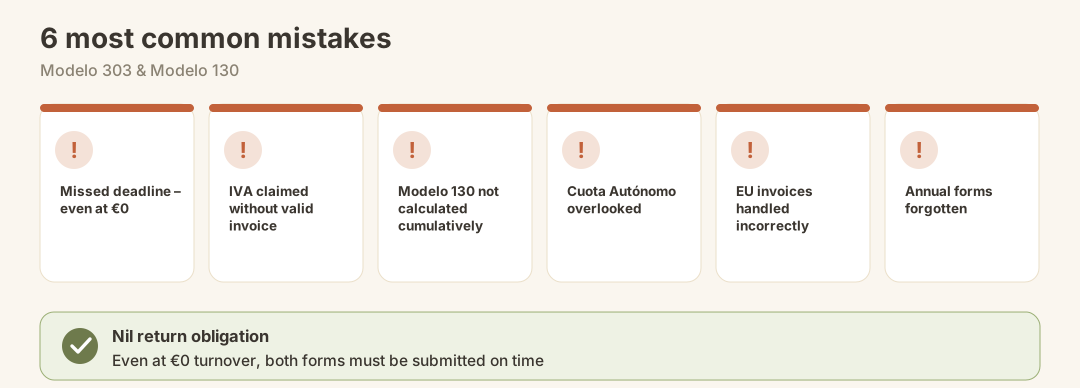
2. Input VAT claimed without a valid invoice
Only invoices made out in your name and your NIF/NIE, and containing all required particulars, can be claimed as input tax. Receipts, tickets, and informal proof of payment do not qualify.
3. Modelo 130 not calculated cumulatively
A classic mistake: entering only the income and expenditure for the current quarter rather than the cumulative annual profit. Modelo 130 works on a cumulative basis – always from January through to the end of the relevant quarter.
4. Forgetting the Cuota Autónomo
The monthly social security payment (Cuota) is a fully deductible business expense in the Modelo 130. Anyone who forgets it ends up paying more IRPF advance tax than necessary. Find out more about calculating the Cuota in the guide to Cuota Autónomo Spain.
5. Handling invoices to EU clients incorrectly
Anyone invoicing businesses in other EU countries uses the reverse charge mechanism – no IVA on the invoice, but a reporting obligation in the Modelo 303 (and where applicable in the Modelo 349 for intra-Community services). Incorrectly adding IVA to EU invoices creates unwanted reversal work.
6. Forgetting the annual forms
Modelo 303 has a counterpart at the end of the year: the Modelo 390 (annual IVA summary, generally due in January). Modelo 130 has the Modelo 100 (Renta, by 30 June). Both are due separately.
What comes next? The annual declarations
After four quarters come the two major annual returns:
Modelo 390 (annual IVA summary) A summary of all four Modelo 303 declarations. No separate payment process, but mandatory submission. Deadline: generally the end of January of the following year.
Modelo 100 (Renta / IRPF annual declaration) This is where all income and expenses for the year are finally settled – self-employment income, any capital gains, property income, and special deductions. The Modelo 130 payments made throughout the year are credited in full. Deadline: 30 June of the following year.
Note: Anyone who also has capital gains from ETFs, funds, or shares will find the tax treatment explained in our guide to ETFs & index funds in Spain.
Checklist: quarterly taxes as an autónomo
Use this list before each filing deadline:
- All outgoing invoices for the quarter collected and totalled (net + IVA)
- All incoming invoices in your name (net + IVA) collected
- Cuota Autónomo for the three months of the quarter noted down
- Cumulative profit since 1 January calculated (for Modelo 130)
- Previously paid Modelo 130 amounts deducted
- Certificado Digital / Cl@ve is working (don't test it for the first time on the submission day)
- Modelo 303 completed, Justificante downloaded
- Modelo 130 completed, Justificante downloaded
- Payment confirmed or Domiciliación booking checked
- All records kept for at least 5 years
Conclusion
Modelo 303 and Modelo 130 are not bureaucratic nightmares – once you understand the system, each quarter becomes a manageable routine: add up your income, deduct your expenses, submit two forms online, confirm payment. What gets autónomos into trouble most often is not the complexity of the forms themselves, but lack of preparation, missed deadlines, and careless errors when cumulating figures in Modelo 130. Using a reliable gestoría or a purpose-built tool makes life easier – but the responsibility always remains with you personally. Good bookkeeping discipline (filing every invoice immediately, monthly bookkeeping rather than quarterly panic) is the best-value investment you can make as an autónomo.
Those who are just starting out as an autónomo will find the complete set-up process in the guide Autónomo Spanien – from the NIE number to your first Modelo 036.
Official Sources
- Agencia Tributaria (AEAT) – Sede Electrónica, Modelo 303, Modelo 130, Modelo 390, Modelo 100: https://sede.agenciatributaria.gob.es
- AEAT Modelo 303 (updated version from 1. Februar 2026): https://www.agenciatributaria.es/AEAT.internet/Inicio/Ayuda/Modelos__Procedimientos_y_Servicios/Ayuda_Mod_303/
- AEAT Modelo 130 – Instrucciones: https://sede.agenciatributaria.gob.es/Sede/ayuda/manuales-videos-folletos/manuales-practicos/modelo-130.html
- BOE – Reglamento del IVA (Real Decreto 1624/1992): https://www.boe.es/buscar/act.php?id=BOE-A-1992-25149
- BOE – Ley 37/1992 del Impuesto sobre el Valor Añadido: https://www.boe.es/buscar/act.php?id=BOE-A-1992-28740
- AEAT – RETA / Seguridad Social (Importass): https://www.importass.seg-social.es