
Maria de la Salut, Mallorca: Guide to the Rural Heart

Places to stay in Maria de la Salut
AdTo load the accommodation map by our partner Stay22, we need your consent for marketing cookies. Your consent applies to all marketing content on mallorca.com.
Maria de la Salut lies in Pla de Mallorca, the island’s broad, agricultural heartland. The village is not geared towards large numbers of visitors: its church, village squares, traditional façades and the everyday life of a small rural community take centre stage. Anyone wishing to discover Mallorca through its villages, fields and regional produce will find it a suitable starting point. Maria de la Salut is less appropriate, however, for a conventional sightseeing day with a long list of spectacular monuments. Its appeal lies in its manageable distances, views of traditional architecture and close connection to agriculture. Melons, garlic, almonds, carob and Tomàtigues de Ramellet are among the products with which the village is associated on Mallorca.
Maria de la Salut also has a distinct profile as a place to live. Grocery shops and the market, which is geared towards local needs, support everyday life, while roads in the surrounding area lead to fincas and through cultivated land. Coastal tourism shapes the annual rhythm far less than in seaside resorts. For many journeys outside the village, however, a car remains the most practical option.
A visit is particularly worthwhile as part of a drive through Pla de Mallorca, together with Sineu, Petra or the countryside between the villages. Travellers who take their time, do not judge architecture solely by size and enjoy stopping where a place still functions primarily for its residents will understand Maria de la Salut best.
History of Maria de la Salut
The village’s history is revealed less through large fortifications or prestigious palaces than through the long-established relationship between the church, country estates and agriculture. The surrounding cultivated land formed its economic foundation for a long time. Even today, Maria de la Salut and its fields are particularly associated with melons, garlic, almonds, carob and Ramellet tomatoes. These products are therefore more than a culinary subject: they explain why the village centre is surrounded by an extensive agricultural landscape and why local festivals feature farm produce.
Finca Son Roig and Julià Font i Roig
Finca Son Roig, a historic country estate dating from the 16th century, offers a tangible introduction to the village’s earlier history. The property is regarded as the birthplace of Julià Font i Roig, an important religious figure from Maria de la Salut. He was involved in founding the Dominican convent in Manacor and is still commemorated in his home village. A depiction in the parish church also refers to him, directly connecting the estate’s history with the village’s culture of religious remembrance.
Church and Historic Village Centre
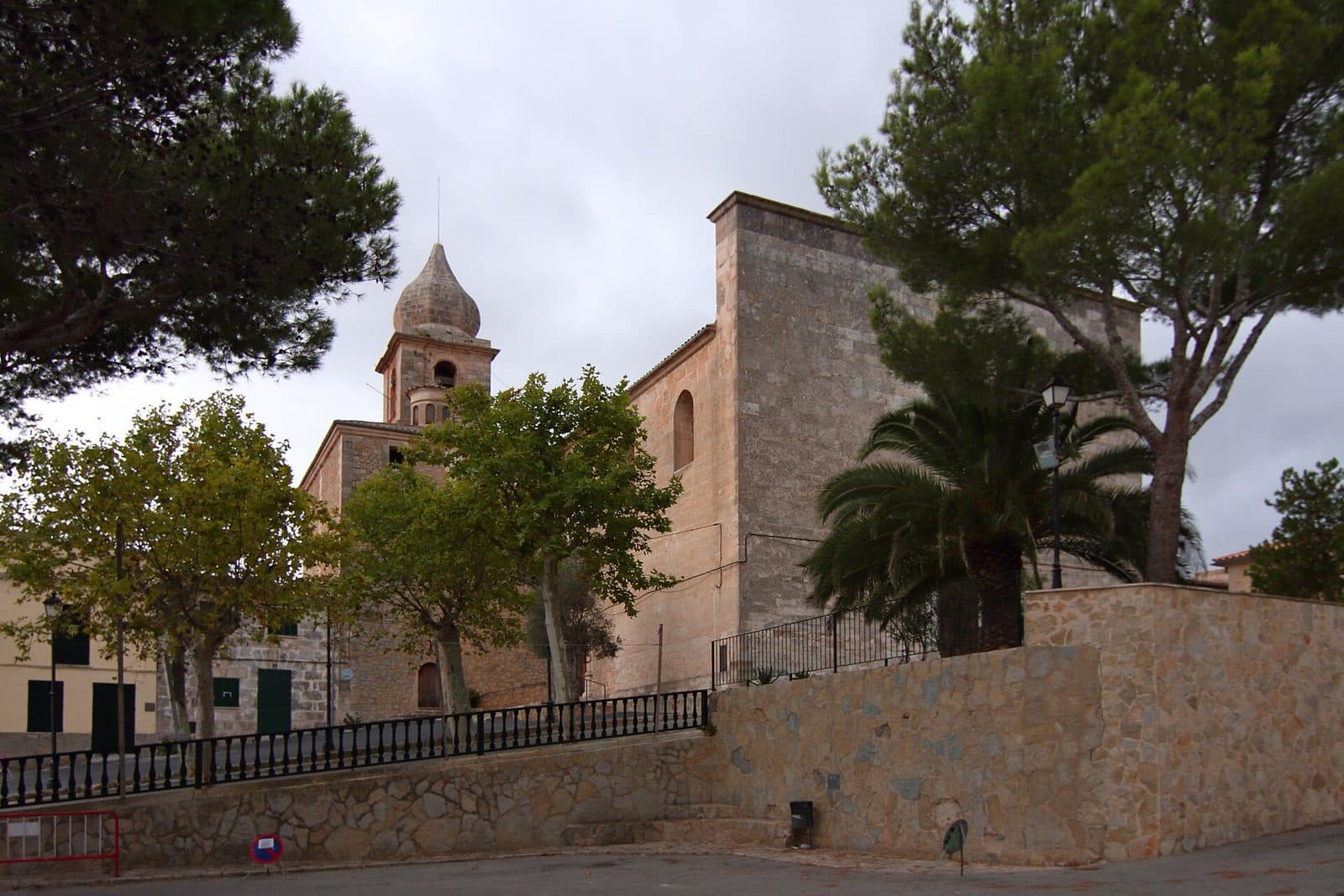
The parish church stands at the highest point of the village and forms the visible centre of the old quarter. Its position illustrates how strongly the village’s development was oriented around its religious and social centre. A network of narrow streets, restrained façades and traditional rural architecture has survived around it. The historic value lies not in a completely museum-like ensemble, but in a village centre that remains inhabited and in use.
The Present Village Name
The municipality bears the full name Maria de la Salut. The additional words refer to the religious identity also expressed through the veneration of the Mare de Déu de la Salut and the village’s patron saint festival. The name, parish church and patronal celebration therefore belong to the same historical narrative. At the same time, Maria de la Salut has remained an independent rural municipality whose identity is shaped not only by the church but equally by agriculture, the village market and local produce.
Sights in Maria de la Salut
Most sights are located in or near the village centre. A walk therefore works without a fixed route: short streets lead from the central squares to the church and examples of traditional residential and rural architecture. What matters is less the number of stops than the opportunity to understand the structure of a Mallorcan village in Pla.
Església de Maria
The parish church, also known as Església de la Mare de Déu de la Salut, stands at the highest point of the village. Its façade appears comparatively austere, while the interior is considerably more richly decorated with altars, religious depictions and other ecclesiastical ornamentation. The chapel containing an image of Julià Font i Roig has particular local significance. He came from Maria de la Salut and was involved in founding the Dominican convent in Manacor.
The church is not merely an individual architectural monument but also the best landmark in the village. The adjoining streets provide access to the older centre, with its traditional architecture and house fronts. During the Maria de la Salut Classica festival, the church interior also serves as a concert venue, giving it a cultural function alongside its religious role.
Plaça des Pou
Plaça des Pou is a central everyday gathering place and the setting for the weekly market. On ordinary days, it provides a good sense of the short distances within the village centre; on market morning, the square becomes a meeting place for shopping and conversation. Because the town hall, market area and streets leading to the parish church are close together, the square is a suitable starting point for a walk.
Its value does not lie in monumental square architecture. Instead, Plaça des Pou demonstrates how a village square continues to be used rather than serving merely as a backdrop. Anyone wishing to understand Maria de la Salut should therefore not visit only the church, but also spend some time on the square and in the adjoining streets.
Finca Son Roig
Finca Son Roig dates from the 16th century and is one of the municipality’s historic country estates. It represents the rural architecture that characterises the area outside the compact village centre. As the birthplace of Julià Font i Roig, it also has a biographical connection to the parish church and the village’s religious history.
As this is an estate rather than a conventional urban museum, an exterior view should not automatically be taken to imply unrestricted access. Nevertheless, identifying it as a historic country estate helps explain the municipality’s settlement pattern: a compact village centre on one side, scattered fincas and cultivated land on the other.
Ca’s Metge Monjo
Ca’s Metge Monjo is known as the house of a former doctor from Maria de la Salut. The building is one of those sites of local history whose importance derives from its former use rather than monumental dimensions. It is a reminder that the village’s history was also shaped by local professions and personalities.
The Defensive Tower
A historic defensive tower is associated with protecting the village from pirate attacks. Structures of this kind illustrate how even inland communities were affected by dangers that reached Mallorca through its coast. The tower is therefore interesting primarily as evidence of an insecure period rather than as an extensively developed visitor attraction.
The Weekly Market
The weekly market on Plaça des Pou is small and primarily geared towards residents’ needs. This is precisely what distinguishes it from the island’s large markets, which attract many tourists. Rather than long rows of souvenir stalls, the focus is on shopping for the home and kitchen, as well as providing a regular meeting place in the village centre.
Plaça des Pou
The stalls are concentrated on the central square in front of the town hall. Because distances within the village are short, the market can easily be combined with the parish church and a walk through the older centre. Anyone travelling solely for the market should expect a small local market that offers a compact impression of how a community shopping market operates in a village of Pla.
Food, Plants and Everyday Goods
The documented range includes fruit and vegetables, plants and flowers, as well as clothing and shoes. This focus suits the agricultural surroundings and the market’s everyday character. Fresh produce is particularly interesting for visitors, while the market also fulfils a practical supply function for residents. The selection may be smaller than at the island’s best-known markets, but it can be explored without prolonged crowding.
Atmosphere on Market Morning
On market day, Plaça des Pou changes more noticeably than the rest of the village. Shopping, brief conversations and a visit to a bar can be combined without turning the occasion into a major tourist event. Anyone wishing to browse the stalls at leisure should come during the morning and then allow time for the church and surrounding lanes. Once the market is over, the square quickly returns to its usual role as a quiet village centre.
Food and Drink
The culinary identity of Maria de la Salut begins in its fields. Official island information describes the municipality as one of Mallorca’s productive horticultural areas and highlights melons, garlic, almonds, carob and Tomàtigues de Ramellet. Anyone eating or shopping for food here therefore encounters not a local cuisine created specifically for visitors, but the produce of Pla de Mallorca.
Tomàtiga de Ramellet
The Ramellet tomato is the best-known local product. This Mallorcan tomato variety is closely associated with the island’s cuisine and has particular visibility in Maria de la Salut thanks to its own festival in August. Its importance demonstrates how directly agriculture, food and the village’s events calendar are connected.
For a visit to Maria de la Salut, it is therefore more interesting than an arbitrary souvenir: it represents a regional product rooted in rural daily life. At the market and in grocery shops, it is worth asking about regional origins and seasonality.
Melons, Garlic, Almonds and Carob
Maria de la Salut is also known for melons and garlic. Both products reflect the municipality’s horticulture and a cuisine in which high-quality basic ingredients matter more than elaborate presentation. Almonds and carob are among the tree crops that help shape the landscape of the island’s interior.
The combination of several crops is particularly characteristic: fruit and vegetable cultivation exists alongside almond and carob trees. Depending on the season, both the available produce and the appearance of the fields change. Visitors with a culinary interest should not judge Maria de la Salut solely by restaurant names, but view the market, grocery shops and agricultural surroundings as interconnected.
Rice Dishes, Stews and Poultry
Rice and stew, as well as poultry with vegetables, are mentioned among the village’s traditional dishes. This is consistent with Mallorca’s hearty, seasonal rural cuisine, which makes use of available produce and is not defined by maritime ingredients. In a village in the island’s interior, such dishes make more cultural sense than a menu catering exclusively to expectations associated with a beach holiday.
The precise preparation may vary from household to household and from one establishment to another. Visitors are therefore better advised to ask about daily dishes and seasonal ingredients than to search for a single supposedly original dish. The culinary side of Maria de la Salut is most immediate wherever produce from Pla is used in the kitchen.
Fig Bread
Fig bread is also mentioned as a local speciality. As a gift to take home, it has a clear connection to Mallorca’s rural diet without relying on decorative souvenir appeal.
Bars and Dining in the Village
The range of places to eat and drink is more limited than in coastal resorts. Around the central area, a market visit can be combined with coffee and a simple meal. It is advisable to check daily specials and opening days, particularly outside the summer travel season. Maria de la Salut is not a destination with a long restaurant strip; its appeal lies in a meal that fits naturally into a village visit.
Eating, drinking and staying in Maria de la Salut
The best-rated businesses from our directory, ordered by Google rating — not by advertising.
Restaurants
Cafés and bakeries
Bars
Activities and Excursions
Maria de la Salut is best suited to activities focused on landscapes and villages. Pla de Mallorca is characterised by fields, fruit growing, almond and carob trees, and scattered country estates. Many roads between the villages run through open cultivated land and present a different Mallorca from the densely developed stretches of coast.
Cycling in Pla de Mallorca
The paved country roads around Maria de la Salut are described as good terrain for road cycling and touring. The island’s interior is more open and less mountainous than Serra de Tramuntana, but sunshine, wind and regular road traffic still require realistic planning. Routes connecting Maria de la Salut, Sineu, Petra and other villages in Pla are particularly appealing.
A cycling route should not be selected solely on the basis of the shortest road connection. Minor roads pass closer to fields and fincas and reveal the area’s agricultural character more clearly. Water, sun protection and a route checked in advance are important, as not every country road offers shade or somewhere to stop for refreshments.
Walks Around the Village Outskirts
A walk can continue from the village centre towards the adjacent fields. The transition from the compact village to scattered fincas quickly becomes apparent. These are less like marked mountain hikes and more like quiet paths and roads through cultivated land. Consideration for private access roads, working farmland and vehicle traffic is essential.
The landscape looks different at various times of year: orchards, almond groves and fields change in colour and vegetation without the village depending on a short holiday season. For nature observation and photography, the outskirts are therefore often more interesting than a hurried walk confined to the centre.
Sineu and Petra
Sineu and Petra can be combined effectively with Maria de la Salut, as they are also villages in the island’s interior. In Maria de la Salut, agriculture, the parish church and everyday village life are the main focus.
The Bay of Alcúdia
The north coast can be reached by car from the island’s interior. Combining a village visit with the coast makes particular sense: a village or market visit in the morning, followed by the coast later. Without a car, this combination is considerably less flexible.
Festivals and Events
The village’s recurring events combine religious tradition, agriculture and culture. They are not simply additional entertainment for holidaymakers, but address subjects important to Maria de la Salut itself: its patron saint, a characteristic agricultural product and the parish church as a community venue.
Ramellet Tomato Festival
In August, the Ramellet tomato takes centre stage at its own local festival. The event highlights a product that is equally important to the municipality’s horticulture and Mallorcan cuisine. For visitors, it offers particularly direct access to the agricultural identity of Maria de la Salut because the celebration is not based on an arbitrary festival theme, but on produce genuinely associated with the village.
Its midsummer date coincides with the tomato’s seasonal availability. Anyone travelling specifically for the festival should check the current programme, as individual activities and venues may change from one edition to the next. Its character nevertheless remains clear: the village presents one of its best-known products and combines enjoyment, local knowledge and community life.
Festes de la Mare de Déu de la Salut
The patron saint festival begins towards the end of August and continues into September. It honours the Virgin Mary, whose name shapes both the parish church and the village’s full name. Religious elements are combined with a broader village programme. The celebration therefore offers an opportunity to experience Maria de la Salut not merely as a collection of historic buildings, but as an active community.
During the festival, more activity and temporary changes to the normal routine can be expected in the centre. For visitors, this can be a good opportunity to discover local traditions; anyone primarily planning a quiet walk should choose a different period.
Maria de la Salut Classica
The Maria de la Salut Classica festival brings classical music to the parish church. A sixth edition is documented for 2026, showing that the event extends beyond a one-off concert. Chamber music is particularly well suited to the intimate church interior and presents the village’s most important building in a different context.
At the same time, the festival demonstrates that cultural life in Maria de la Salut does not consist exclusively of traditional celebrations. The church remains the religious centre, but during this concert series it also becomes a performance venue. As programmes and dates vary, the latest event announcement should be checked before making a dedicated journey.
Getting There and Getting Around
Maria de la Salut lies away from the main holiday centres in the island’s interior. From Palma, the journey initially follows the fast northern route towards Inca and then continues along roads through Pla to the village. From the north or east, the approach follows the network of country roads between the municipalities. The final stretches already provide a good impression of the fields, fincas and open landscape.
By Car
For visitors, a car is the most flexible option. From Palma, the journey is said to take approximately 40 minutes under normal conditions. The decisive factor is not simply getting there, but mobility once in the area: Sineu, Petra, the north coast and rural destinations can be combined into a day trip far more easily with a private vehicle.
Some streets in the village centre are narrow. It is therefore more practical to leave the vehicle at the edge of the central area and complete the final distances on foot rather than driving directly up to the church or market stalls. On market mornings and during festivals, additional time should be allowed for finding a parking space.
By Bus
Maria de la Salut is served by regional buses. This may be sufficient for a single journey to the village centre, but timetables and connections shape the day more strongly than when travelling by car. Anyone wishing to visit several villages or continue to the coast should plan both the outward and return journeys in advance rather than waiting until after the walk to look for a connection.
The Maria de la Salut 2 bus stop is listed in the local area. By contrast, buses are only of limited use for remote fincas and countryside activities.
On Foot and by Bicycle in the Village
The central area is compact and easy to explore on foot. A bicycle also offers advantages for everyday journeys within the village. Conditions change outside the centre: distances increase, shade cannot be expected everywhere and roads are shared with motor traffic. Good visibility is particularly important on country roads.
Bus lines to Maria de la Salut at a glance
| Line | Route | Departures/day | First | Last |
|---|---|---|---|---|
| 441 | Ariany - Maria - Sineu | 19 | 06:15 | 22:17 |
From the official GTFS feeds (TIB/SFM), no real-time data. The figures cover all stops in the town; weekend and holiday services differ — check with the operator before travelling.
Getting there by bus
Maria de la Salut 2 (35003) · 1.1 km as the crow flies
- 441Ariany - Maria - Sineu · Daily
Timetable data: official GTFS feeds (TIB/EMT), no real-time — check with the operator before travelling.
Living in Maria de la Salut
As a place to live, Maria de la Salut differs markedly from Mallorca’s coastal municipalities. Everyday life is shaped more strongly by the local population, agriculture and local shopping than by hotels, seafront promenades or seasonal leisure facilities. This makes the village interesting to people who consciously wish to live in Pla de Mallorca.
Local Shopping in the Village
Supermarkets and grocery shops are among the types of business strongly represented in the village. Together with the weekly market, they provide a useful basis for regular shopping. The market is not merely an attraction but is tailored to residents’ needs. For a wider selection, specialist purchases or extensive errands, trips to larger towns remain worthwhile.
The compact layout makes journeys within the centre easier. Anyone living near Plaça des Pou and the historic centre can complete many small shopping trips on foot. Daily life changes considerably at a finca outside the built-up area: even the journey to a shop, bus stop or appointment may require a vehicle.
Living in the Centre and Countryside
The village centre is dominated by traditional houses on narrower streets, short distances and proximity to the church, square and shops. Noise levels follow the local daily rhythm and may become livelier on market days or during festivals. Outside the centre, fincas stand among agricultural land. They offer more distance from the centre but also require greater independence in terms of mobility and supplies.
These two forms of living should not be treated as equivalent. An address in the centre allows for a more walkable daily routine, while a country house makes a car an almost permanent part of everyday organisation. Before moving, the precise location is therefore more important than simply the name Maria de la Salut.
Commuting and Living Without a Car
Palma can be reached by road in approximately 40 minutes, traffic conditions permitting. This is manageable for occasional trips, but daily commuting requires the usual allowance for traffic and onward travel within Palma. The regional bus provides an alternative, though it offers less flexibility in terms of time.
Living without a car can work in the village centre if daily life centres on local shopping and planned bus journeys. For commuting, larger purchases, remote fincas or spontaneous trips to the coast, a private vehicle is considerably more practical. Maria de la Salut is therefore particularly suitable for people who regard rural tranquillity as a genuine residential asset and organise their mobility accordingly.
Practical Information for Your Visit
Maria de la Salut is best explored without a packed sightseeing programme. A manageable walk is sufficient for the church, Plaça des Pou and surrounding streets; adding a market visit, coffee or a meal turns it into a relaxed half-day outing. Anyone also wishing to drive through the agricultural landscape or visit neighbouring villages should allow more time.
The Best Time of Day
A morning visit can be combined effectively with shopping and activity on the central squares. On market morning, Plaça des Pou is significantly livelier and provides the best insight into local shopping routines, while the centre appears quieter on other days. The cooler hours are more pleasant for walks around the village outskirts because the open landscape offers only limited shade.
Village Walk and Church Visit
Plaça des Pou is a suitable starting point. From there, the route leads through the centre and uphill to the parish church before returning through neighbouring streets. During religious services, consideration is more important than sightseeing.
Parking and Market Activity
When arriving by car, it is advisable not to drive directly onto the central square. A parking space on an approach road followed by a short walk is usually easier. On market mornings, stalls occupy the square; during major village festivals, road closures and additional visitors must also be expected. Arriving earlier is sensible on these occasions.
Useful Combinations
Because of their location and distinct village character, Sineu and Petra combine well with Maria de la Salut. Anyone wishing to experience both countryside and sea in one day can then continue towards the Bay of Alcúdia. A private vehicle makes such combinations considerably easier because the length of time spent in each place can be determined freely.
Realistic Expectations
Maria de la Salut has neither a beach nor a harbour and does not offer a large sequence of museum-style attractions. A tourist shopping strip is not part of the village either. Visitors should instead expect an inhabited village with a parish church, small market, grocery shops and a close relationship with the surrounding cultivated land. With precisely this expectation, the visit becomes rewarding: not as an obligatory stop on an island tour, but as a focused insight into rural Mallorca.
Local businesses and services
The best-covered sectors in our directory for Maria de la Salut — each with address, contact details and opening hours.
Run a business here? Add it to the directory for free and be found on this page. Add your business