
Talaiot quadrat de ses Llenques near Colònia de Sant Pere
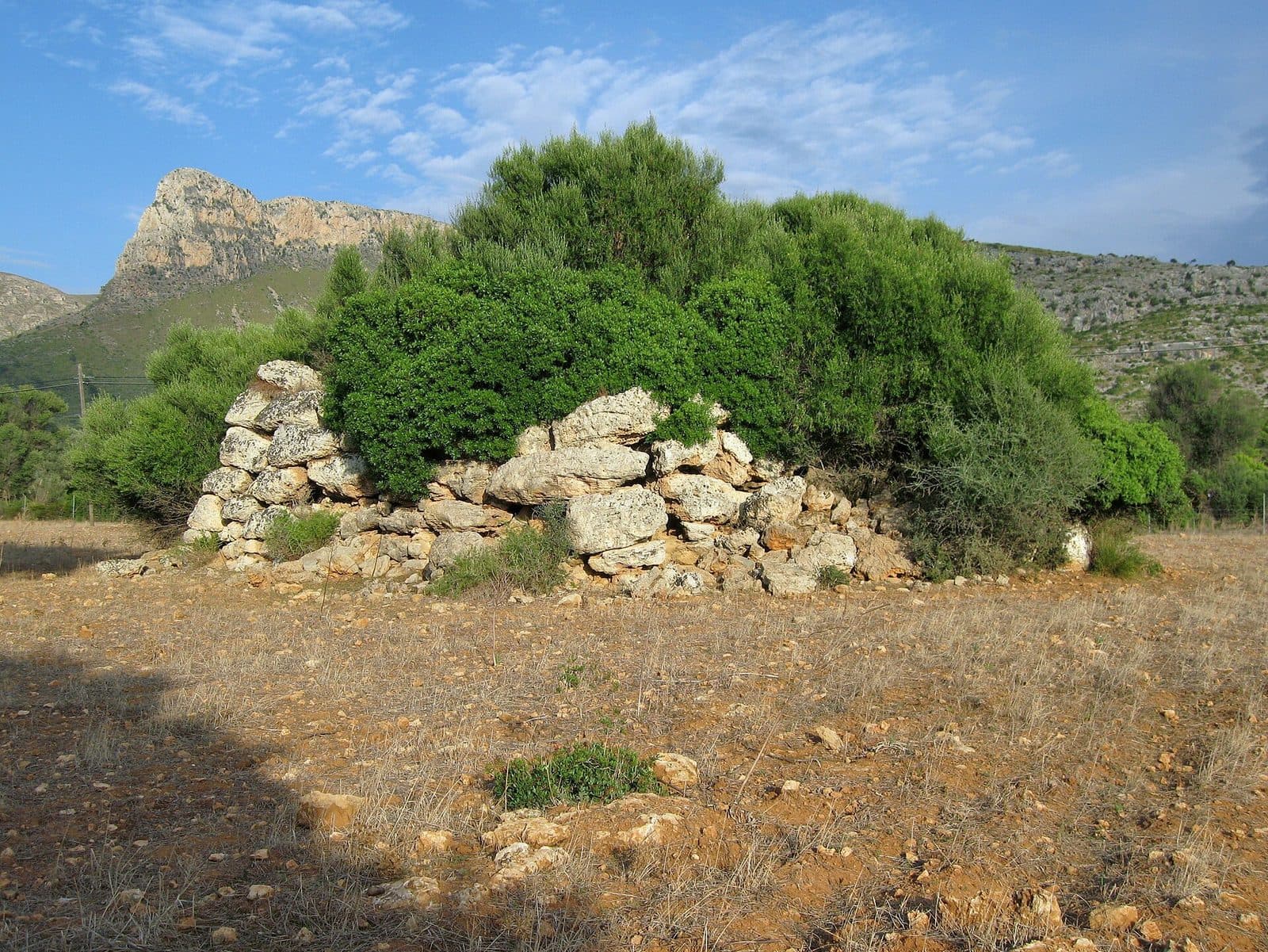

Between the hinterland of the Bay of Alcúdia and Colònia de Sant Pere, the Talaiot quadrat de ses Llenques recalls an era from which no written records have survived on Mallorca. The square stone structure belongs to the archaeological site of the Talaiotic settlement of Sa Canova on the sa Canova de Morell estate in the municipality of Artà and is an example of prehistoric architecture. This makes the talaiot especially suitable for visitors who want to discover Mallorca’s history beyond old towns, churches, and castles.
Questions remain unanswered, however: talaiots have been interpreted as buildings used by the community, places for distributing and processing food, meeting spaces, defensive structures, or points for monitoring the surrounding area. The precise role that the Talaiot quadrat de ses Llenques played in the everyday lives of its builders cannot be reduced to a single explanation.
History and significance
The Talaiotic communities
Around 3000 to 2500 years ago, communities lived on Mallorca and Menorca that are now described as Talaiotic after their most striking monuments. Their name derives from “talaia,” the Catalan word for a watchpoint or lookout. This designation is more recent than the structures themselves, however, and should not be understood as proof that every talaiot was exclusively a watchtower.
The Talaiot quadrat de ses Llenques is associated with the Bronze Age settlement site of Sa Canova. It should therefore not be understood as an isolated curiosity, but as part of an inhabited and used cultural landscape in what is now northeastern Mallorca. The people who built here possessed the knowledge to quarry and transport heavy stones and assemble them into load-bearing walls without modern lifting equipment.
Talaiots stood at the heart of social activities whose details can now be reconstructed only through archaeology. Possible uses under discussion include community gatherings, economic activities, the distribution of supplies, and defensive or territorial functions. Lines of sight across the surrounding area may also have been important. In the case of the Talaiot quadrat de ses Llenques, this range of possibilities should be regarded as historical context, not as a definitively established plan of use.
Sa Canova de Morell
The settlement remains lie on the sa Canova de Morell estate near the Bay of Alcúdia. This location shows that prehistoric settlement on Mallorca was not concentrated solely in today’s towns and villages. The square talaiot is therefore both a structure and a record of the landscape. It tells of a time long before Colònia de Sant Pere was founded, when the area was already organized, inhabited, and shaped by construction. The surviving stones connect today’s coastal region with a much older layer of settlement.
Protected cultural heritage
The talaiot is listed in the Spanish heritage register as a Bien de Interés Cultural under reference RI-51-0001771. This protected status emphasizes that it is not merely a collection of old fieldstones. The monument forms part of the archaeological heritage of the municipality of Artà and is therefore among the material records of Mallorca’s prehistory.
This leads to a simple principle for visitors: the surviving stonework is to be observed, not altered. Moving stones, climbing on the masonry, or taking supposedly insignificant finds would damage the historical context from which archaeologists derive their knowledge.
What to see
The square layout
The Catalan name already reveals the defining feature: “quadrat” refers to the square layout. Talaiots occur in different forms across the Balearic Islands; the clear geometry of ses Llenques helps visitors understand the structure’s arrangement within the landscape. It is best not to begin by looking for a main façade. It is more revealing to examine the course of the outer edges and the corner areas one after another. From close up, the talaiot appears less like a conventional building than a massive form of stone architecture emerging from the terrain.
The dry-stone masonry
Talaiots were built from large stone blocks without mortar to bond and stabilize the walls. Their strength came from the selection, placement, and weight of the individual stones. This construction method is often too hastily described as “primitive,” but the masonry demonstrates the opposite: without wheels for transport, modern cranes, or fired binding materials, construction required planning, communal labor, and precise knowledge of the materials. The talaiot is therefore significant not only because of its age, but also as evidence of prehistoric engineering.
The talaiot as part of a settlement
The individual structure gains its historical meaning from the Sa Canova site. A talaiot was not conceived as a standalone monument in the modern sense. It belonged to a community and was connected to the used areas and other settlement remains in its surroundings. Only by viewing it repeatedly from several directions does its square arrangement become apparent, offering an impression of the physical labor involved in positioning the stones.
A monument with unanswered questions
The name talaiot can easily evoke the idea of a simple lookout tower. Archaeologically, this is only one of several interpretations. Communal spaces, economic functions, defense, and territorial control are also under discussion. During a visit, it is therefore worth distinguishing between visible evidence and possible interpretation: the layout, wall sections, and construction technique are visible. What remains unknown is who occupied the interior, what activities took place there, and what significance the structure held for different groups within the settlement. This boundary of knowledge is precisely what makes the talaiot such a vivid place for archaeological thinking.
Visiting the talaiot
A useful tour begins from a distance. From several steps away, the square shape is easier to recognize than when standing directly in front of the stones. The four sides, and especially the corners, can then be examined one after another. This reveals how the straight wall sections were joined and how strongly the structure’s impact depends on its mass. Visitors who merely photograph the talaiot and immediately move on often miss the very details that demonstrate the technical achievements of its builders.
There is no meaningful fixed duration for visiting the talaiot. The site can be explored as a focused archaeological stop or examined in greater depth as part of the settlement landscape of Sa Canova. Visitors interested in history should allow enough time to view the stone structure from several directions rather than treating it merely as a brief photo stop.
Specific opening hours and admission conditions are not permanently documented. Because access and local regulations may change, the current conditions should be checked before traveling. This is especially important if the talaiot is the main destination of a longer excursion.
Getting there and parking
From Palma Airport
The stated route information leads to Colònia de Sant Pere, not directly to the talaiot. The road distance from Palma Airport is 72 kilometers, and the journey takes around 65 minutes. The route follows the Ma-15, then the Ma-3322 and Ma-3331 toward the coast near Colònia de Sant Pere.
The Ma-15 covers the long section through the island’s interior. Only on the subsequent roads does the route become more regional and enter the municipality of Artà. For the final stretch to the archaeological site, the talaiot’s exact position should be entered separately into the navigation system, as the route destination of Colònia de Sant Pere is not the monument itself.
From central Palma
From central Palma, the road distance to Colònia de Sant Pere is 75 kilometers. The journey takes around 72 minutes and likewise follows the Ma-15 → Ma-3322 → Ma-3331 route. Anyone starting in the city should bear in mind the difference between the coastal village and the archaeological site and allow additional time for finding the way along the final section. No bus stop in the immediate vicinity of the talaiot is documented either, so an individual route plan is necessary for a targeted visit.
Nearby attractions
Colònia de Sant Pere
Colònia de Sant Pere was established in 1880 as an agricultural colony and is therefore much younger than the talaiot. The small coastal village lies on the eastern side of the Bay of Alcúdia and, like the archaeological site, belongs to the municipality of Artà. Its modest scale distinguishes it from the larger holiday resorts around the bay.
Today, the harbor is home mainly to yachts alongside fishing boats. To the north, the promenade offers views across the bay; below it lies the village beach, protected by a breakwater. The contrast is appealing: at the talaiot, the focus is on the early settlement of the hinterland, while the coast features the much younger village with its harbor and shoreline.
The Bay of Alcúdia
The location near the bay helps visitors see the site as more than a remote point on an archaeological map. The talaiot documents an early phase of land use long before today’s coastal settlements emerged. A visit can therefore easily be combined with time on the promenade or at the harbor in Colònia de Sant Pere. The neighboring coastal areas near Betlem and Son Serra de Marina, as well as the town of Artà, also make suitable additional stops without requiring a tightly scheduled sightseeing itinerary.
Artà and its prehistory
Anyone wishing to explore Talaiotic culture in greater depth can combine the excursion with the well-known settlement of Ses Païsses near Artà. There, visitors can trace a larger settlement structure with an enclosing wall and additional buildings. Ses Llenques remains the quieter counterpart: a single square talaiot where the basic form and masonry technique can be examined with particular focus.
Local insider tips
Find the corners first
The square layout is easier to understand from a little distance. First locate the four corner areas one after another, then move closer to the masonry—this turns seemingly unordered stones into a clear architectural form.
Look closely at the joints
Talaiots were built from large stone blocks without mortar to bond and stabilize the walls.
Combine it with the harbor
After the prehistoric stone architecture, Colònia de Sant Pere offers an appealing contrast: the village was founded in 1880 as an agricultural colony and has a small harbor and a promenade on the Bay of Alcúdia.
Compare it with Ses Païsses
Anyone with more time for prehistory can combine ses Llenques with the Talaiotic settlement of Ses Païsses near Artà. There, the broader settlement context becomes clearer, while ses Llenques places the individual square structure at the center.