
Mallorca in Autumn: Weather, Sea & Premium Enjoyment
Autumn turns Mallorca's year on its head, so to speak: while in spring the air warms up faster than the sea, in autumn the air cools down while the water still holds onto the warmth of summer. Anyone choosing this transitional period between September and November for a trip will find soft light, pleasant temperatures for hiking and cycling – but must also reckon with the fact that these months bring most of the year's rain. This piece shows how air, water and rainfall shift over the three autumn months, what that means for individual activities, and which regions of the island are especially worthwhile at this time.
Autumn in Mallorca: an overview of the weather
Mallorcan autumn begins where summer stops repeating itself. In September, daytime air temperatures still reach 27.0 °C, and the sea, having warmed steadily over the summer months, is hardly any cooler than in August at 24.7 °C. This lag is no coincidence but simple physics: water retains heat far longer than air, so the Mediterranean holds onto what it absorbed in July and August well into autumn. For swimmers, this means September is often the most comfortable month of the whole year for a dip, since the extreme heat of the air has passed while the water remains at summer levels.
With the move into October, the picture slowly begins to turn. Air temperatures drop noticeably, while the sea follows only hesitantly. By November, the gap has shifted further still: daytime highs for the air then stand at 19.1 °C, and although the water is cooling too, at 18.7 °C it still holds a level that many other destinations never reach even in winter. This lag between air and water is essentially the reverse of spring, when it is the air that races ahead of the still-cool sea.
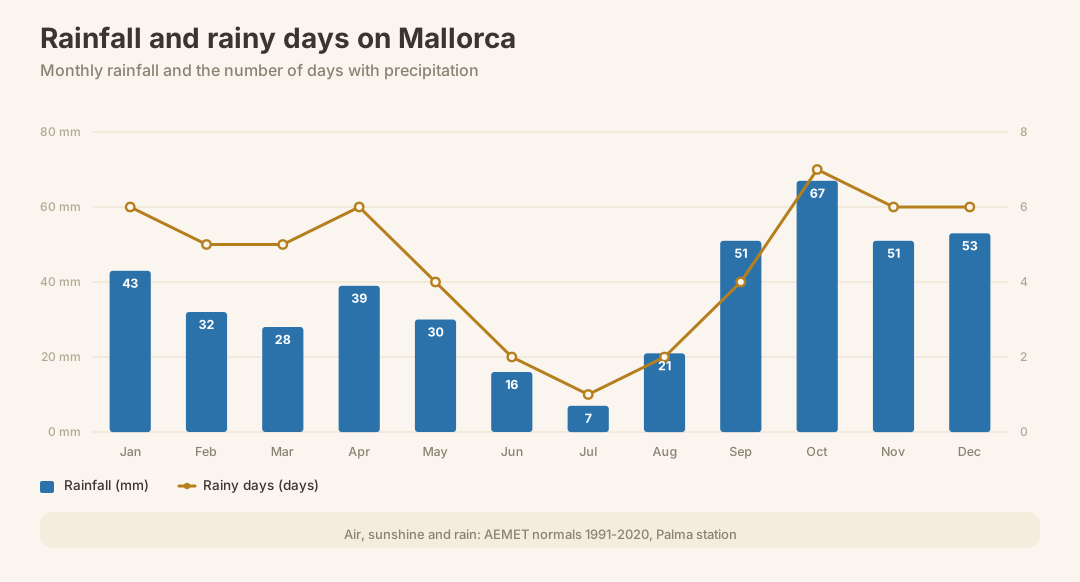
Alongside this shift in warmth, the second major factor of autumn changes too: rain. What barely plays a role in summer becomes the defining feature of the weather between September and November. Already in September, 51 mm falls across 4 rainy days, noticeably more than in the preceding months, yet this is only the beginning. As autumn reaches its peak, rainfall totals continue to rise, and November, with 51 mm across 6 rainy days, ranks among the wettest months of the entire year. This increase does not spread evenly across the weeks but often arrives in bursts: sunny, dry spells are followed by individual days of heavy, sometimes thundery rain that can account for much of the month's total. Anyone planning an autumn trip should therefore think less in terms of steady, drawn-out rain and more of an interplay between largely pleasant weather and interspersed, often brief but intense, downpours.
Sunshine hours and humidity also shift over the course of the season, though less dramatically than temperature and rainfall. The days grow noticeably shorter, which directly affects the number of sunshine hours, and humidity rises as rain spells become more frequent. Overall, though, autumn – especially in its first half – remains a season with clearly more sunny days than rainy ones, simply with a trend that shifts month by month towards the wet winter.
Month by month through autumn
September in Mallorca often still feels like an extension of summer. Daytime air reaches 27.0 °C, nights cool to 16.6 °C, and the sea remains at 24.7 °C, a level that invites long swims. The sun shines on average for 7.9 h, and on 4 rainy days there is already more rain than in high summer, with 51 mm falling, yet the character of the month remains distinctly summery. Comparing the number of rainy days with the long sunny stretches in between reveals that September is above all one thing: a mild transition, not a break.
October marks the true turning point of the season. Maximum temperatures drop to 23.2 °C, nights cool to 13.4 °C, and the water, too, noticeably loses some of its summer warmth, falling to 22.0 °C. At the same time, rainfall increases markedly: with 67 mm across 7 rainy days, October ranks among the wettest months of the year. Sunshine hours stand at 6.4 h, showing that despite the increasing rain spells, many pleasant hours still remain each day. October is thus the month in which early and late autumn overlap most clearly: warm, almost summery days alternate with the first cooler, rainier spells.
November, finally, shows autumn at its most pronounced. Daytime temperatures still reach 19.1 °C, but nights already cool to 9.1 °C, a difference that makes a jacket sensible in the evenings. The sea, at 18.7 °C, has cooled considerably, though by many northern European standards it remains mild. Rain reaches its yearly peak: on 6 rainy days, 51 mm falls, more than in any other month. Sunshine hours drop to 5.4 h, noticeably less than in September, partly due to the shorter days. Anyone choosing November gets a month defined less by steady good weather than by individual clear, often surprisingly mild days between the rain spells.

What autumn in Mallorca makes possible
Swimming remains one of the most obvious options in early autumn. As long as the sea still carries its summer warmth, September and most of October can be enjoyed for swimming without needing a heated pool. Only in November, when the water cools noticeably and the number of rainy days rises, does the character of the coast shift more towards walks than long hours in the water.
Hiking, by contrast, gains appeal in autumn rather than losing it. The summer heat that makes long tours in the Tramuntana difficult in July and August has passed, and temperatures sit in a range that makes even multi-hour ascents pleasant. October and early November in particular are considered by many to be the best hiking time of the year, provided one packs weatherproof clothing for occasional showers and avoids scheduling tours on days with heavy rain.
Cycling benefits from the season for similar reasons. The summer temperatures often too hot for road cyclists give way to a climate that allows long rides without heat stress, while traffic on the island's roads noticeably eases compared with high season. Those who plan flexibly and simply set rainy days aside for other activities will find ideal conditions for training in autumn.
Cultural offerings such as museums, churches, monasteries and weekly markets combine well with the more changeable autumn weather: on rainy days they provide a sensible alternative to the beach or hiking trail, without having to forgo an outing altogether. In Palma especially, city-centre programmes are less crowded in autumn than in summer, making visits altogether more pleasant.
Culinary life coincides with harvest time in autumn: grapes are picked and made into young wine, mushrooms find their way into kitchens in the forests of the Tramuntana and the interior, and many restaurant menus switch from light summer dishes to heartier, seasonal fare. This combination of mild weather and harvest season makes autumn one of the most interesting times for anyone wanting to get to know Mallorca not just through its beaches, but through its cuisine and landscape as well.
Where you're best off in autumn
How different autumn feels in Mallorca depends heavily on which part of the island one chooses. We do not have individual measurement series for specific towns, but the broad differences between the island's landscape regions can still be described well without local data.
The Tramuntana shows autumn at its most intense. The mountains intercept moisture, which tends to make the region one of the rainier parts of the island, especially when fronts stack up against the slopes in October and November. At the same time, this is exactly why the region becomes so striking scenically: wisps of fog in the valleys, clear views after a shower, and light that often feels softer in autumn than in the glaring summer sun. The Tramuntana is therefore ideal for hiking, as long as one factors in the chance of rain and avoids starting routes when storms are forecast.
Es Pla, the flat centre of the island, experiences autumn more calmly. Here, vineyards and fields shape the scenery, and harvest time makes the region especially worth seeing in early autumn, when the grape harvest is underway and the landscape appears in warm colours. Weather-wise, Es Pla is less extreme than the mountains: rain here tends to fall in a more orderly, briefer fashion, without the build-up effects seen in the Tramuntana.
The south and east coasts tend to remain the drier, warmer regions of the island in autumn. Here, mild conditions often persist the longest, the sea cools less noticeably than elsewhere, and rain spells are frequently shorter and weaker compared with the mountains. Anyone focused mainly on beach days and reliable swimming weather in autumn is generally better off along these coastal stretches than inland or in the mountains, even though the odd rainy day cannot be ruled out there either.
Frequently asked questions
What is autumn like in Mallorca?
Is autumn a rainy season in Mallorca?
Can you still swim in the sea in Mallorca in autumn?
Is autumn a good time for the Mallorcan wine harvest?
Is autumn good for hiking in Mallorca?
What's on in Mallorca in October
Events
- Exhibition «Voices of the south India-Nepal, and other perspectives»Valldemossa
- Port de Sóller Classical Music Festival
- Golden Room by ESNPalma
- Puerto Portals Winter Series
- Friday FITZPalma
- LA RUBIA CAÑERA, a melodrama with a tragicomic scent.Palma
Worth doing now
- Visit inland wineries during the grape harvest, especially around Binissalem.
- Hike the Tramuntana as temperatures ease from the summer heat.