
Mallorca water temperature in June: start of the bathing season
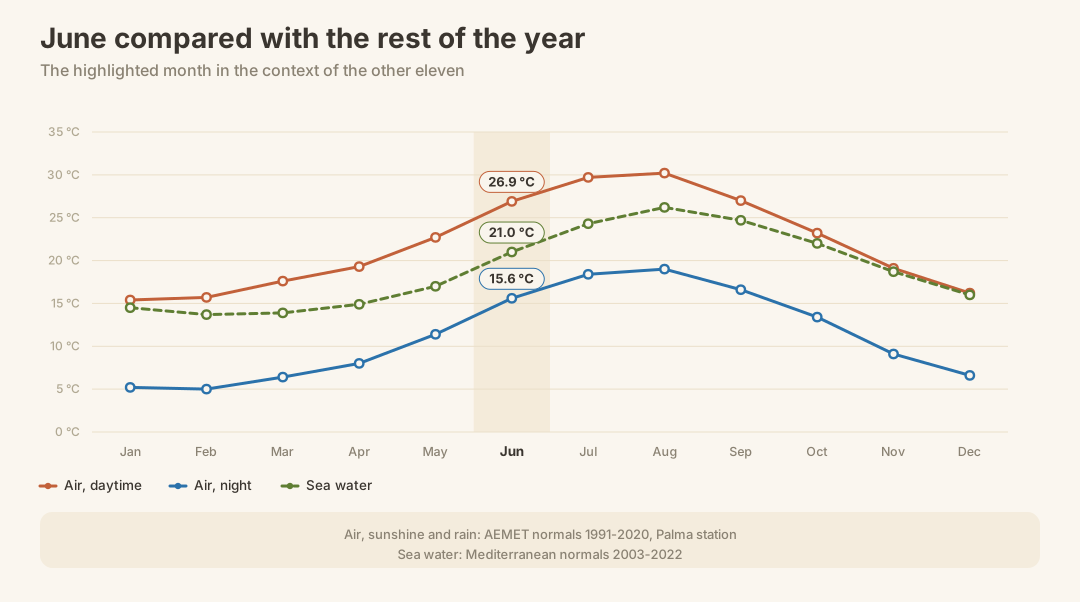
Palma normals as an island-wide approximation: In June, the average daytime high is 26.9 °C and the sea is 21 °C, with 2 rain days and 10.4 hours of sunshine per day.
Anyone travelling to Mallorca in June often wonders, first of all, whether the sea already matches the summer weather on land. The short answer: yes, but on its own rhythm. While the air already reaches summery values and the days are as long as at any other time of year, the Mediterranean takes longer to catch up. This article shows how warm the water actually is in June, why it lags behind the air, where the warmest spots around the island can be found, and what all this means for swimming, snorkelling and diving.
Water temperature in June
Yes, by June you can already swim comfortably on Mallorca. The sea reaches a monthly average of 21.0 °C – a value at which most people no longer perceive seawater as cool, but as pleasant to refreshing. Anyone who still hesitated in May will find conditions considerably more inviting in June, even though the water has not yet reached the warmth it has in late summer.
June marks the true start of the swimming season on land: daytime air temperatures climb to 26.9 °C, the sun shines for 10.4 h per day, and with 14.8 h of daylight, June ranks among the longest days of the whole year. This combination of abundant light, mild evenings and a sea that has noticeably warmed makes the month one of the most pleasant times to experience the island from the water side.
Even so, the water still lags behind the air. While air temperature adapts to new weather within a few days, the sea takes weeks to months to catch up. In June this lag is still noticeable – the water feels fresher than the air, especially early in the morning or after a few overcast days. Those who are particularly sensitive to cooler water are best off swimming around midday or in the afternoon, once the upper water layer has warmed further from the day's sunshine.
Wind- or weather-related fluctuations are normal in June: after a few days of onshore wind or choppy seas, cooler deep water can mix towards the surface and briefly lower the perceived temperature. These fluctuations, however, even out again within a few days, so the monthly average provides a reliable picture. Overall, June is thus the first month of the year in which the sea is pleasant for most visitors without any need to acclimatise – provided one does not yet expect the warmth of high summer.
Why the sea lags behind the air
The reason for this delay lies in physics: water has a far higher heat capacity than air. Warming a given amount of water by one degree requires many times the energy needed for the same warming of air. This is why air temperature reacts immediately to sunshine and weather patterns, while the sea only absorbs and stores this energy over weeks and months. The Mediterranean around Mallorca is also deep enough that the warmth must spread through an entire water column, not just the surface, before noticeably higher temperatures set in.
This inertia can be seen clearly in the shift between the warmest air month and the warmest water month. Air temperature reaches its peak as early as August, at 30.2 °C. The water, however, needs a little longer: in August it measures 26.2 °C, yet only a month later, in September, it reaches its true annual peak of 24.7 °C – at a point when the air, at 27.0 °C, has already become noticeably milder. The sea therefore holds onto summer warmth longer than the air, because it has stored that warmth throughout the summer and only releases it with a delay.
This gap opens most clearly in spring, when the air is already making summery advances but the sea is still shaped by the cool winter months. In May, for instance, air temperature already rises to 22.7 °C, while the water, at 17.0 °C, still lags well behind. At this time of year the gap between air and water is the widest of the entire year, because spring's warmth has not yet worked its way down into deeper water layers. By June this gap has already narrowed noticeably, even if it has not yet fully closed.
In autumn the relationship then reverses: while the air cools rapidly after summer, the sea holds onto its warmth for longer. This is precisely why the months after high summer are often those in which swimming remains pleasant for longest, even though the air on land already feels more autumnal. This pattern of delayed warming and delayed cooling is typical of deep, large bodies of water such as the Mediterranean, and it explains why a single calendar month never automatically reveals how warm the water actually is.
Where the water is warmest in June
The island-wide average of 21.0 °C obscures the fact that the water around Mallorca in June is by no means the same everywhere. Shallow, sheltered bays warm up considerably faster than open, deep stretches of coast, because there is less water volume to absorb the sun's energy, and because wind and currents create less exchange with cooler deep water there.
In the south and east of the island, around Playa de Palma, Es Trenc, the bays near Cala Millor or the broad beaches of the Bay of Alcúdia, the water is often noticeably warmer than the island average. These stretches of coast slope gently, are largely sheltered from wind, and also receive many hours of sunshine a day – ideal conditions for the water to already feel pleasant in June, even though the deeper layers remain cooler.
The northwest of the island, by contrast, is far more reserved. Along the steep coast of the Tramuntana, near Sóller, Deià or the Bay of Sa Calobra, the seabed drops quickly to great depth. Here the warmed surface water mixes more readily with cooler deep water, and exposed locations are also more often subject to wind, which further promotes mixing. Anyone swimming along this coast in June will notice the water is distinctly cooler compared with the shallow bays in the south and east.
For individual bays and beaches we have no separate measurement series, so these differences can only be described qualitatively rather than in concrete figures. As a rule of thumb, however: the shallower and more sheltered a bay, the more likely its water temperature in June lies above the island average, and the more open and deep the coast, the more likely it lies below. Those seeking the warmest possible water in June are generally better served by the flat sandy beaches in the south and east than by the rugged northwest coast.
June's sea compared with the rest of the year
Over the course of the year, June already sits clearly on the warm side, though not yet at its peak. The island's coldest water of the year is measured in February, at 13.7 °C, while the warmest comes in September, at 24.7 °C. Between these two extremes, June, at 21.0 °C, lies noticeably closer to the warm end, even though a few degrees are still missing before the true annual peak in late summer.
Particularly revealing is the comparison with the month that sits directly opposite on the calendar: December. Both months are equally far from the summer or winter solstice respectively, and in a body of water without thermal inertia they ought to be roughly equally warm. In fact, comparing 21.0 °C in June with 16.0 °C in December reveals exactly the delay that characterises the Mediterranean: December still benefits from the warmth stored during summer and turns out considerably milder than its calendar position alone would suggest, while June, conversely, has not yet reached the full warmth of the coming summer.
This asymmetry is the true fingerprint of the sea's thermal inertia. A body of water that followed the air and sunshine without delay would show nearly identical values in June and December. But because the Mediterranean warms over months and cools down just as slowly, its annual cycle is noticeably shifted relative to that of the air and to the astronomical calendar. June therefore marks the part of the year in which the water is on an upward trend but still clearly below its annual maximum, while December is on a downward trend but still well above its annual minimum.
For travellers this means: anyone looking for pleasant bathing water already in June need not compromise, but should know that the warmest weeks for swimming still lie ahead, in late summer and early autumn, when the sea draws fully on its stored reserves of warmth.
Swimming, snorkelling, diving: what is worthwhile now
With a water temperature of 21.0 °C, an ordinary swimsuit or pair of trunks is entirely sufficient for most people in June. Anyone who only swims briefly or moves around a lot will feel no cold that would call for a wetsuit. It is a different matter, however, if you spend longer periods in the water, for example during extended snorkelling or several dives in succession: in that case a thin neoprene vest or shorty can make sense, because the body cools down more over an extended time in the water than a quick dip might suggest.
For divers, depth also plays an additional role. Surface water temperature says little about how cool it is a few metres down. Since the sea in June has only been warming for a few weeks, the water column is not yet as evenly warmed as it is in late summer, and temperature can drop noticeably with increasing depth. A medium-thickness wetsuit is therefore worthwhile for dives into greater depths, even when the surface itself already feels pleasantly warm.
Underwater visibility in June benefits from a combination of plenty of sunlight and still comparatively calm conditions. With 10.4 h per day, a good deal of light penetrates the upper water layers, which noticeably improves colours and visibility while snorkelling. Since the high season with heavy swimming and boat traffic only reaches its peak in the following months, the water in June is in many places still clearer and less churned up. Anyone wanting to combine snorkelling and diving with good visibility will therefore find good conditions in June, without yet having to compete with the busiest time in the water.
Wind remains a factor in June that further shapes the conditions as they are felt: on days with stronger wind – June averages 13 km/h – the water at exposed coasts can briefly feel cooler and choppier, even though the average temperature remains unchanged. For calm snorkelling it is therefore worth looking towards wind-sheltered bays, while open stretches of coast on windy days are better left to experienced swimmers and divers.
Frequently asked questions
Is June the start of the swimming season in Mallorca?
Is June good for snorkelling in Mallorca?
Is the sea warm enough for kids to swim in Mallorca in June?
How much warmer does the sea get after June?
What's on in Mallorca in June
Worth doing now
- Snorkel the coves while visibility and water temperature both hit a comfortable stride.
- Book a beach day with the family now that the sea is genuinely pleasant for kids.