
Water temperature Mallorca in September: warm sea, quiet beaches
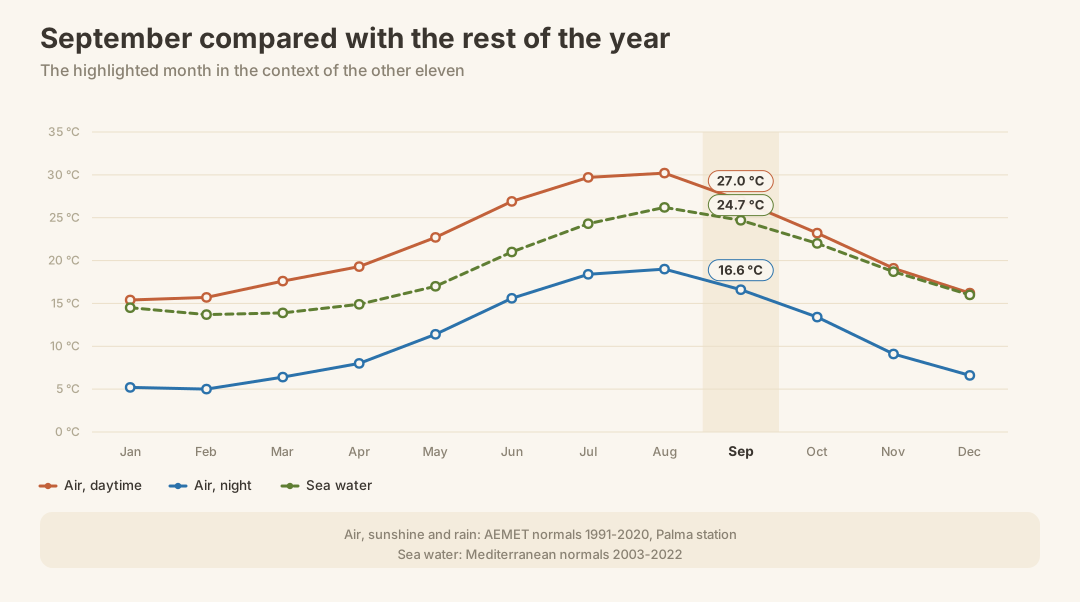
Palma normals as an island-wide approximation: In September, the average daytime high is 27 °C and the sea is 24.7 °C, with 4 rain days and 7.9 hours of sunshine per day.
Anyone travelling to Mallorca in September rightly wonders whether the swimming season is already over. The answer is clear: the sea shows itself at its warmest this month, while the air is already becoming more pleasant and the beaches are emptying. This article explains why that is, where the differences lie around the island, and what it all means for swimming, snorkelling and diving.
Sea temperature in September
The short answer first: yes, swimming in Mallorca in September is excellent, and for many people even better than in high summer. The sea reaches 24.7 °C this month, comfortably above the threshold at which most people find water pleasantly warm. Anyone who has already swum in July or August will notice no real difference in September – if anything, quite the opposite, since the water has been storing warmth all summer long and only releases it slowly.
It is precisely this combination that makes September so popular among those in the know: the sea holds on to its summer level, while the air loses its closeness and the oppressive heat of high season eases off. Air temperatures during the day still climb to pleasant levels, but the evenings turn noticeably milder, and the dense crowds at the well-known beaches thin out markedly, since school holidays in most countries of origin have ended. Anyone seeking peace and quiet on the beach is more likely to find it now than in August.
In fairness, one caveat belongs here: September is also the month on Mallorca in which the first autumn storms can announce themselves. After weeks of stable summer weather, warm, humid air occasionally builds up, leading to brief but intense showers and thunderstorms, sometimes with heavy rainfall. This does not affect the water temperature, but it can disrupt the odd day at the beach. If in doubt, it is worth checking the short-term forecast, since stable, high-summer spells of fine weather still clearly dominate in September, and on most days nothing stands in the way of a relaxed day in the water.
Why the sea lags behind the air
The fact that the sea is still so warm in September, even though summer is long past on the calendar, has a simple physical explanation: water has a far higher heat capacity than air. To put the same amount of energy into a given mass of water as into the same mass of air takes many times more solar energy – and just as much patience before that energy escapes again. Air reacts almost instantly to sunshine and weather patterns, changing by several degrees within a few hours. The Mediterranean, by contrast, reacts sluggishly: it takes weeks and months to warm up, and just as long to cool down again.
This inertia creates a time lag between the two annual cycles that can be read very concretely from the calendar months. Air temperature reaches its peak as early as high summer, with the hottest values in July, when daytime highs average 29.7 °C. The sea, however, lags behind: it gathers the warmth of the entire summer and reaches its own peak only weeks later, once the air has already begun to ease off slightly. This delay of roughly a month is typical of deep, open bodies of water such as the Mediterranean and explains why September is often more appealing for swimmers than one might expect.
The gap between air and water becomes especially clear in spring. While air temperature rises comparatively quickly after the cool winter months, as soon as the sun grows stronger again, the cold lingers in the sea for much longer. In April, for instance, air temperature is already well above winter levels, while the water, at 14.9 °C, remains noticeably cool and still holds the memory of winter. Only over the following months does this gap gradually close, until water and air draw closer together again in late summer or early autumn. Anyone wanting to understand the seasons of the Mediterranean should therefore never look at air temperature alone, but should always bear in mind that the sea keeps its own, far slower clock.
Where the water is warmest in September
Even though the island seems small, the sea around Mallorca is by no means equally warm everywhere. We have no dedicated measurement series for individual bays and beaches, so no figures can be given here for specific locations – but the general tendency, which rests on the physical properties of the respective stretches of coast, can be described well.
Shallow, sheltered bays generally warm up faster and more strongly than deep, open water, because less water mass has to be heated by the same amount of solar energy, and there is no exchange with cooler water from the depths. This favours above all the south and east of the island: the broad, gently shelving sandy beaches around Playa de Palma, the bays near Colonia de Sant Jordi and Es Trenc, and the many small calas along the east coast between Cala Millor, Porto Cristo and Cala d'Or are, by experience, among the areas where the water feels especially pleasant in September. The sheltered bays of the Bay of Alcúdia and Pollença also benefit from their shallow, wide shape.
The north-west coast, by contrast, works differently. Between Sóller, Banyalbufar and the cliffs near Sa Calobra, the seabed often drops away steeply close to shore, and open, deep water on the whole warms more slowly – but also cools more slowly. In September this coast, too, benefits from the summer warming, but the direct contact with larger, cooler bodies of water usually gives a noticeably fresher impression than in the shallow bays of the south and east. For anyone specifically seeking the warmest water, the rule of thumb is therefore: shallow and sheltered beats deep and open, regardless of which direction of the compass you happen to be on.
September's sea against the rest of the year
Looking at the year as a whole, September sits close to the warmest point of the season, though not quite at the very top. The sea usually reaches its maximum in August, at 26.2 °C, while September, at 24.7 °C, lags only slightly behind. The difference is small and barely noticeable in the water – for practical purposes, September can safely be regarded as a continuation of the summer peak.
At the other end of the scale stands the coldest month of the year, usually February, when the sea reaches its low point of 13.7 °C after the short, cool days of winter. Between this value and the September temperature lies the greatest span of the entire year – a difference that makes clear just how much warmth the sea has actually absorbed over the summer months, and how long it takes to release it again.
The comparison becomes especially revealing when set against the month that stands symmetrically opposite September on the other side of the year: July. Both months lie roughly the same distance from the summer temperature maximum, July before it, September after. While the air differs markedly between these two months – July considerably hotter and drier, September already milder and more changeable – the water tells quite a different story: the sea temperature in July, at 24.3 °C, lies close to that of September. It is precisely here that the sea's inertia becomes most vividly visible – the water knows no calendar dates, but follows only the warmth it has slowly stored, regardless of how the air above the surface happens to be behaving.
Swimming, snorkelling, diving: what's worthwhile now
The same good news applies to all three activities in September: the water temperature of 24.7 °C is so far above the threshold at which most people find cool water uncomfortable that a simple swimsuit or pair of trunks is entirely sufficient. A wetsuit only becomes necessary once the water cools significantly over an extended period, which happens at the earliest in late autumn. Anyone going into the water in September can therefore quite happily do without extra layers of protection, even for longer swims or extended snorkelling sessions.
For snorkellers, the mild temperature above all means one thing: there is no need to rush. Without having to keep moving constantly to fend off the cold, reefs, seagrass meadows and rock formations can be explored at leisure, without the body cooling down prematurely. For children or less confident swimmers, too, the water temperature in September poses no obstacle, which makes the month a pleasant time for families wanting to avoid the hustle and bustle of the main season.
For diving, visibility also plays a role alongside temperature. After the warm summer months, during which plankton and algae growth often cloud underwater visibility somewhat, conditions gradually settle over the course of late summer, without the water becoming noticeably colder. This makes September an appealing time for many experienced divers: pleasant temperatures with no need for a wetsuit, combined with visibility that tends to improve rather than worsen compared with high summer. So anyone looking for both relaxed swimming and slightly more demanding underwater exploration will find one of the most favourable combinations of the entire year in September.
Frequently asked questions
Is the sea still warm enough to swim in Mallorca in September?
Why is the sea warmer in September than earlier in summer?
Is September good for snorkelling in Mallorca?
How long does the warm water last after September?
What's on in Mallorca in September
Events
- Danzú FestivalPalma
- Dance ShowcaseBunyola
- SEO Congress - Sociedad Española de OftalmologíaPalma
- Awareness TalkDeià
- Theatre: Cròniques d'un mig estiu - Sala La FornalManacor
- Let’s Talk About Suicide: Breaking the TabooBanyalbufar
Worth doing now
- Snorkel in warm, calmer water now that the peak-summer crowds have thinned out.
- Pair a late swim with a vineyard visit as the harvest gets underway inland.