
Discover the Magic of Mallorca in September: A Haven of Warmth and Tranquility
Palma normals as an island-wide approximation: In September, the average daytime high is 27 °C and the sea is 24.7 °C, with 4 rain days and 7.9 hours of sunshine per day.
Among seasoned connoisseurs of Mallorca, September is often considered the true high point of the travel year, even though no holiday brochure markets it that way. The sea has warmed up over the summer and stubbornly holds onto its temperature, while the air already takes on a touch of mildness and the great wave of holidaymakers ebbs away. Anyone wanting to know exactly what to expect this month – from the water temperature to the first autumn thunderstorms – will find here an honest assessment, free of brochure tone.
The weather in September at a glance
September marks the transition on Mallorca from high summer to mild autumn, even if little of that is initially noticeable. By day the mercury still climbs to 27.0 °C, while at night it cools to 16.6 °C – making the nights noticeably more pleasant than in August, without the days losing any of their strength. The sea, as every year, lags behind the air and holds close to its summer level at 24.7 °C, which makes September one of the best months for swimming of the entire year.
With an average of 7.9 h of sunshine per day, there is still plenty of time for the beach, excursions and long evenings outdoors, even though the days are already noticeably shorter than at the height of summer. At the same time, autumn is announcing itself: on 4 rainy days in the month, there can be heavy, sometimes thundery showers, which differ markedly from the drizzly, drawn-out rainy days of a northern European autumn.
Anyone arriving in September thus encounters a combination that connoisseurs of the island deliberately choose this month for: the sea still at summer level, the air already a shade milder and more pleasantly tempered, plus noticeably fewer crowds on the beaches and in the towns than just a few weeks earlier. The main holiday season across much of Europe is over, families with school-age children rarely travel any more, and the island visibly breathes a sigh of relief. Anyone wishing to avoid both crowds and heat, without giving up on swimming weather, finds in September a window of time that rarely repeats itself in quite this form.
Towards the end of the month, the likelihood of the first genuine autumn thunderstorms increases, usually triggered by the still-warm sea surface combining with incoming cooler air – a weather pattern typical of the Mediterranean late summer, which tends to concentrate on a few individual but intense days, while the rest of the month remains largely dry and sunny.
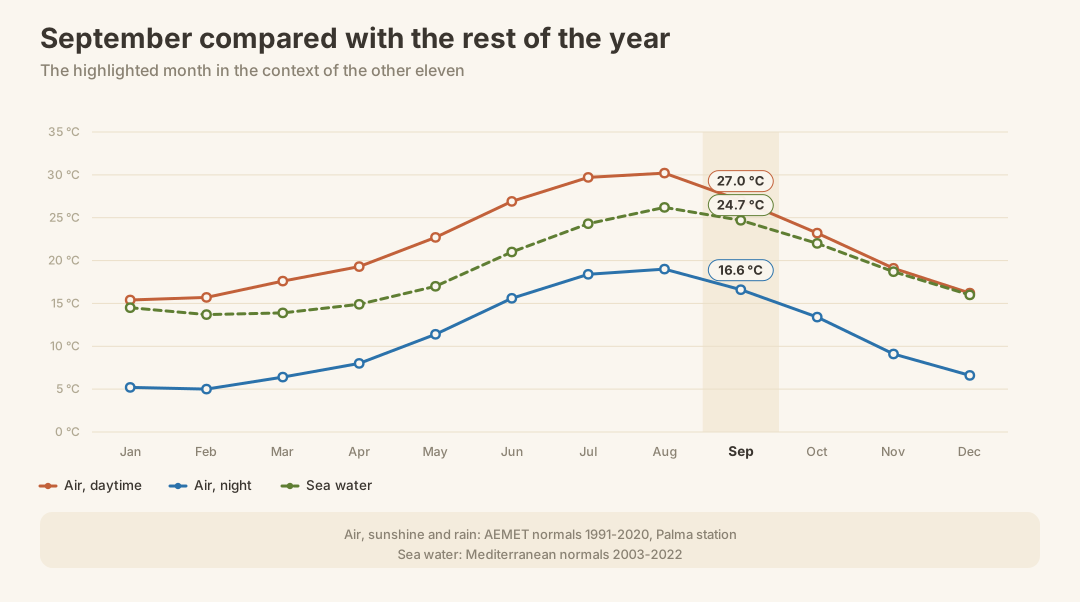
Water, sun and rain in September
For daily life on Mallorca in September, three factors matter above all: the water temperature, the hours of sunshine, and the distribution of rainfall. Water temperature always reacts to air temperature with a noticeable delay over the course of the year, because large bodies of water warm up and cool down far more slowly than the air above them. The Mediterranean around Mallorca therefore reaches its highest temperature not in high summer but only in late summer and early autumn – and that is exactly what you experience in September. At 24.7 °C, the sea is almost at August's level, even though the air already shows the first signs of autumn. In practical terms, this means you benefit from the warming built up over the preceding months, without having to endure the oppressive heat that in July and August often barely lets up even at night. Swimming feels especially pleasant this month, because the contrast between air temperature and water temperature is smaller than in any other month of the year.
Hours of sunshine already decline noticeably in September compared with high summer, but at 7.9 h per day you are still at a level that leaves most northern European summers far behind. Day length shortens noticeably – to 12.2 h per day – and evenings arrive noticeably earlier than in August, which many find pleasant, as it allows a better balance between beach days and quiet evenings in restaurants or on terraces.
When it comes to rain, September displays a pattern typical of the entire Mediterranean climate: not many days of rain, but few, often intense events. On average the month counts 4 rainy days, spread across the whole month, though the second half tends to be more prone to showers and thunderstorms than the first. Total rainfall stands at 51 mm – markedly more than in the parched summer months, but still far from the wettest months of the year. What matters here is less the quantity than the form: rather than days of drizzle, you tend to experience short, heavy showers or isolated thunderstorms that often clear away as quickly as they arrived. The weather can turn from bright sunshine to a brief, intense downpour within a few hours, before clearing up again. For planning purposes, this means: a cloudy morning is not a lost day, and a rain shower in the afternoon by no means rules out a sunny evening.
What is possible in September — and what is not
September on Mallorca is above all a month for anyone wishing to combine swimming, activity and cultural excursions without having to endure the midday heat of summer. Swimming works without restriction this month: with a water temperature of 24.7 °C, the sea is still excellent for extended swims, and even longer spells in the water do not feel cool. Anyone looking, over the course of the year, for the best compromise between a warm sea and bearable air is clearly better off in September than in July or August.
Walking and cycling also improve noticeably compared with high summer, even if the month is not the most comfortable of the year for this. With highs around 27.0 °C, it remains warm enough during the day, particularly inland, that strenuous tours in the early afternoon offer little enjoyment. Anyone wishing to explore the Tramuntana or cover longer distances by bike during this period is better off planning the active hours for the morning or late afternoon and avoiding midday, much as in August. Unlike in high summer, however, the evenings are already pleasantly cool enough for relaxed walks or dining outdoors, without oppressive humidity spoiling the experience.
City and cultural excursions combine well with September regardless of the weather, since Palma and the island's other towns offer plenty of covered museums, churches and markets. On the occasional rainy days, which tend to occur mainly in the second half of the month, an alternative programme in Palma's old town, in cathedrals, monasteries or wineries offers itself, while the next sunny day can again be used for the beach or nature.
What September does not offer, however, is the guarantee of consistently stable weather that July or August deliver almost reliably. Anyone planning a trip that depends from start to finish on dry, uninterrupted sunny weather – such as a multi-day hiking tour with no fallback option, or a large open-air event – takes on a certain residual risk in September that is smaller in the high summer months. Anyone specifically hoping for long, bright evenings on the beach will also notice that the days are already noticeably shorter than in August. September is thus not a month of compromises when it comes to swimming, but one with slight compromises regarding weather stability – a trade that most connoisseurs of the island make consciously and gladly.
Where you are best off in September
Our series of measurements is based on the Palma station, which is representative of the east coast, the south and large parts of the surrounding area. For individual locations beyond that – such as high up in the Tramuntana or in remote coves on the north coast – we have no measurements of our own, but the fundamental differences within the island can still be described well for September.
Along the coast, proximity to the sea remains a noticeable advantage in September: temperatures fluctuate less between day and night than inland, because the still-warm sea moderates the air even in the evening. Anyone seeking particularly warm, extended evenings for swimming is well placed along the coast, especially in the south and east of the island. Inland, by contrast, temperatures drop more quickly at night and, away from the sea breeze, often rise higher during the day – a contrast that becomes more pronounced in September than in high summer, when high temperatures prevail everywhere anyway.
The Tramuntana in the northwest behaves in September like its own small climate system. The mountains trap moisture, encourage more frequent cloud formation, and are more prone to the year's first autumn showers and thunderstorms than the drier south of the island. Anyone wishing to hike here should reckon more with short-term changes in weather and plan day trips flexibly, while the south around regions such as Santanyí or Colònia de Sant Jordi tends to stay dry and stable for longer.
Wind plays a noticeable, but mostly pleasant, role in September. Exposed stretches of coast, especially in the north and northwest, often feel onshore wind more directly, which provides welcome relief on hot days but can also turn unpleasant more quickly when showers move in. Sheltered coves and locations in the lee of the mountains, such as parts of the east coast, remain calmer and are therefore particularly well suited to long beach days where wind should not be a factor.
What to pack for September
What belongs in the suitcase for September can be deduced directly from the month's figures. Swimwear comes first: with a water temperature of 24.7 °C, the sea is still worthwhile for extended swims, so you should plan for at least one, preferably two, swimming outfits. For daytime, light, breathable fabrics are recommended, since with highs around 27.0 °C it remains warm enough during the day for short sleeves and airy clothing.
For the evenings, things look different than in August: with lows around 16.6 °C, it already cools noticeably after sunset, so a light cardigan or a long-sleeved shirt is sensible for an evening stroll or dining outdoors. Rain protection also belongs in the luggage, though not a heavy raincoat: since the month counts 4 rainy days, which mostly occur as brief, heavy showers, a compact, foldable rain jacket or a small umbrella is entirely sufficient to be prepared for the occasional downpour without unnecessarily filling the suitcase.
Sun protection remains essential despite the advancing year: with 7.9 h of sunshine per day, the intensity of radiation is still considerable, which is why sunscreen, a hat and sunglasses continue to belong in the basic kit. Anyone wishing to be active – for instance hiking in the Tramuntana or on longer bike tours – should also pack sturdy footwear and a light, windproof jacket, since noticeable wind is to be expected on exposed coastal stretches and in the mountains. Overall, a mix of summer and light transitional clothing is worthwhile, one that can flexibly adapt to a day that may begin sunny in the morning and bring a brief shower in the afternoon.
September compared with the neighbouring months
Compared with its neighbouring months, September clearly shows why it is so popular among many experienced Mallorca travellers. August offers slightly warmer conditions, with highs around 30.2 °C and a water temperature of 26.2 °C, but also considerably more crowding on beaches, in restaurants and on the roads, along with nights that, with lows around 19.0 °C, often still feel humid and oppressive. September takes over almost all of August's swimming pleasure – the sea remains at nearly the same warmth with 24.7 °C – but delivers more comfortably tempered nights and noticeably less bustle, which many regard as a clear gain.
October, in turn, already shows more clearly how autumn is progressing: with highs around 23.2 °C and a water temperature of 22.0 °C, both the air and the sea cool noticeably, while the number of rainy days at 7 rainy days is already higher than in September. Anyone arriving in October must reckon more with changeable weather and can no longer rely consistently on warm bathing water, but benefits from even quieter locations and lower prices.
September thus sits exactly between these two poles, without inheriting the drawbacks of either month: it has neither the bustle and oppressive night-time warmth of August, nor the increasing susceptibility to rain and noticeably cooler sea temperatures of October. Anyone choosing between the three months and placing value on warm swimming combined with a more relaxed atmosphere will find in September the most fitting combination of all three – a window of time whose balance of summer remnants and autumn harbingers recurs at only a few points in the course of the year.
Frequently asked questions
Is September warmer than August in Mallorca?
Does it rain more in September than in summer on Mallorca?
Is September quieter than August in Mallorca?
Can you still go hiking in Mallorca in September?
Is September a good month for wine lovers visiting Mallorca?
What's on in Mallorca in September
Events
- Multihull Cup RegattaCalvià
- Rata Market
- Concert Cançons per a la vidaSanta Eugènia
- Notice of the ordinary plenary sessionPorreres
- Let’s Talk About Suicide: Breaking the TabooBanyalbufar
- Exhibition by Jaime Colorao at the Fundació Cultural Coll BardoletValldemossa
Worth doing now
- Visit inland wineries as the grape harvest gets underway.
- Take advantage of quieter beaches and still-warm water once the summer crowds thin out.