
Hipoteca residentes España: 80 % financing, equity & costs
As a resident — that is, someone with tax residency in Spain — you have clear advantages over non-residents when buying property: Spanish banks will typically finance up to 80 % of the valuation, require less additional documentation, and offer more favourable interest rates. What many people underestimate: even with 80 % financing, you will need substantial equity, because the purchase costs come on top. In this guide you will learn how the hipoteca residentes España works in practice — from the minimum equity required, through the types of interest rate, to every cost item at completion. You will get real figures, a clear process overview, and the most important mistakes to avoid.

Mortgage calculator
Explanation
The loan amount is the capital originally granted. The preset is arithmetically consistent with the selected loan-to-value share of the example purchase price.
Explanation
These are this calculator’s three modelling paths, not a statutory product classification: a fixed rate, index plus margin, or a fixed phase followed by a variable phase.
Explanation
TIN (tipo de interés nominal) is the nominal annual interest rate before costs; TAE (tasa anual equivalente) includes costs and payment timing and does not belong in this field. The preset is a round worked example, not a market rate.
Explanation
The total term determines the number of monthly payments. The preset is a worked example.
- Monthly payment (cuota)
- €1,280.37
Why this figure?
The cuota is the regular monthly payment of interest and principal under the French annuity system.
Model calculation: twelve equal months, first payment one month after disbursement, no stub period and the calculator’s own cent rounding. The bank schedule can differ because of its day-count convention, stub period and rounding. The controlling documents are the FEIN (European Standardised Information Sheet containing the binding loan information) and the escritura (notarial loan deed).
Legal status: 1 January 2023
This calculation is provided for guidance only and is not a substitute for tax or legal advice in specific cases.
Resident vs. non-resident: what really makes the difference to a bank
The decisive factor for a Spanish bank is not your nationality but your tax residency (residencia fiscal). Anyone who pays income tax in Spain — that is, someone who lives there for more than 183 days per year or whose primary economic interests are based there — is considered a resident and receives the more favourable terms.
The difference is significant:
| Feature | Resident | Non-resident |
|---|---|---|
| Maximum financing | up to 80 % of the valuation (exceptionally up to 90–100 %) | 50–70 % of the valuation |
| Interest rate | Standard terms | Surcharge of approx. 0.3–0.8 percentage points |
| Maximum term | up to 30 years (depending on the bank) | 20–25 years depending on the bank and profile |
| Documentation requirements | Standard | Increased (overseas income verification, proof of source of funds) |
| Required equity | approx. 20 % of the purchase price + additional costs | approx. 35–50 % of the purchase price + additional costs |
Please note: 'Exceptionally up to 100 %' is in practice limited to very specific situations — always plan on 80 % as the realistic maximum.
How much equity do you actually need?
The most common miscalculation when buying property in Spain: buyers only account for the 20 % gap not covered by the bank. On top of this come the purchase costs — transfer tax, notary fees, land registry fees, legal advice — which the bank will generally not cover.
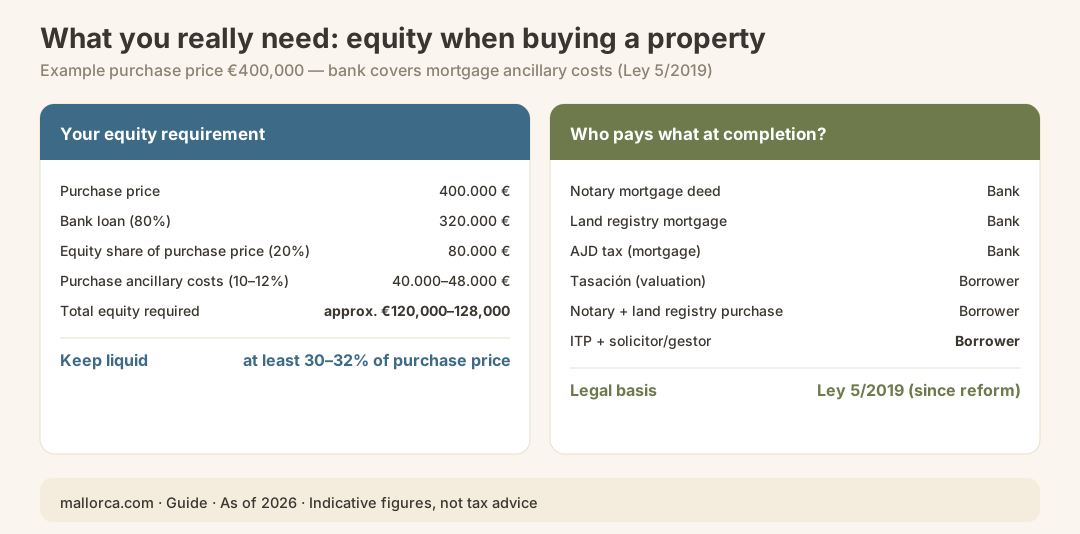
Example calculation for a purchase price of 400.000 €:
| Item | Amount (indicative) |
|---|---|
| Purchase price | 400.000 € |
| Bank loan (80 %) | 320.000 € |
| Equity contribution towards purchase price (20 %) | 80.000 € |
| Purchase additional costs (approx. 10–12 % in Mallorca) | 40.000–48.000 € |
| Total equity required | approx. 120.000–128.000 € |
Please note: The exact amount of the additional costs depends on the purchase price, property type, and the current Balearic property transfer tax (ITP). Have the figures broken down in a binding manner before you buy — find out more in the guide to Purchase costs in Mallorca.
The most important types of interest rates at a glance
Spanish mortgages are offered in three basic models. Which one suits you depends on your risk appetite, the current interest rate environment, and the planned holding period of the property.
| Interest rate type | How it works | Advantage | Disadvantage |
|---|---|---|---|
| Variable rate (tipo variable) | Adjusted to Euribor + bank margin | Benefits from falling interest rates | Unpredictable monthly payments |
| Fixed rate (tipo fijo) | Constant throughout the entire term | Financial planning certainty | Usually a higher initial interest rate |
| Mixed rate (tipo mixto) | Fixed for a number of years, then variable | Combination of both advantages | More complex to evaluate |
The Euribor is the dominant reference interest rate for variable mortgages in Spain. Make sure to check the current level before signing a contract — the monthly Euribor data is published by the Banco de España at bde.es.
Which documents does the bank require?
As a resident with a Spanish income tax assessment (declaración de la renta), the documentation package is manageable, but must be submitted in full. Missing documents regularly cause delays in the process.
Standard documentation for employees:
- Valid national identity card or passport
- NIE (Número de Identificación de Extranjeros) — mandatory
- Last 2–3 pay slips (nóminas)
- Most recent income tax return (declaración de la renta / IRPF)
- Employment contract (contrato de trabajo)
- Bank statements for the last 3–6 months
- Información crediticia / CIRBE report (credit history held by the Banco de España)
Additional documents for the self-employed (autónomos):
- Tax assessments for the last 2 years (modelo 100 / modelo 130)
- Evidence of business income
- Where applicable, balance sheets or profit and loss statements
Please note: Even as an EU citizen with Spanish residency, you must present a valid NIE. The application is submitted in person at the relevant Comisaría or through the Spanish consulate abroad — however, the consulate only forwards the application and does not issue the NIE itself.
The financing process step by step
The journey from the initial enquiry to signing at the notary typically takes 6 to 12 weeks. Allow plenty of buffer time — especially during the holiday season on Mallorca.
- Clarify your financing framework: Compile a realistic picture of your income, outgoings, and equity
- Compare banks: Either directly or through an independent mortgage broker (intermediario de crédito inmobiliario, registered with the Banco de España)
- Submit your document package: Complete and up to date — missing documents are the most common cause of delays
- Obtain pre-approval (preaprobación): Gives you certainty before signing the reservation agreement
- Have the property valued (tasación): The bank typically commissions an approved valuation firm — this figure forms the basis for the 80 % threshold
- Receive the FEIN (Ficha Europea de Información Normalizada): A standardised European information sheet setting out all loan terms — you have at least 10 days to consider it
- Notary appointment: First the mortgage deed, then the purchase deed (escritura de compraventa) — both must be entered in the land registry
- Land registry entry: Completion of the purchase process
You can find more on the legal process for purchasing property in the guide Legal process for buying property.
Costs when taking out a mortgage: who pays what?
Spanish mortgage costs
Explanation
The principal amount paid out under the mortgage loan.
Explanation
The responsabilidad hipotecaria is the mortgage liability amount stated in the escritura (notarial deed). It includes secured principal and any secured interest, costs and penalties; if no amount is stated, Article 30.1 TRLITPAJD uses principal plus three years of interest. Copy the figure from the deed.
Scope: property in the Balearic Islands and a loan within Ley 5/2019 (consumer and professional lender).
- Paid by the bankCalculated bank item (AJD)
- €4,500.00
- Paid by youyour calculated one-off ancillary costs
- €0.00
Legal status: 1 January 2025
This calculation is provided for guidance only and is not a substitute for tax or legal advice in specific cases.
Since the reform of the Spanish mortgage law (Ley 5/2019), the allocation of costs between the bank and the borrower has fundamentally changed. Some items previously borne by the buyer are now covered by the bank.
| Cost item | Responsible party |
|---|---|
| Notary costs for the mortgage deed | Bank |
| Land registry entry of the mortgage | Bank |
| Stamp duty (IAJD / AJD) on the mortgage | Bank |
| Tasación (property valuation) | Borrower |
| Notary for purchase deed | Borrower |
| Land registry entry for the owner | Borrower |
| Property transfer tax (ITP) on the purchase | Borrower |
| Solicitor / Gestor | Borrower |
Note: The Tasación typically costs several hundred euros depending on the property value and provider. Ask the bank in advance which approved valuation companies it accepts.
How does the bank assess your borrowing capacity?
Spanish banks primarily examine two key figures:
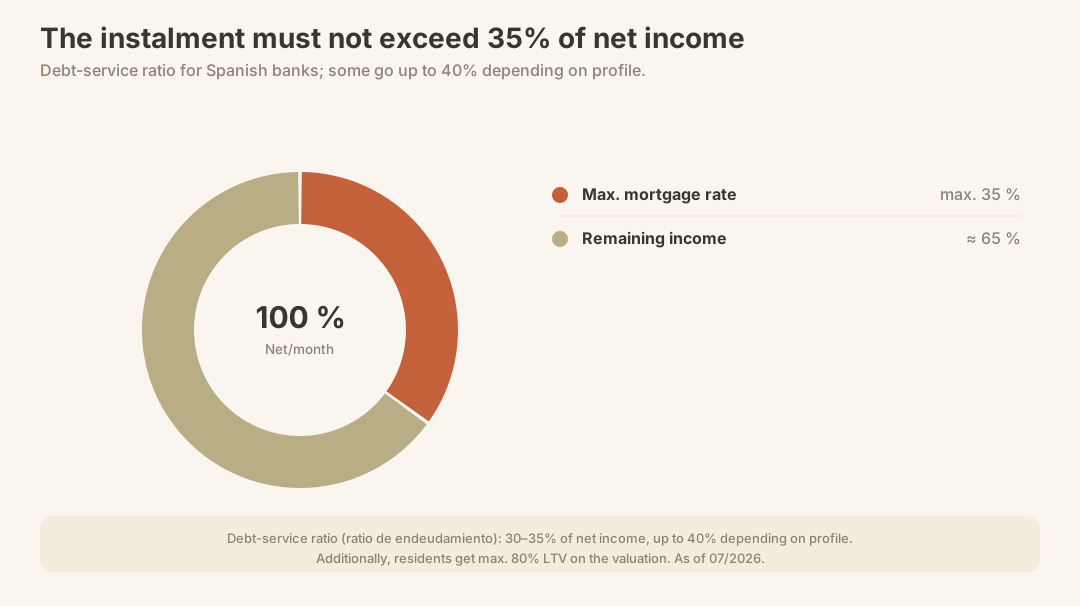
1. Debt-service ratio (ratio de endeudamiento): The monthly mortgage repayment — plus all other loan obligations — should generally not exceed 30–35 % of monthly net income. Some banks will go up to 40 % depending on your profile.
2. Loan-to-Value (LTV): The ratio of the loan amount to the valuation value — a maximum of 80 % for residents as the standard limit.
Borrowing capacity example:
| Monthly net income | Max. monthly repayment (35 %) | Possible loan (30 yrs., 3.5 % interest, indicative) |
|---|---|---|
| 3.000 € | 1.050 € | approx. 230.000 € |
| 5.000 € | 1.750 € | approx. 385.000 € |
| 8.000 € | 2.800 € | approx. 615.000 € |
Please note: These figures are indicative values. The actual decision is made by each bank based on its own risk model, your professional profile, your credit history, and the property itself. Have your situation calculated by an independent mortgage broker.
Mortgage and taxes as a resident
As a tax resident in Spain, the mortgage also affects your tax situation — in both directions.
- IRPF (income tax): The former national tax deductibility of mortgage interest for a primary residence was abolished for contracts concluded after 2013. However, some Comunidades Autónomas still offer regional supplementary deductions — consult a local tax adviser for details.
- IBI (property tax): As an owner you pay the municipal property tax annually, regardless of the mortgage. Further details can be found in the guide on IBI Tax Spain.
- Imputed income / Imputación de rentas: For a property not used as your primary residence, a notional income tax applies as a resident — relevant if you buy but do not move in yourself.
- Wealth tax: Above certain thresholds, the property value is subject to the Balearic wealth tax — more on this in the guide Wealth Tax Spain.
Mortgage broker or direct bank — which is worth it?
In Spain there are regulated mortgage brokers (intermediarios de crédito inmobiliario) who must be registered with the Banco de España. They negotiate with several banks simultaneously and can often secure better terms than a direct application — particularly if your profile is not entirely "standard" (self-employed, mixed income sources, income from abroad).
When a broker is especially worthwhile:
- You have income from multiple sources
- You have only recently become tax resident in Spain
- You are looking for a property in the upper price segment
- You want to compare banks without submitting multiple applications yourself
Please note: Make sure the broker is listed with the Registro del Banco de España. The fee can be agreed on a success basis or as a fixed retainer — ask for written confirmation of this in advance.
Most common mistakes when taking out a mortgage in Spain
1. Underestimating the equity required Planning only for the 20% gap while forgetting the additional purchase costs is the classic mistake number one. Budget at least 30–32% of the purchase price as liquid reserves.
2. Signing a reservation agreement without prior approval A reservation contract (contrato de arras) is legally binding. Anyone who subsequently fails to secure financing will typically forfeit their deposit.
3. Valuation value ≠ purchase price The bank finances 80% of the valuation value — not the purchase price. If the purchase price exceeds the valuation value, you will need to make up the difference out of your own pocket.
4. Choosing too short a loan term A shorter term saves on interest but increases the monthly repayment and therefore the debt service ratio. This can jeopardise approval.
5. Not checking your credit report Existing entries in the CIRBE or negative records can block your application. Check your status before applying.
6. Signing tied products without thinking them through Banks often offer lower interest rates in exchange for taking out insurance policies or savings plans. Work out whether the package is genuinely cheaper overall than a higher interest rate with no tied products.
What comes after the mortgage?
Once the escritura de compraventa has been signed and the land registry entry has been made, you are the owner — but a number of obligations kick in immediately:
- Home insurance: Banks typically require buildings insurance of at least the reinstatement value as a condition of the mortgage. You can find more details in the guide Home Insurance Spain.
- Check the land registry: After registration in the Registro de la Propiedad, you should verify that the entry is correct — more on this in the guide Checking the Land Registry in Spain.
- IBI and other ongoing taxes: Property tax liability begins from the date of transfer.
- Energy certificate: If not already in place, it is compulsory for occupied properties — more on this in the guide Energy Certificate Spain.
Checklist: Hipoteca residentes España
- Tax residence in Spain confirmed (Empadronamiento + IRPF)
- NIE obtained and up to date
- Equity fully calculated (20% of purchase price + additional costs)
- Debt service ratio below 35% of net income
- Documents fully compiled (payslips, tax assessment, bank statements)
- Credit report (CIRBE) checked in advance
- At least 3 bank offers obtained or a mortgage broker engaged
- Valuation value known and compared with the purchase price
- FEIN (European Standardised Information Sheet) received and reflection period used
- Notary coordinated for both the mortgage deed and the purchase deed
- Land registry entry checked after completion
Conclusion
The hipoteca residentes España is one of the most powerful financing instruments for purchasing property in Spain — particularly when compared to the more restrictive conditions available to non-residents. Up to 80 % financing, more favourable interest rates, and less documentation make a genuine difference. What is crucial, however, is realistic planning: anyone who overlooks the ancillary costs or underestimates the difference between the purchase price and the valuation figure is in for a nasty surprise shortly before the notary appointment. With a solid set of documents, a preliminary credit check, and ideally the support of an independent estate agent, you can navigate the process with confidence.
Official sources
- Banco de España — Register of authorised mortgage brokers (intermediarios de crédito inmobiliario), Euribor data, CIRBE: bde.es
- Ley 5/2019, de 15 de marzo, reguladora de los contratos de crédito inmobiliario (BOE-A-2019-3814): boe.es
- ATIB — Agència Tributària de les Illes Balears (ITP, AJD Balearic): atib.es
- Registro de la Propiedad — Land registry search and registration: registradores.org
- Agencia Estatal de Administración Tributaria (AEAT) — IRPF, residency status: sede.agenciatributaria.gob.es
Older mortgages: reclaiming arrangement costs
The allocation of costs when taking out a new mortgage is a different matter from reclaiming costs paid previously. In older agreements, clauses requiring the borrower to pay all arrangement costs may be invalid. Whether you have a claim for a refund, and for how much, depends on the agreement, the items paid for and the individual circumstances. The current allocation under Ley 5/2019 cannot be applied across the board to earlier agreements.
If you want an older mortgage assessed, have the mortgage deed and invoices and proof of payment for the notary, Land Registry, gestoría and valuation ready. Compare these documents with the costs clause and address any potential claim to the bank concerned. A payout is not guaranteed just because other customers of the same bank have received refunds.
Note: This is not legal or tax advice. Have your entitlement, the amount you may be able to claim and any applicable deadlines assessed for your particular agreement.