
Where to buy property in Mallorca? The eight regions compared by price
Where you should buy a property on Mallorca depends less on island clichés than on hard figures: price per square metre, density of rental licences, building quality and buyer profile differ considerably between the island's eight regions. The southwest around Calvià and Andratx is the most expensive and most internationally marketed axis; the island's centre (Pla) offers the lowest price per square metre with a central location. This guide classifies the eight regions by population, price level, holiday-rental licences and typical investor profile – so that your choice of location is based on data, not gut feeling. At the end you'll find a checklist to help you narrow down the region before you even plan a viewing.
- Purchase-related costs on Mallorca in detail
- Download the free 2026 property market report (PDF) — all figures and regional profiles in detail
Eight regions at a glance: structure and prices
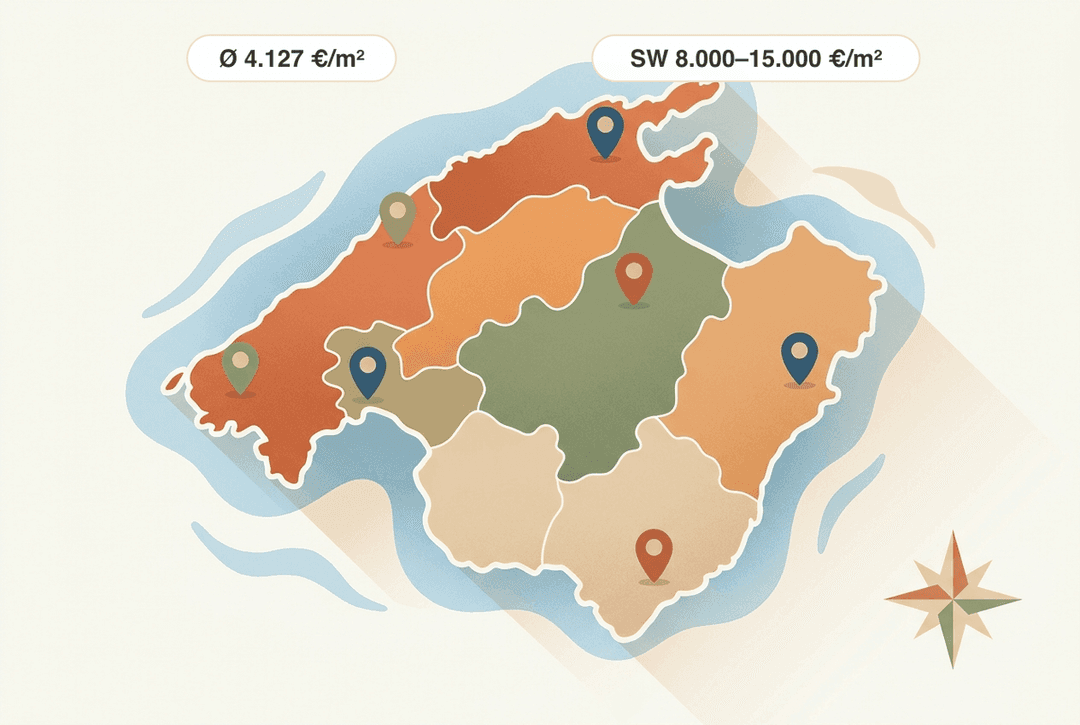
Mallorca's 53 municipalities can be grouped into eight sub-regions, which differ significantly in population density, building quality and demand structure. Palma city and the neighbouring municipality of Marratxí form, with around 475,000 inhabitants, the only region with a genuine year-round urban economy; at the other end is the island's centre (Pla), with 23 predominantly rural municipalities and the lowest price per square metre on the island.
| Region | Municipalities | Inhabitants | Profile | Investor profile |
|---|---|---|---|---|
| Palma (city + Marratxí) | 2 | 475.208 | Urban economy, urban premium | Core – highest liquidity |
| Southwest (Calvià, Andratx) | 5 | 68.979 | International premium locations | Lifestyle core – owner-occupation with liquidity |
| North (Pollença, Alcúdia) | 6 | 80.017 | Bays, tourism focus | Yield – highest licence density |
| Northwest / Tramuntana | 7 | 30.509 | UNESCO World Heritage, heritage character | Legacy – low turnover |
| Northeast (Cala Ratjada, Artà) | 3 | 34.181 | Rural premium locations | Yield + lifestyle |
| East (Manacor, Felanitx) | 3 | 77.530 | Existing property stock | Value-add – renovation potential |
| South (Santanyí, Llucmajor) | 4 | 71.302 | Newer building stock | Lifestyle core |
| Island centre / Pla | 23 | 122.544 | Wine corridor, traditional Mallorca | Value-add – lowest price per m² |
When it comes to the pure price per square metre, different sources deliver different figures because they measure asking prices rather than actual sale prices, or cover different time periods. They should therefore be read side by side, not added together.
| Indicator | Source | Value |
|---|---|---|
| Existing properties Balearics (sale) | Spanish Land Registry, Q4 2025 | 4,127 €/m² |
| Existing properties Palma city | Spanish Land Registry, Q4 2025 | 4,086 €/m² |
| Houses Mallorca (asking) | Engel & Völkers, as of June 2026 | approx. 4,700 €/m² |
| Apartments Mallorca (asking) | Engel & Völkers, as of June 2026 | approx. 5,000-5,400 €/m² |
| Premium properties Southwest (Andratx, Santa Ponsa, Portals) | Industry analysis | 8,000-15,000 €/m², luxury properties above that |
Note: Experience shows that asking prices tend to be higher than actual sale prices. For a reliable assessment of your specific property, it's always worth checking current notary and land registry data for the relevant municipality.
Palma and Marratxí: the city economy with the highest liquidity
Palma city has around 416,000 inhabitants; together with Marratxí the region reaches 475,208 – a good half of the island's population. It is the only Mallorca region with a genuine year-round economy: port, university hospital, international school clusters and a direct-flight hub. Premium locations are found in Son Vida, El Terreno, La Bonanova, Génova, Cala Major and the old town around the Catedral.
The buying argument is the island's highest liquidity and the shortest time-to-sale on resale. However, anyone seeking the rural Mallorca image – fincas, olive groves, tranquillity – is buying in the wrong place in Palma city; the east or the island's centre are better suited for that.
For families with children of school age, proximity to Palma-Son Vida and Marratxí is additionally relevant, because that is where the island's only German school recognised by the German Central Agency for Schools Abroad (Zentralstelle für das Auslandsschulwesen) is located – a factor that tends to make locations within commuting range more valuable than equally priced but more distant ones.
Southwest: Calvià, Andratx and the international premium axis
Calvià, Andratx, Banyalbufar, Estellencs and Puigpunyent form the region with the island's densest international premium marketing. Cluster locations such as Bendinat, Portals Nous and the Son Vida axis concentrate historic Mediterranean building stock, often renovated to a high standard. According to industry analyses, high-quality properties here range between €8,000 and €15,000/m², and considerably higher for properties with direct sea access and sea views.
The buying argument is the island's densest, longest-established buyer structure – international demand and professional marketing have come together here for decades. The risk: the price level is considered already fully stretched, and recent value appreciation has lagged behind the island average. Those buying in the southwest are buying stability rather than upside potential.
The spatial proximity to the yacht harbours Puerto Portals and Port Adriano is an additional structural anchor: the yacht-service infrastructure stabilises demand from capital-strong international buyers independent of local interest rate levels.
North: bays, families and the highest rental density
Pollença, Alcúdia, Muro, Santa Margalida, Sa Pobla and Campanet form the region with the island's highest seasonal rental activity. With 5,326 of a total of 17,034 active holiday-rental licences (as of May 2026), almost one in three of Mallorca's licences is in the north – Pollença is considered the island's densest rental micro-cluster.
| Region | ETV licences (May 2026) | Pool rate in existing stock | Operator concentration |
|---|---|---|---|
| North | 5.326 | 51 % | low (top 10 <15%) |
| South | 2.800 | 53 % | low-medium (15-25%) |
| East | 2.209 | 59 % | low (top 10 <15%) |
| Island centre (Pla) | 2.174 | 48 % | medium (25-35%) |
| Northeast | 1.533 | 49 % | low-medium (15-25%) |
| Northwest / Tramuntana | 1.162 | 28 % | medium-high (35-45%) |
| Southwest | 1.026 | 37 % | high (>45 %) |
| Palma | 804 | 50 % | low (Top 10 <15 %) |
Note: New holiday rental licences for flats have generally been halted since April 2025. Whether an existing licence is transferable on change of ownership is decided case by case and should be legally checked before purchase.
The buying argument in the north is thus the highest licence stock on the island and a realistically achievable rental component. Details on the transferability of an existing licence can be found in the guide to ETV licence transfer.
Northwest / Tramuntana: UNESCO World Heritage status and heritage prices
Sóller, Deià, Valldemossa, Esporles, Bunyola, Escorca and Fornalutx lie within the UNESCO World Heritage Serra de Tramuntana – historic stone houses, olive-tree terraces, artistic tradition (Robert Graves and Joan Miró lived in Deià). It is at the same time the region with the oldest building stock and the lowest pool ratio on the island (28 %), as well as medium to high operator concentration in the rental segment.
The buying argument is a heritage stock that cannot simply be multiplied – a comparable cluster is not documented anywhere else in the western Mediterranean. The risk lies in heritage protection requirements that limit conversion and pool options, as well as renovation costs that are often higher than for comparable properties. Anyone buying here should check the requirements early on – more on this in the guide to Heritage protection and BIC on Mallorca.
Northeast, east and south: between Cala Ratjada, Manacor and Santanyí
These three regions differ significantly in building stock and seasonality, but share a lower entry price level than the southwest or the north.
- Northeast (Artà, Capdepera, Son Servera): combines touristic clusters such as Cala Ratjada and Costa de los Pinos with rural premium locations around the old town of Artà. Cheaper than the southwest with comparable rental volume, but the most pronounced seasonality on the island.
- East (Manacor, Felanitx, Sant Llorenç): with around 49,000 inhabitants, Manacor is the only independent town function outside Palma – with a hospital, industry and the Rafa Nadal Academy. Lower entry prices and the greatest upgrade potential with classic fincas, but renovation costs that are hard to calculate without a local network.
- South (Llucmajor, Campos, Santanyí, Ses Salines): the axis from Sa Ràpita via Es Trenc to Cala Figuera and Cala d'Or has the youngest building stock of all regions – more new-build development over the last three decades than the historic regions. Santanyí is considered a premium cluster with lower renovation needs.
Anyone investing in fincas or rural stock in the east should familiarise themselves beforehand with the rules on land purchase and on finca and suelo rústico.
Island centre (Pla): the most affordable entry with substance
23 central municipalities – including Inca, Binissalem (centre of Mallorcan wine growing with a protected designation of origin), Sineu, Alaró, Algaida and Sencelles – carry the traditional Mallorca identity: fincas, olive trees, almond groves, rural tranquillity combined with central proximity to Palma and the coasts.
The buying argument is the lowest price per square metre on the island combined with a central location. The risk: lower rental suitability, since tourism only occurs on the fringes here – the region is thus better suited to owner-occupation and long-term value appreciation than to short-term yield strategies.
Taxes and ancillary costs: regionally the same, but with different outcomes
Transfer tax (ITP)
Explanation
The taxable base (base imponible) is the value used to calculate the tax: the price stated in the deed or the higher cadastral reference value. Enter the higher value.
Explanation
A main home (vivienda habitual) is the home you normally occupy under Spanish income tax rules. Select a profile only if you meet all its conditions; the calculator checks the value threshold and transaction date.
The general tariff applies without personal tax relief, for example when buying a second home.
- Property transfer tax (ITP) payable
- €25,600.00
Legal status: 14 June 2026
This calculation is provided for guidance only and is not a substitute for tax or legal advice in specific cases.
The property transfer tax (ITP) on the purchase of an existing property applies on a progressive scale across the Balearics and is the same regardless of region – but its effect varies greatly by region due to differing purchase prices.
| Purchase price tier | ITP rate |
|---|---|
| up to €400,000 | 8 % |
| 400.001-600.000 € | 9 % |
| 600.001-1.000.000 € | 10 % |
| over €1,000,000 | 12 % |
| over €2,000,000 | 13 % |
For a €350,000 flat in the centre of the island, the resulting ITP amount is significantly lower than for a comparably taxed million-euro villa in the southwest – the tax rate itself is the same across regions, but the absolute burden scales with the already higher price level of premium locations. The exact, currently applicable rates and possible special regulations can be found in the guide on ITP Balearics 2026; a complete breakdown of all ancillary costs – notary, land registry, lawyer – is provided in the guide on Purchase ancillary costs Mallorca.
Note: In addition to the ITP, the ongoing property tax IBI applies in all regions, the amount of which is set by the respective municipality. Details on this can be found in the guide on IBI tax.
Who buys where: buyer profiles and investment strategy
The share of foreign buyers in the Balearics stood at 31.5 percent in the fourth quarter of 2025 – the highest figure of all Spanish provinces, well above the Spanish average of around 14 percent.
| Metric | Balearics | Spain average |
|---|---|---|
| Foreign buyer share (Q4 2025) | 31,5 % | 14,0 % |
International buyers appear markedly more often with a substantial cash component than local Spanish buyers, who predominantly finance the premium segment via mortgages. This explains why demand and price levels behave so differently by region: in the southwest and in Palma, well-capitalised non-residents set the price floor, while in the east and the centre of the island, local and value-oriented buyers play a bigger role.
The investor profiles from the overview table – Core, Lifestyle-Core, Yield, Legacy, Value-add – are intended as guidance, not as a recommendation. Anyone aiming for returns should additionally check the current figures on Return on investment in Mallorca 2026 and on Zonas Tensionadas / rent price cap before finally settling on a region.
Most common mistakes when choosing a region
- Confusing tourism volume with rental yield. High tourist numbers do not automatically mean high rental income – without a transferable ETV licence, the rental component is completely lost.
- Underestimating heritage protection in the Tramuntana. Regulations limit pool and renovation options; refurbishment costs are often higher than for comparable existing properties.
- Calculating finca renovation costs in the east without a local network. The scope of work is difficult to estimate seriously in advance.
- Buying in the southwest just because "that's what one does". The price level is considered stretched; value appreciation was recently below the island average.
- Forgetting the ITP scale when planning the budget. The marginal tax rate changes noticeably precisely at the price thresholds of €400,000 and €1,000,000.
- Matching pool expectations with the regional housing stock. In the island's centre and in the Tramuntana, the pool ratio is structurally lower than in the south or east.
What comes after the location decision?
Once the region is decided, the actual purchase process follows a fixed legal procedure:
- Property search and viewings in the chosen region
- Reservation contract with a deposit to secure the property
- Legal and urban-planning due diligence by a Spanish lawyer
- Notarisation before a notary and payment of the purchase-related costs
- Registration in the land registry (Registro de la Propiedad)
You'll find a detailed step-by-step plan with deadlines in the guide on Property purchase: process. For legal support – especially for fincas, heritage-protected properties, or purchases via power of attorney from abroad – it's advisable to engage a specialised Lawyer for property purchases early on. Anyone looking for a holiday property with rental intentions should also read the guide on Buying a holiday property.
Checklist: 7 steps to the right region
- Clarify usage: personal use, rental, investment, or a combination.
- Realistically calculate the budget, including the ITP scale and purchase-related costs.
- Match rental intentions with the ETV licence density of the target region.
- Compare building-quality expectations (new build vs. heritage vs. finca) with the regional housing stock.
- Check accessibility to the airport, schools, and doctors for the planned intensity of use.
- Clarify heritage-protection or renovation risks in the Tramuntana and the east in advance.
- Plan for a legal review by a Spanish lawyer before every reservation.
Conclusion
There is no objectively "best" region on Mallorca – only the region that matches your budget, intended use and time horizon. Palma offers the highest liquidity, the Southwest the densest international marketing, the North the highest density of rental licences, the Tramuntana a unique heritage stock, and the East and the island's centre the greatest potential for value appreciation at a lower entry price. Anyone who compares these profiles with their own strategy before the first viewing avoids the most costly mistakes when buying in Mallorca – regional missteps can hardly be corrected later on.
Official sources
- Spanish Land Registry (Colegio de Registradores) — https://www.registradores.org
- Spanish Statistical Institute (INE) — https://www.ine.es
- Balearic Statistics Authority (IBESTAT) — https://ibestat.caib.es
- Bank of Spain (Banco de España) — https://www.bde.es
- Spanish Association of Notaries (Consejo General del Notariado) — https://www.notariado.org
- Agencia Tributaria de las Illes Balears (ATIB, ITP rates) — https://www.atib.es
- Spanish Land Registry Office (Sede Electrónica del Catastro) — https://www.sedecatastro.gob.es
- AENA (Palma Airport data) — https://www.aena.es
- Eurostat — https://ec.europa.eu/eurostat
Mallorca or mainland Spain: where is a seaside holiday home cheaper?
If you are not set on Mallorca, it is worth comparing Spain’s mainland coasts too. More affordable areas to search include parts of Galicia, the coasts of the provinces of Almería and Castellón, and the Region of Murcia. A low provincial average does not, however, mean that a flat right on the beach will be equally affordable: coastal location, condition and features can make a substantial difference to the price.
One example is Cariño in Galicia: in an analysis of Spanish coastal towns, the municipality was named the cheapest place surveyed in May 2026, with an average asking price of €728/m². This is neither a guaranteed purchase price nor a ranking of every coastal town in Spain. Nor does it establish which Balearic island is ‘cheapest’: an affordable town on Mallorca cannot be compared with the average for an entire island.
The choice of a holiday home therefore depends on more than the price per square metre. The coastal setting you want, how easily you can reach it for your stays, the condition of the specific property and your total budget, including purchase costs, all matter. If you are specifically looking on Mallorca, you can start by comparing the property listings on Mallorca with your available budget. A lower purchase price on the mainland, by contrast, is a reason to reconsider your choice of location.