
Finca Suelo Rústico Mallorca: What You May Build, Renovate and Rent Out
Anyone searching Mallorca for a country estate with olive groves, almond groves, and the island's characteristic stone farmhouse will sooner or later inevitably come across the term Finca Suelo Rústico Mallorca — and encounter one of the most complex legal frameworks in Spanish property law. Suelo Rústico (rural land) in the Balearic Islands is not a single uniform concept but an entire system of zones, protection levels, and municipal plans that has evolved over decades and was most recently tightened considerably in spring 2020 by the Decreto Ley 9/2020. This guide explains step by step which minimum plot sizes you need for a new build, where construction is fundamentally prohibited, what the decree means for pool sizes and floor areas, how water rights and tourist licences work — and where the most common pitfalls lie when buying.

Are you planning to purchase a finca on Suelo Rústico and want to know whether the plot has building rights?
- 📩 Submit a personal enquiry — We will check the zoning and connect you with experienced lawyers in Mallorca
- All guides to buying property in Mallorca
What exactly is Suelo Rústico?
In Spain — and therefore in Mallorca — every plot of land is assigned to one of three land categories: urban building land (suelo urbano), developable land (suelo urbanizable), and rural land (suelo rústico). The latter is by definition reserved for agriculture, forestry, or nature conservation and is not generally intended for construction. The fact that hundreds of authentic rural properties nevertheless stand on such land is because some of these buildings have grown up historically — and another portion came into being under the narrow exception rules that Balearic law permits.
The specific classification of a plot in Mallorca is determined by two sets of regulations which together govern permitted use:
- Plan Territorial de Mallorca (PTM) — the overarching spatial planning framework of the Consell Insular de Mallorca, which divides the entire island into zones.
- Plan General d'Ordenació Urbana (PGOU) of the relevant municipality — this gives more detailed effect to the PTM requirements at local level.
Important: Not every municipality has an up-to-date PGOU. Where no local plan exists, the PTM applies directly. In practice, this means that identical plots in different municipalities can have entirely different building rights.
The most important Suelo Rústico categories at a glance
| Category (abbreviation) | Description | Construction permitted? |
|---|---|---|
| Suelo Rústico Común (SRC) | Ordinary arable land, almond/olive groves | Yes, subject to conditions |
| Áreas de Protección Territorial (APT) | Protected areas with special requirements | No |
| Áreas de Interés Natural (ANEI) | Areas of special natural interest | No |
| Áreas de Alta Protección Natural (AANP) | High-protection zones (e.g. Tramuntana core zone) | No |
| Áreas de Transición (AT-C) | Transition zones between nature and settlement | No |
| Áreas Rurales de Interés Paisajístico-B (ARIP-B) | Rural landscape conservation zones Type B | No |
| Áreas de Prevención de Riesgos (SRP-APR) | Risk prevention zones (fire, flooding) | No |
Source: legal-steps.com, bufetefrau.com (Balearic Land Law / PTM)
Minimum plot sizes: when is new construction permitted at all?
The minimum plot size is the first — and often decisive — hurdle. Without meeting this threshold, there is no right to build, regardless of what the seller promises.
| Plot type | Minimum area for new construction |
|---|---|
| Standard Suelo Rústico (Común) | 14.000 m² |
| Landscape conservation zones / forestry land | 50.000 m² |
| ANEI, AANP, APT, AT-C, ARIP-B, SRP-APR | New construction generally prohibited |
Source: legal-steps.com, bufetefrau.com, porta-mallorquina.de
What this means in practice: even on ordinary agricultural land, you need at least 1.4 hectares to legalise a new build. On landscape-protected or forest-adjacent land, this threshold rises to 5 hectares. And across a considerable portion of the island — Natura 2000 areas, the Tramuntana core zone, flood plains, and risk zones — new construction is simply not permitted, regardless of the size of the plot.
Please note: Many plots currently on the market sit just below the 14.000 m² threshold or border protected zones. Always have the zoning classification and the exact plot area as recorded in the Catastro checked by an independent solicitor before signing a reservation agreement. For more detail, see the guide on checking the Land Registry in Spain.
Decreto Ley 9/2020: the tightened rules you need to know
On 25 May 2020, the Balearic Islands enacted the Decreto Ley 9/2020 de medidas urgentes de protección del territorio de las Illes Balears into force. It was the most far-reaching change to rural planning law up to that point, and fundamentally altered the framework conditions for new Finca builds and extensions.
What the decree specifically changed
1. Floor area (Construcción) The decree restricts the permissible floor area for detached houses on Suelo Rústico to a significantly reduced level. Generous Finca complexes with several hundred square metres of living space and numerous outbuildings — the kind that could still be planned before 2020 — are no longer eligible for planning permission on new-build projects.
2. Footprint (Ocupación) The key distinction is between construcción (floor area) and ocupación (the actual built footprint): both figures are now subject to stricter limits. As a practical rule of thumb, the built coverage ratio is generally a maximum of around 2 % of the plot area — exact figures may vary depending on the municipality and zoning.
3. Pools Swimming pools were a standard feature of large rural holiday properties before 2020. The decree significantly restricts the maximum permitted pool size — with the stated aim of conserving water resources and curbing the over-dimensioning of rural properties for tourist use.
Please note: Decreto 9/2020 is expressly aimed at disproportionately large detached houses in rural areas that are effectively used as tourist holiday villas. Anyone purchasing an existing Finca is not initially directly affected by these new-build rules — however, any extension requiring planning permission must be assessed in accordance with the new regulations.
Worked example: new build on 14,000 m² (simplified)
| Parameter | Value (indicative, Suelo Rústico Común) |
|---|---|
| Plot area | 14,000 m² |
| Built coverage (Ocupación) | approx. 2 % = approx. 280 m² |
| Max. floor area (Construcción) | dependent on the local plan; generally well below 280 m² |
| Max. pool volume / area | limited under Decreto 9/2020 (specific m² figures vary by municipality) |
| Building height | generally max. 2 storeys / restricted eaves height |
All figures are indicative and must be verified against the relevant local plan on a case-by-case basis.
What is permitted on Suelo Rústico — and what is not
Alongside residential construction, there are a number of other uses that are permitted, restricted, or prohibited on rural land. The following overview summarises the most practically relevant ones:
| Use | Status on Suelo Rústico Común | Note |
|---|---|---|
| Detached house (new build) | Permitted on ≥ 14.000 m² and subject to zoning compliance | Subject to planning permission; observe Decreto 9/2020 |
| Renovation/refurbishment of existing buildings | Generally permitted | Licence required; volume may not normally be increased |
| Extension of existing buildings | Heavily restricted | Only up to certain thresholds; new rules apply |
| Agricultural use | Permitted | Core purpose of Suelo Rústico |
| Cultivation of olives, almonds, carob | Permitted | No minimum plot size for agricultural activity |
| Ancillary buildings (tractor store, storage) | Permitted with restrictions | Tied to agricultural use |
| Swimming pool (new build) | Permitted with restrictions | Size limited since Decreto 9/2020 |
| Well / water extraction | Subject to planning permission | Water rights to be checked separately (ABAQUA) |
| Solar installation / photovoltaics | Permitted with restrictions | Registration required; see Photovoltaics Mallorca |
| Holiday tourist residential property (ETV licence) | Severely restricted since 2025 | Observe moratorium / Decreto 4/2025 |
| Commercial building, hotel | Prohibited (except with special permit) | Not subject to normal Suelo Rústico regulations |
| Plot subdivision below minimum area | Prohibited | Do not fall below parcela mínima |
For a detailed look at the planning permission process, we recommend the guide Baugenehmigung Mallorca.
Water rights: the underestimated issue when buying a finca
Water is a scarce resource on Mallorca — and in rural areas there is no municipal water supply. Many fincas rely on well water (pozo), cisterns (aljibe), or both. This may sound pragmatic at first, but it is legally complex.
What you need to clarify before buying:
- Is there a registered well? Wells must be registered with the competent water authority (on the Balearen: ABAQUA). Many older wells on Mallorca are not registered or incorrectly registered — this is a legal grey area that should be made transparent during the purchase process. Find out more in the guide Brunnen Mallorca legalisieren.
- Is it groundwater or surface water? Both are subject to different concession regimes.
- Is the water usage registered in the land registry? An unregistered usage can lead to disputes with neighbours or authorities after the purchase.
- How is the pool filled? On many fincas, pool water may not be drawn from the property's own well — a separate concession is required for this.
Please note: The Balearic water authority ABAQUA (Agència Balear de l'Aigua i la Qualitat Ambiental) is the competent body for water rights on the Balearen. Always have the water situation of a finca checked by a lawyer or engineering firm.
Tourist rental (ETV licence) on Suelo Rústico
Many finca buyers dream of renting out the property to tourists during their absence. The legal reality on Mallorca has become considerably more sobering, at the latest since 2025.
The key facts at a glance:
- A ETV licence (Estancias Turísticas en Viviendas) is mandatory.
- The issuing of new ETV licences on Mallorca has been suspended under a moratorium. New licences for fincas on Suelo Rústico are not being granted at present.
- Decreto 4/2025 has tightened restrictions in rural areas further. Existing licences remain tied to the property in principle, but may lapse under certain conditions.
- An estate agent listing featuring the note "ETV licence held" is therefore a significant value driver — but check in the Land Registry and the Conselleria registers whether the licence actually matches the property and its current use.
Warning: Letting for tourist purposes without a valid ETV licence is subject to fines. Find out more at ETV licence Mallorca.
Anyone who does not plan to let on a tourist basis but wishes to let on a long-term basis is unaffected by the ETV restrictions — in that case it is worth consulting the guide Long-term rental Mallorca.
Buying existing buildings: "Habitable" vs. "Uninhabitable"
With existing fincas, the distinction between habitable and uninhabitable buildings is crucial to your purchasing strategy.
| Status | Meaning | Consequence on purchase |
|---|---|---|
| Habitable | Building has a valid residential occupation permit (licencia de primera o segunda ocupación) | Can be occupied immediately; however, renovations must be licensed |
| Uninhabitable / Ruin | No habitable status, or habitable status has lapsed | Restoration requires a permit; new-build rules may apply |
| Legalizado / Alegalizado | Formally legalised / de facto tolerated, but not fully registered | Legal uncertainty; verification is essential |
| Fuera de ordenación | Outside the building regulations, but with protected existing-use status | Maintenance only permitted, no extensions |
The category fuera de ordenación is particularly common with older fincas: the building exists legally thanks to protected existing-use status, but may not be enlarged. Anyone unaware of this who plans to extend the house by 50 m² is in for a nasty surprise when they consult an architect.
You can find more on the subject of non-legalised older buildings in the guide Legalising an Illegal Build in Mallorca.
Renovation and Conversion: What Requires a Building Licence
Wanting to renovate an existing finca in Mallorca sounds more straightforward than building from scratch — but in practice that is not always the case.
The following measures generally require planning permission:
- Structural alterations (removing walls, renewing the roof)
- Increasing the usable floor area (e.g. converting the loft)
- Changes to the façade or external appearance
- Installing a swimming pool or extending an existing one
- Installing an air-conditioning system (depending on the unit — more on this: Installing Air Conditioning in Mallorca)
- Installing a photovoltaic system above a certain output threshold
The following measures can generally be carried out without a full licence:
- Pure interior decoration (paint, flooring, furniture)
- Minor repairs involving no structural work
Please note: On Suelo Rústico, a licensed architect must be involved for virtually all construction work that goes beyond simple maintenance. This is not a recommendation — it is a legal requirement.
The Purchase Process: Finca-Specific Considerations
The general procedure for buying a property in Mallorca also applies to fincas — but there are several rural particularities you should be aware of. A complete overview is provided in the guide Property Purchase Process.
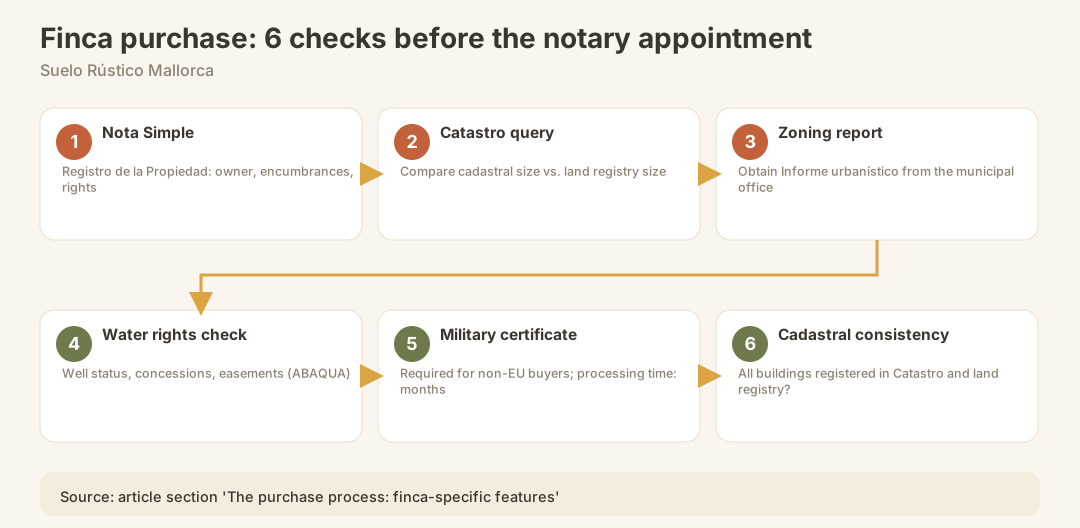
Additional checks for finca purchases on Suelo Rústico:
- Nota Simple from the Registro de la Propiedad — verifies the chain of ownership, encumbrances and registered rights
- Catastro enquiry — comparison of the cadastral size with the land registry size (discrepancies are common with fincas)
- Zoning report (Informe urbanístico) — from the relevant municipal office or Consell de Mallorca; it takes time but is indispensable
- Water rights assessment — well status, concessions, rights of way (servidumbres)
- Military certificate for non-EU buyers — rural plots may fall within border zones; non-EU nationals require authorisation from the Ministry of Defence (Autorización Militar)
- Cadastral consistency — Are all buildings registered in the Catastro and in the land registry? Anything missing does not legally exist
Tip: Have an independent solicitor carry out a due diligence review before signing the reservation contract. The cost is marginal relative to the purchase price of a finca — the risk of skipping it is not. There is a dedicated guide on the Reservierungsvertrag Spanien.
Additional purchase costs for fincas on Suelo Rústico
For existing fincas (resale), Impuesto sobre Transmisiones Patrimoniales (ITP) applies — the Balearic property transfer tax. It is banded and varies depending on the purchase price. Current figures from the Agència Tributària de les Illes Balears (ATIB) should be checked shortly before purchase, as rates and thresholds may be adjusted. A complete overview of all additional costs is provided in the guide Kaufnebenkosten Mallorca.
Typical cost items when buying a finca (indicative figures):
| Cost item | Indicative figure |
|---|---|
| ITP (property transfer tax, Balearen) | banded according to purchase price; check current rates with ATIB |
| Notary fees | approx. 0,5–1 % of the purchase price |
| Land registry entry | approx. 0,1–0,5 % |
| Legal fees (recommended) | approx. 1 % |
| Urban planning assessment / Due Diligence | depending on scope, a few hundred to a few thousand euros |
| Mortgage (if financed) | Bank fees + valuation costs; see Hypothek Mallorca |
Most common mistakes when buying a Finca on Suelo Rústico
The same mistakes come up time and again in practice:
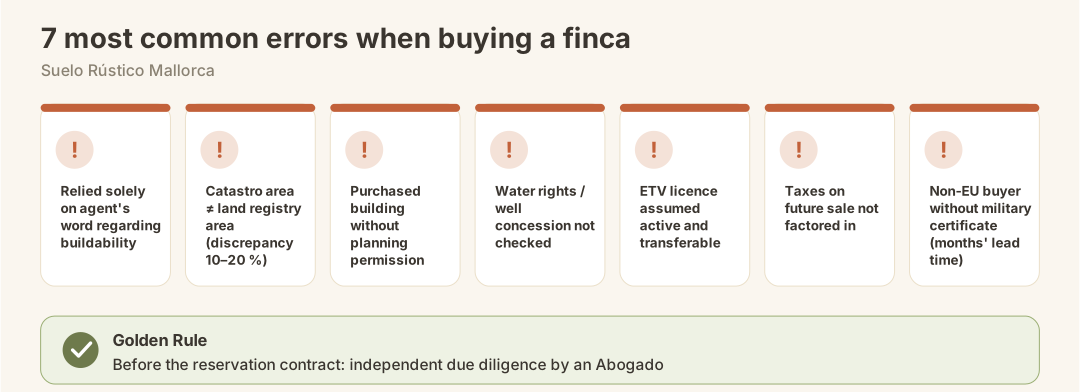
Relying on estate agent assurances regarding planning permission — without an independent legal assessment. Agents are not planners; the planning authority decides, not the brochure.
Catastro area ≠ land registry area ≠ actual area — Discrepancies of 10–20 % are not uncommon with older Fincas. What is missing from the land registry has, in case of doubt, no protected existing-use status.
Buying a building without planning permission — "It has always been like this" offers no protection. Buildings without a valid licence can become a problem when planning renovations, because the authority reviews the entire existing structure.
Water rights not checked — A well without a valid concession is not a given. In the worst case, you will have to have water delivered by tanker.
Assuming an ETV licence is guaranteed — Listings stating "ETV licence in place" are tempting, but you must verify whether the licence is still active, transferable, and tied to the property.
Taxes on a future sale not factored in — Anyone who sells a Finca after a few years will pay Plusvalía and capital gains tax. More on this: Steuern beim Immobilienverkauf Spanien.
Non-EU buyers without a military certificate — The Autorización Militar is not a mere formality; it takes several months and must be applied for well in advance.
What comes after the purchase?
The purchase has been completed — here is what to do next:
- Land registry entry (Registro de la Propiedad): Takes place after signing the escritura at the notary; allow sufficient time to follow up on the registration.
- Catastro re-registration: Must be applied for separately at the Catastro so that the property tax (IBI) is issued in your name going forward. More on the IBI Steuer Spanien.
- Utility contracts (electricity, water): transfer to your name.
- Contents insurance: There are particular considerations on Suelo Rústico — fire risk from vegetation is a real factor. See also: Contents insurance in Spain.
- Architect's brief for renovation/conversion: If works are planned, start the process immediately — waiting times with architects and authorities on Mallorca are lengthy.
- Energy certificate: Already required at the point of purchase; it must be renewed after renovation. Details: Energy certificate Spain.
Checklist: buying a Finca on Suelo Rústico in Mallorca
- Have the zoning under the PTM and the municipality's PGOU checked
- Verify the minimum plot size (14.000 m² or 50.000 m²)
- Check the Land Registry (Nota Simple) for encumbrances, easements and entries
- Clarify any discrepancies between the Catastro, the Land Registry and the actual plot area
- Check the legal building status of all structures (habitable / fuera de ordenación / ilegal)
- Enquire about water rights and well status with ABAQUA
- Check ETV licence status (if holiday letting is planned)
- Apply for the military certificate in good time for non-EU buyers
- Obtain a planning report (Informe urbanístico)
- Instruct a lawyer (Abogado) for due diligence
- Calculate all purchase costs in full (ITP, notary, Land Registry, lawyer)
- Compare the renovation budget against the current building regulations (Decreto 9/2020)
Conclusion
Buying a Finca on Suelo Rústico is one of the most rewarding — and at the same time one of the most legally complex — property decisions you can make on Mallorca. The combination of Balearic planning law, municipal development plans, water rights, existing-use protection and tourist licence regulations makes it virtually impossible to rely solely on an agent's assurances. What you genuinely need is: an independent legal opinion on buildability, a thorough review of the water situation, and an architect with experience of rural Mallorca. When all the groundwork has been done properly, a Finca on Suelo Rústico ranks among the most enduring and characterful properties the island has to offer.
Official sources
- Plan Territorial de Mallorca (PTM) — Consell de Mallorca, Departament de Territori: https://www.conselldemallorca.cat/ca/web/territori/planificacio-territorial
- Decreto Ley 9/2020 de medidas urgentes de protección del territorio de las Illes Balears — Govern de les Illes Balears / BOIB: https://www.caib.es/eboibfront/ca/2020/11162/624432/decret-llei-9-2020-de-25-de-maig-de-mesures-urgent
- Agència Tributària de les Illes Balears (ATIB) — Property Transfer Tax ITP, current rates: https://www.atib.es
- ABAQUA — Agència Balear de l'Aigua i la Qualitat Ambiental — Water rights and well permits: https://www.caib.es/sites/abaqua
- Registro de la Propiedad — Retrieve a Nota Simple online: https://www.registradores.org
- Sede Electrónica del Catastro — Cadastre information: https://www.sedecatastro.gob.es
- Conselleria de Medi Ambient i Territori (Govern Balear) — ETV licences, Decreto 4/2025: https://www.caib.es/govern/organigrama/area.do?lang=ca&coduo=4690262