
Accounting as an Autónomo in Spain: Obligations, Deadlines and Software 2026
Anyone setting up as an autónomo in Spain doesn't swap German bureaucratic stress for freedom – they swap it for a different rhythm: four quarters, four deadlines, two types of tax, one fixed calendar. The good news is that the accounting obligations for most self-employed people are manageable. As long as you invoice less than €600,000 per year, a simplified income-expenditure statement is sufficient – no Spanish chart of accounts, no balance sheet. In this guide you'll learn which modelos you need to submit and when, how the Estimación Directa works, which costs are deductible, what software options are available, and where the most common mistakes occur – with concrete figures, deadlines and contact details.

Do you already know whether your expenses are recorded correctly – and whether you're making use of all your allowances?
- 📩 Submit a personal enquiry — Have your accounting situation reviewed by an expert
- Everything about the Cuota Autónomo and current contribution rates
What an autónomo actually needs to do in terms of accounting
Spanish tax law draws a clear distinction between commercial companies (e.g. a Sociedad Limitada) and natural persons operating in their own name. As an autónomo you are a natural person – and that simplifies many things. As long as your annual turnover is below €600,000, you are not required to maintain full financial accounting in accordance with the Spanish Plan General Contable (PGC) or to produce balance sheets. Instead, a simplified profit calculation is sufficient: income minus deductible expenditure.
What you must, however, document without gaps:
- All outgoing invoices (Facturas emitidas) – with sequential numbering, date, NIF of the recipient, amount and IVA rate
- All incoming invoices (Facturas recibidas) – deductible business expenses only
- IVA register (Libro de IVA) for input and output transactions
- IRPF withholding register (Libro de retenciones), if you issue invoices with IRPF withheld
These records form the basis for all quarterly and annual returns. Without them you risk significant penalties in the event of an inspection (Inspección) by the Agencia Tributaria.
The two taxes that affect you as an autónomo
As an autónomo you are primarily confronted with two types of tax: income tax (IRPF) and value added tax (IVA). In addition there is the monthly social security obligation, which is not, however, a tax form.
| Tax | Spanish term | Relevant for |
|---|---|---|
| Income tax | IRPF – Impuesto sobre la Renta de las Personas Físicas | All autónomos |
| Value added tax | IVA – Impuesto sobre el Valor Añadido | Most activities (exceptions: e.g. certain healthcare professions, education) |
| Social security | Cuota RETA | Compulsory contribution, no form required at Hacienda |
For certain activities – such as rental income, capital gains or income from abroad – additional declaration obligations apply. Anyone operating globally should also keep an eye on the Modelo 720 .
Estimación Directa Simplificada: the standard system for most people
By far the most common method of calculating profit for autónomos is the Estimación Directa Simplificada (simplified direct method). It applies automatically to everyone who invoices less than 600,000 euros per year and has not explicitly opted for a different method.
The principle is straightforward: you add up all income for the quarter, deduct the allowable business expenses, and arrive at your provisional profit. On this amount you make a flat 20% IRPF advance payment – this percentage is set by law and cannot be adjusted individually.
Alternatively, there are:
- Estimación Directa Normal – compulsory from 600,000 euros annual turnover, full bookkeeping in accordance with the PGC required
- Estimación Objetiva (Módulos) – flat-rate calculation based on objective factors (number of employees, square metres, etc.), permitted only for certain activities; increasingly being restricted
For the vast majority of German-speaking self-employed people on Mallorca – freelancers, consultants, tradespeople, designers – the Estimación Directa Simplificada is the right and simplest route.
The quarterly calendar: deadlines, modelos and consequences
The cornerstone of the bookkeeping obligation as an autónomo is the quarterly cycle. Two forms dominate: the Modelo 130 for the IRPF advance payment and the Modelo 303 for the IVA return. Both are submitted for the same quarter – always by the 20th of the month following the quarter (or the 15th if using direct debit).
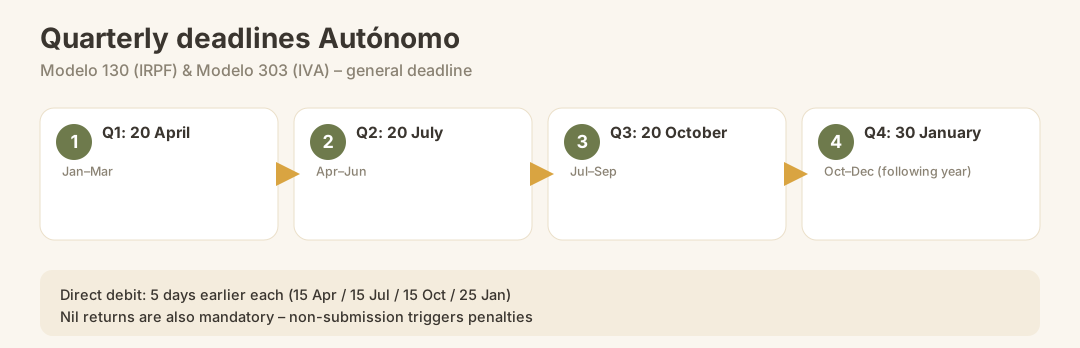
| Quarter | Period | Submission deadline (general) | Deadline for direct debit |
|---|---|---|---|
| Q1 | January – March | 20 April | 15 April |
| Q2 | April – June | 20 July | 15 July |
| Q3 | July – September | 20 October | 15 October |
| Q4 | October – December | 30 January (following year) | 25 January |
Please note: If the 20th falls on a weekend or public holiday, the deadline shifts to the next working day. Even so, it is advisable to allow a buffer of several days — technical problems on the AEAT platform are not uncommon.
A late Modelo 130 or 303 automatically triggers a surcharge (Recargo). Anyone who fails to file at all risks a full assessment by the authorities and significantly higher penalties.
Modelo 130: IRPF Advance Payment Step by Step
The Modelo 130 is the key document for the quarterly income tax advance payment. It is completed on a cumulative basis: in the second quarter you do not enter only the April–June figures, but the total income and expenditure from January to June — minus whatever you already paid in the first quarter.
The process in detail:
- Add up all income (net, excluding IVA) received so far in the current year
- Add up all deductible business expenses (net, excluding IVA) incurred so far in the current year
- Calculate the difference = provisional profit to date
- Calculate 20 % of this = cumulative IRPF liability
- Deduct amounts already paid in previous quarters
- Result = current payment due (may also be zero if previous quarters have already covered more than enough)
- In addition: offset any IRPF withheld from invoices (retenciones) against the amount due, where applicable
The advance payments made are offset against the final income tax (Modelo 100) at the end of the year. Anyone who has overpaid will receive a refund – anyone who has underpaid must make an additional payment.
Modelo 303: IVA returns and what many people underestimate
The Modelo 303 is the quarterly VAT return. The principle: you take the IVA you have charged on your invoices (IVA repercutido), minus the IVA you have paid yourself on business expenses (IVA soportado). The balance goes to the Hacienda – or comes back to you.
| IVA rate | Typical use cases |
|---|---|
| 21 % | Standard rate – most services and goods |
| 10 % | Food (certain items), catering, accommodation |
| 4 % | Basic foodstuffs, books, certain medicines |
| 0 % | Intra-community supplies (B2B EU) under certain conditions |
If you provide services exclusively for private clients outside the EU or for IVA-exempt activities, you must still submit the Modelo 303 – in that case as a nil return.
Important for anyone who works extensively with EU business clients: as soon as you provide intra-community services, you are additionally required to submit the recapitulative statement (Modelo 349). This is also submitted on a quarterly basis.
What you can deduct as a business expense
This is often an area of untapped potential – and at the same time a minefield for incorrectly recorded expenses. The basic rule: an expense is deductible if it is necessary for business purposes and supported by documentation. The Hacienda may request proof if in doubt.
| Expense category | Deductibility | Notes |
|---|---|---|
| Office supplies, software, hardware | In full | Pro rata where there is mixed use |
| Travel costs (business) | Partial / in full | Clear documentation of business purpose required |
| Telephone costs | Proportional (50 % is standard for mixed personal/business use) | Individual receipts recommended |
| Cuota RETA (social security contributions) | In full | Direct deduction as a business expense |
| Gestoría/tax adviser fees | In full | Also applicable retrospectively for the year of establishment |
| Entertainment and representation costs | Limited deductibility | Proof of business connection required |
| Home office (proportional rent/electricity) | Proportional – complex | Requirement: property registered as place of work |
| Further training, specialist literature | In full | Relevance to the sector must be clearly demonstrable |
The Cuota RETA – i.e. your monthly social security contribution – is one of the few expenses you can deduct in full without any argument. In the first year with the Tarifa Plana, the Cuota amounts to 88,64 euros per month; from the second year onwards it rises depending on your actual net profit to amounts of between around 200 and 607 euros per month.
Annual tax return: Modelo 100 by 30 June
The quarterly advance payments are merely instalments on account. The final settlement follows with the Modelo 100, the annual income tax return (Declaración de la Renta). It covers all income from the previous year – not just self-employed activity, but also rental income, capital gains, pension receipts, and other sources.
Key facts:
- Submission period: Typically April to 30 June of the following year
- Submission: Online via the Agencia Tributaria portal (using a Certificado Digital or Cl@ve PIN)
- Offsetting: All Modelo 130 payments made, as well as withheld retenciones, are credited against the final liability
- Result: Either a supplementary payment (a ingresar) or a refund (a devolver)
The actual IRPF tax rate is progressive and depends on total income – the flat 20 % paid in advance may therefore have been too much or too little. Anyone making use of the Beckham Law is subject to a different taxation system and files the Modelo 151 instead of the Modelo 100.
Software and Tools: What Autónomos in Spain Use
A structured filing system and a simple bookkeeping tool will save you and your Gestoría a great deal of work – and therefore costs. As an Autónomo under the Estimación Directa Simplificada, you do not need full accounting software to German standards.
| Tool / Service | Focus | Notable Feature |
|---|---|---|
| Xolo Spain | Autónomos with international clients | All-in-one: invoicing, tax filings, compliance |
| Holded | SMEs and Autónomos in Spain | Invoicing, bookkeeping, CRM in Spanish |
| Quipu | Autónomos and small businesses | Automatic form generation (Mod. 130, 303) |
| Contasimple | Beginners / straightforward activities | Affordable, tailored to Spanish obligations |
| Excel / Google Sheets | Very straightforward activities | Only practical for a small number of transactions; Gestoría checks manually |
Note: The obligation for electronic invoicing (Facturación Electrónica) was newly regulated by Real Decreto 238/2026 of 25 March 2026. Mandatory e-invoicing requirements for Autónomos issuing B2B invoices are coming in the foreseeable future. Keep your software up to date in this regard – or ask your Gestoría about the current implementation status.
Anyone who does not yet have a Spanish bank account should sort this out before their first quarterly payment – opening a bank account in Spain is generally straightforward, but time-sensitive.
Gestoría or DIY? An honest assessment
Technically, you can file all Modelos yourself – provided you have a Certificado Digital and are familiar with the AEAT platform. In practice, most Autónomos engage a Gestoría, if only because the costs are tax-deductible.
| Scenario | Self-managing feasible? | Gestoría recommended? |
|---|---|---|
| Freelancer, 1–2 clients, homogeneous activity | Yes, with good software | Optional |
| Mixed income sources (rental + self-employment) | Laborious | Yes |
| International invoices / EU clients | Complex (Mod. 349) | Yes |
| Employees or subcontractors | Very complex | Absolutely |
| First time becoming self-employed in Spain | Steep learning curve | Recommended |
Typical Gestoría costs for ongoing bookkeeping for a straightforward Autónomo are around 50 to 100 Euro per month. The annual tax return is usually charged separately on top of this. Highly complex cases cost correspondingly more.
Most common bookkeeping mistakes as an Autónomo
These mistakes crop up regularly at Gestoríen and tax advisers – and all of them are avoidable:
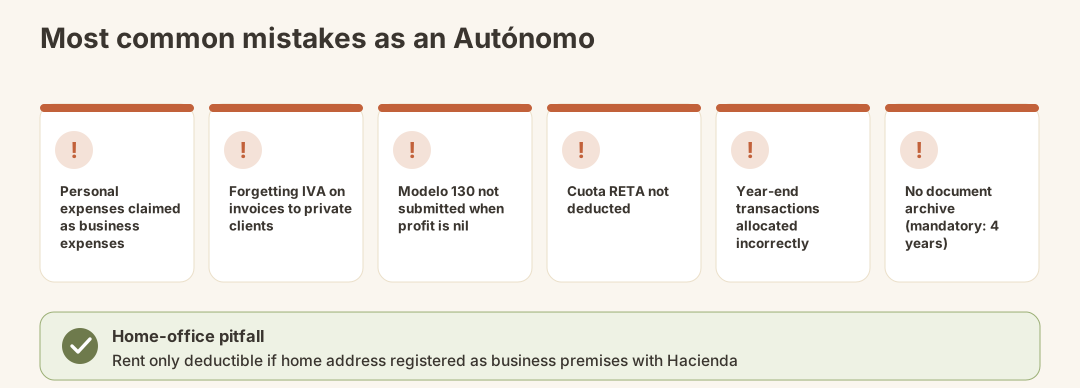
- Personal expenses recorded as business expenses – a classic audit risk. The Hacienda is entitled to request every receipt.
- Forgetting IVA on invoices to private clients – anyone who does not show IVA on their invoices must still calculate it out of the income received and remit it.
- Modelo 130 not submitted because profit was zero – even nil returns are mandatory; failing to submit triggers automatic penalties.
- Cuota RETA not recorded as a business expense – by doing so you are giving away a fully deductible amount.
- Year-end bookings mixed up – services rendered and payments received must be allocated to the correct tax year.
- No receipt archive – invoices must be retained in Spain for at least four years; digital storage is permitted provided the authenticity of the originals is guaranteed.
- Home-office costs without correct registration – anyone wishing to deduct a proportional share of rent must have registered their home address with the Hacienda as a place of business.
What comes next? Overview of annual filings
In addition to the quarterly filings, there are further annual obligations that catch many people off guard:
| Filing | Form | Deadline (approximate) | Content |
|---|---|---|---|
| Annual income tax return | Modelo 100 | April–30 June | Total income for the previous year |
| Annual IVA summary | Modelo 390 | 30 January | Summary of all IVA quarters |
| Client list from €3.005,06 upwards | Modelo 347 | February | Clients/suppliers above this threshold |
| Assets held abroad | Modelo 720 | 31 March | When assets held abroad exceed €50,000 |
| Intra-Community transactions | Modelo 349 | Quarterly (monthly if applicable) | B2B transactions with EU countries |
Modelo 347 is often overlooked: anyone who invoiced a single customer or supplier more than €3,005.06 in a year must report this in February of the following year. Omitting it risks penalties.
Checklist: Bookkeeping as an Autónomo – the essentials at a glance
- NIE, NIF and RETA registration are complete
- Certificado Digital is active (for online submissions to the AEAT)
- Activity registered with the Hacienda (Modelo 036 or 037)
- IVA records (Libro de IVA) are kept up to date
- All outgoing invoices contain the full mandatory details including IVA
- All incoming invoices are kept as originals (for at least 4 years)
- Quarterly deadlines in the calendar: 20 April, 20 July, 20 October, 30 January
- Modelo 130 is submitted even when profit is zero
- Modelo 303 is submitted even when the IVA balance is zero
- Cuota RETA is recorded as a business expense
- Gestoría has been briefed or software has been configured
- Modelo 100 (Renta) planned for submission by 30 June of the following year
Conclusion: Bookkeeping as an Autónomo is no dark art – but it does require discipline
The bookkeeping obligations for an Autónomo in Spain are, by international standards, perfectly manageable: no mandatory balance sheet, no full financial accounting, a straightforward calendar with four quarterly filings per year. The decisive factor is not complexity, but consistency – anyone who misses deadlines or fails to keep receipts ends up paying unnecessary penalties.
For those starting out in Spain, engaging a Gestoría for the first year or two is a worthwhile investment: the costs are modest and tax-deductible, and the margin for error drops considerably. After that, good software lets you handle many tasks yourself. Anyone who also receives pension income, rental income or international earnings should seek ongoing professional support – because tax interactions arise that are far from obvious. You can find more on the broader tax context in the overview article Taxes as a Resident (IRPF).
Official sources
- Agencia Tributaria (AEAT) – central tax authority, forms and submissions: https://www.agenciatributaria.es
- Modelo 130 – quarterly IRPF advance payment: https://sede.agenciatributaria.gob.es/Sede/procedimientoini/G322.shtml
- Modelo 303 – quarterly IVA declaration: https://sede.agenciatributaria.gob.es/Sede/iva/modelo-303.html
- Modelo 100 – annual income tax return (Renta): https://sede.agenciatributaria.gob.es/Sede/irpf/renta.html
- Tesorería General de la Seguridad Social (TGSS) – RETA registration and contributions: https://www.seg-social.es
- Real Decreto-ley 16/2025 and RDL 3/2026 – freeze on autónomo contribution rates for 2026 (BOE): https://www.boe.es
- Real Decreto 238/2026 of 25 March 2026 – electronic invoicing (e-Factura): https://www.boe.es
- ICAC – Instituto de Contabilidad y Auditoría de Cuentas – accounting regulations: https://www.icac.gob.es