
Renewing your driving licence in Spain: Psicotécnico, deadlines and costs
If you want to renew your driving licence in Spain, there's one thing you need to know above all: it's not about a new test, but about a medical certificate – the so-called Psicotécnico. This applies to everyone who already holds a Spanish permiso de conducir (either from the start or after exchanging a foreign driving licence). This guide explains how long your Spanish driving licence is valid for, when you need to have the medical assessment done, how the process at the Centro de Reconocimiento de Conductores works, what it costs and which special rules apply from age 65 and 70. By the end, you'll know whether you need to act immediately or still have time.

- Transferring a driving licence in Spain — If you don't yet have a Spanish driving licence, this is where the first step begins
Renewal or exchange? The difference matters
The two terms are constantly confused in forums, but at the DGT (Dirección General de Tráfico) they refer to completely different procedures. With the exchange (canje), you convert a foreign driving licence – for example your German one – into a Spanish one for the first time. With the renewal (renovación), it's about renewing an already existing Spanish driving licence (or an EU driving licence tied to Spanish residency) before its validity expires.
Note: Once you have your habitual residence in Spain, you can no longer have a foreign driving licence from your home country renewed there. If your German, Austrian or British driving licence expires while you hold Residencia in Spain, you must first go through the exchange (canje) process before a renewal under Spanish law is even possible.
Anyone who ignores this difference risks driving around with an expired document – and in Spain, this counts as driving without a valid licence.
Who has to renew their driving licence in Spain?
In principle, anyone holding a Spanish permiso de conducir whose expiry date is approaching is required to renew it. This applies both to residents born with a Spanish driving licence and to former foreigners who have already exchanged their German or other EU driving licence.
| Situation | Can it be renewed in Spain? |
|---|---|
| Spanish driving licence, resident in Spain | Yes, regular renewal via CRC or DGT |
| Exchanged (formerly German) driving licence, resident in Spain | Yes, like any Spanish driving licence |
| Spanish driving licence, but now resident in another EU country | No, renewal must take place in the country of residence |
| German driving licence (not exchanged), residence in Spain | No, an exchange is required first |
If you haven't yet registered as a resident at all, it's worth first taking a look at the Residencia in Spain and the Empadronamiento on Mallorca, as both dates can be relevant for calculating deadlines.
Validity period: How long is your Permiso de Conducir valid?
The validity period depends on the licence category and your age. In Spain there is no maximum age for driving, but as you get older, the intervals for the medical check become shorter.
| Licence category | Validity up to age 65 | Validity from age 65 |
|---|---|---|
| AM, A1, A2, A, B (car, motorcycle, moped) and Licencias de Conducción | 10 years | 5 years |
| C, C1, D, D1, EC, EC1, ED, ED1 (lorry, bus, professional categories) | 5 years | 3 years |
Please note: If the medical examination reveals an illness or health condition that does not currently mean you're unfit to drive but could worsen over time, the validity period of your new licence may be shortened. In this case, the fee payable is usually correspondingly lower.
The Psicotécnico: How the medical examination works
At the heart of every renewal is the informe de aptitud psicofísica – colloquially known as the Psicotécnico. It replaces any test: neither a theoretical nor a practical driving test is required for the renewal, regardless of age.
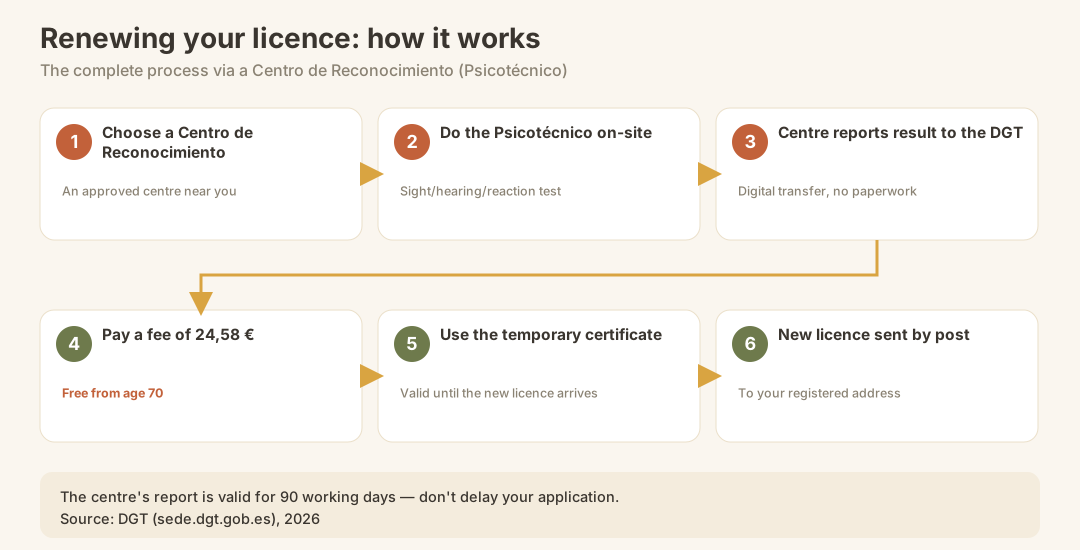
- Book an appointment at the Centro de Reconocimiento de Conductores (CRC) – authorised centres can be found all over Mallorca; you can find an overview in the driving school directory or directly via the DGT's list of centres.
- Bring documents: valid DNI/NIE or Residencia card, current driving licence, and glasses or contact lenses if you wear them while driving.
- Medical examination carried out: vision, hearing and reaction tests as well as a brief consultation with a doctor.
- Photo is usually taken directly at the centre.
- The CRC electronically forwards the application and medical report to the DGT; you pay the traffic fee directly on site.
- You immediately receive a provisional driving licence, which allows you to keep driving within Spain.
- The definitive driving licence arrives by post at your registered address.
Note: The medical report is only valid for 90 working days from the date of issue. Anyone who delays their appointment at the DGT or the CRC for too long will have to repeat the Reconocimiento médico.
Deadlines: when you need to take action
The DGT gives you more leeway than many people assume – but negligence still comes at a cost.
| Timing | What applies |
|---|---|
| From 3 months before the expiry date | Renewal application possible |
| Early application | No loss of validity days – the new period continues from the old expiry date |
| After the expiry date | Renewal is still possible, but driving with an expired licence is prohibited |
| Complete loss of points | No renewal possible; point recovery is required instead |
| Residence in another EU country | Renewal must take place there, not in Spain |
You can track the status of your application at any time online via the DGT website. This is particularly worthwhile if the definitive driving licence takes longer than the usual six weeks to arrive.
Costs at a glance
The pure administrative fee is modest – on top of that comes the invoice from the medical centre for the report.
| Item | Cost |
|---|---|
| DGT fee (Tasa 4.3) for renewal | 24,58 € |
| DGT fee for persons aged 70 and over | fee-free |
| Medical report (Reconocimiento médico) at the CRC | is set individually by each centre and is not officially standardised |
| Provisional driving licence | included in the procedure, no additional costs |
Note: The exact amount for the medical report is set by each Centro de Reconocimiento de Conductores itself, as these centres operate privately but are DGT-authorised. It's worth calling ahead to check.
Special rules from 65 and 70 years of age
From your 65th birthday, the renewal intervals shorten to 5 years (standard classes) or 3 years (professional classes). The medical report itself does not differ in content from that of younger drivers – it simply becomes due more frequently.
Two practical simplifications apply from age 65:
- No appointment requirement at DGT counters: Anyone aged 65 or older may attend during the preferred opening hours of the respective Jefatura de Tráfico without a Cita previa – however, only for their own matter, not on behalf of others.
- Fee exemption from age 70: The traffic fee of 24,58 € is waived entirely, but the medical report remains chargeable.
Attention: The exchange of driving licences from countries with a bilateral agreement is excluded from this appointment exemption – an appointment is always required here due to verification by the country of origin.
Loss of points and what it means for renewal
A renewal requires that points are still available on your driving licence account. If you have lost all your points due to traffic offences, the DGT does not fall back on the normal renewal procedure – instead, you must go through a separate procedure for point recovery before renewal can even be considered. Anyone who regularly collects fines should proactively familiarise themselves with the Spanish points system and fines in Spain in order to avoid exactly that.
Residence abroad: Where you need to renew
If you move back to Germany or another EU country with your Spanish driving licence and live there for at least six months as a student or permanently, the Spanish DGT is no longer responsible. The renewal must then take place with the competent authority of your new country of residence. Conversely: as long as your habitual residence is on Mallorca, the DGT is solely responsible – regardless of whether you are additionally registered in Germany. Anyone unsure whether their stay in Spain already counts as habitual residence will find guidance in our 90/180-day rule initial guidance.
Most common mistakes
- Leaving it too late: Anyone who only takes action after expiry is no longer allowed to drive until the renewal has been successfully completed – not even "just a quick trip to the supermarket".
- Letting the medical certificate lapse: The informe de aptitud is only valid for 90 working days; if the DGT appointment is delayed, the Reconocimiento médico has to be repeated.
- Confusing it with the exchange: A German driving licence that hasn't yet been exchanged cannot simply be "renewed" in Spain – the exchange has to happen first.
- Using the provisional licence abroad: The provisional document is only valid within Spain, not for trips to Germany or other countries.
- Ignoring a change of residence: Anyone permanently moving to another EU country must renew their licence there – the Spanish DGT is no longer responsible in that case.
What comes next?
Once the definitive licence has arrived, it's worth doing a quick overall check: are the name and address correct, and has the new validity period been entered correctly? At the same time, you should check whether your vehicle is also technically up to date – the deadlines for the ITV (MOT) on Mallorca continue independently of the driving licence. Anyone who hasn't yet registered their vehicle in Spain will find all the further steps bundled together in the overview on Cars & Traffic.
Checklist: renewing your driving licence in time
- Check the expiry date on your current driving licence
- Book an appointment at the Centro de Reconocimiento de Conductores at least 3 months in advance
- Have valid DNI/NIE or residency documents ready
- Complete the Reconocimiento médico (vision, hearing, reaction test)
- Have the DGT fee of €24.58 ready (unless you are over 70)
- Collect the provisional driving licence and use it only within Spain
- Check for delivery of the definitive document after around 1.5 months
- If moving abroad, contact the relevant authority there in good time
Conclusion
The Spanish driving licence renewal process is bureaucratically manageable: no exam, one medical certificate, a moderate fee of 24.58 euros – all handled in a single appointment at the Centro de Reconocimiento de Conductores. What matters is that you act in good time, ideally within the three-month window before expiry, and that you don't confuse renewal with exchange. Anyone who knows these basic rules will lose neither their driving licence nor their nerves.
Official sources
- DGT – Renewal of driving licences and permits close to expiry: https://sede.dgt.gob.es/es/permisos-de-conducir/obtencion-y-gestion-de-permisos/renovacion-de-permiso-proximo-a-caducar/
- DGT – Renewing a licence close to expiry: https://www.dgt.es/nuestros-servicios/permisos-de-conducir/ha-caducado-o-necesitas-una-copia-de-tu-permiso/renovar-un-permiso-proximo-a-caducar/
- DGT – Driving licence for those over 65 years of age: https://www.dgt.es/nuestros-servicios/permisos-de-conducir/permiso-de-conducir-para-mayores-de-65-anos/
- DGT – Driver Recognition Centres: https://www.dgt.es/conoce-la-dgt/con-quien-trabajamos/centros-reconocimiento-conductores/