
Foreign number plates in Mallorca: the 183-day rule, IEDMT and Operación Filtrocar
Driving around Mallorca on a German, Austrian or Swiss number plate is perfectly legal for holidaymakers — up to a point. Anyone who stays longer, works here, or relocates their centre of life to the island faces a clearly regulated obligation: the vehicle must be registered in Spain, and sooner than most people expect. Based on Ley 38/1992, Real Decreto Legislativo 6/2015 and current case law (as of April 2026), this guide explains when you must act with aforeign number plate on Mallorca, what re-registration costs, how the Operación Filtrocar works, and which mistakes can turn out very expensive. You will also learn how days of presence are counted in legal terms and why the magic words "183 days" alone are no guarantee of safety.
Not sure whether you already need to re-register — or whether you're still on the safe side?
- 📩 Submit a personal enquiry — We'll help you assess your situation clearly
- All topics relating to cars & transport on Mallorca
The one question everything hinges on
Before we get into deadlines, taxes and fines: the decisive factor is your tax residence. Are you a resident in Spain or not? Everything else follows from that answer.
| Situation | Obligation to re-register | IEDMT due |
|---|---|---|
| Tourist / short stay of under 183 days | No | No |
| Resident (183+ days in the calendar year) | Yes, within 30 days | Yes (exceptions possible) |
| Genuine relocation with 12 months of prior residence abroad | Yes | No (Franquicia fiscal) |
| Second home, vehicle permanently on the island | Grey area — depends on actual use | Depends on the individual case |
Important: being a resident, as defined by Art. 68 Real Decreto Legislativo 6/2015, doesnotmean having applied for a Residencia or being registered on the padrón. What counts are the actual circumstances — that is, how many days you actually spend in Spain and where your centre of life is located.
The 183-day rule: what is actually counted
The figure of 183 is well known, but how days are counted in practice is not defined by statute. Spain's Central Economic-Administrative Court (TEAC) has, in recent case law, distinguished three categories of days of presence:
Three types of days of presence (TEAC case law)
| Category | Definition | Example |
|---|---|---|
| Confirmed Presence | Evidenced by documentation — both the arrival and departure day count in full | Doctor's appointment, credit card payment in Spain |
| Presumed Presence | Days logically assumed to fall between two evidenced periods of stay | If you were verifiably in Palma on 1 and 10 March, the days in between can be counted as Spain days |
| Occasional Presence | If you do not reach 183 days in any country, Spain may attribute third-country days to you, provided you were not present longer anywhere else | Frequent travellers without a clear principal residence |
Please note: The days do not need to be spent consecutively — they are added up across the entire calendar year. Furthermore: if your spouse and children are already tax-resident in Spain, your own residency is rebuttably presumed — the burden of proof then rests with you.
There is also a second criterion applied by the Spanish tax authority AEAT: the centre of economic interests. Anyone who derives their primary income from Spain, owns property here, or holds significant assets here may be classified as a resident even below the 183-day threshold.
What the AEAT currently accepts as evidence
Thanks to digitalised data analysis, the AEAT evaluates, among other things:
- Credit card transactions by location and date (financial geolocation)
- Electricity and water consumption at the property
- School enrolments of children in Spain
- Memberships in local associations or clubs
This means: the statement "I was there for fewer than 183 days" is not sufficient if your digital footprint indicates otherwise.
IEDMT: The Registration Tax — Costs and Exemptions
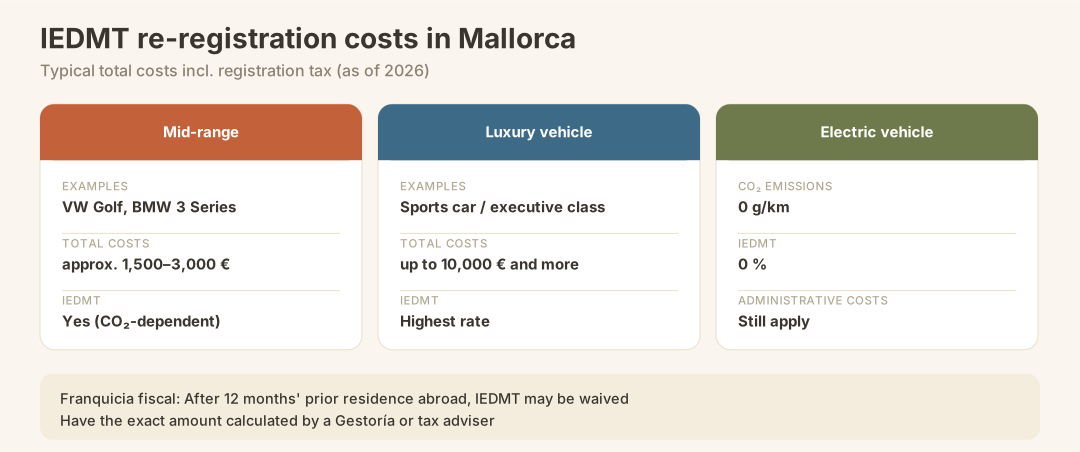
The IEDMT (Impuesto Especial sobre Determinados Medios de Transporte) is the Spanish registration tax on vehicles. It is based on the vehicle's CO₂ emissions and is governed by Ley 38/1992.
IEDMT Tax Rates
| CO₂ Emissions | IEDMT Rate |
|---|---|
| Below 120 g/km | 0 % |
| 120 to 159 g/km | Generally lower rate |
| 160 to 199 g/km | Middle rate |
| 200 g/km and above | Highest rate |
Please note: The exact percentages may vary depending on the vehicle type and current legislation. Have the precise amount calculated by a gestoría or tax adviser before re-registering.
What this means in euros:
| Vehicle class | Typical total re-registration costs incl. IEDMT |
|---|---|
| Mid-range vehicle (e.g. VW Golf, BMW 3er) | approx. 1.500–3.000 € |
| Luxury vehicle / sports car | up to 10.000 € and more |
| Pure electric vehicle (0 g CO₂) | 0 % IEDMT, but administrative costs still apply |
When is IEDMT waived? The Franquicia exemption
Anyone who had their habitual residence for at least 12 months outside Spain prior to moving there and already owned and used the vehicle in that country may be exempt from the registration tax. This so-called Franquicia fiscal can be difficult to prove — you will need, among other things, evidence of your previous place of residence, vehicle documents, and the date of first acquisition. A gestoría should handle this on your behalf.
Operación Filtrocar: How the checks really work in 2026
Since December 2024, the Guardia Civil on Mallorca has been carrying out increased coordinated vehicle checks, which have become known under the name Operación Filtrocar. The Guardia Civil and Policía Local work together — typically at ports, major arterial roads, and popular tourist areas.
The infraction rate during these checks stands at 15,6 % — meaning that an irregularity is detected in more than one in every seven people checked.
What officers are permitted to ask for during a check
During a traffic stop, you are generally required to produce the following documents:
- Driving licence
- Vehicle registration document / certificate of registration
- Proof of insurance
- ITV certificate if applicable (Spanish MOT certificate)
Important: There is no legal obligation during a routine traffic stop to provide ferry tickets, passports, or information about the duration of your stay. The burden of proof for exceeding the 183-day limit lies with the authorities. That said: remain polite and calm — escalating the situation will not work in your favour.
What officers can do if they have reasonable suspicion: they can retrieve data from border control systems and other sources that document entries and exits.
Penalties: What are the consequences of a violation?
Anyone who is a resident and drives a foreign-registered vehicle in Spain without re-registering it risks significant sanctions on several levels:
| Violation | Possible penalty |
|---|---|
| Driving with foreign number plates as a resident | €2.000 to €10.000 |
| Vehicle confiscation | Possible in cases of repeated or serious violations |
| Back payment of IEDMT including late-payment interest and surcharges | Can exceed the value of the vehicle |
| Insurance risk in the event of an accident | Motor insurance may refuse to pay out (check your policy terms!) |
The insurance issue is often underestimated: if you are a resident driving with foreign number plates and are involved in an accident, your existing motor insurance may refuse to settle the claim — because the vehicle should have been re-registered under Spanish law. It is therefore worth finding out about motor insurance in Spain that covers your actual status.
The re-registration process in Mallorca: step by step
The authority responsible for vehicle registration in Mallorca is the Jefatura Provincial de Tráfico, handled in practice through the Consell de Mallorca. The only ITV location on Mallorca that accepts vehicles for re-registration (registration of foreign-plated vehicles) is in Manacor.
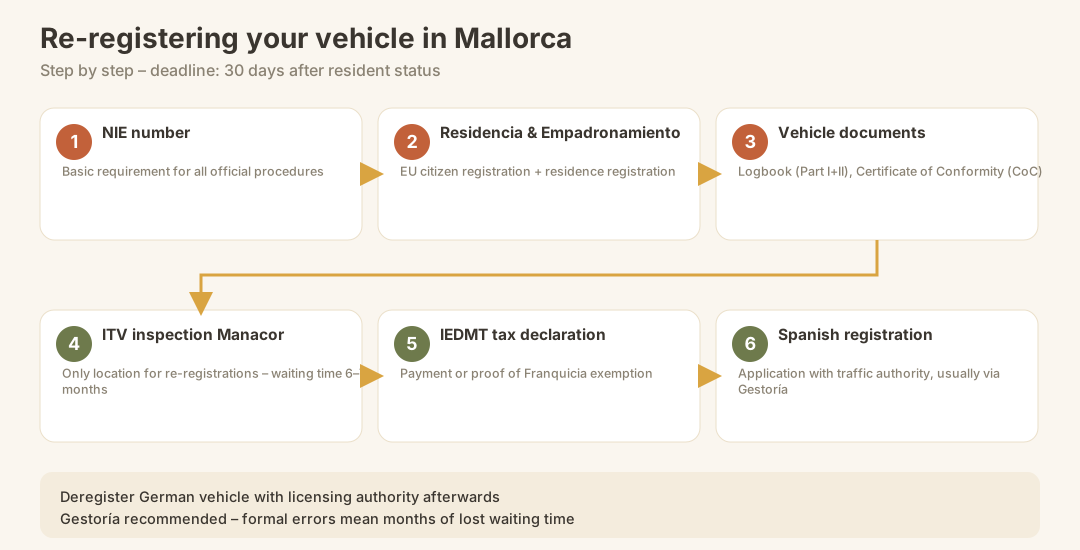
Please note: According to our research, the current waiting time for re-registration appointments is 6 to 7 months. Start the process as early as possible — ideally before you officially become a resident.
Step by step: what you will need
- NIE number (Número de Identificación de Extranjero) — a fundamental requirement for any dealings with the authorities → Applying for a NIE number in Mallorca
- Residencia / Certificate of EU Citizen Registration → Residencia in Spain
- Empadronamiento (registering your address with the local council) → Empadronamiento Mallorca
- Vehicle technical documentation: vehicle registration documents (Parte I and II), Certificate of Conformity (CoC), and a translation if required
- ITV inspection in Manacor — the vehicle must comply with Spanish standards → ITV Mallorca
- IEDMT tax declaration and payment (or proof of exemption via Franquicia)
- Application for Spanish registration with the traffic authority — usually handled through a gestoría → Gestoría Spain
- De-registering the German vehicle logbook with the relevant German registration office (if necessary by power of attorney and post)
Tip: Work with a gestoría that specialises in vehicle re-registration. The process is bureaucratic and prone to errors — a single procedural mistake can mean months of lost waiting time.
Low Emission Zone Palma: New rules for foreign number plates
Since March 2026, the city of Palma has revised its regulations for the Zona de Bajas Emisiones (ZBE). Previously, vehicles with foreign number plates were categorically excluded and were receiving fines on a regular basis — causing considerable frustration.
The new regulations provide for:
- Foreign vehicles may apply for entry permits provided they meet the applicable emissions standards (Euro standards)
- The permit must be applied for at least 5 days in advance online via the portal mobipalma.mobi be applied for
- It is valid for 30 calendar days from the chosen start date
- Required documents: ID, driving licence, vehicle registration document, proof of ownership and proof of entry; for leasing or hire vehicles, the contract is also required
Please note: Anyone who enters the ZBE without a permit continues to risk fines. Apply for the permit in good time before your stay.
Most common mistakes — and how to avoid them
1. Underestimating the Residencia status
Many people assume the 30-day period only begins once the Residencia card is issued. This is incorrect: what counts is the moment you are actually considered a resident — that is, when you exceed the 183-day threshold or transfer your primary place of residence. Do not wait for the plastic card.
2. Missing the Franquicia deadline
The tax exemption for a genuine relocation must be applied for correctly and in good time. Those who wait until the IEDMT demand lands on their desk usually end up paying more.
3. Going to the wrong ITV centre
On Mallorca, only the branch in Manacor handles re-registrations. Other ITV stations do not carry out such initial inspections — which wastes both time and patience.
4. Failing to update your insurance cover
Foreign motor insurance policies are often incompatible with your legal status as a resident in Spain. Clarify this with your insurer before you find yourself involved in a claim.
5. Ignoring your digital footprint
Credit card payments, electricity and water consumption, school enrolments — all of this can be used by the AEAT to establish your presence. Anyone who assumes they are automatically safe with fewer than 183 confirmed days is underestimating modern monitoring methods.
6. Waiting too long for an ITV appointment
With waiting times of 6–7 months in Manacor, you must book your appointment well before your 30-day period expires. Schedule your tax advice and document preparation in parallel.
What comes next? The path after re-registration
Once your vehicle is registered in Spain, new obligations apply:
| Topic | What you need to know now |
|---|---|
| Annual vehicle tax (IVTM) | Collected by the local authority; the due date varies depending on the municipality |
| ITV Vehicle Inspection | Regular mandatory inspection — interval depends on vehicle age → ITV Mallorca |
| Spanish Driving Licence | EU driving licence remains generally valid; conversion recommended → Convert Your Driving Licence |
| Income Tax (IRPF) | As a resident, you pay tax on your worldwide income → Taxes as a Resident |
| Fines in Spain | Know the new traffic regulations → Fines in Spain |
Also worth noting: if you are registered as a resident, you should be aware of your full tax obligations — from income tax to declaring foreign accounts. Our Tax & Finance Guide.
Checklist: Foreign Number Plates on Mallorca
Use this list as a guide — it is not a substitute for individual legal advice:
- Clarify your status: tourist or resident? (183-day test)
- NIE number in place?
- Empadronamiento and Residencia applied for?
- Have the IEDMT calculation carried out by a gestoría / tax adviser
- Check franquicia exemption (12 months of prior residence abroad?)
- Book your ITV appointment in Manacor well in advance (waiting time 6–7 months!)
- Obtain CoC (Certificate of Conformity) and vehicle documents
- Update your motor insurance to reflect resident status
- Deregister your German vehicle (registration office)
- Zona de Bajas Emisiones Palma: permit applied for via mobipalma.mobi?
- Check / convert your Spanish driving licence
Conclusion
Driving on Mallorca with foreign number plates is perfectly fine for genuine tourists — but the point at which obligations kick in is sharper than many people realise. The 183-day rule is not the only threshold: even those who spend fewer days in Spain can be classified as residents on the basis of their economic centre of life or where their family is based. Anyone who crosses that threshold has 30 days to re-register their vehicle — but with a 6–7 month waiting time in Manacor, planning needs to start far earlier. Operación Filtrocar shows that checks are real and consistently enforced. The good news: anyone who understands the process, plans ahead, and engages an experienced gestoría can get through the re-registration without any nasty surprises.
Official Sources
- Ley 38/1992 (Special Tax on Certain Means of Transport / IEDMT): https://www.boe.es/buscar/act.php?id=BOE-A-1992-28740
- Real Decreto Legislativo 6/2015 (Road Traffic Act, Motor Vehicle Circulation and Road Safety, Art. 68): https://www.boe.es/buscar/act.php?id=BOE-A-2015-11722
- AEAT – Agencia Estatal de Administración Tributaria (IEDMT, tax residency): https://www.aeat.es
- DGT – Dirección General de Tráfico (registration, ITV, traffic law): https://www.dgt.es
- ATIB – Agència Tributària de les Illes Balears: https://www.atib.es
- Zona de Bajas Emisiones Palma – mobipalma.mobi: https://mobipalma.mobi
- Jefatura Provincial de Tráfico Baleares: https://sede.dgt.gob.es