
Working in Mallorca as an Employee: Contract, Social Security & Payslip
Anyone wishing to work in Mallorca as an employee enters a social security and tax system that differs considerably from other countries in both structure and terminology. With Working in Mallorca as an Employee, there are three things you need to have sorted before your first day at work: your NIE number, your social security number, and – depending on your residency status – your Residencia. This guide explains step by step how a Spanish employment contract is structured, what the Seguridad Social covers and deducts, how to read your monthly Nómina (payslip), and which mistakes you should absolutely avoid. The information is based on the 2026 position and applies specifically to employees in Mallorca and the Balearen.

You have a job offer in Mallorca and don't know where to start?
- 📩 Submit a personal enquiry — We'll help you coordinate all the administrative steps before your first day at work
- All steps relating to authorities & registration
Requirements: What you need before your first day at work
Before you sign any contract, you need to establish two administrative foundations. Without them, your employer cannot register you legally.
NIE Number
The Número de Identidad de Extranjero (NIE) is your personal tax identification number in Spain – it appears on every official form, on your Nómina, and with the tax authorities. EU citizens can apply for it at the relevant immigration office (Extranjería) in Palma.
👉 Detailed step-by-step guide: NIE Number Mallorca
Social Security Number (Número de Afiliación)
The Número de Afiliación a la Seguridad Social is obtained from the Tesorería General de la Seguridad Social (TGSS). Some employers apply for it on your behalf, but you are legally responsible for ensuring it is in place in good time. This number is valid for life and is carried over to all future employment relationships in Spain.
| Document | Issuing authority | Where in Mallorca |
|---|---|---|
| NIE Number | Oficina de Extranjería / Policía Nacional | C/ Lluís Fàbregas i Cuxart 2, Palma |
| Número de Afiliación | TGSS (Tesorería General) | C/ Reina Esclaramunda 5, Palma |
| Empadronamiento | Ajuntament (local authority) | depending on place of residence |
| Residencia (EU) | Oficina de Extranjería | see above |
Note: Your employer registers you with the TGSS once you present your afiliación number. Until the formal registration (alta) you are not legally permitted to work.
The Spanish employment contract: what must it contain?
In Spain, the employment contract (contrato de trabajo) must in principle be concluded in writing. Under Spanish employment law (Estatuto de los Trabajadores, Real Decreto Legislativo 2/2015) it must include certain minimum particulars:
| Mandatory detail | Explanation |
|---|---|
| Full names of employer / employee | incl. NIE/NIF and addresses |
| Start date and duration of the employment relationship | for fixed-term contracts: end date or condition |
| Job location / place of work | place where duties are to be performed |
| Occupational group / category | in accordance with the collective agreement (convenio colectivo) |
| Basic salary and additional payments | gross, in euros |
| Working hours and distribution | Weekly hours, shifts |
| Holiday entitlement | at least 30 calendar days per year |
| Applicable collective agreement | e.g. Convenio de Hostelería de Baleares |
| Social security contribution group | Grupo de Cotización |
Fixed-term vs. permanent contracts
Seasonal contracts (contrato temporal por circunstancias de la producción) are widespread in Mallorca due to the pronounced tourist season, but have been more strictly regulated since the 2022 labour law reform. A seasonal contract may in principle run for no longer than six months (extendable via collective agreement to a maximum of one year). Anyone working on the island on a permanent basis should insist on an open-ended contract (contrato indefinido) or at the very least agree a timeframe for conversion.
Caution: Verbal agreements are treated under Spanish employment law as a permanent full-time contract — a blank cheque for both parties. Only sign what is set out on paper, and if in doubt have the contract reviewed by a gestoría.
👉 Using a gestoría in Mallorca
The Seguridad Social: structure and benefits
The Seguridad Social is Spain's statutory social insurance system, covering health, pension, unemployment and accident insurance under one umbrella. It is divided into three bodies with clearly defined responsibilities:
| Sub-organisation | Abbreviation | Function |
|---|---|---|
| Tesorería General de la Seguridad Social | TGSS | Collection of contributions, member administration, Afiliación |
| Instituto Nacional de la Seguridad Social | INSS | Approval and calculation of benefits (pension, sick pay) |
| Servicio Público de Empleo Estatal | SEPE | Unemployment benefit (prestación por desempleo) |
For employees, the practical point of contact is primarily the TGSS (for registration) and the SEPE (if you become unemployed). The healthcare system (sanidad pública) operates on Mallorca via IB-Salut and is organisationally linked to the Seguridad Social, but regionally administered.
What does the Seguridad Social cover as an employee?
- Health insurance: GP and specialist appointments, hospital treatment, accident and emergency, ambulance services, antenatal care, vaccinations – though without free choice of doctor and generally without dental treatment
- Sick pay (baja): In the event of incapacity for work, you receive sick pay from the 4th day of illness (the first 3 days are generally covered by the employer)
- Pension insurance: Contribution periods on Mallorca count towards your future pension
- Unemployment benefit: Depending on the number of contribution months paid in, you are entitled to prestación por desempleo
- Maternity/paternity benefits: 16 weeks of equal parental protection pay for both parents
Note: The benefits provided by the Seguridad Social are more limited compared to the standard of the German statutory health insurance. Many residents on Mallorca take out supplementary private health insurance.
👉 Health insurance in Spain – all the options
Seguridad Social contributions: who pays how much?
Seguridad Social contributions are split between employer and employee. The employer bears the significantly larger share and remits everything monthly to the TGSS. On your Nómina you will only see the employee's share as a deduction.
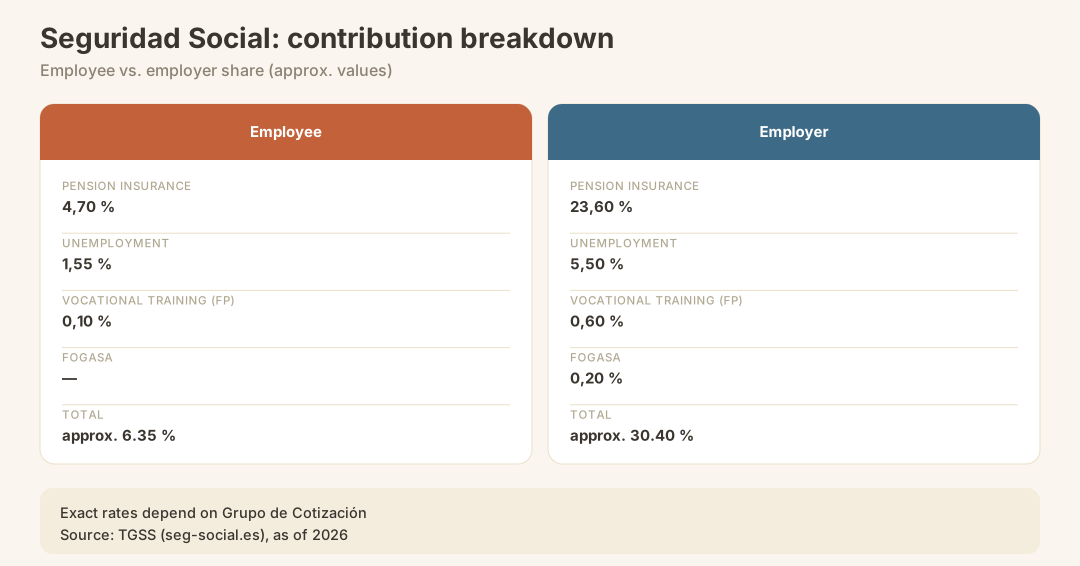
| Type of contribution | Employee's share (approx.) | Employer's share (approx.) |
|---|---|---|
| General pension insurance | 4,70 % | 23,60 % |
| Unemployment | 1,55 % | 5,50 % |
| Vocational training fund (FP) | 0,10 % | 0,60 % |
| Wage guarantee fund (FOGASA) | — | 0,20 % |
| Total (simplified) | approx. 6.35 % | approx. 30.40 % |
Please note: The exact percentages depend on your contribution group (Grupo de Cotización) and may change as a result of annual budgetary decisions. The figures given here reflect the standard rates that typically apply – please check current figures on the TGSS website (seg-social.es).
The contribution base (Base de Cotización) is not identical to your gross salary: it comprises the basic salary plus most regular allowances, but is capped at a minimum base on the lower end and a maximum base on the upper end (each depending on the Grupo de Cotización).
Reading the Nómina: your Spanish payslip explained
The Nómina is the monthly payslip and at the same time a legally binding document. It must be issued to you every month and essentially contains three sections:
Section 1 – Devengos (gross earnings)
| Item | Explanation |
|---|---|
| Salario base | Basic salary as per collective agreement or contract |
| Complementos salariales | Supplements (night, weekend, hazard allowances, etc.) |
| Pagas extraordinarias | Bonus payments (usually 2 × per year, sometimes split monthly) |
| Horas extraordinarias | Overtime pay |
| Total devengado | Total gross salary |
Block 2 – Deducciones (Deductions)
| Item | Explanation |
|---|---|
| Cotización SS (trabajador) | Employee's social security contribution (~6,35 %) |
| IRPF (retención) | Income tax withholding at source (individual, depending on annual salary and personal circumstances) |
| Otras deducciones | Other deductions (e.g. salary advances) |
| Total a deducir | Total deductions |
Block 3 – Líquido a percibir
The Líquido a percibir is the amount transferred to your bank account – your net pay.
Please note: Spain has a statutory system of 14 monthly payments per year: 12 monthly salaries plus two bonus payments (pagas extraordinarias), due in summer and winter. Many employers spread these across the 12 months (pagas prorrateadas) – which must be noted on the Nómina.
Minimum wage as the lower limit
The Spanish minimum wage (Salario Mínimo Interprofesional, SMI) applies as the absolute lower limit. For current figures, please refer to our dedicated guide:
👉 Minimum wage in Spain – current status
IRPF: Income tax on your Nómina
The IRPF (Impuesto sobre la Renta de las Personas Físicas) is the Spanish income tax. As an employee, it is not levied once a year but withheld monthly directly from your salary (retención a cuenta). The employer remits this amount to the tax authority (AEAT).
The level of the monthly withholding tax depends on:
- your gross annual salary (progressive tax rate)
- your marital status and the number of dependent children
- whether you have two or more employment relationships at the same time
At the end of the year you submit the Declaración de la Renta (income tax return). If you were taxed too much each month, you will receive a refund of the difference; if you were taxed too little, you will have to pay the shortfall.
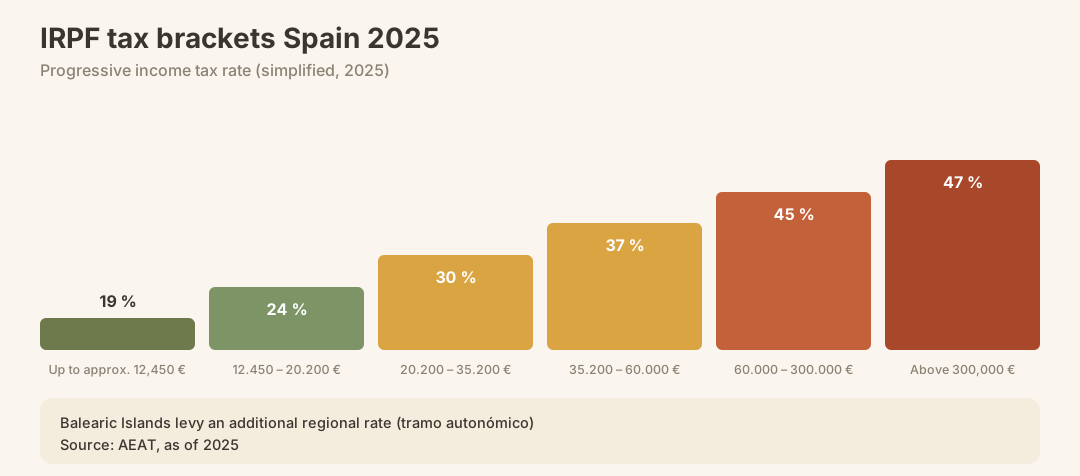
| Taxable annual income (simplified, 2025) | Tax rate |
|---|---|
| Up to approx. 12.450 € | 19 % |
| 12.450 – 20.200 € | 24 % |
| 20.200 – 35.200 € | 30 % |
| 35.200 – 60.000 € | 37 % |
| 60.000 – 300.000 € | 45 % |
| Over 300.000 € | 47 % |
Please note: The Balearic Islands levy their own regional income tax rate (tramo autonómico), which affects the overall tax rate. For an accurate calculation of your tax burden in Mallorca, you should consult a gestoría or a tax adviser.
👉 Taxes as a resident in Spain (IRPF)
Working from home for a German employer: social security implications
A common question concerns Germans who relocate to Mallorca but continue to work remotely for a German company. The governing principle here is lex loci laboris: if the work is actually carried out in Spain and the employee is permanently resident in Spain, social security contributions are generally payable in Spain.
An exception applies in the case of temporary postings: anyone posted to Spain on a fixed-term basis by a German employer whilst retaining their place of residence in Germany can use the A1 certificate to demonstrate that they remain within the German social security system.
From 1 July 2023 a multilateral framework agreement has also been in force which, under certain conditions, permits remote working abroad without a change of social security country. The specific requirements (including, amongst other things, the proportion of work carried out in the country of residence) are complex — seek advice from a gestoría specialising in the Balearic Islands.
👉 Autónomo in Mallorca – the alternative to employed status
Healthcare as an employee: access to IB-Salut
Once you are registered with the Seguridad Social, you are entitled to public healthcare in Mallorca. The regional health authority IB-Salut (Institut Balear de la Salut) administers the health centres (centres de salut) and hospitals on the island.
The necessary steps after registering:
- Have your NIE number and Número de Afiliación to hand
- Obtain your empadronamiento certificate from your local council
- Apply for the Tarjeta SIP (health card) at the relevant health centre (based on your home address)
- Take your Tarjeta SIP to your GP (médico de cabecera) and register with them
Note: Dental treatment and optical care are generally not covered by the public system. Many residents supplement their Seguridad Social cover with a private additional insurance policy.
👉 An Overview of the Healthcare System in Mallorca
Typical sectors and realistic salary expectations
So you know what you're letting yourself in for: salaries in Mallorca for local employment are significantly lower than German levels. This is only partially offset by lower living costs in some areas — particularly when it comes to rents in Mallorca.
| Sector / Job | Typical gross salary per month (approx.) |
|---|---|
| Reception / Hospitality | 1.200 – 1.600 € |
| Service staff / Waiter | 1.200 – 1.500 € (+ tips) |
| Tour guide (German-speaking) | 1.300 – 1.800 € |
| Estate agent (employed) | 1.400 – 2.000 € + commission |
| IT / Call centre | 1.500 – 2.500 € |
| Trades (plumbing, electrical) | 1.600 – 2.400 € |
| Administration / Office | 1.300 – 1.900 € |
For remote jobs where you work for a German or international company, the salary levels of the home country generally apply — this is the real financial advantage of the model.
👉 Realistic assessment of the cost of living in Mallorca 👉 Finding a job in Mallorca – practical tips
Most common mistakes when working in Mallorca
From experience, we see these stumbling blocks time and again:
- Working without an NIE: No legal employment relationship is possible – and no social security cover. Don't start even a single day without an NIE.
- No written prior registration (alta previa): Your employer must register you with the TGSS before your first working day. If this doesn't happen, you won't be insured in the event of an accident.
- Letting a seasonal contract be tacitly extended: After certain notice periods, a permanent employment contract arises automatically – good for you, but only if you know about it.
- Not checking your IRPF deduction: Particularly with multiple jobs or changing circumstances, the deduction may be set too low. The tax office will reclaim the shortfall when you file your annual return.
- Not having the pagas extraordinarias anchored in the contract: Never assume they are a given – check whether they are paid out in monthly instalments or transferred twice a year.
- Not requesting a copy of the contract when starting a job: You have the right to a fully signed copy. Employers who refuse this are a warning sign.
- Not looking into the Beckham Law: Highly qualified newcomers may in certain circumstances be able to take advantage of the favourable flat-rate taxation under the Beckham Law – however, the application must be submitted within six months of starting work.
👉 Beckham Law – who benefits and how to submit the application
What comes next? Registrations, taxes, everyday life
With your employment contract and Seguridad Social number in hand, the rest of your integration in Mallorca follows. The most important next steps:
| Step | Guide |
|---|---|
| Applying for residencia (EU citizens) | Residencia Spain |
| Empadronamiento (municipal registration) | Empadronamiento Mallorca |
| Opening a Spanish bank account | Opening a bank account in Spain |
| Applying for a Certificado Digital / Cl@ve | Certificado Digital |
| Tax obligations as a resident | Taxes as a resident (IRPF) |
| Reporting foreign assets (from €50,000) | Modelo 720 |
Checklist: Before your first working day on Mallorca
- NIE number applied for and received
- Número de Afiliación a la Seguridad Social applied for
- Written employment contract read and understood (gestoría if needed)
- Registration (alta) with the TGSS confirmed by the employer
- Empadronamiento completed (municipal registration)
- Spanish bank account opened for salary payments
- Tarjeta SIP (health card) applied for with IB-Salut
- First nómina checked for completeness (devengos, deducciones, líquido)
- IRPF withholding rate discussed with employer
- Beckham Law – check eligibility (if highly qualified / first time in Spain)
- Apply for residencia (at the latest after 3 months as an EU citizen)
Conclusion
As an employed worker on Mallorca you are well protected – provided everything is set up correctly. The Spanish Seguridad Social system gives you health, pension, unemployment and accident cover from day one, and the monthly nómina sets out all deductions transparently. The key difference from the German system is that many things which happen automatically there must be initiated here by you – from the afiliación number to the Tarjeta SIP. Anyone who understands the processes and obtains the necessary documents in good time can start their working life on Mallorca without any nasty surprises. When in doubt, a good gestoría is the best investment you can make in your fresh start.
Official sources
- Tesorería General de la Seguridad Social (TGSS): https://www.seg-social.es — afiliación, contributions, alta/baja
- Instituto Nacional de la Seguridad Social (INSS): https://www.seg-social.es/wps/portal/wss/internet/InformacionUtil/44539 — Benefit approval, sick pay
- Servicio Público de Empleo Estatal (SEPE): https://www.sepe.es — Unemployment benefit, contracts
- Agencia Tributaria (AEAT): https://www.agenciatributaria.es — IRPF, Declaración de la Renta
- Real Decreto Legislativo 2/2015 – Estatuto de los Trabajadores (BOE): https://www.boe.es/buscar/act.php?id=BOE-A-2015-11430 — Employment law in Spain
- IB-Salut (Healthcare in the Balearic Islands): https://www.ibsalut.es — Tarjeta SIP, health centres
- Regulation (EC) No 883/2004 – Coordination of Social Security in the EU: https://eur-lex.europa.eu/legal-content/DE/TXT/?uri=CELEX%3A32004R0883 — cross-border social security