
Minimum Wage Spain (SMI) 2026: What You Actually Earn and What It Means for Contracts
The minimum wage in Spain — in Spanish Salario Mínimo Interprofesional, or SMI for short — rose to €1,221 gross per month on 1 January 2026, spread across fourteen payments per year. The increase of 3.1% compared with 2025 may sound modest, but it has concrete consequences for every employment contract below this threshold: the employer must adjust, and retroactively at that. In this guide you will learn how the SMI is made up, what remains net after deductions, what special rules apply to part-time workers, domestic staff and seasonal workers, what collective agreements have to do with it — and what mistakes newcomers to the Spanish labour market repeatedly make.

Are you planning to work in Spain or to employ someone, and want to make sure your contract is legally compliant?
- 📩 Submit a personal enquiry — We will connect you with an experienced employment law specialist or a gestoría in Mallorca
- Working & Career in Mallorca – Overview
The key facts about the SMI 2026 at a glance
On 17 February 2026 the Spanish Council of Ministers adopted Real Decreto 126/2026. The Royal Decree was published in the Boletín Oficial del Estado (BOE) on 18/19 February 2026 and applies retroactively from 1 January 2026. Anyone who has been employed since the start of the year at a wage below the new threshold is entitled to back payment of the difference for the preceding months.
| Key figure | Amount (gross) |
|---|---|
| Monthly SMI (14 payments) | 1.221,00 € |
| Annual SMI (total) | 17.094,00 € |
| Daily SMI | 40,70 € |
| Daily rate for seasonal and temporary workers | 57,82 € |
| Previous year's level 2025 (monthly) | 1.184,00 € |
| Increase compared with 2025 | +3,1 % |
| Increase compared with 2018 | +66 % |
The outcome is the result of an agreement between the Ministerio de Trabajo and the majority trade unions CCOO and UGT at the Social Dialogue round table. According to government figures, around 2.5 million workers benefit from the increase in Spain.
Note: The annual figure of 17.094 € is calculated as 14 × 1.221 €. Some contracts pay the annual salary in twelve monthly instalments — in that case, the Christmas and summer bonuses must already be included on a pro-rata basis in the monthly amount, so that the total annual value still reaches at least 17.094 €.
Fourteen salaries: what does that mean?
Anyone coming from Germany is used to twelve monthly salaries. Spain works differently. The law provides for two mandatory bonus payments (gratificaciones extraordinarias): one at Christmas and a second whose due date is governed by collective agreement or works agreement — typically in summer.
These extra payments normally equal one month's salary, but may differ under collective agreements. It is also possible to spread them across twelve months (prorratear), provided the collective agreement permits it and you agree. In that case you would see roughly 1.424 € gross per month instead of 1.221 €, but you would receive no separate payments in July and December.
| Payment model | Monthly gross amount | Note |
|---|---|---|
| 14 salaries (standard) | 1.221,00 € | + bonus payment July & December |
| 12 salaries (pro-rated) | approx. 1.424,50 € | Bonus payments included |
| Total annual amount (always) | 17.094,00 € | statutory minimum |
What remains net? Social security and tax
Gross is not net — in Spain too. Two deductions are taken directly from your SMI gross salary:
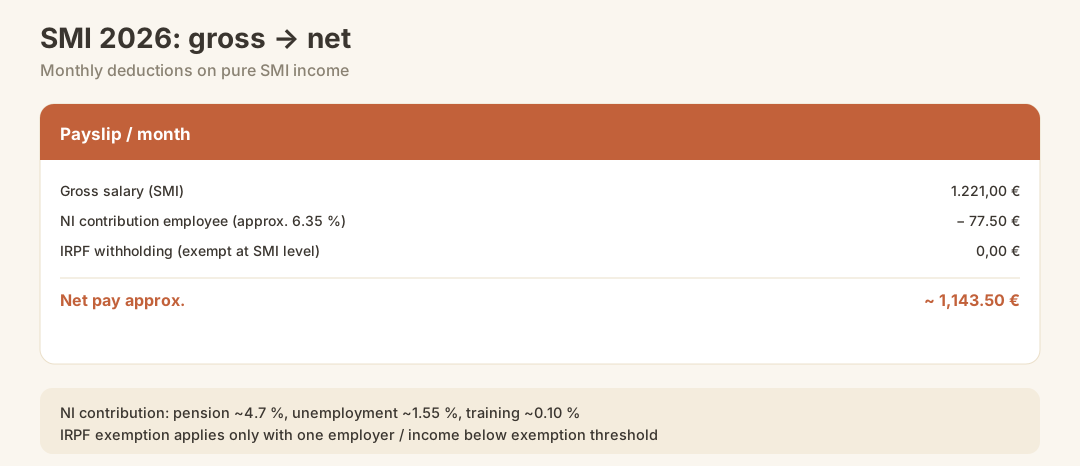
1. Employee's social security contribution (cuota obrera) Contributions cover pension, unemployment, occupational accident, and continuing-education insurance. For employees, the total contribution rate is generally around 6,35 % of gross pay (pension ~4,7 %, unemployment ~1,55 %, training ~0,10 %). On an SMI of 1.221 € gross, that amounts to approximately 77–78 € per month.
2. Income tax (IRPF) An important special rule applies here: annual income at SMI level — 17.094 € — has been exempt from income tax (IRPF) since the 2026 agreement. This means: anyone earning exclusively the minimum wage pays no income tax. The employer therefore makes no IRPF deduction on the payslip.
Please note: This tax exemption only applies if you have exclusively this one employer and your annual income does not exceed the exemption threshold. With multiple employers or additional income, IRPF may apply. Have this checked by a gestoría.
Approximate net calculation on a pure SMI income:
| Item | Amount/month |
|---|---|
| Gross salary (SMI) | 1.221,00 € |
| Employee social security contribution (approx. 6.35 %) | − 77.50 € |
| IRPF deduction (exempt at SMI) | 0,00 € |
| Approximate net pay | ~1.143,50 € |
This figure is a guide. Your actual net pay depends on your personal circumstances (marital status, children, place of residence). For an accurate tax calculation, it is worth taking a look at Tax as a Resident (IRPF).
Who is affected? Scope without exception
Real Decreto 126/2026 applies universally and without age-related tiers. In Spain — unlike in some other EU countries — there is no reduced youth minimum wage. Specifically, the SMI applies to:
- Permanent employees (trabajadores fijos)
- Fixed-term employees (trabajadores temporales) with up to 120 days of service with the same employer
- Agency workers and temporary staff (trabajadores de ETT)
- Seasonal workers (seasonal workers): the increased daily rate applies here of 57,82 €
- domestic workers (empleados de hogar): also protected by the SMI, with their own hourly rate
Please note: Anyone employing a domestic helper should ensure the correct social security contributions are paid. More on this in the guide Registering a domestic worker in Spain.
collective agreements (Convenios Colectivos): often above the SMI
The SMI is the statutory minimum — but in many sectors a higher minimum applies in practice. Spain has a dense network of collective agreements at sector, regional and company level. These Convenios Colectivos can and may set higher wages, but never lower ones.
Practical examples from the Balearic context:
| Sector / Area | Collectively agreed minimum wages | Special feature |
|---|---|---|
| Hospitality & Hotels (Balearic Islands) | Generally above the SMI | Balearic Islands' own Convenio |
| Construction | Regulated by sector-specific agreement | Supplements for hazardous work |
| Domestic workers | SMI hourly rate as the basis | Entitlement to social security registration |
| Agriculture / seasonal work | Daily rate of €57.82 or more | Convenio del Campo |
When you sign an employment contract in Mallorca, always check first which Convenio applies to your industry. The applicable collective agreement must be stated in the employment contract. For research, the database of the Spanish Ministerio de Trabajo as well as the BOIB for Balearic agreements are helpful.
What the SMI means in practice for your employment contract
When signing an employment contract in Spain, the rule is: any agreement that falls below the SMI is void — regardless of whether both parties have consented. The employee nonetheless retains their entitlement to the minimum wage.
Specific contractual obligations:
- Check the minimum wage clause: The agreed gross salary must amount to at least €17,094 per year on a full-time basis.
- Part-time contracts: The SMI applies proportionally. For 20 hours/week (half-time), the statutory minimum is half — i.e. approx. €610.50 gross/month.
- Backdated payment 2026: Anyone who has been employed since January 2026 is entitled to a backdated payment of the difference for the months prior to the publication of the decree.
- Absorption: Those already earning above the previous SMI are not generally entitled to an automatic adjustment — unless the collective agreement or the individual contract provides for this.
- Wage supplements (complementos): The government is working on measures to prevent employers from neutralising the SMI increase by reducing existing wage supplements.
Please note: Remuneration in kind (salario en especie) must not fall below the cash entitlement under the SMI. Accommodation or meals cannot be offset against the SMI to the extent that doing so would cause the cash payment to fall below the minimum threshold.
Historical development: From basement-dweller to EU benchmark
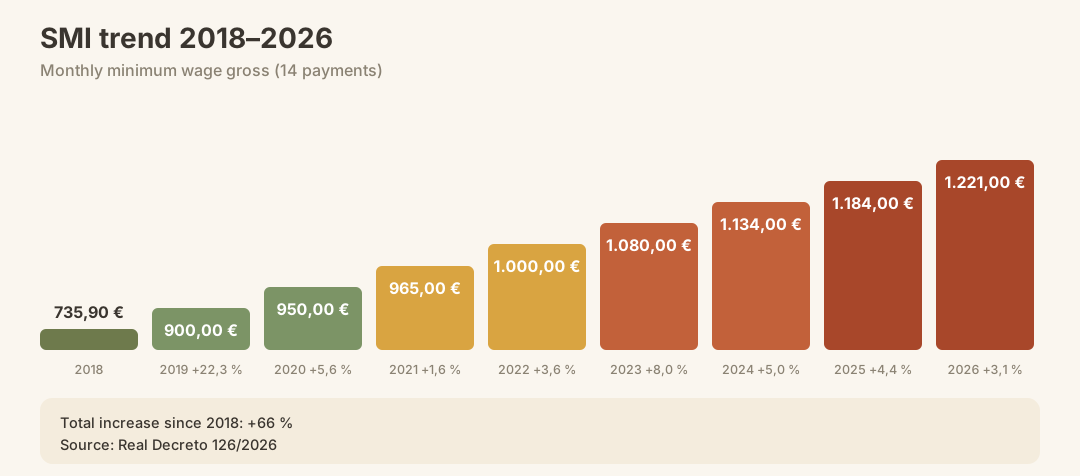
Spain's minimum wage has undergone a remarkable transformation since 2018. The government has made eight increases since that year — a political constant combining cross-party consensus and trade union pressure.
| Year | SMI monthly (gross, 14 salaries) | Change |
|---|---|---|
| 2018 | 735,90 € | Starting point |
| 2019 | 900,00 € | +22.3 % |
| 2020 | 950,00 € | +5.6 % |
| 2021 | 965,00 € | +1.6 % |
| 2022 | 1.000,00 € | +3.6 % |
| 2023 | 1.080,00 € | +8.0 % |
| 2024 | 1.134,00 € | +5.0 % |
| 2025 | 1.184,00 € | +4.4 % |
| 2026 | 1.221,00 € | +3.1 % |
Compared with 2018, the SMI has risen by 66 per cent in total. The government's stated aim is to keep the SMI at around 60 per cent of the median wage in Spain — a benchmark aligned with the EU Minimum Wage Directive.
SMI in European comparison
Spain's minimum wage sits in the European middle ground — well above Eastern European countries, yet still below the leading Western European nations.
| Country | Monthly minimum wage (approx., 2025/2026) |
|---|---|
| Luxembourg | ~2.570 € |
| Germany | ~2.408 € (13,90 €/h × ~173 h) |
| France | ~1.800 € |
| Spain | 1.221 € |
| Portugal | ~1,020 € |
| Poland | ~900 € |
Note: The German minimum wage has been 13.90 euros per hour since January 2026 13.90 euros per hour, whereas the Spanish SMI is a monthly figure — a direct hourly comparison depends on the agreed weekly working hours. Based on the Spanish standard of 40 hours/week, the calculated hourly rate works out at approximately 7,05 € — meaning Spain falls behind Germany in an hourly comparison.
Special Considerations for Autónomos and the Self-Employed
The SMI explicitly does not apply to the self-employed (autónomos). If you register as an autónomo in Spain, there is no statutory minimum income — you bear the entrepreneurial risk yourself. However, the SMI is indirectly relevant: it serves as the basis for calculating various state benefits and income thresholds.
Important: The SMI figure also influences the social security contribution assessment thresholds. Anyone wishing to understand the contribution structure as an autónomo will find further information in the guide Cuota Autónomo Spain.
Most Common Mistakes on the Topic of Minimum Wage in Spain
These misconceptions come up time and again — among both employees and small employers:
"1,221 € per month, twelve times" — incorrect. There are fourteen payments; the total annual amount is 17,094 €. Anyone receiving only twelve payments of 1,221 € each (= 14,652 € annually) is below the SMI.
Paying young people less — not permitted. The SMI applies without any age-related tiers.
Offsetting benefits in kind against the SMI — only permissible within very narrow limits; the cash element must not fall below the minimum.
Ignoring the applicable collective agreement — a Convenio may stipulate higher minimum wages. The SMI is only the absolute floor, not the industry standard.
Underestimating retrospective effect — the decree applies from 1 January 2026 but was not published until February. Employers owe the difference for January and February 2026 as a back payment.
Miscalculating the part-time ratio — the SMI applies proportionally to the agreed number of hours, not as a flat rate.
Taking tax exemption for granted — the IRPF exemption only applies under certain conditions; if you have multiple sources of income, IRPF may still be payable.
Cost of living in Mallorca: what the SMI is really worth
Around €1,143 net per month sounds like a solid starting point. In Mallorca — where rents have risen considerably in recent years — this is often barely enough to run an independent household. According to our guide on cost of living in Mallorca, a one-bedroom flat typically costs well over €700 per month.
Realistic monthly budgets for Mallorca (rough guide):
| Expense | Amount/month (approx.) |
|---|---|
| Rent (1-bedroom, Palma) | 750–950 € |
| Food & household | 250–350 € |
| Transport (bus/car) | 80–150 € |
| Communications & internet | 40–60 € |
| Total | 1.120–1.510 € |
Those earning at SMI level will in many cases need to rely on flatmates (compañeros de piso) or employer-provided accommodation (common in the hotel and catering industry) to make ends meet.
What comes next? Further steps to take
Once you have signed — or are about to sign — your employment contract, these are your next concrete steps:
- Apply for your NIE number — without it, no legal employment relationship can be established. → NIE number Mallorca
- Empadronamiento — registering at your place of residence is a prerequisite for many dealings with the authorities. → Empadronamiento Mallorca
- Apply for residencia — compulsory for EU citizens staying longer than three months. → Residencia Spain
- Sort out your health insurance — as an employee you are covered by compulsory social security; check whether you need additional private cover. → Health Insurance Spain
- Check tax number and tax liability — after 183 days per year in Spain you are liable for income tax. → Taxes as a Resident (IRPF)
- Open a bank account — almost always required for salary payments. → Open a Bank Account in Spain
Checklist: SMI-compliant Employment Contract on Mallorca
- Annual gross salary of at least 17.094 € stated (or proportionate part-time equivalent)
- Fourteen payments or correctly prorated monthly amount agreed
- Applicable collective agreement (Convenio Colectivo) stated in the contract
- Bonus payments (Christmas + summer) explicitly regulated
- Working hours (full-time 40 h or specific part-time hours) stated
- Social security registration (alta en la Seguridad Social) confirmed before commencement of employment
- No benefits-in-kind offsetting that reduce cash pay below the SMI
- Retroactive back payment from 01.01.2026 checked (if contract existed before decree publication)
- IRPF withholding verified in payslip or tax exemption confirmed
Conclusion
The minimum wage in Spain for 2026 stands at 1.221 euros gross per month across fourteen payments — an all-time high, and 66 per cent higher than in 2018. The SMI exemption from income tax makes the net income more attractive than it might appear at first glance. At the same time, it is clear that on Mallorca a pure SMI income is barely sufficient for an independent household. Anyone working here should be familiar with the applicable collective agreement, check the contract for the total annual sum, and arrange their NIE, Residencia and social security registration in good time. An experienced Gestoría on Mallorca will help you avoid making any mistakes.
Official Sources
- Real Decreto 126/2026, de 18 de febrero — Setting of the minimum wage for 2026: https://www.boe.es/eli/es/rd/2026/02/18/126/con
- La Moncloa — Statement by the Spanish government on the 2026 SMI increase: https://www.lamoncloa.gob.es/lang/en/gobierno/news/paginas/2024/minimum-wage-spain-smi.aspx
- BOE (Boletín Oficial del Estado) — Spain's official state gazette: https://www.boe.es
- Ministerio de Trabajo y Economía Social — Information on collective agreements and employment law: https://www.mites.gob.es
- Agencia Tributaria (AEAT) — IRPF and tax exemptions: https://www.agenciatributaria.es
- Seguridad Social — Social security contributions and domestic workers: https://www.seg-social.es
- GTAI — Legal update on the 2026 SMI adjustment: https://www.gtai.de/de/trade/spanien/recht/anpassung-des-spanischen-mindestlohnes-1081852