
Rain in Mallorca: months, regions and torrential rain
Anyone planning a trip to Mallorca will sooner or later wonder how much rain to actually expect – and whether a shower might spoil the holiday. The answer is more nuanced than the island's reputation as the "sunshine island" suggests: it rains on Mallorca on a manageable number of days each year, but when it does, it is often heavy and concentrated into just a few weeks in autumn. This article explains when, where and how heavily it rains, why the weather here works so differently from central Europe, and what a rainy day on holiday actually means in practice.
When it rains on Mallorca
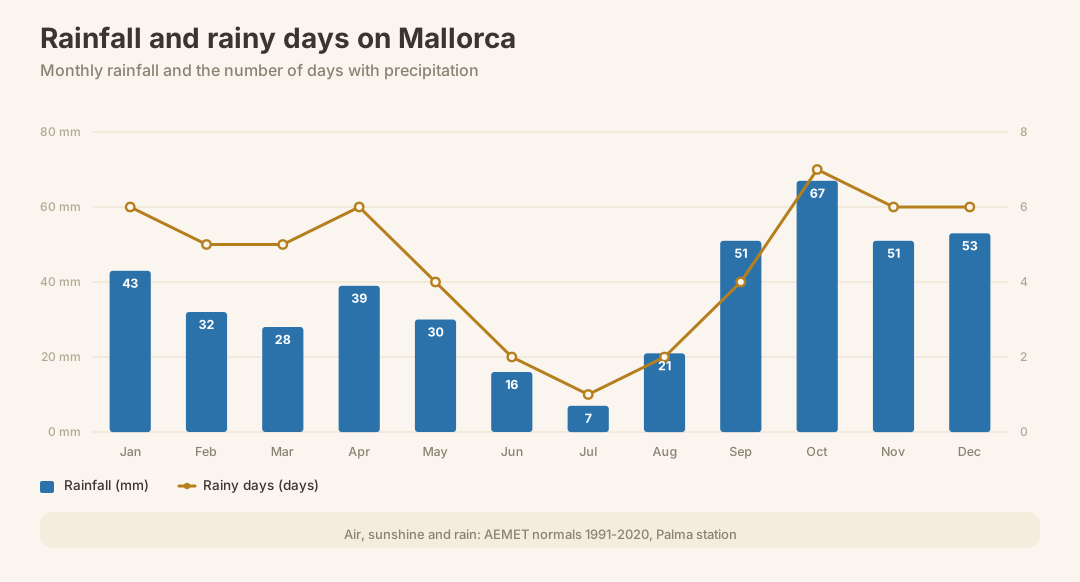
Rain on Mallorca follows a very clear annual rhythm that differs markedly from what one is used to in central Europe. High summer is practically free of precipitation: July has 1 rainy day, and only 7 mm falls in total. August is barely any different. For weeks on end the sky stays flawlessly blue, and clouds are more of a visual detail than a source of rain.
As soon as autumn begins, the picture flips. October is considered the wettest month of the year: on 7 rainy days, 67 mm falls – a substantial share of what accumulates over the entire year. November, too, remains noticeably wetter than the rest of the year, before winter follows with more moderate but still noticeable rainfall. Across the whole year, this adds up to 438 mm, spread over 54 rainy days.
What matters more for setting expectations on holiday is not the annual total but the way the rain falls. Mallorca barely knows the central European kind of persistent drizzle that drags a grey day out for hours. Instead, the rainfall is concentrated into comparatively few but intense events: heavy showers or thunderstorms that often affect only part of the day before giving way to clear skies again. Anyone travelling in autumn or winter should therefore not expect days on end of dull weather, but rather isolated, concentrated spells of rain that usually leave the rest of the day untouched.
Why it rains differently on Mallorca than in central Europe
The reason for this uneven pattern lies in the large-scale weather situation over the western Mediterranean. In summer, a stable subtropical high-pressure system settles over the Balearics. Sinking air masses almost entirely suppress cloud formation, so stable, dry conditions persist for weeks. During this phase, rain is not simply rarer – it is actively prevented by the large-scale circulation. This sets Mallorca fundamentally apart from temperate latitudes, where shifting low-pressure systems provide fairly even rainfall throughout the year.
In autumn, this balance shifts. The Mediterranean reaches its highest water temperature at this time of year; in October it stands at 22.0 °C. At the same time, the first cooler air masses begin to flow in from the northwest at altitude. When cold air aloft meets the still-warm, moisture-saturated air over the sea, a highly unstable system develops: warm, humid air rises explosively, forming powerful storm cells. In the Balearics, this weather pattern is known as the Gota Fría, literally "cold drop". It can bring as much rain within a few hours as would otherwise fall over several weeks.
This mechanism also explains why the same annual amount of rain is experienced completely differently on Mallorca than, say, in a region with an even distribution. If the yearly total were spread evenly across twelve months, it would result in consistently slightly overcast, moderately damp conditions. Instead, Mallorca experiences months of stable dryness, interrupted by brief but intense rainy spells. For travellers, this means that the likelihood of rain depends heavily on the season, rather than on chance or bad luck – those who choose summer are very likely to encounter stable dry conditions, while those travelling in late autumn should factor in brief, powerful changes in the weather.

Where it rains most on the island
Alongside the season, location on the island plays at least as significant a role – in fact, the spatial differences are greater than the seasonal ones. Responsible for this is the Serra de Tramuntana, which stretches like a barrier along the northwest coast. Moist air from the Mediterranean is forced to rise over the northwestern slopes, cooling as it does so, and the moisture condenses into cloud and rain. This effect, known as orographic rainfall, means that places such as Sóller, Deià, Fornalutx or the upland valley around Escorca receive many times more rain than reaches the south coast.
The south coast and the plain around Palma, by contrast, lie in the rain shadow of the mountains. Moist air masses have largely already shed their moisture on the mountains before reaching the south and southeast of the island. The wide plains of the Pla de Mallorca and the drier areas in the east likewise benefit from this position and remain considerably drier than the northwest.
At this point, however, an explicit caveat is needed: the data series underlying the figures in this climate portal comes from the station in Palma and therefore describes the conditions of the coastal plain in the south. We do not have an equivalently verified data series of our own for the mountainous areas of the Serra de Tramuntana. Anyone making concrete plans for the northwest of the island – a hike in the mountains, for instance – should not apply the figures given here for Palma without qualification, but should assume that it rains noticeably more often and more heavily there, even though we cannot put a figure on that here.
What a rainy day actually means on holiday
Meteorologically, a day already counts as a rainy day if only a small amount of precipitation is recorded – for holiday planning, that is not a particularly useful definition. What matters more in practice is the experience that a rain shower on Mallorca rarely claims the entire day. A typical pattern is a cloudy or unsettled morning, a heavy but time-limited shower or thunderstorm, and then clearing or once again sunny weather as the day progresses. Those who stay flexible can often split a rainy day in two: bridging the wet spell indoors and spending the rest of the day outside.
It is worth having alternatives in mind for precisely this wet spell, without a rainy day automatically counting as a lost day. Palma's old town, with its lanes, churches and courtyards, can be explored wonderfully under arcades and covered passageways. The island's numerous limestone caves are an indoor experience in any case and entirely weather-independent. Museums and exhibition venues, from small village museums to larger cultural institutions, are just as suitable as bodegas offering wine tastings and tours of their cellars. Those who prefer something calmer will find the island's thermal and spa facilities an obvious retreat for a rainy afternoon.
What matters is the underlying attitude: a single rainy day in autumn or winter on Mallorca is rarely a complete write-off, but rather an occasion to rearrange the day's schedule. Anyone who uses the time around the shower for indoor activities and plans the rest of the day for outdoors usually loses surprisingly little of their actual holiday time.
Drought is the bigger issue
From the island's own perspective, rain is not the real problem – its absence is. Mallorca covers a considerable part of its water needs from groundwater and from the few reservoirs in the uplands of the Serra de Tramuntana. Both sources depend directly on the autumn and winter rains falling reliably. If they fail to appear, or turn out weaker than usual, water levels drop noticeably, and in dry years this leads to restrictions on water extraction, for instance for agriculture or the irrigation of green spaces.
The island's agriculture, from the almond and olive groves inland to vegetable growing on the fertile plains, relies on these seasonal rainfall amounts, without artificial irrigation being able to replace them fully. The drinking water supply for the growing population and the tourism centres also comes under pressure during dry periods, which regularly leads to discussions about water-saving measures, desalination plants and more sustainable use of resources.
Some restraint is called for here: the data series underlying the figures in this climate portal describes a verified current state over a reference period, not a trend across the years. Whether and to what extent rainfall amounts are changing in the long term cannot be deduced from such a snapshot. What can be said, however, is that the island is already operating with an essentially tight water balance – and that, from this perspective, every heavy autumn rainfall is less a nuisance for travellers than a necessary replenishment of the reserves.
Frequently asked questions
Which month has the most rain in Mallorca?
Are there dry months in Mallorca?
Does it rain all day when it rains in Mallorca?
What can you do in Mallorca on a rainy day?
Is the Serra de Tramuntana rainier than the rest of Mallorca?
What's on in Mallorca in October
- Day Ø 18.3 °C
- Sea 22 °C
- Rain days 7
- Sun 6.4 h
- Daylight 10.9 h
Events
- Xino-xano. Stories and music for babies aged 0-2Sa Pobla
- Concert by Jove Camerata Acadèmica Sant LlorençCapdepera
- Correfoc for adults with CAPOCORP and DIMONIS DE HIACHATSantanyí
- Theatre: Apocalisis Fatxa! - Sala La FornalManacor
- They sing and tell tales: scary legends in Mallorca, Night of Souls. Turn on the light and banish your fear!Capdepera
- ‘Our Blai’: Xavier Pla and Maria BohigasSantanyí
Worth doing now
- Plan a museum or wine-tasting day for the odd rain shower rather than letting it disrupt the whole trip.
- Use a rainy morning for Palma's covered markets, then head out again once it clears.