
Investing in Mallorca Property: Returns 2026 – Long-Term Rental vs Holiday Letting
Anyone buying a property on Mallorca in 2026 who is thinking beyond purely personal use faces a central question: can you achieve a better return with long-term rental or holiday letting — and which route suits your own risk profile? The market has changed structurally: average prices of 7,370 € per m² island-wide (according to the CRES market study 2026), a de facto moratorium on new holiday rental licences, and a simultaneously strained long-term rental market all combine to create a complex picture. This guide shows you, as an investor, how to calculate the net rental yield of both models realistically, which costs, taxes and regulatory hurdles you need to factor in, and which locations in 2026 offer the best balance between entry price and yield potential.

Which rental model suits your Mallorca property — and what do you actually keep after tax?
- 📩 Submit a personal enquiry — Individual yield assessment for your property
- Everything about renting out property on Mallorca
Mallorca's property market in 2026: what you need to know as an investor
The starting point for property investors on Mallorca in 2026 is more ambivalent than ever: prices continue to rise unabated, supply remains tight — and at the same time the regulatory screw is being tightened further. Anyone investing here needs a clear strategy.
The independent CRES market study (Steinbeis Transfer Institute, twelfth edition, in cooperation with Porta Mallorquina) shows an island-wide average price per m² of 7,370 € for 2026 — an increase of 9.8 per cent compared with the previous year. Since 2015, prices have effectively almost doubled (+97 %). Existing properties rose in value by around 12 per cent, considerably more strongly than new builds (+4 %), even though new builds per m² remain 24 per cent more expensive than existing stock.
| Region | Avg. price/m² 2026 | Price trend |
|---|---|---|
| South-west (Andratx, Son Vida, Calvià) | from 10,000 € | Luxury segment +84 % |
| Palma (apartments) | 5.000–10.000 € | stable–rising |
| North-east | Supply +21 % | up to +17 % |
| South-east | Supply +24 % | strong growth |
| Island-wide (avg.) | 7.370 € | +9.8 % |
At the same time, data from the Spanish notarial portal show that the number of residential property transactions in the Balearic Islands in November 2025 fell year-on-year by 13.9 per cent has fallen – one of the steepest declines across Spain. High price levels and regulatory pressure are dampening transaction volumes without pushing prices down significantly.
Note: The price gap between straightforward resale properties and top-end products with sea views is enormous. Properties with premium sea views or a private luxury pool each account for only around 2 % of available supply, according to the study – scarcity is driving premium prices well above the average.
For a detailed overview of price trends by location, see our Property Prices Guide.
Purchase Costs: What You Must Factor In Before Calculating Your Return
Before comparing rental income against the purchase price, buying costs must be included in any return calculation. In Mallorca (Balearen), the following items typically arise when purchasing a resale property:
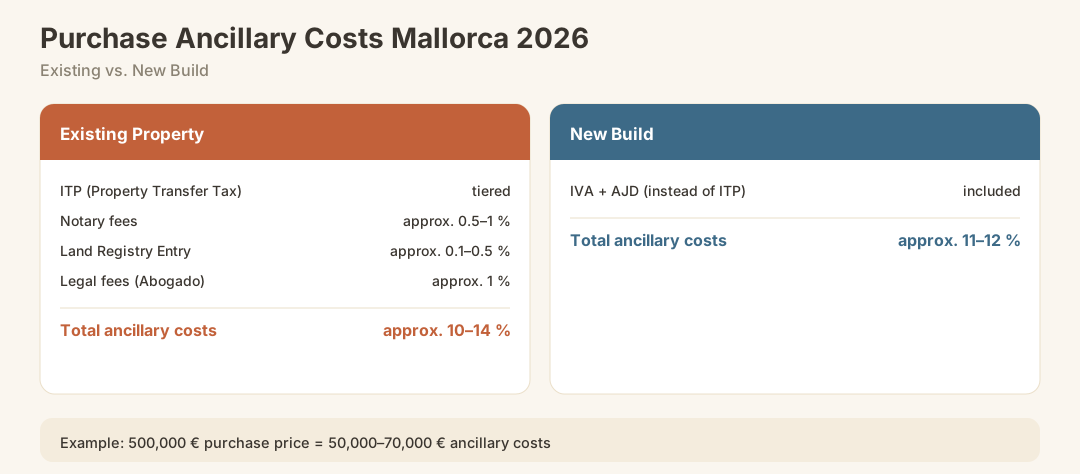
| Cost Item | Amount (approx.) | Basis |
|---|---|---|
| ITP (Property Transfer Tax Balearen) | tiered according to purchase price | Balearen rate, details → ITP Balearen 2026 |
| Notary fees | approx. 0.5–1 % | Purchase price |
| Land Registry entry | approx. 0.1–0.5 % | Purchase price |
| Legal fees (Abogado) | approx. 1 % | Purchase price |
| Total purchase costs (resale) | approx. 10–14 % | Purchase price |
| New build (IVA + AJD instead of ITP) | approx. 11–12 % | Purchase price |
This means: anyone buying a property for 500.000 Euro will realistically 50,000–70,000 Euro in additional purchase costs – capital that generates no return and significantly reduces the return on equity in the first few years. More on this in the guide to Purchase Costs Mallorca.
Model 1: Long-term rental – stable returns, manageable risk
Long-term letting (Spanish: arrendamiento de vivienda) is governed by the national tenancy law (LAU). Tenants enjoy security of tenure; the minimum tenancy period is generally five years for private landlords (and generally seven years where the landlord is a legal entity). For you as an investor this means: predictable income, virtually no seasonal fluctuations, but limited flexibility.
What rental income can you achieve from long-term lets on Mallorca?
Demand for long-term rental properties on Mallorca is considerable: the tight housing market – driven by tourism pressure, population growth and sluggish new construction – is pushing rents up. In Palma, monthly rents of 1,200 to 2,000 Euro are typical for well-appointed apartments (80–100 m²), and even higher in sought-after locations.
| Property type / Location | Monthly rent (approx.) | Annual rental yield (gross) |
|---|---|---|
| Apartment 70 m², Palma (standard) | 1.200–1.500 € | 14.400–18.000 € |
| Apartment 90 m², Palma (good) | 1.500–2.000 € | 18.000–24.000 € |
| House/Villa 150 m², surrounding area | 2.000–3.500 € | 24.000–42.000 € |
| Apartment, rural municipality | 800–1.200 € | 9.600–14.400 € |
Typical ongoing costs (borne by the landlord):
- IBI (property tax): varies depending on the municipality and cadastral value → IBI Guide
- Comunidad de Propietarios (service charge): depending on the development 50–300 €/month → Owners' Community Spain
- Buildings insurance: recommended → Home Insurance Spain
- Management/Property Management: approx. 5–10 % of the rent
Tax treatment: Rental income is subject to Spanish income tax (IRPF). Landlords not resident in Spain (non-residents) pay a flat rate of 19 % (EU/EEA nationals) on net income. Deductible expenses include interest, depreciation, management fees and repairs.
Note: Under certain conditions, Spain offers tax incentives for long-term landlords – depending on the letting situation, deductions on net rental income may be available. The precise conditions change regularly; have these checked by a tax adviser (Asesor Fiscal) in your individual case.
More details on long-term letting: Long-term Rental Mallorca
Model 2: Holiday Rental – Higher Income, More Complex Framework
Holiday rental (arrendamiento de viviendas vacacionales, ETV = Estancia Turística Vacacional) was long the dream of many Mallorca investors: attractive weekly rates can be achieved during peak season, and when calculated over many weeks, the figures sound enticing. Yet by 2026, the reality has changed fundamentally.
ETV Licence: Effective Freeze on New Grants Since Decreto 4/2025
Arguably the most significant regulatory development for Mallorca investors in 2026 is the Decreto 4/2025 of the Balearic Government: this regulation has effectively frozen the granting of new ETV licences for apartments in multi-family residential buildings (so-called pisos). New holiday rental licences for this property category are therefore no longer available in the Balearics.
What does this mean in practice?
| Property Category | ETV Licence Possible in 2026? |
|---|---|
| Detached houses, fincas, villas | generally yes (existing rules apply) |
| Apartments/flats in multi-family buildings | New grants frozen (Decreto 4/2025) |
| Properties with an existing ETV licence | transferable on purchase – subject to individual assessment |
| Urbanisations with a zoning plan | depends on the municipality – always check |
Please note: Anyone who rents out a property as a holiday let without a valid ETV licence risks substantial fines. Inspections in the Balearics have been stepped up considerably in recent years. Full details on the licence requirement: ETV Licence Mallorca
What Does Holiday Rental Actually Generate?
Anyone who purchases a property with an existing ETV licence, or acquires a villa or finca that meets the relevant requirements, can continue to welcome holiday guests. Income is – with professional management – higher than with long-term rental, but costs are also considerable.
Realistic example calculation (villa, 4 bedrooms, south-west Mallorca):
| Item | Amount/Year |
|---|---|
| Gross rental income (20 weeks at an average of 3.500 €/week) | 70.000 € |
| Agency management fee (20–25 %) | –15.750 € |
| Cleaning, laundry, service | –6.000 € |
| Minor repairs, maintenance | –3.500 € |
| Electricity, water (landlord's share) | –2.500 € |
| IBI, Comunidad, insurance | –4.000 € |
| Void months (pro rata) | already accounted for |
| Net income before tax | ca. 38.250 € |
| Spanish income tax (19 %, EU citizens) | –7.268 € |
| Net return after tax | ca. 31.000 € |
Based on a purchase price of 900.000 Euro (plus approx. 12 % ancillary costs = approx. 1.008.000 € total investment), this gives a net rental yield of approx. 3,1 %. The gross yield before costs and taxes is around 7,8 % – the figure agents like to quote, but one that is rarely achievable without qualification.
Please note: The actual return depends heavily on occupancy. 20 weeks is realistic for premium locations; in weaker locations or with less professional management, the figure can be significantly lower – which considerably worsens the calculation.
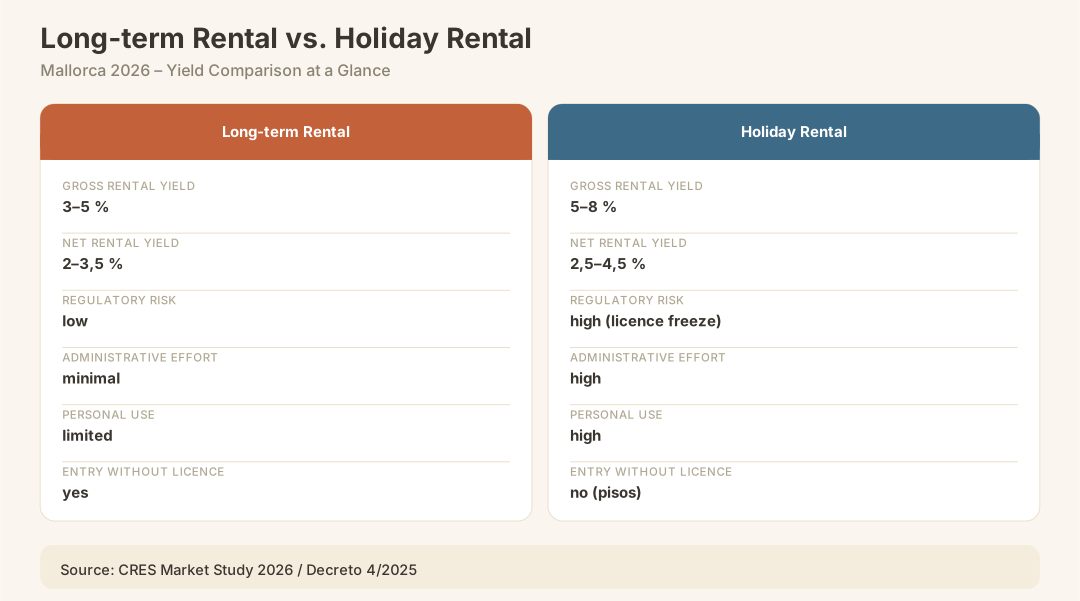
Yield comparison: long-term rental vs. holiday letting at a glance
| Criterion | Long-term rental | Holiday letting |
|---|---|---|
| Gross rental yield (approx.) | 3–5 % | 5–8 % |
| Net rental yield after costs & taxes | 2–3,5 % | 2,5–4,5 % |
| Regulatory risk 2026 | low | high (licence freeze) |
| Administrative burden | low | high |
| Flexibility for personal use | low | high |
| Tax deductibility | good | good |
| Default risk | medium (tenancy law) | seasonal |
| Capital appreciation potential | equal | equal |
| Entry possible without licence | yes | no (pisos) |
Comparison conclusion: The higher gross figures for holiday letting shrink after costs, taxes, and realistic occupancy rates to a level that is often not far above long-term rental — but with considerably more effort and regulatory risk attached.
Which locations offer the best yield-to-price ratio?
Not everywhere on Mallorca are purchase price and achievable rental income equally well balanced. While the south-west features the highest prices alongside the highest holiday rents, structurally growing locations in the north-east and south-east can offer more attractive entry opportunities.
| Location | Ø Price/m² | Long-term yield potential | Holiday yield potential | Note |
|---|---|---|---|---|
| South-west (Andratx, Calvià, Son Vida) | from 10.000 € | low (high purchase price) | medium-high | Luxury segment, ETV stock scarce |
| Palma (old town, Santa Catalina) | 7.000–10.000 € | medium | restricted (licence freeze on pisos) | High long-term demand |
| North-east (Alcúdia, Pollença) | below average | medium | medium | Supply +21 %, growing |
| South-east (Santanyí, Ses Salines) | below average | medium | medium-high | Supply +24 %, up-and-coming |
| Inland/villages | favourable | low-medium | low | Emerging appreciation, niche appeal |
Tip: According to market research, the north-east and south-east offer the strongest supply growth in 2026 – giving buyers more choice and potentially stronger negotiating positions, without having to forgo price momentum.
Tax on rental income: what do you actually keep?
The tax treatment of rental income depends on whether you are classified as a resident or non-resident in Spain.
Non-residents (the most common situation for German investors):
| Tax type | Rate | Tax base |
|---|---|---|
| IRNR (non-resident income tax) | 19 % (EU/EEA) | Net rental income after expenses |
| IBI (property tax) | per municipality | Cadastral value |
| Wealth tax (Balearic Islands) | progressive | Property value → Wealth tax Spain |
| Tourism levy (ETV rental) | depending on season/category | per guest per night → Sustainable tourism tax |
Residents declare rental income via IRPF (progressive income tax). Different — and in some cases more favourable — rules apply here. Individual advice from an Asesor Fiscal is strongly recommended.
Please note: Tax law is subject to change. The Balearic tourism levy (Ecotasa) applies to holiday rentals and is charged per guest per night — the exact amount varies depending on the season and accommodation category. Have current rates confirmed by an Asesor Fiscal. For more on the tax implications: Taxes & Law Mallorca
Total return: capital appreciation as the third pillar
The net rental yield alone only tells part of the story. For Mallorca properties, capital appreciation has historically been a significant return component: since 2015, prices across the island have risen by around 97 per cent.
Looking ahead, however: past appreciation is no guarantee of future performance. CRES forecasts further growth for 2026, albeit more moderate than during the boom years. Anyone speculating solely on capital gains is taking on market risk.
Total return example (simplified, 5 years, long-term rental):
| Component | Amount (example) |
|---|---|
| Purchase price 2021 (500,000 €) + ancillary costs (60,000 €) | 560,000 € total investment |
| Net rental income over 5 years (Ø 15,000 €/year) | 75.000 € |
| Estimated capital appreciation (Ø 7 %/year, cumulative) | approx. +200,000 € |
| Total value increase (rental income + capital gain) | approx. 275,000 € |
| Total return on equity (5 yrs.) | approx. 49 % |
This is a model calculation – it assumes constant rental occupancy, zero vacancy, and a continuation of the current price trend. As a point of reference, however, it illustrates why Mallorca properties remain attractive to many investors despite moderate ongoing rental yields.
Financing and return on equity
Leverage can boost the return on equity – provided the interest rate is below the property yield. In Mallorca, non-residents can generally finance up to 60–70 % of the purchase price via a Spanish mortgage; residents generally up to 80 %.
Important: Financing costs must be factored into the yield calculation. With a loan interest rate of 3.5 % and a gross rental yield of 4–5 %, the leverage effect is limited and the risk should not be underestimated.
More on financing options: Hypothek Mallorca
The most common mistakes when investing for yield in Mallorca
Many investors make the same avoidable mistakes. Here are the most important ones – and how to avoid them:
- Confusing gross with net: Agents quote gross yields. After deducting management, maintenance, vacancy, IBI, Comunidad and taxes, the figure shrinks considerably.
- Not checking the ETV licence status before purchase: Anyone assuming they can simply let any property as a holiday rental has had a problem since Decreto 4/2025. Always check before signing at the notary.
- Underestimating purchase ancillary costs: 10–14 % in ancillary costs is capital that is missing from the yield calculation.
- Misjudging seasonality: 20 peak-season weeks are realistic in prime locations – but often not in B-locations or without professional management.
- Ignoring renovation costs: Existing properties frequently require investment. Renovation costs in Mallorca are considerable in 2026; a buffer of at least 10–15 % of the purchase price is advisable. More: Bauen & Renovieren Mallorca
- Land registry entries not checked: Encumbrances, debts or unclear ownership in the land registry can prove costly. → Grundbuch Spanien prüfen
- Neglecting tax optimisation: Whether direct purchase, SL structure or holding company – the choice of purchase structure has a significant impact on the tax burden. → Immobilie per SL kaufen
- Ignoring the okupas risk: During vacancy between bookings or in breaks between long-term tenancies, a well-thought-out security concept is advisable. → Okupas Mallorca Protection
What Comes Next? Decisions After the Purchase
The purchase is the beginning, not the end. Afterwards, a number of operational decisions need to be made:
- Choosing a property manager: Professional management typically costs 15–25 % of rental income, but saves an enormous amount of time and reduces vacancy rates.
- Obtaining an energy certificate: Mandatory for letting. → Energy Certificate Spain
- Planning maintenance: Air conditioning, pool, garden – ongoing costs that are often underestimated. → Air Conditioning Mallorca
- Keeping an exit strategy in mind: When and how the resale process works, and which taxes apply: → Taxes on Property Sales Spain
- Inheritance planning: Mallorca properties must be included in estate planning. → Inheritance & Gifts Balearic Islands
Checklist: Investment Property Mallorca 2026
Before making a purchase decision, you should tick off the following points:
- Land registry extract (Nota Simple) requested and checked for encumbrances, debts, and easements
- ETV licence status of the property clarified (existing / transferable / not possible)
- ITP rate and purchase ancillary costs calculated specifically for your property
- Yield calculation prepared on a net basis (incl. taxes, management, maintenance, vacancy)
- Financing structure and equity requirement determined
- Purchase structure (private vs. SL) discussed with a tax adviser
- Energy certificate of the property reviewed
- Potential renovation costs estimated and factored in
- Community charge amount (Comunidad de Propietarios) enquired about
- IBI for recent years reviewed
- Property management quotes obtained
- Abogado (independent solicitor) engaged
Conclusion: Is investing in a Mallorca property worthwhile in 2026?
Yes – but not blindly, and not for everyone. In 2026, Mallorca is not a straightforward yield market in the traditional sense: with ongoing net rental yields of a realistic 2–4.5 % (depending on the model and location), the island sits on a par with other European premium destinations. The historical price appreciation of around 97 % since 2015 has been impressive – whether it will continue at that pace remains uncertain.
What sets Mallorca apart from other markets is the combination of owner-occupation, lifestyle appeal, international investor sentiment, and structurally constrained supply. Buyers who purchase a property with an existing ETV licence or as a long-term rental in a sought-after location, finance it carefully, and manage it professionally can achieve a viable return despite high entry prices.
Those who speculate on renting out a Palma flat quickly as a holiday let without a licence will, since Decreto 4/2025, rapidly run into regulatory barriers.
The best return decision starts with a sober, comprehensive calculation – and a clear answer to the question: would I still be happy buying this property even if letting it out doesn't go to plan?
Official sources
- CRES – Center for Real Estate Studies (Steinbeis-Transfer-Institut): Market study Mallorca 2026, in cooperation with Porta Mallorquina — porta-mallorquina.de/blog/marktstudie-immobilien-mallorca-2026
- Consell de Mallorca – Tourism & ETV licences (holiday lettings): conselldemallorca.net
- Govern de les Illes Balears – Decreto 4/2025 (ETV regulation): caib.es / BOIB
- ATIB – Agència Tributària de les Illes Balears (ITP, taxes): atib.es
- AEAT – Agencia Estatal de Administración Tributaria (IRNR, IRPF): agenciatributaria.es
- Consejo General del Notariado – Statistics portal for transaction data in the Balearic Islands: notariado.org
- BOE – Boletín Oficial del Estado (LAU, Spanish tenancy law): boe.es