
Balearic Islands first-time buyer grant: who can get up to €10,000
For people under 40 in the Balearic Islands, buying a home on their own is now almost out of reach: purchase prices are well over €300,000, buying costs add another 10 to 14 per cent, and banks rarely finance more than 80 per cent. The Balearic regional government has therefore put together a tiered support package combining three measures: a direct grant of up to €10,000, a full ITP exemption for the youngest buyers, and a government guarantee for the portion of the mortgage the bank would not otherwise finance. This guide explains exactly who is eligible, what documents you need, how to apply step by step and where the most common pitfalls lie. The information on the direct grant is based on the funding terms published in July 2026 (Convocatoria 2026–2027).

The Balearic support package at a glance
Balearic President Marga Prohens announced or confirmed three complementary measures in the general parliamentary debate on 7 October 2025, aimed specifically at young first-time buyers in the Balearic Islands. They work together and, based on the information available so far, can be used at the same time.
| Measure | Who it is for | Main benefit |
|---|---|---|
| Direct grant | Aged 40 or under, with 5 years of continuous residence in the Balearic Islands | Up to €10,000, with no repayment required |
| ITP exemption (0%) | Under 30, first-time buyers | No ITP on the first €270,151.20; 8% above that |
| Hipoteca Joven / guarantee | Young buyers (exact age limit depends on the scheme) | Government guarantee for up to 100% of the purchase price |
Note: Since 14 June 2026, the Balearic property value threshold for ITP relief has depended on the island: €331,859.70 on Mallorca and Menorca, and €378,211.68 on Ibiza and Formentera (Ley 4/2026; Orden 5/2026 as amended by Orden 13/2026).
Buyers aged between 30 and 39 who no longer qualify for the 0% ITP category can still benefit from the direct grant and, where applicable, a reduced ITP rate. The standard Balearic rates for existing properties rise progressively from 8% (up to €400,000) through 9% (€400,001–€600,000) to 13% (over €2,000,000), so any saving makes a noticeable difference.
Who is eligible? The main requirements
Age limit
The direct grant is available to people aged 40 or under. Your age on the date you apply is what counts.
Residence requirement: 5 years in the Balearic Islands
The key eligibility requirement is proof of at least five years of residence in the Balearic Islands (Empadronamiento). This reflects the stated policy aim of prioritising help for people with lasting roots on the islands. The five years must be continuous and immediately precede the application, and you must remain resident until the purchase. If two people buy together, it is enough for one of them to meet this requirement.
First-time purchase – no existing property ownership
The grant is available only for a first property purchase. Anyone who already co-owns a property – even a share acquired through inheritance or as a gift – must disclose this when applying.
Owner-occupation
The purchased property must be used as the buyer’s main residence (vivienda habitual). Subsequently letting it or using it as holiday accommodation would trigger repayment of the grant. The required period of owner-occupation will be set out in the implementing regulations.
Purchase price limit
Since 14 June 2026, the ceiling for tax relief has depended on the island: 331,859.70 euros on Mallorca and Menorca, 378,211.68 euros on Ibiza and Formentera. The direct grant is subject to the conditions of the Convocatoria 2026–2027; check the property price limit there.
The direct grant: how much, for whom and when?
Amount
The grant is a fixed 10,000 euros per property – a direct, non-repayable payment from the Balearic regional budget. If two people buy together, it is divided according to their ownership shares.
What the grant covers
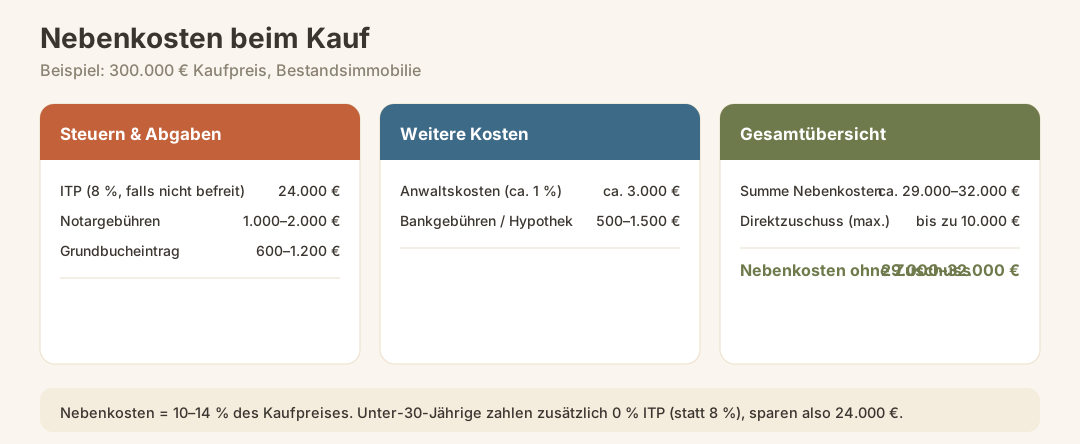
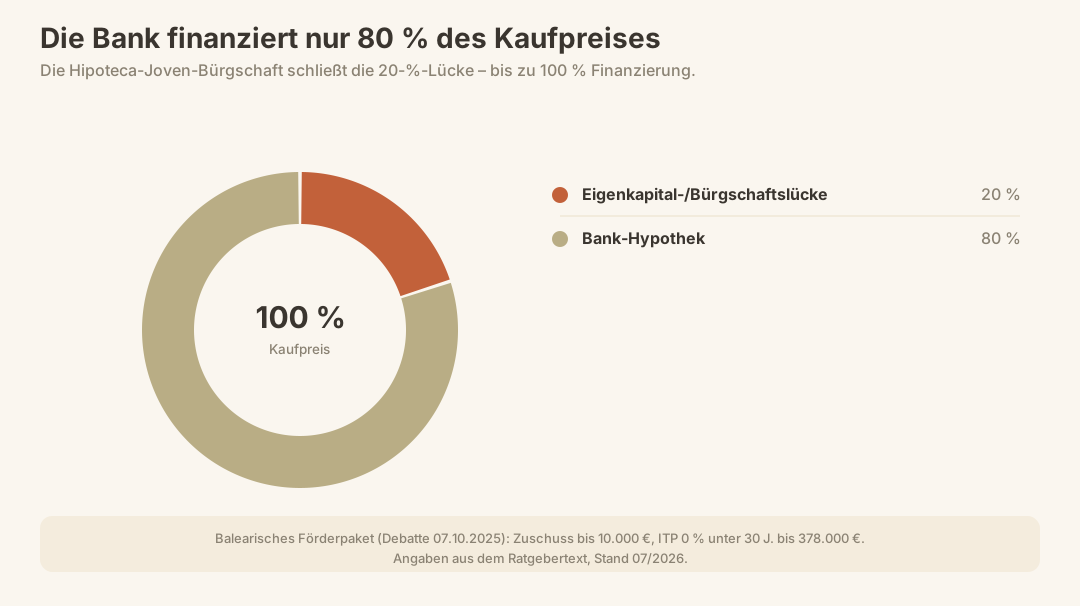
The grant is intended to help with the additional costs of buying – bridging the funding gap that arises because banks typically finance only 80% of the purchase price, while the additional costs of buying on Mallorca add another 10–14% on top.
| Cost item | Typical amount for a purchase price of €300,000 |
|---|---|
| ITP (8% of €300,000, if no exemption applies) | €24,000 |
| Notary fees | €1,000–2,000 |
| Land Registry registration | €600–1,200 |
| Legal fees (approx. 1%) | approx. €3,000 |
| Bank fees / mortgage costs | €500–1,500 |
| Total additional costs | approx. €29,000–32,000 |
A €10,000 grant therefore covers a substantial share of the additional costs — provided you are not already fully exempt from ITP.
ITP exemption: 0% for buyers under 30
Anyone who buys a property before their 30th birthday pays no property transfer tax (ITP) in the Balearic Islands — provided the purchase price does not exceed the threshold for their island: €331,859.70 on Mallorca and Menorca, and €378,211.68 on Ibiza and Formentera. The relief applies to the first €270,151.20; the amount above that is taxed at 8%. On a purchase price of €300,000, you would therefore pay €2,387.90 in ITP to ATIB (Agència Tributària de les Illes Balears), rather than €24,000 without the relief.
According to the regional president, more than 1,500 young people have already benefited from this measure.
Note: The ITP exemption applies to existing properties (resale properties). New-build properties are subject to VAT (IVA, currently 10% for residential properties) plus stamp duty (AJD) instead of ITP; separate rules apply.
Important: The five-year residency requirement applies to the direct grant. Under Article 14 quater of Decreto Legislativo 1/2014, the ITP exemption requires you to have been ordinarily resident in the Balearic Islands for at least three years immediately before the purchase. There is also an income limit of €52,800 for individual tax returns and €84,480 for joint tax returns, and a mortgage loan of at least 60% of the appraised value is required.
ITP overview for first-time buyers in the Balearic Islands
| Buyer's age | ITP rate | Price limit | Conditions |
|---|---|---|---|
| Under 30 | 0% on the first €270,151.20; 8% above that | up to €331,859.70 (Mallorca/Menorca), €378,211.68 (Ibiza/Formentera) | First purchase, main residence, at least 3 years' residence in the Balearic Islands, income up to €52,800 (individual) or €84,480 (joint), mortgage of at least 60% of the appraised value |
| 30–39 years old | Standard tiered rates (from 8%) | not applicable | No special rate, but a grant may be available |
| 40 years old and over | Standard tiered rates (from 8%) | not applicable | No special grant |
This calculator shows how much property transfer tax (ITP) you'll still have to pay if the exemption applies — enter your purchase price and select your buyer profile:
Transfer tax (ITP)
Explanation
The taxable base (base imponible) is the value used to calculate the tax: the price stated in the deed or the higher cadastral reference value. Enter the higher value.
Explanation
A main home (vivienda habitual) is the home you normally occupy under Spanish income tax rules. Select a profile only if you meet all its conditions; the calculator checks the value threshold and transaction date.
The general tariff applies without personal tax relief, for example when buying a second home.
- Property transfer tax (ITP) payable
- €25,600.00
Legal status: 14 June 2026
This calculation is provided for guidance only and is not a substitute for tax or legal advice in specific cases.
Hipoteca Joven: When the bank will only lend 80%
Mortgage calculator
Explanation
The loan amount is the capital originally granted. The preset is arithmetically consistent with the selected loan-to-value share of the example purchase price.
Explanation
These are this calculator’s three modelling paths, not a statutory product classification: a fixed rate, index plus margin, or a fixed phase followed by a variable phase.
Explanation
TIN (tipo de interés nominal) is the nominal annual interest rate before costs; TAE (tasa anual equivalente) includes costs and payment timing and does not belong in this field. The preset is a round worked example, not a market rate.
Explanation
The total term determines the number of monthly payments. The preset is a worked example.
- Monthly payment (cuota)
- €1,280.37
Why this figure?
The cuota is the regular monthly payment of interest and principal under the French annuity system.
Model calculation: twelve equal months, first payment one month after disbursement, no stub period and the calculator’s own cent rounding. The bank schedule can differ because of its day-count convention, stub period and rounding. The controlling documents are the FEIN (European Standardised Information Sheet containing the binding loan information) and the escritura (notarial loan deed).
Legal status: 1 January 2023
This calculation is provided for guidance only and is not a substitute for tax or legal advice in specific cases.
The third pillar of the support package is the Hipoteca Joven, a government guarantee under which the Balearic regional government covers the portion of the financing that banks typically won't provide. In theory, this makes 100% financing with no deposit from your own funds possible – a huge advantage for young buyers with no savings.
Note: Full financing still means higher monthly repayments and greater interest-rate risk. Before committing, ask an independent financial adviser to calculate what your monthly payments would be.
For details of how the mortgage works in practice, read our guide to property financing in Mallorca.
Step by step: How to apply for the direct grant
The eligibility criteria have been published since July 2026. Submit your application as a declaration (declaración responsable), together with supporting documents, online or in person, to the Conselleria de Vivienda, Territorio y Movilidad; full details are available at adquisiciohabitatge.caib.es.
Get an NIE – You cannot apply without a Número de Identificación de Extranjero. Apply for your NIE well in advance through the Policia Nacional or a consulate in Germany. Processing typically takes several weeks, depending on the time of year.
Provide proof of empadronamiento – Obtain a certificate (certificado de empadronamiento histórico) from your local town hall (Ayuntamiento) documenting your full five-year period of residence without gaps.
Sign a purchase agreement (Contrato de Arras) – In most cases, you can only submit a formal application for support once you have a legally binding preliminary or reservation agreement. Read more in our guide to the reservation agreement.
Have the property checked – Before applying, clarify the land registry status, any charges and the property's planning status. You can find useful information in the article Checking the Spanish land registry.
Submit your application – Online via adquisiciohabitatge.caib.es or in person at the Conselleria de Vivienda. Make sure you have all the required documents ready (see the checklist below).
Wait for the grant decision – You will receive confirmation only after a positive decision and, as a rule, before signing the purchase deed before a notary. Check in advance whether the grant will be paid before or after the notary appointment.
Notary appointment and completion of the purchase – The purchase itself takes place before a Spanish notary. The ITP exemption is declared at this stage; the grant is paid separately.
Land registry registration – After the notary appointment, the property is registered in your name at the Registro de la Propiedad.
Checklist: Documents you need
| Document | Note |
|---|---|
| Valid passport or DNI | Original required |
| NIE certificate | Current and valid |
| Certificado de empadronamiento histórico | Must show at least 5 years of residence in the Balearic Islands |
| Proof of income (IRPF tax returns) | For the last 1–2 years, complete |
| Contrato de arras / reservation agreement | Stating the purchase price and the property being purchased |
| Nota simple from the land registry | No more than 3 months old |
| Declaration that you do not own any other property | Official form or notarised declaration |
| Proof of bank account (Spanish IBAN) | For payment of the grant |
The most common mistakes – and how to avoid them
Gaps in proof of residence The most common reason for rejection is being unable to document the full five-year residence requirement because changes of address were not registered or the certificado histórico is incomplete. Request the certificate from the Ayuntamiento well in advance – it can sometimes take several weeks.
Purchase price exceeds the island’s value limit If the purchase price is even one euro above your island’s value limit – €331,859.70 on Mallorca and Menorca, €378,211.68 on Ibiza and Formentera – the tax relief is lost entirely. Below that limit, it applies in stages: in full to the first €270,151.20, then at 8 percent on the remainder. Negotiate the purchase price accordingly, if possible.
Nota simple too old when applying The authorities generally will not accept a Nota simple from the Land Registry if it is more than three months old. Order a new one shortly before submitting your application.
Application submitted after signing before the notary For many grant schemes, you must submit your application before, or at the latest when, the purchase is completed. If you leave it until afterwards, you will often miss out.
Failure to meet the owner-occupation requirement If you rent out the property after buying it or use it as a holiday home, you risk having to repay the grant. An ETV licence for holiday rentals would also be problematic in this case – find out about the Mallorca ETV licence.
No independent legal advice A lawyer is particularly worthwhile when applying for public grants. Mistakes on the form or incorrectly completed declarations can lead to rejection, which may be difficult to remedy afterwards.
How this interacts with other tax obligations
Buying a property in the Balearic Islands triggers several tax obligations you should know about – even if you receive a grant or tax relief.
| Tax / charge | Who pays | Note |
|---|---|---|
| ITP (property transfer tax) | Buyer | Exemption possible (see above) |
| IBI (annual property tax) | Owner | Payable from the year after purchase |
| Plusvalía municipal | Seller | Municipal tax; not relevant to first-time buyers |
| IRPF (imputed rental income) | Second-home owners | This charge does not apply to a primary residence |
| Notary fees / AJD (stamp duty) | Buyer | For new-build properties, instead of ITP |
For a complete overview of taxes when buying property, read our section on Tax & Law or our dedicated article on IBI tax.
What happens next? The steps after buying
The notary appointment is not the end of the process. These are the things to take care of immediately after buying:
- Land Registry registration (Registro de la Propiedad) after the notary appointment
- ITP tax return – submit it to ATIB; even if you are exempt, you must formally claim the exemption (deadline: one month from signing the deed)
- Empadronamiento at your new address – register your change of address with the Ayuntamiento; this is also important for future grant applications
- Take out home contents insurance – the bank will require it when you take out a mortgage anyway; find out more about home contents insurance in Spain
- Join the Comunidad de Propietarios – if your flat is in a shared development, there will be decisions, house rules and shared charges to consider; read all about it in our article on the property owners’ association in Spain
- Check the energy certificate – it should be provided when you buy and is relevant to future renovation grants
If you are considering energy-efficiency improvements in the longer term, it is worth looking at renovation grants in Mallorca.
Market context: Why the support is being introduced now
The announcement of purchase assistance is no coincidence. The Balearic property market is under structural pressure: demand – particularly from international buyers – remains strong, supply remains limited, and prices remain high despite a slight decline in transactions towards the end of 2025 (–13.9% for residential properties in November 2025 year on year, according to Spanish notaries). For local residents on local incomes, home ownership has effectively become unattainable. The support aims to ease this structural problem to some extent – not solve it. Anyone looking for a realistic view of current Mallorca property prices will find up-to-date assessments there.
Conclusion
The Balearic purchase assistance for first-time buyers under 40 is the most comprehensive regional support package the islands have seen so far: a direct grant of up to €10,000, an ITP exemption for under-30s on the first €270,151.20 within the island’s value limit, and a government guarantee that makes 100% financing possible. The main hurdles are proof of at least five years’ residence in the Balearic Islands, the price limit and the requirement to live in the property yourself. Anyone who meets all three conditions and submits a complete application early could secure a saving of four or five figures – and take a first step into one of Europe’s most expensive property markets.
For a guide to the full legal process, see our article on the property purchase process.
Official sources
- BOIB (Butlletí Oficial de les Illes Balears) – the Balearic Islands’ official gazette, where the support conditions are published: https://www.caib.es/eboibfront/
- IBAVI (Institut Balear de l'Habitatge) – the body responsible for housing support in the Balearic Islands: https://www.ibavi.es
- ATIB (Agència Tributària de les Illes Balears) – responsible for ITP exemptions and tax returns: https://www.atib.es
- Parlament de les Illes Balears – record of the general debate on 7 October 2025 (announcement of the support measures by Marga Prohens): https://www.parlamentib.es
- Agencia Tributaria (AEAT) – national tax authority responsible for IRPF matters: https://www.agenciatributaria.es