
Foreign buyers Mallorca: Who buys, where and why
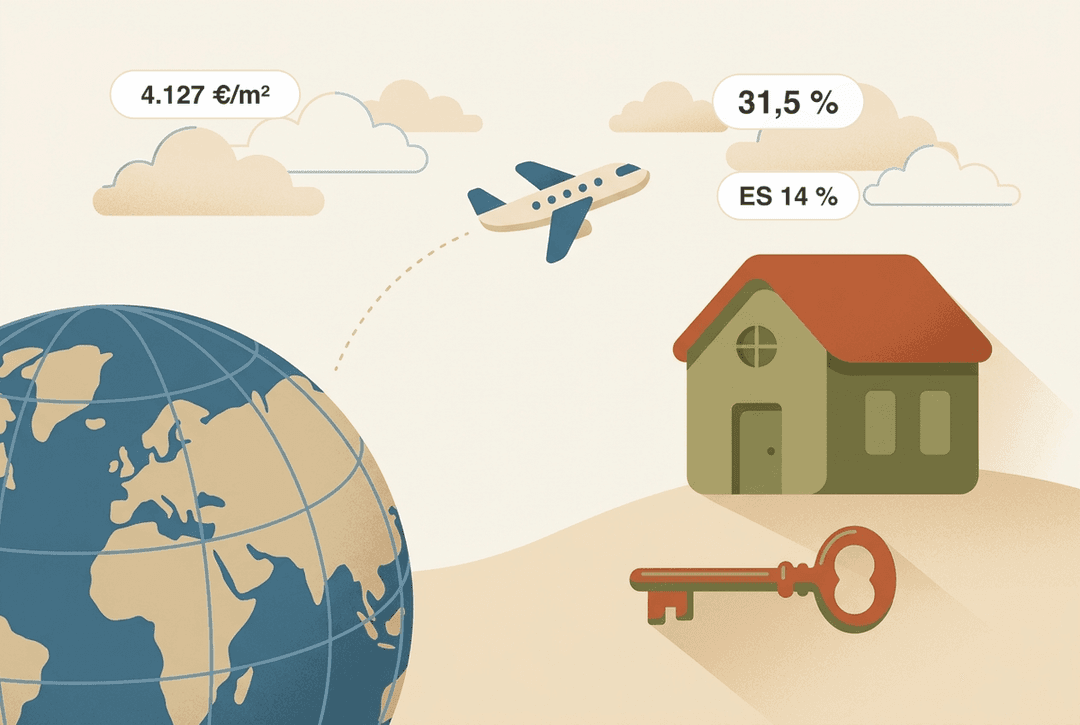
Hardly any Spanish province attracts as many foreign buyers as the Balearic Islands: 31.5 percent of all residential property sales in the fourth quarter of 2025 went to non-residents – more than double the Spanish average of 14 percent. Anyone wanting to understand why Mallorca properties hold their value even as interest rates rise must first understand who is actually buying here. This guide contextualises the available data on origin, buying motives, regions and financing structure, and shows which tax and legal questions specifically arise for international buyers in 2026 – from initial price research through to the question of whether and how a holiday property can later be rented out.

- Regions in price comparison
- Download the free Property Market Report 2026 (PDF) — all figures and regional profiles in detail
The market in 2026: prices, volume, dynamics
In 2025/26, the Balearic Islands broke free from the slipstream of the national property market. After eight quarters in which price development lagged slightly behind the Spanish average, the Balearic Islands are once again just ahead in the fourth quarter of 2025, with +13.4 percent year-on-year (Spain: +12.9 percent). The price level itself depends heavily on the survey method – the Notaries' Association, the Land Registry and mallorca.com aggregation arrive at different but consistently high figures.
| Indicator | Source | Period | Value |
|---|---|---|---|
| Average sale price (all residential properties) | Spanish Notaries' Association | February 2026 | €3,880/m² |
| Existing properties, Balearic Islands | Spanish Land Registry | Q4 2025 | €4,127/m² |
| New-build properties, Balearic Islands | Spanish Land Registry | Q4 2025 | €3,995/m² |
| Existing properties, Palma city | Spanish Land Registry | Q4 2025 | €4,086/m² |
| Overall aggregate, Balearic Islands | mallorca.com (Aggregation) | Q4 2025 | 4.101 €/m² |
Despite the price dynamics, transaction volume remains orderly: 10.986 residential property sales on Mallorca in 2025, around 1.190 monthly sales in the Balearics at the start of 2026 (January 1.197, February 1.188). Forced sales stand at a historic low of 45 cases in the fourth quarter of 2025 (compared with 105 in the same quarter of the previous year) – an indication that the market is not over-indebted but carried by strong capital.
Note: Four different public sources measure price levels using different methodologies. Figures should be read side by side, not added together.
Who buys on Mallorca? Foreign share compared across provinces
No mainland Spanish region comes even close to the Balearic share of foreign buyers. As early as the third quarter of 2024, the figure stood at 32,5 percent – more than double the nationwide average of 14,8 percent at the time, and clearly ahead of all other Spanish provinces.
| Province | Foreign buyer share (Q3 2024) |
|---|---|
| Balearics | 32,5 % |
| Valencia | 28,5 % |
| Canary Islands | 27,3 % |
| Murcia | 24,7 % |
| Catalonia | 16,8 % |
| Spain average | 14,8 % |
In the fourth quarter of 2025, the figure stands at 31,5 percent (Spain: 14 percent). The share was at times even higher in previous years – at the end of 2022 a figure of around 35 percent was recorded – but it remains by far the highest of all Spanish provinces. With around 3.000 sales in the quarter, this corresponds to an estimated 944 purchases by non-residents.
Countries of origin: DACH clearly in the lead
The leading countries of origin by volume are, in alphabetical order, Germany, France, the United Kingdom, Italy, the Netherlands, Austria, Poland, Sweden and Switzerland. The German-speaking region (DACH) together forms by far the largest buyer group; within DACH, Germany is clearly ahead of Switzerland and Austria. A reliable quantitative breakdown by nationality is not currently available in sufficient granularity in the public land registry data.
In addition, tourism origin data show the scale of the international communities on the island: over 3,4 million German visitors per year correspond to around 40 percent of total Mallorca tourism, while British visitors number around 2,3 million (26 percent). Scandinavian visitors are put at around 340.000 per year, French visitors at around 238.000, Swiss visitors at around 160.000 and Irish visitors at around 136.000.
| Origin | Annual visitor numbers (indicative) | Share of Mallorca tourism |
|---|---|---|
| Germany | 3,4 million+ | approx. 40 % |
| United Kingdom | 2,3 million+ | approx. 26 % |
| Scandinavia | approx. 340,000 | – |
| France | approx. 238,000 | – |
| Switzerland | approx. 160,000 | – |
| Ireland | approx. 136,000 | – |
Please note: These figures describe tourist flows, not buyer numbers. They should be read as a background indicator of the size of the respective international community, not as a direct purchasing statistic.
Why international buyers buy: motives and wealth structure
The purchasing motives of foreign buyers differ structurally from those of local buyers – and this shapes the entire premium market. Three groups of motives can be distinguished: the classic second home with seasonal own use, the shift of one's main residence (fully or for part of the year), and capital investment with a rental component. These motives frequently overlap within the same purchase.
What is decisive for the market is the financing structure behind it: local Spanish buyers finance the premium segment predominantly through mortgages, whereas international buyers from the DACH region, Scandinavia and the UK appear considerably more often with a substantial cash component – typically from the sale of a property back home, from liquid family wealth, or from the sale of a company or shareholding.
| Characteristic | Local buyers | International buyers (DACH focus) |
|---|---|---|
| Typical financing | predominantly mortgage | high cash share |
| Interest rate sensitivity | high | low |
| Reaction in bidding situations | more cautious when interest rates rise | faster commitments possible |
| Debt-to-income ratio Balearics (median) | 55% (Q4 2025) | generally significantly lower |
This structural difference in wealth explains why a shift in interest rates affects the Mallorca premium market differently than the Spanish mainland: capital-strong non-residents effectively set the price floor that the entire segment orients itself around. Anyone planning with equity capital from Germany, Austria or Switzerland will find further in-depth information under Equity capital & Lombard loan as well as on the practical process under Transferring money to Spain.
Where international buyers buy: eight regions, eight profiles
Mallorca is divided into eight regions, each with its own buyer profile. The concentration of international buyers and professional marketing varies greatly by region.
| Region | Population | Character | Typical buyer profile |
|---|---|---|---|
| Palma (city + Marratxí) | 475.208 | Urban economy, urban premium | highest liquidity, shortest holding periods |
| Southwest (Calvià, Andratx, etc.) | 68.979 | international premium locations, densest marketing | Lifestyle with high market liquidity |
| North (Pollença, Alcúdia, etc.) | 80.017 | Bays, highest density of rental licences | Rental-oriented investment |
| Northwest / Tramuntana | 30.509 | UNESCO World Heritage, heritage properties | rare stock that cannot be freely expanded |
| Northeast (Cala Ratjada, etc.) | 34.181 | tourist clusters, rural premium locations | Yield at a lower entry price |
| East (Manacor, Felanitx) | 77.530 | Finca stock, renovation potential | Value appreciation through renovation |
| South (Santanyí, Llucmajor, etc.) | 71.302 | the island's newest building stock | Owner-occupation with lower renovation risk |
| Island centre / Pla | 122.544 | Wine corridor, traditional Mallorca | lowest m² price, appreciation potential |
The south-west has historically concentrated the densest international buyer base and the island's most professional marketing – closely interlinked with the yacht infrastructure around Puerto Portals and Port Adriano. The north, on the other hand, leads in rental licence density: around 31 percent of all active holiday rental licences on the island are located there. You'll find an in-depth comparison under Regions in Price Comparison.
Financing: cash buyers meet strained local affordability
Interest rate trends show how differently market participants react. The one-year Euribor rose from 2.079 percent in July 2025 to 2.747 percent in April 2026 – a tightening of around 67 basis points in nine months.
| Period | Euribor 1-year |
|---|---|
| July 2025 | 2,079 % |
| February 2026 | 2,221 % |
| March 2026 | 2,565 % |
| April 2026 | 2,747 % |
For local buyers, this means increasing pressure: the average debt-to-income ratio in the Balearic Islands stood at around 55 percent of household income in the fourth quarter of 2025 – well above the roughly 35 percent mark historically considered sustainable. International buyers with a high equity ratio are largely unaffected by this development, which stabilises the premium segment while the local middle-class segment is being held back.
Anyone who, as a non-resident, still wants to obtain financing in Spain will find the relevant framework under Mortgage Non-Resident and on the fixed vs. variable rate option under Mortgage Fixed or Variable.
Tax framework for foreign buyers
In recent years, the Balearic Islands have adjusted several regional regulations that may be relevant for internationally oriented buyers. This overview reflects market observation and does not replace individual tax advice.
| Regulation | Key point |
|---|---|
| Inheritance and gift tax | substantial regional reduction for close relatives since 2023 (inheritance), and since 2025 also for lifetime gifts |
| Wealth tax allowance Balearic Islands | €3 million per person (as of 2024), compared to the €700,000 Spanish minimum standard |
| Beckham Law | 24% flat tax rate on employment income earned in Spain, for up to 6 tax years – a pure property purchase does not automatically qualify |
Note: The specific tax burden depends on degree of kinship, asset structure, tax residency, double taxation agreements, and individual home-country tax law. Check this with qualified advisors in Spain and in your home country before any purchase.
You'll find further information on wealth tax under Wealth Tax Property Purchase, on inheritance succession under Inheritance & Gift Tax in the Balearics, on the ongoing purchase costs under Additional Purchase Costs in Mallorca and on the current ITP rates under ITP Balearic 2026. Anyone wishing to structure the purchase through a company can find background information under Buying Property via an SL, and anyone planning to change their place of residence should check the implications in their home country under Exit Tax in Spain.
Rental: licence situation limits yield expectations
Yield calculator
Property and purchase
Explanation
The notarised purchase price excluding buying costs. It is the basis for gross yield; buying costs are added in the next step.
Explanation
Existing property or new build determines the purchase tax: existing property is subject to ITP (property transfer tax), while a new build is subject to IVA (value added tax) plus AJD (stamp duty on notarised documents).
Seasonal rates
High season (July, August)
Explanation
The price the guest pays per night for the whole property, excluding the tourist tax entered separately.
Explanation
The share of nights occupied in this season. The calculator rounds occupied nights down.
- Net yield (on purchase price including buying costs)
- 2.31%
- Result after tax
- €16,475.49
- Purchase price including buying costs
- €712,765.00
Legal status: 1 January 2026
This calculation is provided for guidance only and is not a substitute for tax or legal advice in specific cases.
Anyone viewing a Mallorca property also as an investment with rental income needs to know the licence situation. As of May 2026, Mallorca has a total of 17,034 active holiday rental licences. New licences for flats have generally been halted since April 2025; an existing licence is only transferable upon change of ownership under certain conditions.
| Region | Active licences | Share of the island total |
|---|---|---|
| North | 5.326 | approx. 31% |
| South | 2.800 | approx. 16% |
| East | 2.209 | approx. 13% |
| Central island | 2.174 | approx. 13% |
| Northeast | 1.533 | approx. 9% |
| Northwest / Tramuntana | 1.162 | approx. 7% |
| Southwest | 1.026 | approx. 6% |
| Palma | 804 | approx. 5% |
Note: An existing licence is a prerequisite for legal short-term rental – it is not an automatic guarantee of returns. Before buying, check individually: licence transferability, occupancy rate and daily rate for the specific location, existing standard, and the tax treatment of rental income.
Further reading: Transferring an ETV licence, Mallorca returns 2026 and Buying a holiday property.
The legal process: what foreign buyers need to know
Foreign buyers in Spain generally have the same property rights as Spanish citizens – EU citizens are not subject to any special restrictions, while non-EU citizens additionally require an NIE number (foreigner identification number). The process generally follows these steps:
- Preparation and market research (around 2–4 weeks): budget, region, selection of estate agent and lawyer.
- Viewing and inspection (around 1–2 weeks): property inspection, document review, price negotiation.
- Reservation or preliminary contract (Arras) (around 1 week): signing, deposit typically in the range of 5–10 percent of the purchase price.
- Legal due diligence (around 2–3 weeks): review of ownership rights, charges, building permits and community fees.
- Notary appointment and transfer of ownership: signing of the escritura, registration in the Registro de la Propiedad.
Important: Unlike in Germany, there is no neutral notary in Spain who automatically protects both parties equally – an independent legal review before signing the contract is standard practice for international purchases. Likewise, the land registry (Registro de la Propiedad) in Spain does not automatically establish ownership; it mainly serves to provide protection against third parties. The precise legal position should be clarified on a case-by-case basis with a Spanish lawyer.
Details on the process can be found under Property purchase: process, on the role of the notary under Notary Spain, on the reservation contract under Reservation contract Spain and on legal support under Property Purchase Lawyer. Anyone who cannot handle the purchase in person on-site will find information under Power of Attorney Spain Notary.
Most Common Mistakes Made by Foreign Buyers
International buyers regularly underestimate how much the Spanish purchase process differs from that in their home country. Recurring pitfalls include:
- Relying on German expectations regarding the notary and land registry, even though the protection mechanisms in Spain are distributed differently – independent legal review is often obtained too late.
- Underestimating the purchase-related additional costs, which must be budgeted for in addition to the purchase price.
- Buying a holiday property without checking the transferability of the licence – otherwise the rental component is lost without replacement.
- Lack of coordination regarding tax residency between Spain and the home country, especially in the case of a planned change of residence.
- Underestimating the impact of rising interest rates on debt financing, if insufficient equity is contributed.
What Happens After the Purchase?
After the handover of keys, international owners typically face further matters: the ongoing property tax (IBI), possible registration with the owners' association, the question of renting out or personal use, and – in the case of a planned change of residence – tax registration in Spain. Anyone wishing to rent out the property long-term rather than to holiday guests short-term will find the legal basis under Long-Term Rental Mallorca and regarding the ongoing tax under IBI Tax Spain. In the case of several co-owners or communities of heirs, the structure of the owners' association is also relevant, see Owners' Association Spain.
Checklist for International Buyers
- Apply for the NIE number in good time before signing the contract
- Engage an independent property lawyer in Spain before signing the reservation agreement
- Have the purchase-related additional costs and tax burden (ITP, possibly wealth tax) calculated in advance
- If intending to rent out: have the licence status and transferability checked in writing before making a purchase offer
- Coordinate the financing structure (cash portion, possibly mortgage as a non-resident) with the bank at an early stage
- Clarify the tax implications in the home country (double taxation, possibly exit taxation) before the purchase
- Plan the notary appointment and land registry entry with sufficient time buffer
Conclusion
By 2026, Mallorca is no longer a regional niche market, but Spain's most internationalised property market – with a foreign-buyer share more than double the Spanish average, and a clear DACH dominance within this buyer group. Anyone buying here as a German, Austrian or Swiss buyer encounters a market with high price dynamics, tight supply, and a buyer structure that is increasingly capital-strong rather than credit-driven. This opens up opportunities, but also shifts negotiating power – making thorough legal and tax preparation more important than ever.
Official sources
- Spanish Land Registry (Colegio de Registradores) – foreign-buyer share, existing-property and new-build prices: https://www.registradores.org
- Spanish Association of Notaries (Consejo General del Notariado) – average sale prices: https://www.notariado.org
- Spanish Statistics Institute (INE) – house price index, transaction statistics: https://www.ine.es
- Banco de España – Euribor, mortgage reference rate: https://www.bde.es
- IBESTAT (Balearic Statistics Authority) – tourism and population data: https://ibestat.caib.es
- AENA – passenger data for Palma Airport: https://www.aena.es
- Govern Illes Balears – special Balearic tax regulations, holiday-rental register: https://www.caib.es
- Agencia Tributaria (Spanish Ministry of Finance) – Beckham Law, wealth tax: https://www.agenciatributaria.es
British and Dutch buyers in the Spain comparison
British buyers are still buying residential property in Spain: in the first half of 2026, more than 3,510 registered purchases were made by British nationals. They accounted for 6.8 per cent of foreign buyers. Their interest is particularly visible in Andalusia and Murcia. Dutch buyers are also active; their property searches focus, among other places, on Alicante and other locations along the Mediterranean coast. These regional patterns do not, however, establish a single reason for buying.
There is no one-size-fits-all answer to where it is best to buy in Spain. Buyer statistics show where others search or buy, not whether a location suits your budget and plans for using the property. Anyone weighing up the mainland against an island should compare specific properties, including their purchase prices, ongoing costs and intended use. For Mallorca, the property overview offers a starting point; the regional differences are already set out on this page.