
Tips for Buying Property in Mallorca: What You Really Need to Know in 2026
Buying property in Mallorca ranks among the most complex transactions you can carry out in Spain – and simultaneously among the most rewarding. The market in 2026 is structurally tight: demand has outstripped supply for over a decade, and prices have risen by around 97 % in nominal terms since 2015. Anyone buying now needs cleartips for buying property in Mallorca – from the first viewing right through to the handover of keys at the notary. This guide shows you which documents you must check before signing the reservation agreement, what the buying process in Mallorca looks like step by step, which taxes and ancillary costs apply, and which mistakes even experienced buyers keep making. You will find concrete figures, deadlines, and ready-to-use checklists – no marketing copy, just genuine guidance.

Are you currently planning to buy property in Mallorca and want to know what really matters in your situation?
- 📩 Submit a personal enquiry — We will analyse your situation free of charge and without obligation
- Understand the buying process in detail
The Mallorca property market in 2026: what you need to know as a buyer
Before you book your first viewing, it is worth taking an honest look at the market. Mallorca is not an ordinary property market – it follows its own rules.
Price levels and price trends
The Steinbeis Transfer Institute market study 2026 records an island-wide average price of around7,370 €/m², representing a year-on-year increase of approximately 9.8 %. In the city of Palma, asking prices in April 2026 averaged5,477 €/m²according to independent portal data. Other sources cite an average of around 3,797 €/m² across the Balearic Islands as a whole, with certain locations in Palma achieving over 4,900 €/m².
| Location / Category | Price indication 2026 | Source / Basis |
|---|---|---|
| Island-wide average | approx. 7,370 €/m² | Steinbeis market study 2026 |
| Palma (asking prices) | approx. 5,477 €/m² | Portal data April 2026 |
| Palma (prime locations) | in some cases over 4,900 €/m² | Mybluemallorca report |
| Balearic Islands average (overall) | approx. 3,797 €/m² | Mybluemallorca report |
| 10-year price growth | approx. +97 % nominal | Fotocasa/Tasalia via Imperial Properties |
| 5-year price growth Balearic Islands | approx. 45–50 % | Imperial Properties 2026 |
Please note: The differing figures from various sources are explained by divergent calculation methods (asking prices vs. transaction prices, different geographical boundaries). Seek advice from a local expert before assessing a purchase price.
What is structurally driving the market
Supply in Mallorca is permanently constrained by protected land, strict planning restrictions, and a limited coastline. Added to this is an internationally diversified demand: around 30 % of all transactions involve foreign buyers, with Germans, British nationals, and Italians making up the largest groups. Coastal regions, the south-west (Andratx, Portals), well-connected neighbourhoods in Palma, and the Tramuntana are particularly sought after. At the same time, the number of transactions cooled by 13.9 % year-on-year in November 2025 – a sign that high price levels are making buyers more selective.
→ Detailed price trends and location analysis: Property Prices Mallorca
Step 1: Preparation – Sort out your finances and documents before you start searching
The most common mistake when searching for property on Mallorca: starting viewings before your budget and financing are firmly in place. In a market with limited supply and fast-moving decisions, you will lose good properties this way.
NIE Number: mandatory before signing any contract
The Número de Identificación de Extranjeros (NIE) is the tax identification number for foreign nationals in Spain. You absolutely need it in order to:
- sign a purchase contract (Escritura pública)
- complete the notarisation with a Spanish notary
- open a Spanish bank account
- pay taxes
The NIE number is applied for at the consulate in Germany or directly at the immigration office (Oficina de Extranjería) in Spain. Allow plenty of lead time for the application – during peak season waiting times can run to several weeks.
Spanish Bank Account
A Spanish bank account is practically indispensable for processing the purchase price and handling future tax matters. Most banks in Spain will open accounts for non-residents (cuenta de no residente), but require the NIE number, a valid passport, and as a rule proof of income.
Financing: mortgage or equity?
If you need a mortgage (Hipoteca), you should establish your financing parameters before beginning your property search. Spanish banks generally lend non-residents up to 60–70 % of the purchase price or the assessed value (tasación) – whichever is lower. Residents are generally offered up to 80 %. A valuation by a bank-certified firm is mandatory.
→ Detailed information: Property Finance Mallorca
| Document / Preparation | Required for | Tip |
|---|---|---|
| NIE number | Notary appointment, taxes, bank account | Apply early – allow at least 4–6 weeks |
| Spanish bank account | Purchase price payment, taxes, IBI | NIE number is a prerequisite |
| Financing framework / mortgage | Securing a binding offer | Clarify before beginning viewings |
| Passport / national identity card | All contract steps | Original + notarially certified copy |
| Power of attorney (notarial power of attorney) | If you are unable to be present in person | Must be notarially certified and apostilled where required |
→ Power of attorney in your absence: Power of attorney Spain notary
Step 2: The property search – location, property type and choice of agent
The right questions about location
Mallorca is not a homogeneous island. The choice of region is at least as important as the choice of a specific property. Well-connected locations in Palma offer urban infrastructure; the south-west (Andratx, Puerto Portals, Santa Ponsa) is regarded as an exclusive address with a strong international buyer base. Sóller and the Tramuntana score highly for authenticity, while the north (Pollença, Alcúdia) is considered family-friendly. The interior of the island offers significantly lower entry-level prices.
→ Strategic location analysis: Property search Mallorca
Overview of property types
| Type | Typical features | Particular risks |
|---|---|---|
| Finca / country house | Rural setting, often older stock | Illegal extensions, water rights, right-of-way easements |
| Villa / detached house | Garden, pool, often new-build or renovation | Check planning permission status |
| Flat / apartment | Leasehold, communal facilities | Community debts, homeowners' association resolutions (actas) to be checked |
| Penthouse / Àtico | Roof terrace, lift, exclusive | Terrace may carry special rights – check the land register |
| New-build off-plan | Guarantees, modern standard | Developer creditworthiness, bank guarantee for deposit |
Choosing an agent: quality over quantity
In Spain there is no legally regulated obligation to use an estate agent and no officially recognised agent qualification. This means the quality of providers varies considerably. Reliable indicators of a reputable agent include membership of professional associations (e.g. API – Agente de la Propiedad Inmobiliaria), transparent commission arrangements and demonstrable local market experience. On Mallorca there are more agents than available properties – a practical tip: stick with one agent you trust and let them proactively supply you with properties, rather than searching across all portals simultaneously.
→ Preparing property viewings systematically: Property viewing checklist
Step 3: Legal due diligence – the essentials before the reservation contract
This is the area where most mistakes are made – and where an independent solicitor (abogado) is indispensable. Always instruct a lawyer who works independently of the seller and the estate agent.
Land Registry Extract (Nota Simple)
The first mandatory step is to request an up-to-date Nota Simple from the relevant land registry (Registro de la Propiedad). This extract shows:
- Who is the registered owner?
- Are there any mortgages, charges, or easements?
- Does the area recorded in the land registry match the area being offered?
Please note: Discrepancies between the land registry area and the actual area are not uncommon in Mallorca – particularly with older fincas. Such inconsistencies must be resolved before completion.
→ Step-by-step guide: Checking the Spanish land registry
Cadastral Extract and Planning Rights
The cadastre (Catastro) is not the same as the land registry. Both must be consistent with each other. You should also check with the relevant planning authority (Urbanismo of the municipality) what use classification the plot has (suelo urbano, urbanizable, rústico) and what development options or restrictions apply.
Illegal Structures and Unauthorised Buildings
Illegal extensions or conversions are one of the most common pitfalls in Mallorca. If an annexe, garage, or pool house has not been granted planning permission, you as the buyer bear a share of the responsibility – and in the worst case will have to demolish or regularise it at your own expense.
Please note: Have all built areas checked against the Licencia de Primera Ocupación (first occupation licence) and planning permission status before you sign anything.
→ More on this topic: Legalising unauthorised buildings in Mallorca
Energy Performance Certificate (Certificado de Eficiencia Energética)
A valid energy performance certificate is legally required for every sale in Spain. If it is missing from the listing, the seller must provide it before the deed is signed. The efficiency rating has a direct impact on running costs and resale value – Class A or B is standard for new builds, while older properties often fall into Class E, F, or G.
→ Everything about the energy performance certificate: Energy certificate Spain
Community Debts in Leasehold Properties
When purchasing a flat (under Spanish horizontal property law: comunidad de propietarios) you as the new owner are liable for any outstanding community charges owed by the previous owner – generally up to three years in arrears. Ask the property manager (property manager (administrador de fincas)) issue a certificate of no outstanding debts.
Step 4: Reservation contract and purchase contract – what you need to sign
The reservation contract (Contrato de Reserva)
Before the actual purchase contract, a reservation contract is often signed, with which you reserve the property for a specific period and make an initial deposit. The exact amount varies depending on the property and the agreement. Read this contract carefully – it contains withdrawal provisions, deadlines, and clauses regarding the use of the deposit.
→ Contract templates and pitfalls: Reservation contract Spain
The private purchase contract (Contrato de Arras)
The most common type of contract prior to notarisation is the Contrato de Arras Penitenciales (under Art. 1454 of the Spanish Civil Code). It governs:
- Purchase price and payment terms
- Right of withdrawal: the buyer forfeits the deposit; the seller repays double the amount
- Typical deposit: 10% of the purchase price
- Deadline until notarisation: typically 30–90 days
Please note: There are various types of arras with different legal consequences (arras penitenciales, arras confirmatorias, arras penales). Always have your solicitor check the type of contract before you make any payment.
The notarised purchase contract (Escritura Pública de Compraventa)
The actual transfer of ownership takes place at the notary's office. In Spain, the notary is an impartial public official who verifies the formal legality of the transaction – however, they are not a substitute for your solicitor, who represents your interests. At the notary appointment, the remaining purchase price is paid (usually by bank transfer or banker's draft), the keys are handed over, and both parties sign.
→ Complete notary guide: Notary Spain property purchase
Additional purchase costs in Mallorca: specific figures
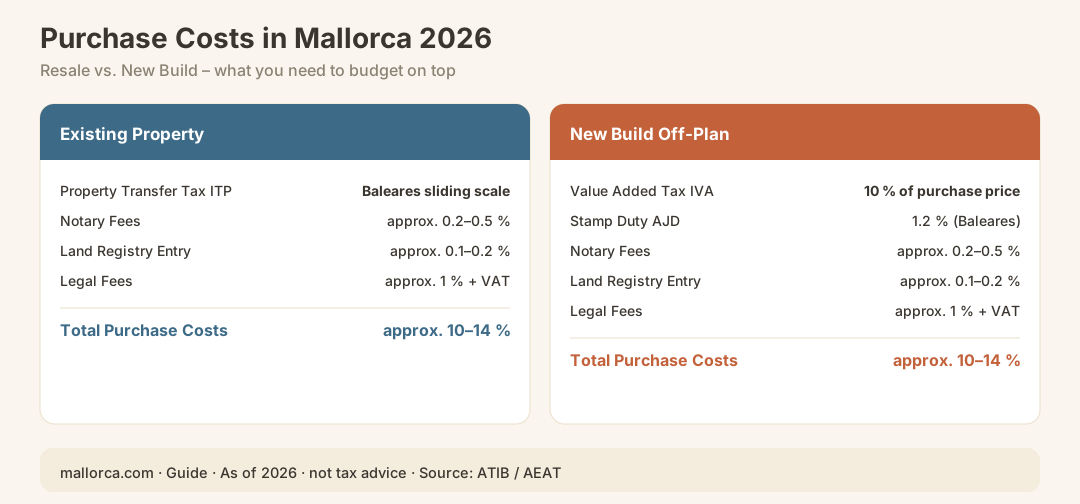
In addition to the purchase price, 10–14% of the purchase price is typically payable in ancillary costs. Factor these in from the outset – they are non-negotiable.
| Cost item | Paid by | Amount / rate |
|---|---|---|
| Property transfer tax ITP (resale) | Buyer | Banded rate Balearic Islands: depending on the purchase price |
| VAT IVA (new build) | Buyer | 10 % of the purchase price (residential properties) |
| Stamp duty AJD (new build) | Buyer | 1,2 % (Balearic Islands, depending on the deed) |
| Notary fees | Buyer (usually) | Approx. 0.2–0.5 % of the purchase price |
| Land registry entry | Buyer | Approx. 0.1–0.2 % of the purchase price |
| Legal fees | Buyer | Approx. 1 % + VAT (guideline figure) |
| Estate agent commission | Seller (as a rule) | Varies, usually 3–6 % |
Please note: The Balearic ITP graduated rate is structured according to purchase price brackets. Have the exact tax liability for your specific property calculated by your lawyer or tax adviser.
→ Full breakdown: Kaufnebenkosten Mallorca
Ongoing costs after the purchase: what you need to factor in on a permanent basis
The purchase price has been paid – but owning property in Mallorca comes with regular costs. Plan for these from the outset.
| Ongoing costs | Frequency | Note |
|---|---|---|
| IBI (property tax) | Annually | Amount is based on the cadastral value and municipality |
| Comunidad (owners' community) | Monthly / quarterly | Only for apartments/strata properties, varies considerably |
| Refuse charge (basura) | Annually or quarterly | Depending on the municipality |
| Home contents insurance | Annually | Bank requirement for a mortgage |
| Non-resident tax IRNR | Annually | Mandatory for non-residents, even without rental income |
| Wealth tax | Annually | Above certain thresholds |
→ IBI in detail: IBI Tax Spain → Insurance: Home Contents Insurance Spain → Wealth tax: Wealth Tax Spain
What you need to know about holiday letting (ETV licence)
Many buyers in Mallorca plan to rent out their property through platforms such as Airbnb or Booking.com. Particular caution is advised here in 2026.
The Balearic holiday letting law is strictly regulated. The licence for tourist rentals (Estancias Turísticas en Viviendas, ETV) is subject to strict requirements. Apartments in multi-family buildings in Mallorca can generally no longer obtain a new ETV licence — this area has been largely closed off for years.
Important: Do not purchase a property with the intention of holiday letting without first having the ETV licence status of the specific property checked by a lawyer. An existing, transferable licence is a considerable added value and should be explicitly addressed in the purchase contract.
→ ETV licence in detail: Holiday Letting Mallorca Licence → Sustainable tourism tax: Sustainable Tourism Tax → Long-term rental as an alternative: Long-term Rental Mallorca
The most common mistakes when buying property in Mallorca
These mistakes recur — even among experienced buyers.
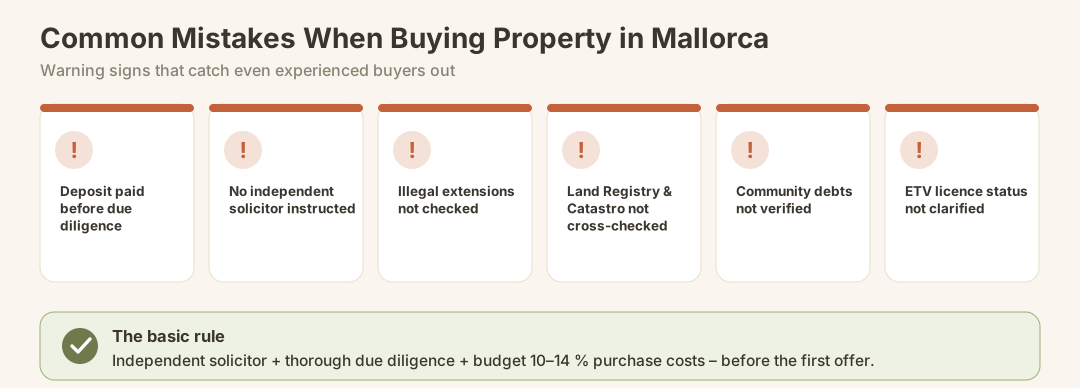
- No independent lawyer: Using the estate agent's or seller's lawyer is a conflict of interest. Always instruct an independent person.
- Paying a deposit before due diligence: If you pay before the land registry check, you may lose your money if problems arise.
- Overlooking unauthorised structures: Undeclared extensions, garages or pools are very common in Mallorca — always cross-check the planning permission status.
- Land registry and cadastre not reconciled: Missing square metres in the land registry or incorrectly registered owners can block the purchase or trigger additional costs.
- Financing not clarified in advance: In a fast-moving market, you will lose properties if you only start applying for a mortgage after the viewing.
- Community debts not checked: As a new owner, you are liable retrospectively for any outstanding community fees.
- ETV licence status not checked: Anyone relying on holiday rental income must clarify the licence situation before purchase — not after.
- Purchase costs underestimated: 10–14 % in additional costs on top of the purchase price is the reality, not the exception.
- No power of attorney prepared: If you cannot be present in person at the notary appointment, you will need a notarially certified, apostilled power of attorney — and that takes time.
- Signing the purchase contract without checking the arras type: The legal consequences of the various arras variants differ considerably.
Property Purchase Checklist Mallorca
Use this list as a guide — it is not a substitute for legal advice.
Before your search:
- NIE number applied for or in the process of being applied for
- Spanish bank account opened or in planning
- Financing framework / mortgage clarified in advance
- Budget set including 10–14 % in additional costs
- Independent lawyer (abogado) engaged
During the viewing:
- Land registry extract (Nota Simple) requested
- Cadastral extract obtained
- Building permits and certificate of first occupation checked
- Energy performance certificate present and valid
- ETV licence status checked (if holiday letting is intended)
- Community debts checked for leasehold/flat ownership
Before the reservation contract:
- Nota Simple and cadastre cross-checked
- No unauthorised structures present
- Arras type checked by lawyer
Before the notary appointment:
- Purchase price and additional costs ready in Spanish account
- Power of attorney arranged (if not attending in person)
- Tax obligations (ITP or IVA+AJD) calculated
What comes next? First steps after the notary appointment
With the signing of the Escritura pública you are the legal owner — but you are not quite done yet:
- Land Registry entry (Registro de la Propiedad): The escritura must be registered with the Land Registry within a short period. This is usually handled by your solicitor or a gestor.
- Paying taxes: ITP or IVA+AJD must be paid within 30 working days of notarisation. Late payment will incur surcharges.
- Transfer IBI and Catastro: Notify your local council and the cadastral office of the change of ownership.
- Transfer utility contracts: Electricity, water, and gas into your name.
- Take out insurance: Contents and buildings insurance.
- Tax registration: As a non-resident, you must register with the Spanish tax authorities for Non-Resident Income Tax (IRNR).
→ Taxes and legal matters at a glance: Taxes & Law Mallorca → Inheritance arrangements for the property: Inheritance & Gifts Balearic Islands
Conclusion: Better prepared means a better purchase
Buying property in Mallorca in 2026 is not a market for bargain hunters – but for well-prepared buyers it is one of the most solid tangible-asset markets in the Mediterranean. Prices have risen by around 97 % in nominal terms over ten years, demand remains structurally stronger than supply, and the international buyer market (approx. 30 % foreign share) underpins price levels even during weaker periods. Anyone who knows the right tips for buying property in Mallorca and applies them consistently – independent solicitor, thorough due diligence, a realistic budget for ancillary costs, financing confirmed before the first offer – can buy with confidence. Those who skip these steps risk costly surprises.
Take the time to go through every step carefully. In this market, it is well worth it.
Official sources
- Registro de la Propiedad (Land Registry): www.registradores.org – Nota Simple, land registration
- Catastro (Cadastral Office): www.sedecatastro.gob.es – cadastral extracts, floor-area verification
- ATIB – Agència Tributària de les Illes Balears: www.atib.es – ITP, AJD, Balearic taxes
- AEAT – Agencia Estatal de Administración Tributaria: www.aeat.es – IVA, IRNR, tax obligations
- Consell de Mallorca – Urbanisme: www.conselldemallorca.net – Building permits, spatial planning
- Govern de les Illes Balears – Turisme: www.caib.es – ETV licences
- BOE – Boletín Oficial del Estado: www.boe.es – Spanish Civil Code Art. 1445 ff. (Compraventa), Arras Art. 1454
- Notariado.org – Statistics portal of the Spanish notaries: www.notariado.org – Transaction data, market statistics