
Buying a Holiday Property in Mallorca: Locations, Financing & Legal Considerations
Anyone looking to buy a holiday property on Mallorca in 2026 is entering a market that has fundamentally changed: strong international demand is meeting an increasingly limited supply, while new regulations — most notably the moratorium on holiday rental licences under Decreto 4/2025 — are rewriting the rules of the game. At the same time, the island continues to attract buyers with stable capital appreciation, a well-developed mortgage system, and a transparent notarial purchase process. This guide shows you which locations currently offer the strongest fundamentals, how to arrange financing as a non-resident, which taxes and deadlines actually apply, and where the most common legal pitfalls lie — from the land registry check to the ETV licence question.

Are you considering buying a holiday property on Mallorca — and want to avoid any nasty surprises?
- 📩 Submit a personal enquiry — We connect you with vetted solicitors and local experts
- All buying guides at a glance
Why Mallorca remains an attractive location for holiday property in 2026
Mallorca is the most sought-after holiday destination in the German-speaking world — and that is reflected in the property market. According to market reports from spring 2026, the island's property market is growing by around 9.8 % overall, with the luxury segment regarded as the most important growth driver. International capital — not only from Germany and Austria, but increasingly from Northern Europe and non-European countries as well — is concentrating on a geographically constrained supply. New building land is barely available; nature conservation zones (ANEI) and the Tramuntana as a UNESCO World Heritage Site block substantial parts of the island from any new development. This is structurally price-driving.
At the same time, the tightening of regulations — particularly around holiday rental law — means that the straightforward investment logic of "buy and rent out immediately" now requires more careful planning than it did five years ago. Those who understand the legal framework and find the right property are buying into a market with long-term, solid fundamentals.
The best locations for a holiday property — region by region
Mallorca can be broadly divided into five purchasing regions, which differ considerably in terms of price level, character, and rental potential. The following table provides a structured overview based on current market observations:
| Region | Character | Typical property types | Price segment (broad guidance) | Notable features |
|---|---|---|---|---|
| South-west (Andratx, Puerto Andratx, Camp de Mar) | Exclusive, international | Villas, apartments with sea views | Upmarket to ultra-luxury | Highest price density, strong foreign demand |
| Palma & surroundings (Son Vida, Santa Catalina, Bonanova) | Urban-Mediterranean, vibrant | City apartments, townhouses, villas | Mid-range to luxury | UNESCO old town, strong long-term and holiday rental demand |
| North-west / Tramuntana (Sóller, Valldemossa, Esporles) | Cultural, mountainous, UNESCO | Historic fincas, townhouses | Medium to very high-end | Strict building regulations, exceptional location quality |
| North (Puerto Pollença, Alcúdia, Artà) | Family-friendly, spacious | Villas, fincas, apartments | Medium to high-end | Nature park proximity, strong holiday rental potential |
| South-east (Santanyí, Portocolom, Campos) | Quiet, authentic | Fincas, country houses | Medium to high-end | Growing popularity, rural quality |
Note: Price indications per square metre vary considerably within each region depending on location, condition, and specification. For guidance on current per-square-metre prices, see the guide on Mallorca property prices.
In the south-west, properties in Puerto Andratx have long been in the upper price bracket – villas with sea views and a pool frequently start above the €3 million mark. In the north and south-east, fincas and country houses in the mid six-figure range can still be found, provided you are prepared to factor in renovation costs.
Legal basics: what you need to know before you sign
The Spanish notary system differs fundamentally from the German one
The key difference: a Spanish notary is a certifying official, not a neutral legal adviser. They authenticate signatures and verify formal requirements – comprehensive legal advice to both parties, as is standard practice in Germany, is not part of their remit. This means you need an independent Spanish lawyer (Abogado) who represents your interests exclusively. Do not cut corners here.
Essential: NIE number and land registry check
Before you sign any contract, you will need a Spanish tax identification number for foreigners – the NIE (Número de Identificación de Extranjero). Without an NIE, neither a notarial deed nor the opening of a Spanish bank account is possible.
At the same time, your lawyer will obtain a full land registry extract (Nota Simple). This shows who is actually registered as owner, and whether any mortgages, charges, rights of way, or other encumbrances are recorded against the property. Outstanding municipal taxes (IBI) or unregistered extensions and alterations will also come to light. More on this in the guide Checking the Spanish land registry.
Reservation contract and preliminary purchase agreement (Arras)
The typical Spanish purchase process runs in several stages:
- Reservation contract (Contrato de Reserva): Secures the property for you on a preliminary basis; you pay an initial reservation fee. More on this under Reservation Contract Spain.
- Preliminary Purchase Contract with Deposit (Contrato de Arras Penitenciales): Typically 10% of the purchase price. With a mutual right of withdrawal: if you pull out as the buyer, you forfeit the deposit; if the seller withdraws, they must refund double the amount.
- Notarial Deed (Escritura de Compraventa): Final transfer of ownership; all purchase ancillary costs fall due at the same time.
- Land Registry Entry: To be arranged immediately after the deed is signed; only then are you fully protected.
The complete process including deadlines is explained in the guide Property Purchase: Process.
Purchase Ancillary Costs: What You Can Really Expect
As a non-resident purchasing a resale property on Mallorca, you should generally budget for ancillary purchase costs of between 10 and 14 % of the purchase price. The largest items:
| Type of Cost | Who Pays | Amount / Note |
|---|---|---|
| Property Transfer Tax ITP (Impuesto sobre Transmisiones Patrimoniales) | Buyer | Progressive Balearic rate (see table below) |
| VAT IVA + Stamp Duty (for new builds) | Buyer | 10% IVA + 1.5% AJD in the Balearics |
| Notary Fees | Buyer (main share) | Dependent on the purchase price |
| Land Registry Entry | Buyer | Dependent on the purchase price |
| Solicitor's Fee | Buyer | Typically 1% of the purchase price |
| Estate agent commission | Seller (standard market practice in Mallorca) | See Estate agent commission Mallorca |
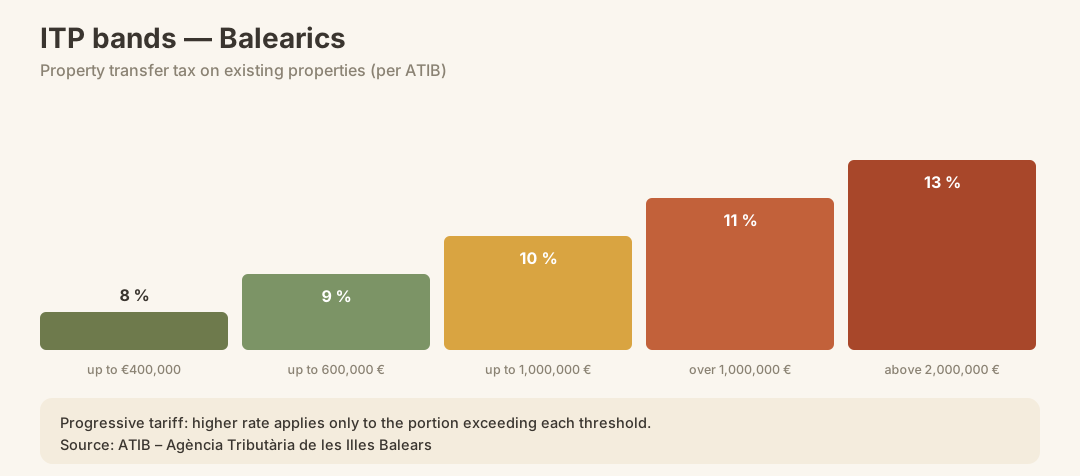
Balearic ITP graduated scale (resale properties)
The Balearic Islands levy property transfer tax on a sliding scale based on the purchase price. The current rates according to ATIB:
| Purchase price (up to …) | Tax rate |
|---|---|
| 400.000 € | 8 % |
| 600.000 € | 9 % |
| 1.000.000 € | 10 % |
| above €1,000,000 | 11 % |
| above €2,000,000 | 13 % |
Please note: The scale is progressive – the higher rate applies only to the portion exceeding each threshold. Always check the currently applicable rates with ATIB (Agència Tributària de les Illes Balears) or have them calculated by your solicitor. Full details on all purchase costs at Purchase costs Mallorca.
ETV licences and holiday rentals: the new legal framework 2025/2026
This is currently the most sensitive issue when buying a holiday property in Mallorca. With Decreto 4/2025 the Balearic Government has frozen the issuance of new holiday rental licences (ETV – Estancias Turísticas en Viviendas). What this means in practice:
- New ETV licences are currently not being issued.
- Existing licences that are tied to the property rather than the owner can, under certain conditions, be transferred – making them a valuable selling point.
- A property without an ETV licence may not be rented out short-term to holidaymakers; only long-term rental (12+ months) or medium-term rental is legally permitted.
Please note: Anyone who purchases a property without an ETV licence and nonetheless accommodates holiday guests risks substantial fines. Always check the licence status before signing any contract – and ensure the licence is explicitly transferred to you in the purchase agreement.
Properties with an existing ETV licence are priced at a corresponding premium. How a transfer works: Transferring an ETV licence Mallorca. Full details on the licensing requirement: ETV licence Mallorca.
Financing as a Non-Resident: German Bank or Spanish Mortgage?
Both routes are viable – they have different profiles. The key differences:
| Criterion | German Bank / Building Society | Spanish Bank (Hipoteca) |
|---|---|---|
| Loan-to-value limit (non-residents) | Depends on the lender, often 60–70 % of market value | Typically max. 60–70 % of the assessed value |
| Fixed-rate period | Typically 10 years fixed (annuity loan) | Often variable (Euribor-based), fixed rate possible |
| Additional products | Generally none | Often bundled with insurance policies, accounts, credit cards |
| Valuation process | Challenging from Germany | Local surveyors on the ground (Tasación) |
| Specialisation | Few banks; e.g. PSD Bank Rhein-Ruhr for Mallorca/Ibiza | Many local and national providers |
What you need to know for financing planning
Non-residents are generally required to provide at least 30–40 % equity as banks in the Balearen rarely finance more than 60–70 % of the assessed value for foreign buyers without Spanish tax residency. The assessed value (Valor de Tasación) does not necessarily equal the purchase price – it is often lower, which increases the effective financing gap.
One tactically interesting aspect: taking out a Spanish mortgage reduces the net asset value of the property for Spanish wealth tax purposes, as liabilities are deductible. This can be tax-relevant for properties above the tax-free allowance threshold – more on this in the next section.
Spanish banks typically require the following documents:
- Last two to three income tax assessments (Germany: Steuerbescheid)
- Recent payslips or profit and loss statement for self-employed individuals
- Bank statements for the last 3–6 months
- Full documentation of the origin of equity funds (anti-money laundering compliance)
When transferring money to Spain, specific reporting obligations apply – read more at Transferring money to Spain and AWV reporting obligation Spain. Full mortgage details at Hypothek Mallorca.
Taxes during ongoing ownership and on sale
Annually recurring taxes
As the owner of a holiday property on Mallorca, regular tax obligations apply:
| Tax | Who? | Notes |
|---|---|---|
| IBI (Impuesto sobre Bienes Inmuebles) | All owners | Municipal tax based on cadastral value; amount varies by municipality |
| Income tax (IRNR) for non-residents | Non-residents | A deemed income attribution applies even for vacant properties |
| Wealth tax (Impuesto sobre el Patrimonio) | Non-residents above the net threshold | Personal allowance in the Balearic Islands since 1.1.2024: 3.000.000 € (Spanish net assets only) |
On wealth tax in detail: The personal allowance in the Balearic Islands was raised to 3.000.000 € on 1 January 2024. If your net assets located in Spain fall below this amount, a declaration is still required, but no actual tax liability arises. If the allowance is exceeded, a progressive rate applies with rates between 0,28 % and 3,45 %. One possible strategy: split ownership between several people (e.g. a married couple) so that the threshold is not exceeded per person. More details at Wealth tax Spain.
On IBI tax: IBI Steuer Spanien.
On sale
On a subsequent sale, Plusvalía Municipal (the municipality's capital gains tax on the increase in the cadastral value of the land) as well as income tax on the actual capital gain will be due. As a non-resident, a withholding tax of 3 % of the purchase price is also retained directly, which is credited against the final tax liability. Full details at Taxes on property sales in Spain.
Special legal risks: what only insiders know
Illegal buildings and unauthorised extensions
Spain – and Mallorca in particular – has a long history of informal building work. Pool terraces, guest houses, garages or loft conversions built without planning permission can push the purchase price down or give rise to legal problems. The crucial point: what appears in the land registry often does not reflect the actual state of the property. Have the property checked by a local architect or technical surveyor to verify that the land registry entry, the catastro description and the physical reality all match. More at Identifying unauthorised extensions and Legalising illegal buildings on Mallorca.
Ley de Costas – Coastal Protection Act
Properties close to the sea may be subject to the Spanish Coastal Protection Act (Ley de Costas). This can mean restricted rights to carry out alterations, time-limited rights of use, or even the threat of demolition if the property is too close to the coastline. Make sure you check this before purchasing – even if the property has been lived in for decades. Details: Ley de Costas Mallorca.
Fincas on Suelo Rústico
Rural properties on rustic land (Suelo Rústico) are subject to particularly strict planning regulations. Extensions are in many cases not permitted at all, or only to a very limited extent; minimum plot sizes must be observed. The question of wells and water supply is also central on rural plots. Read more: Finca Suelo Rústico Mallorca and also Water supply for fincas.
Ownership structure: private individual, couple or SL?
Whether you buy a property on your own, jointly with a partner, or through a Spanish limited company (Sociedad Limitada, SL) has tax and inheritance law implications. Using an SL can, in certain circumstances, reduce wealth tax liability, but it creates its own administrative costs and obligations. Prior advice from a tax adviser specialising in Spain is strongly recommended. More: Buying property via an SL. Inheritance and gift tax law in the Balearic Islands also differs considerably from the German equivalent: Inheritance & gifts in the Balearic Islands.
Power of attorney, notary and completing the purchase from Germany
If you are unable to be present on Mallorca throughout the process, a notarised power of attorney (Poder Notarial) for your lawyer or a trusted representative is essential. This allows all steps of the purchase – from signing the arras contract through to notarisation – to be carried out legally in your absence. The power of attorney can be issued in Germany and authenticated with an apostille. Details: Power of attorney for Spain – notary. On the role of the notary: Notary in Spain.
Most common mistakes when buying a holiday property on Mallorca
| Mistake | Consequence | Protection |
|---|---|---|
| Not engaging an independent lawyer | Overlooked encumbrances, hidden debts, invalid contracts | Instruct an abogado before signing any contract |
| Not checking ETV licence status | Paying the purchase price without having the right to let the property | Verify the licence in the land registry extract and with ATIB |
| Not checking for illegal constructions | Risk of demolition, fines, missing Cédula | Architect's survey before signing the Arras |
| Ignoring the fact that the assessed value ≠ purchase price | A funding gap that catches you off guard | Obtain a bank valuation early on |
| Not clarifying the Ley de Costas situation | Restricted renovation rights, lapse of concessions | Check the cadastral boundary and coastal protection zone |
| Not planning the ownership structure in advance | Unnecessary wealth tax, costly inheritance | Tax adviser and solicitor before completion |
| Not preparing proof of the source of funds | Delays, mortgage refusal | Full documentation of the source of funds |
What comes next? Living with and in your holiday property
After the purchase, the ongoing operation begins – and that has its own requirements:
- Property management: If you are not permanently on the island, you will need a local manager or a property management company to handle maintenance, tradespeople, dealings with the authorities, and – if you let the property – your guests. More: Property management Mallorca holiday home.
- Owners' community: If you live in a block of flats or a residential complex, you automatically become part of the Comunidad de Propietarios, with contribution obligations and voting rights. Details: Owners' community Spain.
- Insurance: Contents and buildings insurance are not required by law in Spain, but are generally mandatory with a mortgage and advisable in any case. Contents insurance Spain.
- Energy certificate: Required for years when buying or letting – check that the property holds a valid certificate. Energy Certificate Spain.
- Renovation Plans: Many types of work require planning permission; particularly strict rules apply in rural areas and nature reserves. Planning Permission Mallorca.
Checklist: Buying a Holiday Property in Mallorca
- NIE number applied for or commissioned
- Independent Spanish lawyer (Abogado) engaged
- Nota Simple (land registry extract) checked for encumbrances, ownership, and description
- ETV licence status verified (present, valid, transferable?)
- Existing structure compared with land registry entry and catastral description (unauthorised building work?)
- Ley de Costas restrictions checked (for coastal properties)
- Suelo Rústico obligations checked (for fincas on rural land)
- Financing strategy defined (German/Spanish, equity, total costs)
- Purchase ancillary costs (10–14 %) factored into the budget
- Ownership structure tax-optimised (sole/married couple/SL)
- Proof-of-funds documentation fully prepared
- Power of attorney for completion issued (if you cannot be present)
- Cédula de Habitabilidad available or obtainable
- Insurance and property management arranged for the period after purchase
Conclusion
Buying a holiday property in Mallorca has become more demanding in 2026 – but by no means riskier if you are well prepared. The market is growing structurally, supply remains tight, and the island continues to attract international capital across every price bracket. The biggest pitfalls – ETV licence status, unauthorised building work, Ley de Costas, financing shortfalls arising from valuation figures – can be reliably navigated with the right lawyer, thorough due diligence, and realistic cost planning. Those who also optimise their ownership structure for tax purposes in advance and are aware of their ongoing obligations lay the groundwork for an investment that brings lasting enjoyment – and appreciates in value.
Official Sources
- ATIB – Agència Tributària de les Illes Balears (ITP tax rates, wealth tax Balearic Islands): https://www.atib.es
- Govern de les Illes Balears – Tourism & ETV Licences (Decreto 4/2025 and current ETV regulation): https://www.caib.es
- Registro de la Propiedad – Nota Simple online: https://www.registradores.org
- AEAT – Agencia Estatal de Administración Tributaria (IRNR, wealth tax): https://www.aeat.es
- Catastro – Sede electrónica del Catastro: https://www.sedecatastro.gob.es
- BOE – Boletín Oficial del Estado (Ley de Costas, tax regulations): https://www.boe.es
- Consell de Mallorca – Ordenació del Territori (planning law, protected natural areas ANEI): https://www.conselldemallorca.net