
Buying New-Build Off-Plan in Mallorca: Instalment Payments, Aval & Completion
Buying a flat or villa in Mallorca before the first stone has been laid is one of the most fascinating – yet also riskiest – areas of the Spanish property market. When purchasing a new-build off-plan property in Mallorca, six-figure sums often change hands before you even hold a key. This guide explains step by step how the instalment payment model works, what the legally required bank guarantee (Aval Bancario) actually covers, which taxes apply to new-build purchases, and how the handover process should be carried out correctly. You will also learn which documents you must check before reserving, and which mistakes buyers repeatedly make at considerable cost.

Are you considering buying a new-build or off-plan property in Mallorca and want to know whether the developer is reputable?
- 📩 Submit a personal enquiry — We review developers, Aval arrangements, and contract clauses with you
- Understanding the entire purchase process
What does off-plan mean and what variations are there?
The term "off-plan" (Spanish: sobre plano) refers to the purchase of a property that has not yet been built or is only at shell-construction stage. You are buying on the basis of floor plans, visualisations, and a specification sheet (memoria de calidades). In addition, there are projects already under construction (en construcción), as well as turnkey new-builds (llave en mano) that have never been lived in.
| Description | Stage | Typical price potential | Waiting time |
|---|---|---|---|
| Off-plan (sobre plano) | Plans only, construction not yet started | Lowest entry price | 24–36 months |
| Under construction (en construcción) | Shell construction already begun | Mid-range level | 12–24 months |
| Turnkey (llave en mano) | Completed, still unsold | Market price | Immediate occupancy |
The main appeal of an early off-plan purchase lies in the price: developers often offer preferential terms in the early phases because they partly secure the project's pre-financing through buyer payments. This is also the core risk: you are financing someone else's construction with your own money.
Note: In Mallorca, new-build projects have been particularly in demand for several years. Market reports indicate that for 2025, average prices in tourist-popular regions are around €6,700 per m² – with a continued slight upward trend forecast for 2026. An early entry can therefore be worthwhile, but it also increases the risk of advance payments.
Essential checks before spending a single euro: what you need before reserving
Before you sign a reservation contract or transfer even a reservation deposit, five documents must be on the table. No reputable developer will refuse to provide these.
- Commercial register extract for the developer (escritura de constitución y poderes): Confirms that the company exists and that the signatory is legally authorised to sign.
- Land registry extract for the plot (nota simple del Registro de la Propiedad): Shows whether the plot is registered in the developer's name and whether any encumbrances (mortgages, liens) exist.Checking the Spanish land registry – we explain how to do this in our detailed guide.
- Planning permission (licencia de obras mayor): Without a legally valid permit, no construction start is lawful. Obtainable from the Consell de Mallorca or the relevant local authority.
- Building specification (memoria de calidades): A binding list of all materials, brands and construction standards. This must form part of the contract.
- Cadastral extract (certificado catastral): Documents the exact location, boundaries and square metres of the plot.
Warning: If the building project has not yet been entered in the land registry as declaración de obra nueva en construcción registered, you should wait for this registration before making any payment, or at least have it reviewed by a solicitor.
The instalment model: how payments are typically structured in off-plan projects
When buying off-plan, you do not pay the full price in one go, but in tranches linked to construction milestones. The exact schedule is not set out in law, but follows a well-established pattern in Mallorca:
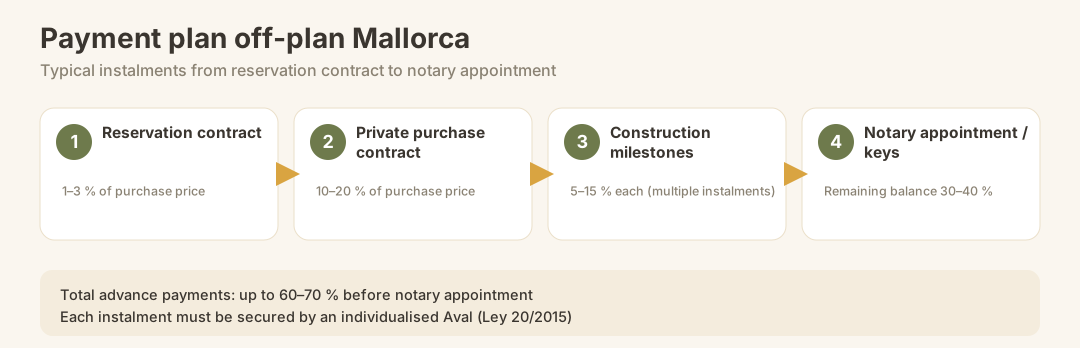
| Stage | Typical payment | Basis |
|---|---|---|
| Reservation agreement | 1–3 % of the purchase price | Firm obligation to refund if no notarial contract is concluded |
| Private purchase contract (contrato privado) | 10–20 % of the purchase price | Bank guarantee must be in place before this payment |
| Construction milestones (depending on the project) | several tranches of 5–15 % each | Each tranche guaranteed separately |
| Notary appointment / key handover | Remaining balance (often 30–40 %) | Payment simultaneous with key handover |
Please note: The sum of all advance payments prior to the notary appointment can amount to as much as 60–70 % of the purchase price, depending on the project. Every one of these amounts must be secured by a bank guarantee or insurance policy — without exception.
A reservation agreement is the first legally binding step in this process. Never sign one without having it reviewed by a solicitor — it already sets out essential terms and conditions.
The bank guarantee (Aval Bancario): your statutory safety net
Legal basis and statutory obligation
Protection for buyers making advance payments on new-build properties has been enshrined in Spanish law since 1968. The original Law 57/1968 was subsequently updated and supplemented by Law 20/2015. The core obligation remains: every developer is required to secure all advance payments made by the buyer by means of a bank guarantee (aval bancario) or an equivalent insurance policy (insurance for advance payments) in favour of the buyer.
How does the bank guarantee work in practice?
The bank or insurance company acts as guarantor towards you as the buyer for every instalment paid. Should the developer become insolvent, the project not be completed within the agreed deadline, or the construction fail for any other reason, you can call in the guarantee directly against the bank or insurer – without having to take legal action against the developer.
| Scenario | What happens without an aval | What happens with an aval |
|---|---|---|
| Developer becomes insolvent | Money absorbed into the insolvency estate – often lost | Bank refunds all guaranteed amounts |
| Construction not completed on time | Legal action against the developer required | Reclaim directly from the bank possible |
| Poor build quality | Defects liability claim | Aval only covers repayment, not defects |
What the aval does not cover
The bank guarantee covers exclusively the recovery of your advance payments – plus statutory interest. Defects in the completed building, late handover without insolvency, or deviations from the building specification are separate legal matters and are not covered by the bank guarantee.
Important: Insist on a separate, individualised guarantee certificate for each individual payment (bearing your name, the exact amount, and the date). A blanket group guarantee covering all buyers in a project is not sufficient. Many buyers have lost their money in the past because they believed they held a guarantee, yet it had not been issued individually in their name when insolvency occurred.
Steps to obtaining a proper bank guarantee
- Request the guarantee document before every payment.
- Check that your name, the exact amount, and the date are correctly entered.
- Ensure that the guaranteeing bank or insurer is based in Spain or is subject to Spanish regulatory oversight.
- Keep the original in a safe place – if in doubt, deposit it with a notary.
- Check that a separate guarantee is issued for each further instalment.
Taxes when buying a new-build: IVA instead of ITP
A key difference from buying an existing property: when a new-build property is sold for the first time by the developer to the initial buyer, Value Added Tax (IVA) applies – no Transfer Tax (ITP). In addition, the tax on documented legal acts (Actos Jurídicos Documentados, AJD) is also due.
| Tax | Rate | Tax base | Due |
|---|---|---|---|
| IVA (VAT) | 10 % | Purchase price | At notarial appointment |
| AJD (Balearic) | variable rate | Purchase price (notarially certified) | At notarial appointment |
| Notary fees | depending on purchase price | Certified value | At notarial appointment |
| Land Registry entry | depending on purchase price | Certified value | After notarial appointment |
Please note: The AJD rate in the Balearic Islands may vary depending on the transaction and the applicable regulations. Have the total amount of purchase ancillary costs calculated precisely by a tax adviser or solicitor before contracts are exchanged. Our overview of purchase ancillary costs in Mallorca gives you an initial guide.
A further advantage: as IVA is not a regional tax but applies nationwide, there are no Balearic particularities here as there are with the ITP rate for existing properties.
The purchase contract (Contrato Privado de Compraventa): What Must Be Included
The private purchase contract is the cornerstone of an off-plan purchase. It is signed long before the notary appointment and governs everything of substance. The following points are non-negotiable:
- Full description of the property including floor areas, floor plan references, and ancillary spaces (garage, basement, parking space).
- Payment schedule with exact due dates or construction milestones.
- Completion deadline with a clear contractual penalty or right of withdrawal in the event of overrun.
- Obligation to issue bank guarantees for each instalment payment – including the named guaranteeing bank or insurance provider.
- Construction specification (memoria de calidades) as a contractual annexe.
- Provisions for discrepancies: What happens if the finished floor area differs from what was promised?
- Contractual penalty in the event of construction delays or non-completion.
Please note: Reputable developers on Mallorca will accept legal review and amendment of the contract. Anyone who refuses this is a red flag.
Construction Progress: Your Rights During the Build Phase
Once the purchase contract has been signed and the first instalment transferred, the phase begins in which you as the buyer need to remain particularly vigilant.
Regular construction progress reports: Many developers provide online portals or monthly updates. Stipulate contractually that you receive at least bi-monthly status reports with photographs.
Right to site visits: As a buyer, you have a legitimate interest in visiting the construction site. Arrange this in good time and have the right to do so confirmed in the contract.
Keep track of the completion deadline: As soon as a delay becomes apparent, your solicitor must formally notify the developer of the delay in writing (notificación de retraso). This is a prerequisite for any subsequent claims for damages or contract withdrawal.
Amendments to the construction specification: Changes to the original memoria de calidades require your explicit written consent. Do not sign any amendment addenda without having them reviewed by a professional.
Handover and key collection: The Licencia de Primera Ocupación
The handover (entrega de llaves) is the final decisive moment – and simultaneously the one at which buyers most frequently sign too hastily.
Mandatory documents at key handover
| Document | Issuer | Significance |
|---|---|---|
| Licencia de Primera Ocupación (LPO) | Municipality | Confirms that the building is legally habitable |
| Certificado de Final de Obra | Architect | Completion certificate issued by the architect of record |
| Libro del Edificio | Developer | Building logbook containing plans, warranties, and insurance documents |
| Cédula de Habitabilidad | Balearic Islands (CAIB) | Habitation certificate |
| Energy certificate (Certificado Energético) | Certifier | Energy efficiency rating of the building |
| Warranty documents | Suppliers | Warranty periods under the LOE |
Without a Licencia de Primera Ocupación you should not accept the keys. Without an LPO you cannot register your address, take out standard insurance, or finalise bank financing.
Handover report (Acta de Entrega)
Go through the property room by room before the key handover – ideally together with an independent building surveyor (perito). Record all defects in writing in the handover report before you sign. If you sign without reservations, it becomes considerably harder to raise defects at a later stage.
Note: The developer is obliged to hand over the Libro del Edificio (building log book). This contains plans, operating manuals, maintenance instructions, and the structural insurance policy. If it is missing, the handover is incomplete.
Structural warranty periods under Spanish law
Spanish construction law (Ley de Ordenación de la Edificación, LOE) distinguishes three warranty periods:
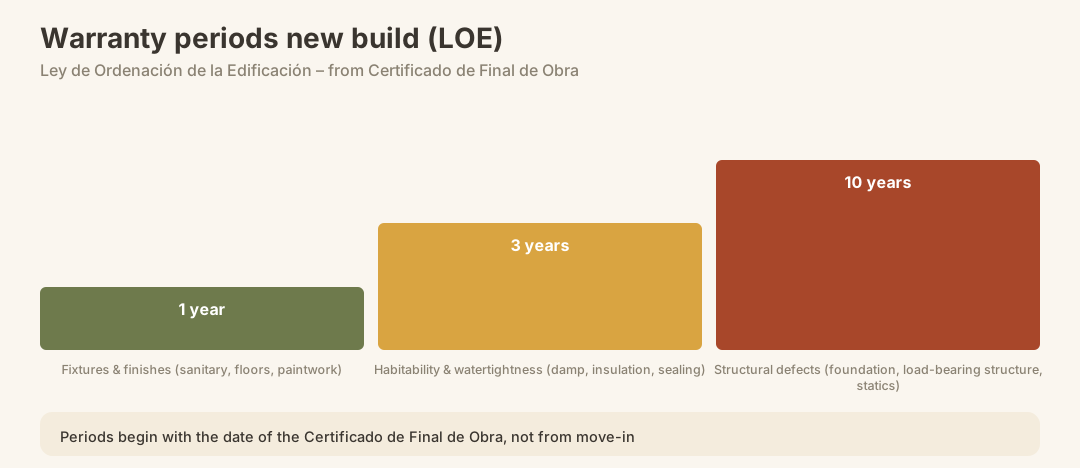
| Defect category | Period | Examples |
|---|---|---|
| Finishes / fittings | 1 year | Plumbing, flooring, paintwork |
| Habitability / watertightness | 3 years | Damp, thermal insulation, waterproofing |
| Structural defects | 10 years | Foundations, load-bearing structure, statics |
These deadlines apply from the date of the Certificado de Final de Obra, not from your move-in date.
Financing and mortgages for off-plan purchases
Obtaining a mortgage on a property that has not yet been built is more complex than with existing properties. Spanish banks typically only provide financing at the notary appointment – i.e. upon completion. The advance payments during the construction phase generally have to be made from your own funds.
In practice, this means: you need sufficient liquid capital to cover all construction instalments before the mortgage kicks in. The mortgage then replaces the self-financed deposits at the notary appointment and covers the remaining balance.
There are exceptions: some developers work with banks that offer partial financing during the construction phase. However, this is not standard practice and always needs to be negotiated individually.
For financing itself, we recommend the guide on property financing in Mallorca.
If you need to transfer larger sums from abroad, read the guide on transferring money to Spain first – FATCA and anti-money-laundering regulations require documentation even for legitimate transactions.
Most common mistakes when buying new-build and off-plan
In practice on Mallorca, the same avoidable mistakes come up time and again:
- No aval for each instalment: Buyers accept a blanket project guarantee instead of individualised avales. In the event of insolvency, the money is often lost.
- Signing without planning permission: Anyone who pays before the licencia de obras has legal force bears the full planning risk.
- No legal review of the purchase contract: Developers' standard contracts are naturally drafted in favour of the developer.
- No completion deadline with penalty clause: Without a contractual penalty, the developer has no financial incentive to deliver on time.
- Accepting the keys without the LPO: Once you have moved in, you lose your leverage over the developer.
- Acceptance without a surveyor/expert: Hidden defects in installations or insulation are difficult for laypersons to detect.
- Failure to check the memoria de calidades as a contractual annex: Anything not explicitly agreed upon does not have to be carried out by the developer as advertised.
- Forgetting the AWV reporting obligation: For transfers of 12.500 Euro or more abroad, German buyers are subject to AWV reporting requirements. More on this in the guide on the AWV reporting obligation.
What comes next? Moving in, taxes, rental
Once you have the keys, further obligations begin:
IBI (property tax): Once the building is registered in the cadastre, the Impuesto sobre Bienes Inmuebles becomes due. Registration generally takes place shortly after the LPO. Details on IBI tax in Spain.
Owners' community: In apartment buildings and residential complexes, you automatically become a member of the Comunidad de Propietarios. Find out about your rights and obligations in our guide on the owners' community in Spain.
Wealth tax: From a net asset value exceeding the Balearic allowance (depending on your tax status), the Impuesto sobre el Patrimonio applies. Details on wealth tax in Spain.
Contents insurance: Take out a policy now — the developer's structural insurance does not replace private coverContents insurance in Spain.
Long-term rental or owner-occupation: Anyone wishing to let the property on a permanent basis will find all the relevant information on long-term rentals in Mallorca. A holiday rental licence for new-build properties is currently virtually impossible to obtain in Mallorca due to the ongoing licence moratorium – check the current legal position before purchasing if that is your intention.
Checklist: Off-plan purchase in Mallorca – step by step
- NIE (Spanish tax identification number) applied for
- Lawyer (Abogado) with off-plan experience instructed
- Commercial register extract of the developer checked
- Land registry extract (nota simple) obtained – no encumbrances
- Licencia de obras confirmed as legally valid
- Memoria de calidades agreed as a contractual annex
- Payment schedule tied to construction milestones set out in writing
- Bank guarantee (aval) for the first instalment received before payment
- Separate aval requested for each subsequent instalment
- Completion deadline with penalty clause included in the purchase contract
- Financing plan for equity instalments in place
- AWV reporting obligation for German bank transfers checked
- Prior to handover of keys: structural surveyor instructed
- Licencia de Primera Ocupación in place
- Libro del Edificio and energy certificate handed over
- All defects recorded in the snagging report
- IBI cadastral registration arranged
- Contents insurance taken out
Conclusion
Buying a new-build or off-plan property on Mallorca can be financially very attractive – early buyers often purchase at below the completion value, and modern energy standards reduce running costs in the long term. The trade-off is a considerably more complex purchasing process than with a resale property: advance payments that must by law be secured by avales, a purchase contract with numerous variables, and a handover inspection at which you should not underestimate a single detail.
The most important takeaway from this guide: not a single euro is transferred without an individualised aval in your name. Anyone who sticks to this consistently and has the contract reviewed by an experienced solicitor before signing is well protected against the typical off-plan risks. Everything else is pleasurable anticipation you can plan for.
Official Sources
- Gesetz 57/1968 (Original aval obligation for advance payments): https://www.boe.es/buscar/act.php?id=BOE-A-1968-456
- Gesetz 20/2015 (Update to aval and insurance obligations): https://www.boe.es/buscar/act.php?id=BOE-A-2015-8140
- Ley de Ordenación de la Edificación – LOE (Ley 38/1999) (New-build warranty periods): https://www.boe.es/buscar/act.php?id=BOE-A-1999-21567
- ATIB – Agència Tributària de les Illes Balears (AJD and taxes in the Balearic Islands): https://www.atib.es
- Agencia Tributaria – AEAT (IVA on property purchases): https://www.agenciatributaria.es
- Registro de la Propiedad (Land Registry) – Nota Simple: https://www.registradores.org
- Consell de Mallorca – Planning Permissions and Urban Development: https://www.conselldemallorca.net
- Govern de les Illes Balears – Habitatge (Housing): https://www.caib.es