
Finding a Job in Mallorca: Job Market, Industries, Portals and Realistic Prospects 2026
Mallorca is not just a holiday island – for tens of thousands of Germans, it is their permanent home and place of work. If you want to find a job here, you can expect a market with real opportunities, but also clear rules of the game: the seasonal rhythm, language barriers and bureaucracy can delay your entry if you underestimate them. This guide shows you which sectors are genuinely recruiting in 2026, what you can realistically earn, which job portals are worth your time, and what you need to have sorted before your first job interview – from your NIE number to social security registration. You will also find out where German language skills are a genuine advantage and when Spanish becomes indispensable regardless.

Already have concrete job plans for Mallorca – but still have questions about residencia, taxes or bureaucracy?
- 📩 Send a personal enquiry — We can help you structure your move and your career entry properly
- Everything about working and careers on Mallorca
The job market on Mallorca: what to expect in 2026
Mallorca is the largest island in Spain and one of the most populous islands in the western Mediterranean. Just over half of the approximately 880,000 residents live in Palma de Mallorca. The job market is closely tied to tourism – which shapes its structure, seasonality and salary expectations.
For German speakers there is a particular dynamic at play: the large German-speaking community on the island creates its own demand for service providers, tradespeople, doctors and property advisers who can communicate in German. This niche remains well occupied in 2026 – but also hotly contested.
Key characteristics of the market:
- Seasonality: The main season runs from approximately April to October, with the strongest job supply between July and September. Many contracts are fixed-term.
- Year-round positions: Permanent roles exist above all in Palma, in the property sector, in the trades and in remote work.
- Competition: Many applicants come not only from Germany but from across Europe. Language skills, local contacts and applying early are decisive.
- Salary levels: Local jobs pay on average noticeably less than comparable positions in Germany or Austria – remote work for overseas clients is therefore, for many people, the most economically attractive option.
The most important sectors for German speakers
Tourism and hospitality
Tourism and hospitality are the largest sector on Mallorca. Receptionists, service staff, chefs, tour guides, entertainers, and bar and kitchen personnel are all in demand. Applicants who speak German in addition to English are particularly sought after – this is a genuine competitive advantage in the German-oriented holiday segment.
Employers in this field frequently offer a complete package alongside the salary: accommodation with a private bedroom, one meal per day, a tip distribution at the end of the season, social security contributions and the so-called finiquito payment upon contract termination (including unused holiday days and any outstanding salary components).
Real Estate
The real estate market in Mallorca is vibrant and attracts many German speakers. Agents, buyer's consultants and assistants are in demand – preferably with German as a mother tongue, as a large proportion of buyers come from German-speaking countries. Portals such as abc-mallorca.com run their own job boards with relevant vacancies.
Trades and Technical Professions
Tradespeople – electricians, plumbers, carpenters, boat mechanics – are in demand on the island because certain apprenticeships are not, or barely, offered locally. Those who hold a German Gesellenbrief (journeyman's certificate) have good prospects, but may need to have their qualifications officially recognised in Spain.
IT and Call Centres
IT professionals are in demand on the island, particularly because relevant training courses are scarce on Mallorca itself. In the call-centre sector, career starters are also hired for certain positions, provided they have the required languages (German, English).
Healthcare and Care Work
There is a niche for German-speaking care workers and physiotherapists within the growing German retiree community. Qualifications generally need to be officially recognised.
Remote Work and Digital Professions
IT, marketing, consulting, content work – anyone working remotely for a German or international company brings their salary level with them to the island. This is the most economically attractive way to live on Mallorca without having to accept local wage structures.
| Sector | Typical Roles | Language Requirements | Seasonality |
|---|---|---|---|
| Tourism / Hospitality | Service, reception, chef, entertainment | DE + EN recommended | April–October |
| Real Estate | Agents, buyer's consultants | DE (core target group) | Year-round |
| Trades | Electricians, plumbers, carpenters, boat mechanics | DE sufficient for German-speaking clients | Year-round |
| IT / Call Centres | Developers, support, telephone operators | EN/DE depending on role | Year-round |
| Health / Care | Carer, physiotherapy | German-language roles for German-speaking residents | Year-round |
| Remote | Marketing, consulting, design | Depends on client | Year-round |
Realistic salaries: what you can earn on Mallorca
This is the point at which many expats need to adjust their expectations. Local jobs on Mallorca pay, on average, considerably less than comparable positions in Germany.
| Job type | Average gross salary |
|---|---|
| Local jobs (tourism, service, administration) | 1.200–2.500 €/month |
| Qualified local positions (real estate, local IT) | generally higher, depending on qualifications and employer |
| Remote jobs (German/international standards) | 35.000–100.000 €/year |
| Seasonal positions with accommodation | often minimum wage plus benefits in kind |
Please note: The salary figures for local jobs are drawn from community sources and job portals for Mallorca 2026. Individual agreements can vary considerably depending on qualifications, employer, and negotiating skills. Year-round positions in Palma or in the luxury segment can be significantly above these benchmark figures.
Anyone working as an autónomo (self-employed) also pays the monthly Cuota Autónomo — for more details see Autónomo in Spain and Cuota Autónomo.
Which documents you need before starting your job search
Without certain paperwork you cannot formally be employed in Spain. You should sort this out early — ideally before you begin applying, or at the very latest in parallel with your applications.
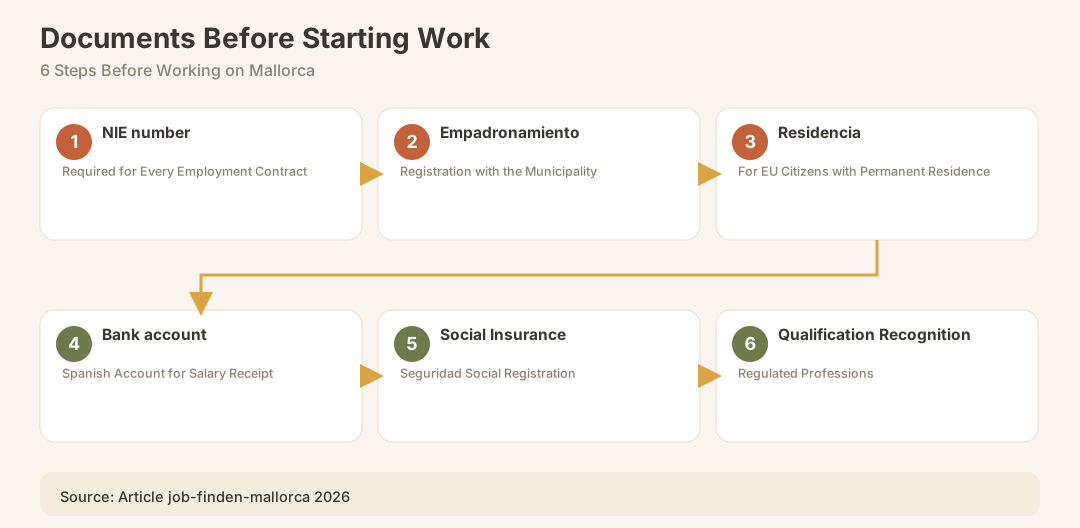
The most important steps at a glance:
- Apply for your NIE number – the Spanish foreign identification number is required for every employment contract, every bank contract, and tax registration. Nothing works without an NIE. → NIE Number Mallorca
- Empadronamiento – registration with the residents' registration office of your municipality. Employers sometimes request this document, and it is the basis for many further dealings with the authorities. → Empadronamiento Mallorca
- Residencia – as an EU citizen living and working permanently in Spain, you must register as a resident. → Residencia Spain
- Bank Account in Spain – you will need a Spanish account for your salary to be paid into. → Opening a Bank Account in Spain
- Social Security – your employer registers you with the Seguridad Social; if you are self-employed, you register yourself as an autónomo.
- Recognition of Qualifications – anyone wishing to work in regulated professions must have their qualifications recognised in Spain.
| Document | Who needs it | Where to apply |
|---|---|---|
| NIE Number | All employees and self-employed individuals | National Police or consulate |
| Empadronamiento | All residents | Ayuntamiento (municipal administration) |
| Residencia (TIE/certificate) | EU citizens with permanent residence | National Police |
| Spanish bank account | Recommended for receiving salary | Spanish bank |
| Recognition of Qualifications | Regulated Professions | Responsible Ministry |
Where to Find Jobs in Mallorca: Portals and Channels
Job hunting in Mallorca works differently from Germany – alongside online portals, personal networks and community channels play a central role.
Online Job Boards
- mallorca-zero.com/stellenmarkt – one of the most widely used German-language job boards in Mallorca, with categories such as hospitality, hotels, trades, real estate, administration and tourism.
- Inselradio Job Board (inselradio.com/jobboerse) – the island's German-language radio platform runs its own jobs board, aimed primarily at the German-speaking community.
- jobs.abc-mallorca.com – the jobs portal of the well-known lifestyle platform abcMallorca, with categories including Architecture & Design, Construction, Hospitality, Healthcare, IT and Household.
- mallorca-expats.de/jobs – vetted job listings and search requests for German speakers, curated by the community platform Mallorca Expats.
- marmarton.net – an English-language portal offering seasonal positions (bar, service, kitchen, entertainment, maintenance) with accommodation included, aimed primarily at the international market.
- InfoJobs.net and Indeed.es – the major Spanish job portals are also worth checking, but are geared predominantly towards Spanish speakers.
- auslandsjob.de – a German portal with a section for Spain/Balearen, more suited to newcomers and those interested in seasonal work.
Networking and Community
Many jobs in Mallorca are never advertised publicly but are filled through personal recommendations. Facebook groups within the German-speaking community, local expat networks and the Inselradio circle are all useful points of contact. Those already living on the island have a clear advantage over applicants based in Germany.
Please note: Job listings on social media have a very short shelf life. Specific vacancies appear in Facebook groups and are often filled within a matter of days. Checking in regularly is well worth the effort.
Working Without Spanish: Where It Works and Where It Doesn't
Spanish is the official language in Mallorca – alongside Catalan/Mallorcan. For many jobs in the German-speaking niche, however, German as a native language is sufficient. That said, there are clear limitations.
Where German is enough:
- Estate agents serving German-speaking buyers
- Tradespeople serving exclusively German-speaking clients
- Care and support of German-speaking residents
- Remote work for German-speaking clients
- Service and reception roles in hotels with a predominantly German-speaking guest base
Where Spanish is indispensable:
- Dealing with authorities and signing contracts independently
- Positions in Spanish companies without a German or international focus
- Medical professions in public institutions
- Management positions in local companies
Note: Even those working within the German-speaking niche benefit enormously from a basic command of Spanish — in everyday life, when dealing with authorities, and when building a broader network. Learning Spanish should be on the agenda alongside the job search. → Education & Language on Mallorca
Self-employment on Mallorca: Autónomo as an alternative
Those who cannot find an employment contract or who prefer more flexibility often opt for self-employment as an Autónomo. This is the standard legal structure in Spain for freelancers and sole traders.
Good to know:
- Registering as an Autónomo is linked to the NIE number and the Seguridad Social.
- A compulsory monthly contribution (Cuota Autónomo) applies; since 2023 its amount has been calculated on an income-dependent basis.
- For highly qualified newcomers with a foreign employer, the so-called Beckham Law (Régimen Especial de Impatriados) may offer attractive tax advantages.
More details: Autónomo in Spain · Cuota Autónomo · Beckham Law Spain
For remote workers and digital nomads who do not yet have Spanish residency, the Digital Nomad Visa Spain may also be an option.
Tax and social security: what you need to know as an employee
Anyone who lives and works on Mallorca becomes liable for tax in Spain. As a resident, you pay the Spanish income tax IRPF (Impuesto sobre la Renta de las Personas Físicas) on your worldwide income.
| Tax liability | Arises when |
|---|---|
| Spanish income tax (IRPF) | You live in Spain for more than 183 days/year |
| Social security (Seguridad Social) | Automatic upon employment; for Autónomo: self-registration |
| Modelo 720 (foreign assets) | Foreign assets above certain thresholds are subject to reporting obligations |
For employees from Germany, the double taxation agreement between Germany and Spain governs where you pay taxes. As a resident on Mallorca, you are generally fully liable to tax in Spain.
More on this: Taxes as a resident (IRPF) · Taxes & finances overview · Modelo 720
Health insurance in Spain is linked to the Seguridad Social. As an employee, you are automatically covered under the public system. As an Autónomo, likewise, once you are paying your contributions. More: Health insurance Spain
Most common mistakes when job-hunting on Mallorca
1. Applying too late Seasonal positions for the summer are frequently filled as early as winter and spring. Anyone who starts looking in June is generally too late.
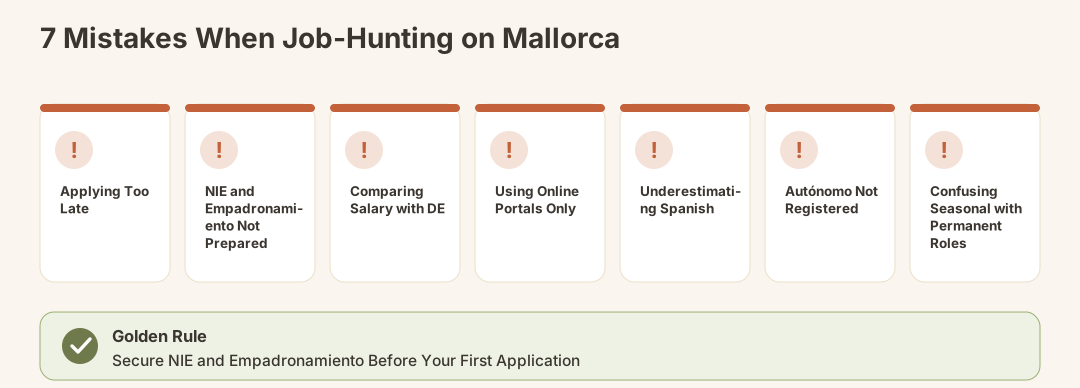
2. Not having the NIE and Empadronamiento prepared Many employers cannot finalise a contract without a NIE. These documents should be in hand before the active application phase begins.
3. Comparing salaries with Germany Local jobs typically pay 1.200–2.500 € gross — this is the market standard, not a sign of a poor employer. Those with higher expectations should look towards remote work or self-employment.
4. Relying solely on online job portals A considerable proportion of positions are filled through personal networks. Those who are already living on the island or have contacts there are at a clear advantage.
5. Underestimating language preparation Even within the German-speaking niche, a basic command of Spanish is indispensable for dealings with authorities and everyday communication.
6. Not registering self-employment correctly Anyone working as a freelancer without registering as an Autónomo risks back payments and fines. Regularising the situation after the fact is time-consuming.
7. Confusing a seasonal contract with a permanent position Many tourism jobs are explicitly limited to the season. Anyone wishing to remain on Mallorca year-round should clarify this at the job interview.
What comes next? Settling into life on Mallorca
Finding a job is an important step — but there are many further matters you will need or want to sort out once you have started work:
- Accommodation: Affordable flats in Palma are hard to come by. → Renting a flat as a foreigner
- Cost of living: What does daily life actually cost? → Cost of living in Mallorca
- Family: If you're moving with children → Schools in Mallorca
- Car: Converting your driving licence, importing a car → Cars & transport in Mallorca
- Certificado Digital: Essential for many official processes online → Applying for a Certificado Digital
- Gestoría: For those who want to outsource the bureaucracy → Gestoría in Spain
Our Mallorca emigration guide.
Checklist: Finding a job in Mallorca – step by step
- Apply for your NIE number (before or shortly after arrival)
- Complete your empadronamiento at the local authority
- Apply for your residencia certificate as an EU citizen
- Open a Spanish bank account
- Brush up your Spanish / start a course
- Check qualification recognition (for regulated professions)
- Monitor job boards early (mallorca-zero.com, Inselradio, abc-mallorca)
- Build your network: community groups, expat events
- Clarify your employment type: employed or autónomo?
- If autónomo: understand your cuota contributions and tax obligations
- Seasonal or year-round position? Clarify this early on
Conclusion: Is it worth looking for a job in Mallorca?
Mallorca offers real job opportunities in 2026 for German speakers – particularly in tourism and hospitality, real estate, trades, and remote work. Salaries for local positions are lower than in Germany, but set against that are a climate, a quality of life, and a network that prove decisive for many people. Those who come well prepared – NIE number in hand, basic Spanish under their belt, and a realistic understanding of salaries – are in a strong position. Anyone who underestimates the bureaucracy or starts applying too late will lose valuable time. The good news: with the right preparation, landing a job in Mallorca is not a matter of luck – it is an achievable, plannable goal.
Official sources
- Seguridad Social (Spanish Social Security): www.seg-social.es – Registration for employees and autónomo
- AEAT (Spanish Tax Authority): www.agenciatributaria.es – IRPF, Modelo 720, tax identification numbers
- Ministerio de Trabajo y Economía Social: www.mites.gob.es – Employment law, types of contract
- EU Social Security Coordination: europa.eu/youreurope/citizens/work/social-security-and-benefits – Cross-border social security
- Govern de les Illes Balears: www.caib.es – Regional authorities Balearic Islands
- SEPE (Spanish Public Employment Service): www.sepe.es – Unemployment, job placement