
Mallorca water temperature in January: cool, clear, honest
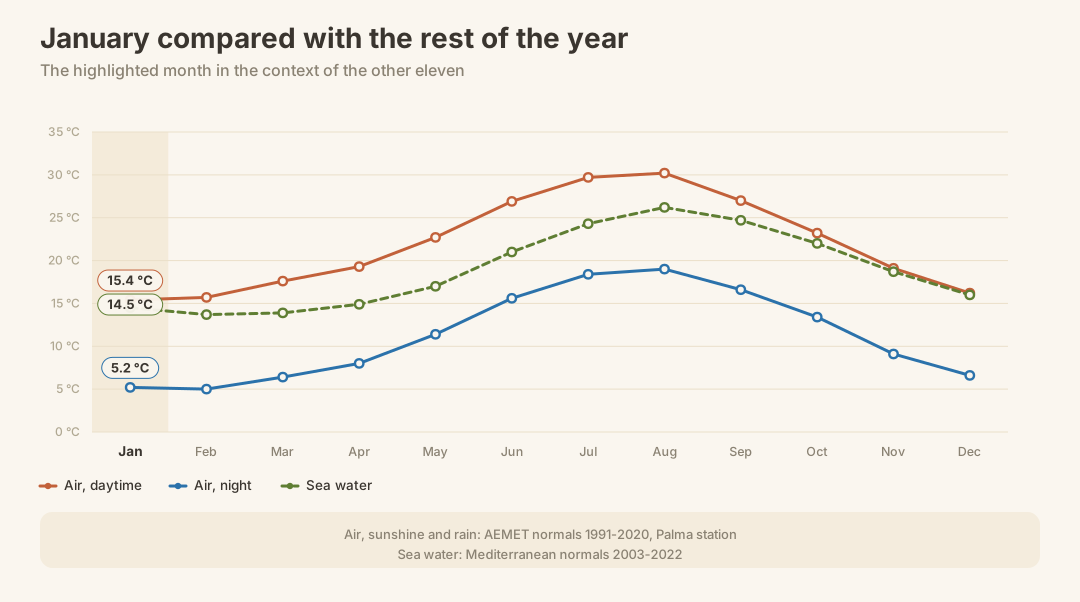
Palma normals as an island-wide approximation: In January, the average daytime high is 15.4 °C and the sea is 14.5 °C, with 6 rain days and 5.5 hours of sunshine per day.
Anyone travelling to Mallorca in January and wanting to know whether the sea still invites a swim will get an honest answer here. The water temperature Mallorca January reaches lies at the lower end of the annual cycle, for a simple physical reason: the sea reacts far more sluggishly to cold than the air does. The following text explains how cold the water really is, why it usually lags the air temperature by weeks, where the mildest spots around the island are to be found, and what this means for swimming, snorkelling and diving this month.
Water temperature in January
The short answer first: swimming in the proper sense is, in January, only for the hardy. The sea measures 14.5 °C, which sits noticeably below the threshold at which most people find a swim without a wetsuit pleasant. Anyone familiar with that threshold knows that clearly warmer water feels soft and inviting, whereas anything below it is quickly perceived as cool and, after a few minutes, as unpleasantly cold. At the current temperature, a brief, brave dip into the water is feasible, but an extended swim hardly is – the body cools down too fast, and without a wetsuit it soon becomes uncomfortable.
This fits the character of the month as a whole: January is the coldest month of the year in terms of air temperature, and this coolness shapes the entire mood of the island. Nights are crisp, the sun warms only tentatively during the day, and towards the end of the month the almond blossom begins in many places – a clear sign that winter is still present but is already leaning towards spring. During this period, the coastal towns in the north and east lie in a kind of hibernation: many hotels, beach bars and restaurants are closed or scale back their operations considerably, the seafront promenades look empty, and life shifts more towards the inland villages. Palma, by contrast, remains largely untouched by the tourist rhythm: the city has its own life all year round, cafés and markets are open as usual, and even in January it is a pleasure to stroll through the old town or along the harbour.
For anyone coming to the island precisely in this month, the more rewarding question is therefore less about swimming in the sea and more about walks along the coast, hikes in the Tramuntana mountains, or simply admiring the first flowering almond trees. The water itself remains, for now, something to observe – and a promise of warmer months to come.
Why the sea lags behind the air
The fact that the Mediterranean stays so cool in January, even though the coldest phase of the air is often already weeks behind or only just being passed through, has a clear physical explanation: water has a far higher heat capacity than air. Heating or cooling a given amount of water by even a single degree requires many times the energy needed for the same temperature change in air. The result is a marked time lag: while the air over Mallorca can change dramatically within just a few days – a cold snap, a few days of föhn wind, a shift in the weather – the sea needs weeks to months to respond to the same seasonal signals. It stores the warmth of summer for a long time and only releases it again with considerable delay, just as it heats up only hesitantly in spring.
This inertia is particularly clear when looking at the year's extreme values. The warmest month for the air is August, when daytime highs climb to 30.2 °C. The sea, on the other hand, reaches its peak later: the warmest water month is September, at 24.7 °C. Between the hottest air month and the warmest water month there is therefore a noticeable shift – proof that the warmth absorbed in summer only settles into the sea with delay, while the air is already turning milder again.
The gap becomes even more evident in spring, when the two curves are furthest apart. In April, the air temperature already reaches 19.3 °C, while the water, at 14.9 °C, still lingers deep in winter levels. The sun has long since noticeably warmed the landmass and the thin layer of air above it, but the large, sluggish body of water that is the Mediterranean still clings to the cold of the preceding months. Only over the course of summer does this gap close again, before the pattern repeats in reverse during autumn: then the sea stays warm for longer while the air is already cooling noticeably. January sits precisely in the phase where both curves are once again close together at the lower end of the year – cool in the air, cool in the water, just arriving there on different schedules.
Where the water is warmest in January
Even in January, the sea around Mallorca is not equally cool everywhere. No dedicated measurement series exist for individual bays and stretches of beach, so no concrete figures can be given here – but there is a clear, well-supported pattern that follows from the island's coastal geography.
Shallow, sheltered bays warm up faster and also cool down again faster than deep, open water. In the south and east of the island – around the Bay of Palma, at Playa de Palma, in the gentle bays around Colònia de Sant Jordi, or in the sheltered sections of the Bay of Alcúdia – the shallower water means the sea warms up somewhat more quickly on sunny winter days and also retains that warmth for longer over the course of the day. The proximity to shallow sandbanks and the shelter from wind play an additional role: where there is little exchange with the open, cooler water, conditions tend to stay a touch milder.
Along the north-west coast, by contrast, along the steep rocky shoreline of the Tramuntana near places such as Sa Calobra, Banyalbufar or Sóller, the water is considerably deeper and directly exposed to the open Mediterranean and to the wind. Here, the near-surface layer of water constantly mixes with cooler water from the depths, which keeps the overall temperature lower and more uniform – an effect that is especially noticeable in winter. So anyone who does want to get into the water in January will find comparatively milder conditions in the shallow, sheltered bays of the south and east, although, without measurements for individual locations, the difference from the open north-west coast can only be described as a tendency, not as an exact figure.
January's sea against the rest of the year
In the Mediterranean's annual cycle, January marks one of the coolest phases, even if it does not quite represent the absolute low point. At 14.5 °C, the month lies well below the warmest water month of the year, September, at 24.7 °C – a gap that illustrates the full range the sea around Mallorca moves through over the course of a year. The distance to the coldest water month, February, at 13.7 °C, is by contrast small: January already sits close to the low point, even though the actual minimum is only reached a few weeks later.
A particularly revealing comparison is with the month that sits symmetrically opposite January in the calendar year: November, at 18.7 °C. Both months are similarly distant from the winter and summer points of solar radiation respectively, and so, averaged over the year, receive a comparable amount of solar energy. Yet the water temperature differs noticeably between the two months. This is precisely where the sea's thermal inertia shows most clearly: November still benefits from the warmth stored during summer and early autumn, while January is already deep into the long cooling phase that only reaches its low point in late winter.
For anyone wanting to keep the annual pattern in mind, January can be summed up like this: cooler than any autumn month, close to the coldest point of the year, but not yet the low point itself, and with a noticeable gap to the warm water of late summer and early autumn. This delay also explains why autumn by the sea often feels milder than spring at comparable air temperatures – the water needs its time, in both directions.
Swimming, snorkelling, diving: what is worthwhile now
At 14.5 °C, the water temperature quite directly determines what makes sense in January and what does not. For a brief swim in a swimsuit or swimming trunks, there is usually time for only a few minutes – the body cools down quickly at this temperature range, and without a wetsuit a longer stay in the water soon becomes uncomfortable, even risky. Anyone who still wants to go in should prepare for a short, intense moment and then dry off and warm up quickly afterwards, rather than aiming for an extended swim.
For anyone wanting to stay in the water a little longer, a wetsuit is essential. A thicker suit with as much coverage of the arms and legs as possible is what makes snorkelling genuinely pleasant at this time of year, since it significantly slows down the cooling of the body. A wetsuit of sufficient thickness is likewise a must for diving; many diving centres on the island offer suitable equipment during the winter months, precisely because they are set up for these temperature conditions.
One clear advantage of the cool water is the visibility beneath the surface. Low temperatures slow the growth of algae and plankton, which in the warm summer months often gives the water a murkier, greener tint. In January, the sea therefore often stays clearer, and anyone who braves the cold and goes in is rewarded with surprisingly good visibility – a circumstance that makes underwater photography and calm snorkelling in shallow, sheltered bays particularly appealing at this time of year, even though the water temperature itself calls for caution.
Frequently asked questions
Can you swim in the sea in Mallorca in January?
Is Mallorca's sea too cold for watersports in January?
Do you need a wetsuit to go in the water in Mallorca in January?
When does the sea start warming up again after January?
What's on in Mallorca in January
Events
- New Year's Day
- Weekly Market in CaimariSelva
- Weekly Market in S'ArenalLlucmajor
- Theatre: Chronicles of Midsummer - Sala La FornalManacor
- Fogueró de Sarau AlcudiencAlcúdia
- Monstruas Impro en Escena 101Palma
Worth doing now
- Leave sea swimming to the wetsuit-clad watersports crowd and take a coastal walk instead.
- Combine a beach visit with sightseeing rather than a swim this month.