
How to claim back mortgage expenses in Spain
If you took out a mortgage to buy a property in Spain, years may pass between the original appointment with the notary and a possible refund. What matters is not simply that you paid fees: you need to distinguish which costs related to setting up the mortgage, which arose from the property purchase and what your contract says about how the costs are shared. If you want to reclaim mortgage costs in Spain, the best place to start is with the deed and the individual invoices – not a blanket claim for all the costs of buying the property.
In this guide, you’ll learn why the Spanish Supreme Court’s 2015 ruling matters, which charges to check and which documents you can present to the bank. It also covers mortgages that have long since been paid off and contracts signed many years ago. There is no fixed refund amount, however: what matters is what you paid and the terms of your contract.

When can you reclaim mortgage costs in Spain?
The starting point is the costs clause in the mortgage contract. In judgment 705/2015 of 23 December 2015, the Spanish Supreme Court ruled that a clause requiring consumers to pay the notary and land registry costs for a mortgage was unfair. That does not mean every invoice connected with a property purchase will be refunded in full.

First, check whether the invoice in question relates to setting up the mortgage at all. Having a purchase contract notarised and registering ownership are not the same as having a mortgage deed notarised and registering the mortgage. For an overview of financing costs, see the guide to additional mortgage costs in Spain.
| Date or decision | What it means for your claim |
|---|---|
| 23 December 2015: judgment 705/2015 | A blanket clause passing the mortgage’s notary and land registry costs on to consumers was ruled unfair. |
| 16 June 2019: Law 5/2019 came into force | A different statutory allocation of costs applies to mortgages set up after this date; the bank pays most of the costs of setting up the mortgage. |
Important: The 2015 ruling does not establish a right to recover taxes or notary or land registry costs paid when buying the property. Separate the purchase costs from the financing costs, invoice by invoice.
Which costs might be refunded?
For older mortgages, it is particularly worth checking the notary fees, the cost of registering the mortgage in the land registry and the gestoría fees associated with the mortgage. Notary fees are split equally; the bank is responsible for the cost of registering the mortgage in the land registry. In principle, the borrower pays for the property valuation.
| Cost item | What to check |
|---|---|
| Notary fees for the mortgage deed | Check whether a partial refund is due; the costs are split equally. |
| Land Registry fees for registering the mortgage | Check whether a refund is due; the costs are borne by the bank. |
| Gestoría fees for processing the mortgage | Check the invoice and the contractual costs clause. |
| Property valuation (tasación) | Generally payable by the borrower; do not treat it in the same way as the other items. |
| Stamp duty (AJD) | Do not automatically count this as a refundable item for older contracts. |
When it comes to AJD stamp duty, be careful: you should not assume it can be refunded for older contracts. The way costs are allocated for new mortgages cannot be applied retrospectively as a guarantee for every older contract. You can read more about the tax itself in the guide to AJD in Spain.
What applies to mortgages taken out since Law 5/2019 came into force?
Since 16 June 2019, banks have had to cover most of the costs of setting up new mortgages, except for the property valuation. If your contract dates from this period, a different question takes priority: Were you charged for an item the bank should have paid for? AJD stamp duty is not included in the following overview; its allocation is not governed by Law 5/2019.
| Mortgage setup item | Allocation of costs since 16 June 2019 |
|---|---|
| Notary | Bank |
| Registration of the mortgage in the Land Registry | Bank |
| Gestoría | Bank |
| Valuation report | Borrower |
Here too, do not confuse the creation of the mortgage with the additional costs of buying a property in Mallorca. An invoice issued at the same notary appointment does not necessarily relate to the mortgage.
Which documents should you give the bank?
Your claim will be easier to assess if you bring together the contract, individual costs and payments. In particular, the bank will need the mortgage deed and copies of the relevant invoices.
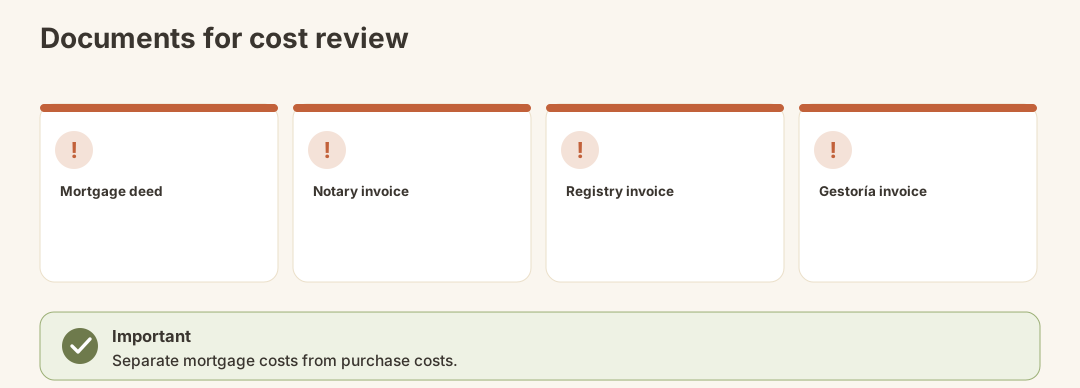
| Document | Why you need it |
|---|---|
| Copy of the mortgage deed | To check the costs clause and the contract. |
| Notary’s invoice | To identify the amount attributable to the mortgage. |
| Land Registry invoice | To identify the mortgage registration costs. |
| Gestoría invoice | To check the service billed and the amount charged. |
| Proof of AJD paid, where applicable Modelo 600 | To prove that tax was paid, if this is relevant to assessing your case. |
If you are missing invoices, ask the bank for the documents and a breakdown of the amounts charged for the mortgage. In your own breakdown, clearly distinguish between invoices relating to the financing and those relating to the purchase.
How do you submit your claim to the bank?
You can first submit your claim directly to the lending bank. Even if you have a particular bank in mind, the preparation is the same: a clear breakdown is more helpful than simply asking for “all mortgage costs”.
- Check the mortgage deed: Find the clause on how notary, Land Registry and administrative fees are allocated.
- Match up the invoices: Mark which items relate to the mortgage and which relate to the property purchase.
- List your own payments: Match each item you are claiming to the relevant invoice.
- Request a refund: Tell the bank exactly which items you are claiming and attach copies of the documents.
- Check the response: Compare any refund offered with the individual invoices, rather than looking only at the total.
Keep your original documents. If you are unsure how to interpret the costs clause or whether an invoice relates to the mortgage, have the specific contract reviewed by a legal professional.
Is it worth claiming a refund?
That depends on the items you actually paid for and are entitled to claim back. A large loan amount alone tells you little about how much you can claim. What matters most is whether the bank made you pay costs associated with setting up the mortgage and whether you can substantiate them with invoices.
Before deciding, make a simple comparison: What did you pay for the notary, Land Registry and gestoría? How much of that related to the mortgage? What has the bank already paid? A blanket refund figure for all contracts would be misleading.
Can you claim costs for an old or paid-off mortgage?
A paid-off mortgage does not, in itself, rule out a claim for reimbursement of costs. The question concerns payments made when the mortgage was originally set up, not the outstanding loan balance.
For a contract that is, for example, ten years old, however, you should assume neither that you definitely have a claim nor that a claim is automatically ruled out. Whether a claim can still be enforced must be assessed on a case-by-case basis. With older contracts in particular, it makes sense to gather the deed, invoices and any previous correspondence before relying on an assumed deadline.
Note: Removing a repaid mortgage from the Land Registry is a separate matter from reclaiming the costs of setting it up in the first place.
Most common mistakes
Adding up all the costs associated with the purchase. The disputed costs clause concerns the mortgage. Property purchase costs must be considered separately.
Assuming the 2015 ruling entitles you to a full refund. Notary fees, valuation costs and AJD, in particular, cannot all be attributed to the bank.
Claiming only a total amount. Without the deed and itemised invoices, it is difficult to see what the claim consists of.
Writing off a paid-off mortgage without checking. Repaying the loan and a possible claim for mortgage set-up costs paid earlier are separate issues.
Assuming a fixed deadline applies to older contracts. Have the enforceability of your claim assessed for your specific case, rather than relying solely on the age of the contract.
Checklist: Is your claim ready?
- You have the mortgage deed.
- You have marked the clause on how costs are allocated.
- You have gathered the notary, registry and, where applicable, gestoría invoices.
- You have separated purchase costs from mortgage set-up costs.
- You have listed each amount you paid separately.
- You have checked whether the bank has already covered any of the items.
- For an older contract, you have clarified whether the claim is enforceable or arranged to have this checked.
What happens next?
If the bank offers a refund, compare every item it accepts or rejects with your list. If the bank rejects the claim or disputes the calculation, its reasons matter most: is the issue the costs clause, how an invoice has been categorised, or whether the claim is enforceable?
An individual assessment can then establish whether it is worth taking further action. This is particularly important if documents are missing or the contract is older. You should not automatically combine other disputes arising from your loan agreement – such as unfair mortgage clauses – with your claim for costs.
Conclusion
If you want to reclaim mortgage costs in Spain, the most important thing is to separate the invoices clearly. Judgment 705/2015 makes mortgage set-up costs passed on wholesale to consumers a matter for review; Law 5/2019 allocates costs differently for newer contracts. Whether you are entitled to anything, and how much, depends not on a general percentage but on the contract, proof of payment and the legal treatment of each item.
Not legal or tax advice: Disputed costs clauses, older claims and tax items require an individual assessment.
Official sources
- Spanish Official State Gazette (BOE) – Law 5/2019 on real estate credit agreements.
- Consejo General del Poder Judicial – Judiciary and case law, including judgment 705/2015 of the Spanish Supreme Court.