
Nuda Propiedad Mallorca: Buy or Sell a Property Subject to Usufruct
Nuda Propiedad is more than a niche market in Mallorca: owners of high-quality properties whose value has multiplied over recent decades can use this arrangement to release cash immediately – while continuing to live in their home for the rest of their lives. For buyers, it offers a purchase price well below market value, with the certainty that full ownership will pass to them automatically, at no additional cost, when the usufruct ends. This guide explains how the Spanish system of divided ownership works, how the value of Nuda Propiedad is calculated, what taxes buyers and sellers face, what to check with the notary – and which mistakes can prove costly.

What Nuda Propiedad means – the legal basis
Spanish civil law clearly separates ownership and use into two distinct legal rights:
- Nuda Propiedad (bare ownership): You are registered as the owner in the Land Registry, but you cannot live in or rent out the property while the usufruct remains in force.
- Usufructo (usufruct): The person holding the usufruct can live in the property, rent it out and keep the income – usually for life, though sometimes for a fixed period.
Together, these rights constitute full ownership (plena propiedad). When the usufruct ends – through the death of its holder or the expiry of an agreed term – full ownership automatically vests in the bare owner, without another purchase contract or a further tax on acquiring the Usufructo interest.
| Term | Spanish | What it gives you |
|---|---|---|
| Bare ownership | Nuda propiedad | Land Registry title, but no right to use the property |
| Usufruct | Usufructo | Right to live in or use the property, but no ownership |
| Full ownership | Plena propiedad | Both rights combined |
| Consolidation | Consolidación | Automatic transfer when the usufruct ends |
The legal framework is set out in the Spanish Código Civil (Art. 467 ff.). The deed is signed before a notary and registered with the Registro de la Propiedad of the Illes Balears.
Note: A usufruct can be agreed for life or for a fixed term. A lifetime usufruct is by far the more common arrangement in Mallorca – particularly for older owners who want to release value from their property.
Why Mallorca is a distinctive market for Nuda Propiedad
Along with Ibiza, Mallorca has one of Spain’s most expensive property markets outside the major cities. According to market data, the average price in Palma is over €3,500/m², with prime locations such as Son Vida, Bonanova and Casco Antiguo commanding considerably more. This exceptional growth in value over recent decades makes Nuda Propiedad particularly attractive to sellers: anyone who bought a flat in Palma in the 1980s or 1990s now holds an asset of enormous value that is difficult to turn into cash.
For buyers, the argument works in reverse: anyone who can acquire a property in one of Europe’s most sought-after locations for 45–65% of its market value secures a built-in price advantage in a market where supply is limited by the island’s geography.
At the same time, recent figures show that the market has become more selective: in the Balearic Islands, Nuda Propiedad transactions fell by around 38% in 2024. This suggests a market in which buyers can negotiate from a well-informed position, provided they understand how valuations work.
How the value of Nuda Propiedad is calculated
The valuation follows a formula defined by law and used for tax purposes in Spain. The starting point is the property’s market value. The value of the usufruct is then deducted; what remains is the value of the Nuda Propiedad.
Formula for a lifetime usufruct (Usufructo vitalicio):
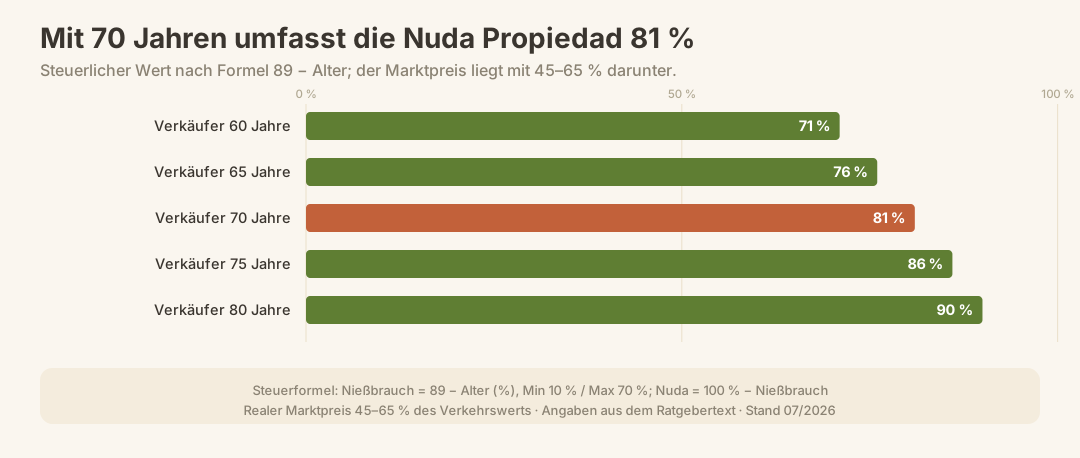
Value of the usufruct = 89 − age of the usufructuary (as a % of market value) Minimum value: 10%, maximum value: 70%
This means: value of the Nuda Propiedad = 100% − value of the usufruct.
| Age of usufructuary | Value of usufruct | Value of Nuda Propiedad |
|---|---|---|
| 60 years | 29% | 71% |
| 65 years | 24% | 76% |
| 70 years | 19% | 81% |
| 75 years | 14% | 86% |
| 80 years | 10 % (minimum) | 90 % |
Note: The formula (89 minus age) is used for tax purposes. On the open market, the price actually negotiated differs from this – in practice, Nuda Propiedad typically sells for 45–65 % of the market value, often below the value calculated for tax purposes. This is because buyers factor in liquidity and longevity risks.
Example calculation: Palma, 70-year-old seller:
| Item | Amount |
|---|---|
| Market value of the apartment | €600,000 |
| Value of the usufruct (19 %) | €114,000 |
| Tax value of the Nuda Propiedad (81 %) | €486,000 |
| Realistic market price (approx. 55 %) | ~€330,000 |
The difference between the tax value and the market price is real and negotiable – another reason to seek professional advice.
Taxes when buying Nuda Propiedad
Impuesto de Transmisiones Patrimoniales (ITP)
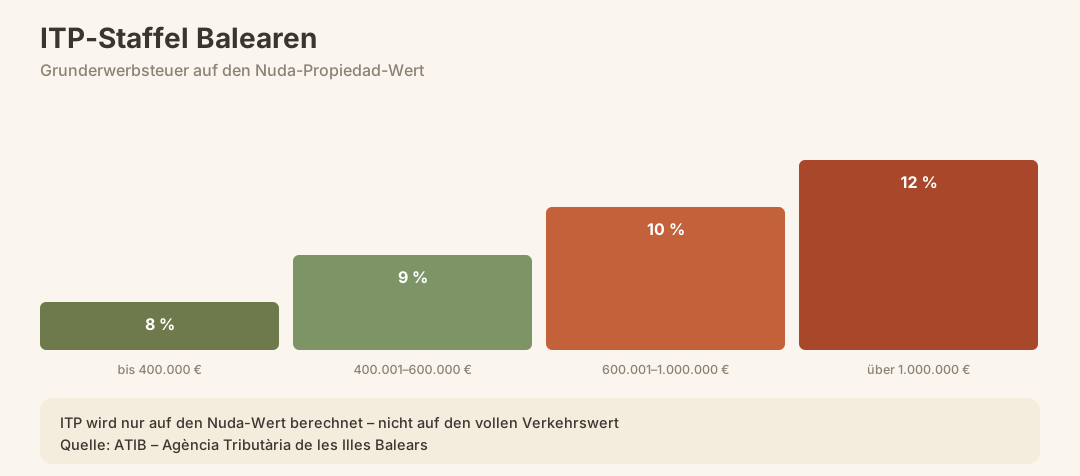
The buyer of the Nuda Propiedad pays ITP on the value of the Nuda Propiedad – not on the full market value. This is the main tax advantage of buying it. The Balearic ITP rates are tiered:
| Purchase price (taxable base) | Balearic Islands ITP rate |
|---|---|
| Up to €400,000 | 8 % |
| €400,001 to €600,000 | 9 % |
| €600,001 to €1,000,000 | 10% |
| €1,000,001 to €2,000,000 | 12% |
| Over €2,000,000 | 13% |
Note: When the bare ownership and usufruct are later consolidated (Consolidación) – that is, when the usufruct passes to the bare owner after the usufructuary dies – no further purchase tax is due. However, supplementary ITP is payable on the original value of the usufruct, calculated using the value agreed at the time. Factor this in when buying.
IRPF for the seller
For the seller, the proceeds from selling the Nuda Propiedad are subject to Spanish income tax (IRPF) as a capital gain – just like an ordinary property sale. Anyone who is tax-resident in Spain and used the property as their main home may qualify for the exemption for people over 65 or the reinvestment exemption. You can find details in our guide to IRPF exemption when selling your main home.
Non-residents are subject to 3% withholding tax (Retención del 3%): the buyer withholds 3% of the agreed purchase price and pays it directly to the AEAT. Read more in our guide to taxes when selling a property.
IBI and ongoing costs during the usufruct
| Cost | Who pays during the usufruct |
|---|---|
| IBI (property tax) | Usually the usufructuary |
| Owners' association | Usually the usufructuary |
| Routine maintenance | Usufructuary |
| Structural repairs | Bare owner |
| Energy certificate, IEE | As agreed |
This allocation follows the rules in the Código Civil, but it can be changed by agreement. Make sure it is clearly settled before signing before the notary.
The split purchase – a property strategy for families
Gift tax Mallorca
Explanation
What is given decides which law applies and what the deduction depends on. For a property it is always the law of the region where it lies — even when donor and recipient both live abroad.
Explanation
For a property, the value declared, at least the Valor de referencia — the official reference value of the land registry office, below which no gift may be taxed. For money, the amount given.
Explanation
The group decides the multiplier and the deduction. For gifts the law treats groups I and II alike; within group III it separates blood relatives from relatives by marriage.
Explanation
For the deduction, the Escritura pública — the notarial deed — must state a value for a property that exceeds the reference value by no more than a fifth. Where there is no reference value, the market value applies. Miss the condition and groups I and II are left with the fallback formula, everyone else with nothing.
- To pay (Cuota a ingresar)
- €0.00
- Value of the gift
- €350,000.00
- Kinship group
- Group I/II — child, grandchild, spouse, parent
Where the recipient lives: On the Balearics
Legal status: 25 July 2025
This calculation is provided for guidance only and is not a substitute for tax or legal advice in specific cases.
Nuda Propiedad is not just an option for older people. A common family strategy works like this: the parents buy a property and retain the usufruct, while transferring bare ownership directly to their children. In effect, the children inherit the property without later paying inheritance tax on its full market value, because they already own it.
A word of caution about this arrangement: If the funds the children use to acquire bare ownership come from their parents, they are treated as a gift. This means gift tax is payable. In the Balearic Islands, gifts between first-degree relatives are subject to specific rates and allowances – see the guide Inheritance & Gifts in the Balearic Islands.
There is still a benefit: inheritance tax is calculated on a reduced value (Nuda Propiedad), and the subsequent consolidation of ownership triggers only a supplementary ITP payment on the usufruct portion – not another payment on the full value.
The process: step by step to Nuda Propiedad
Market valuation: An accredited valuer (tasador homologado) values the property. In Mallorca, choose a valuer who knows the local market – location, views, terrace, and proximity to calas and the harbour all have a significant effect on value. For more on the valuation method, see Tasación – Property Valuation in Spain.
Preliminary agreement / reservation agreement: Both parties agree on the price, usufruct terms and payment arrangements. This step is legally binding – not a good time to forgo a lawyer. See: Reservation Agreement in Spain.
Land Registry check: Before the notary appointment, obtain a Nota Simple from the Registro de la Propiedad to check for existing charges, mortgages or usufruct rights already on the register. Guide: Checking the Land Registry in Spain.
Notary appointment in Palma: The buyer and seller sign the Escritura Pública de Compraventa. The notary records that ownership is transferred in separate interests: Nuda Propiedad passes to the buyer, while Usufructo remains with the seller. The purchase price is paid in full on the day of signing. Important: Power of Attorney at the Notary, if either party cannot attend in person.
Tax payment and Land Registry registration: The buyer files and pays the ITP within one month of notarisation, using Modelo 600 with the ATIB (Agència Tributària de les Illes Balears). The Escritura is then submitted to the relevant Registro de la Propiedad. Only once it is registered is the transfer of ownership effective against third parties.
Ongoing arrangements: The usufructuary lives in or lets the property. The bare owner does not pay ongoing costs associated with its use but must cover structural repairs.
Consolidation (Consolidación): After the usufructuary dies or the term expires, the consolidation is formalised before a notary and recorded in the Land Registry. Additional ITP is payable on the usufruct portion.
Note: The whole process is similar to a standard property purchase – with the crucial difference that you cannot use the property immediately. Read our full guide to buying property in Mallorca.
Rights and responsibilities: What bare owners and usufructuaries need to know
The usufructuary may and must:
- Live in the property
- Rent it out (including on a long-term basis) and keep the rental income
- Pay for routine repairs and maintenance
- Pay IBI and community fees
- Not sell, give away or encumber the property (without the bare owner’s consent)
- Keep the property in good condition
The bare owner may and must:
- The bare owner must not enter or use the property while the usufruct is in place
- Pay for major repairs (e.g. a new heating system or roof renovation)
- Sell or encumber the Nuda Propiedad (but the buyer takes the property subject to the usufruct)
- Claim damages from the usufructuary for serious breaches of their obligations (significant loss in value)
Important: As a rule, the usufructuary cannot legally transfer a holiday rental licence (ETV) while the usufruct is in place. Once ownership is consolidated, the ETV issue becomes the owner’s responsibility. For the latest on ETV: Mallorca holiday rental licence.
Tax considerations for non-residents
3% withholding on a sale
Explanation
The consideration agreed in the deed (contraprestación acordada) is what the withholding is measured against — not the cadastral value and not the reference value (valor de referencia).
Explanation
The capital gain (ganancia patrimonial) is the sale price less your selling costs and less the acquisition value including the costs and taxes of buying, reduced by any depreciation already claimed (amortizaciones) if the property was let. If you sold at a loss, enter the loss with a minus sign: no tax arises and the withholding credited to you can be refunded.
- Buyer's withholding (retención)
- €19,500.00
- Tax on the gain
- €22,800.00
- Additional payment
- €3,300.00
Your tax exceeds the withholding. You pay the difference with your return.
Legal status: 1 January 2016
This calculation is provided for guidance only and is not a substitute for tax or legal advice in specific cases.
Non-residents who own Nuda Propiedad in Mallorca are subject to Spanish wealth tax (Impuesto sobre el Patrimonio) on the value of their Nuda Propiedad – not on the market value of the entire property. That is another structural advantage. Details: Wealth tax in Spain.
If a non-resident later sells their Nuda Propiedad, the 3% withholding tax applies. The gain is taxed under Spain’s non-resident income tax rules (IRNR). Guide: Rental income as a non-resident.
The exit tax may also be relevant if you leave Spain after buying the Nuda Propiedad. More on this: Exit tax in Spain.
Most common mistakes when buying and selling
1. Skipping the lawyer
The cost of a specialist property lawyer is usually modest relative to the transaction value. The risks of going without legal advice – flawed usufruct clauses, unclear division of costs and undiscovered charges – are not. Guide: Lawyers when buying property in Spain.
2. Failing to register the usufruct clearly in the Land Registry
Without registration, the usufruct is not protected against third parties (such as the seller’s creditors). The notary alone is not enough – the Escritura must be registered.
3. Failing to budget for the tax on consolidation
Many buyers only account for the ITP payable at purchase. The additional tax when consolidation (Consolidación) takes place later can be substantial and should be included in the financial plan.
4. Failing to agree maintenance responsibilities in the contract
The law sets out the basic division of responsibilities but leaves room for interpretation. What happens if the bathroom needs an expensive renovation? Who pays to install a lift? Settle this in writing before signing.
5. Misjudging the market value
Buyers who equate the tax value of the Nuda Propiedad with its fair market price may pay too much. Sellers who do not know its professionally assessed market value may lose money. An independent valuation makes sense for both sides.
6. Forgetting that the usufructuary pays tax on rental income
If the usufructuary rents out the property, the rental income is taxable. This does not change the Nuda Propiedad arrangement, but the income must be reported correctly on the IRPF return. See: IRPF deduction for landlords in the Balearic Islands.
What happens next? Handling consolidation correctly
When the usufruct ends, consolidation (Consolidación) proceeds as follows:
Proof that the usufruct has ended: For a lifelong usufruct, this is the usufructuary’s death certificate, certified and, if required, apostilled. For a fixed-term usufruct, expiry of the period specified in the contract is sufficient.
Notary appointment: The bare owner appears before the notary and formally records the consolidation of ownership – alone, without the other party.
Additional ITP: Tax is due on the share attributed to the usufruct at the time. It is calculated on the usufruct value recorded in the original Escritura.
Land Registry registration: The bare owner is now registered as the holder of full Plena Propiedad. Only then can they freely use, let or sell the property.
From this point, all the usual obligations of ownership apply: IBI, Comunidad, any IEE/ITE requirement, Cédula de Habitabilidad and – if you plan to let the property – the Balearic rules under the Ley Vivienda Balearen.
Checklist: Nuda Propiedad in Mallorca
Before buying / selling
- Obtain an independent valuation from a licensed valuer
- Request a Nota Simple from the Registro de la Propiedad
- Check for existing charges, mortgages and rights of first refusal
- Appoint a specialist property lawyer
- Ensure both parties have an NIE number
- Clarify the tax strategy (IRPF exemption, non-resident withholding) in advance
At the notary appointment
- Check that the Escritura correctly divides Nuda Propiedad / Usufructo
- Ensure the allocation of costs (IBI, repairs) is expressly set out in the contract
- Arrange the payment terms and bank transfer (transferring money to Spain)
- Allow for 3% withholding if the seller is a non-resident
After the notary appointment
- Pay ITP to the ATIB within one month of notarisation (Modelo 600)
- Submit the escritura to the Registro de la Propiedad
- Apply to the local council to transfer the IBI account (depending on the agreement)
- Tax on consolidation of ownership included in the financial plan
Conclusion
Nuda Propiedad in Mallorca is a well-established instrument deeply rooted in Spanish civil law, not an obscure arrangement. For older owners who want to release capital from an asset with strong potential to appreciate without having to move out, there are currently interested buyers in Palma and across the island, even though the market declined in 2024. For buyers, the arrangement offers a built-in price advantage in one of Europe’s most supply-constrained property markets, but with the risk of an uncertain timeframe. The taxes are manageable if planned early: ITP on the reduced Nuda Propiedad value at purchase, additional ITP when ownership is consolidated, and IRPF for the seller. What determines success is not the arrangement itself, but the quality of the valuation, the contract and the tax advice.
Official sources
- Código Civil Español (Art. 467–522): Usufruct rights, rights and obligations – https://www.boe.es/eli/es/rd/1889/07/24/(1)/con
- ATIB – Agència Tributària de les Illes Balears: ITP rates and payment deadlines – https://www.atib.es
- AEAT – Agencia Estatal de Administración Tributaria: IRPF, IRNR, 3% withholding – sede.agenciatributaria.gob.es
- Registro de la Propiedad de les Illes Balears: Property register entries, Nota Simple – https://www.registradores.org
- Gobierno de las Illes Balears – Conselleria de Hisenda: Balearic tax rules – https://www.caib.es
- BOE – Boletín Oficial del Estado: Current legislation – https://www.boe.es
Purchase tax or withholding: what non-residents should distinguish
If you buy bare ownership (Nuda Propiedad) in Mallorca as a non-resident, ITP is your tax as the buyer. Not living in Spain does not make the 3% withholding (as at 2026) an additional purchase tax.
The withholding concerns the seller’s side: if the seller is not tax-resident in Spain, you as the buyer withhold the amount from the purchase price and pay it to the Spanish tax authority. These are two separate items in your budget: you pay ITP on top of the purchase price, while you pay the withholding out of the agreed purchase price instead of paying that amount to the seller. Tax obligations during your subsequent ownership must be assessed separately.
Note: This is not legal or tax advice.