
Mortgage rates in Spain in 2026: Euribor, IRPH and borrowing limits
Mortgage interest rates in Spain in 2026 are moving in a noticeably higher, but orderly corridor: the twelve-month Euribor has risen from around 2,08 percent in July 2025 to 2,75 percent in April 2026, while the Spanish reference rate IRPH stood at 2,84 percent in March 2026. For buyers, this means neither panic nor a return to the zero-interest era, but rather a new basis for calculation. In this guide you'll learn how the current interest-rate environment concretely affects your monthly instalment, what loan-to-value limits Spanish banks apply to residents and non-residents, how affordability currently looks on the Balearics, and why a historical comparison with 2007 may seem obvious but is structurally misleading.

- Mortgage for non-residents in Spain
- Download the free property market report 2026 (PDF) — all figures and regional profiles in detail
Mortgage calculator
Explanation
The loan amount is the capital originally granted. The preset is arithmetically consistent with the selected loan-to-value share of the example purchase price.
Explanation
These are this calculator’s three modelling paths, not a statutory product classification: a fixed rate, index plus margin, or a fixed phase followed by a variable phase.
Explanation
TIN (tipo de interés nominal) is the nominal annual interest rate before costs; TAE (tasa anual equivalente) includes costs and payment timing and does not belong in this field. The preset is a round worked example, not a market rate.
Explanation
The total term determines the number of monthly payments. The preset is a worked example.
- Monthly payment (cuota)
- €1,280.37
Why this figure?
The cuota is the regular monthly payment of interest and principal under the French annuity system.
Model calculation: twelve equal months, first payment one month after disbursement, no stub period and the calculator’s own cent rounding. The bank schedule can differ because of its day-count convention, stub period and rounding. The controlling documents are the FEIN (European Standardised Information Sheet containing the binding loan information) and the escritura (notarial loan deed).
Legal status: 1 January 2023
This calculation is provided for guidance only and is not a substitute for tax or legal advice in specific cases.
The interest-rate situation in 2026 at a glance
Unlike in the years of ultra-cheap money, financing a property in Spain in 2026 is no longer a foregone conclusion, but it's not a crisis scenario either. The twelve-month Euribor — the key reference figure for variable-rate mortgages in Spain — has risen by around 67 basis points within nine months. That is a noticeable, but not a dramatic, tightening compared with the interest-rate jumps of 2022/2023.
| Period | 12-month Euribor |
|---|---|
| July 2025 | 2,079 % |
| February 2026 | 2,221 % |
| March 2026 | 2,565 % |
| April 2026 | 2,747 % |
| May 2026 | 2,804 % |
Note: The Euribor is fixed daily, but for mortgage purposes it is usually taken as a monthly average. Variable-rate mortgages in Spain typically adjust to this reference value every six or twelve months — if the Euribor rises between two adjustment dates, you'll only notice it in your instalment at the next review date.
Alongside the Euribor moves the IRPH (Índice de Referencia de Préstamos Hipotecarios), a reference rate calculated by Spanish banks themselves, which is mainly used for older mortgages and certain bank products. It stood at 2,84 percent in March 2026 — only slightly above the Euribor. This shows that, by historical standards, the banks' margin on the pure reference rate remains moderate in 2026.
Euribor, IRPH, and what banks are actually offering
The reference rates are the basis, not the final price of your mortgage. Spanish banks calculate every offer individually — there is no uniform "foreigner rate" and no guaranteed fixed-rate standard for non-residents. Every bank has its own risk policy, and your specific offer depends on income, the property, the loan-to-value limit, and your creditworthiness.
Market observations for 2026 show the following benchmark figures:
| Metric | Value |
|---|---|
| Average mortgage interest rate (market observation) | 2,85 % |
| Lowest observed interest rate | 2,44 % |
| Variable interest rate based on Euribor | 2,95 % |
| Interest rate range (market observation early 2026) | roughly 3 % to 4 % |
The range is explained mainly by residency status, the loan-to-value ratio and the property type (existing property vs. new build, primary vs. second home). Market observations at the start of 2026 cite a range for Spain overall of low 3 to mid 4 percent, depending on mortgage type, residency status and property value — such figures vary depending on the source and the time of survey and should be read as guidance, not as a commitment.
A practical example from a Spanish mortgage broker: with a loan-to-value of 70 percent, an interest rate of 2 percent and a 20-year term, a purchase price of around 1.2 million euros results in a monthly instalment of about 4,249 euros — in addition to purchase-related costs of around 12 percent of the purchase price, which must be available as own funds. Such calculations are always property- and profile-specific and do not replace an individual offer.
Fixed, variable or mixed: how Spanish banks structure mortgages
Spanish mortgage products are comparatively simple in structure by international standards — there are essentially three basic forms:
- Variable mortgage (hipoteca variable): the interest rate is linked to Euribor plus the bank's margin, with adjustment usually annually or every six months.
- Fixed-rate mortgage (hipoteca fija): the interest rate remains constant for the entire term, currently the most predictable option amid a rising Euribor.
- Mixed mortgage (hipoteca mixta): a fixed-rate phase for the first years, followed by a switch to variable.
Note: which option makes sense for you depends on your interest rate outlook, your risk tolerance and your planned holding period. With a rising Euribor path such as in 2025/2026, fixed-rate and mixed models are gaining attractiveness compared with purely variable products.
You can find more on weighing up the models in the guide Mortgage: fixed or variable in Spain.
Loan-to-value limits for residents and non-residents
Calculate closing costs
Explanation
The purchase price stated in the deed. If it is below the cadastral reference value, ATIB taxes the higher value.
Explanation
Existing property is subject to property transfer tax (ITP), while a new build is subject to value added tax (IVA) plus stamp duty (AJD). The two tax treatments are mutually exclusive.
- Total
- €62,765.00
Legal status: 1 January 2023
This calculation is provided for guidance only and is not a substitute for tax or legal advice in specific cases.
Residency status is the most important lever for your loan-to-value limit (LTV). Those who are tax-resident in Spain generally receive significantly more borrowed capital than a buyer resident abroad.
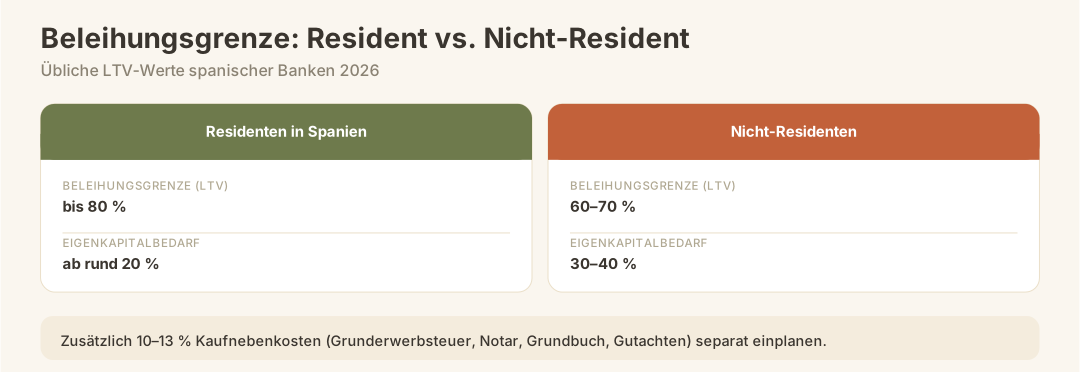
| Buyer group | Typical loan-to-value limit (LTV) | Equity requirement |
|---|---|---|
| Residents in Spain | up to 80 % | from around 20 % of the purchase price |
| Non-residents | 60–70 % | 30–40 % of the purchase price |
In addition to the equity share, you should budget a further 10 to 13 percent of the purchase price for additional costs (property transfer tax, notary, land registry, valuation) — details on this in the guide additional purchase costs in Mallorca and on the regional property transfer tax in the guide ITP Balearic 2026.
For non-residents from Germany, Austria or Switzerland, the lower loan-to-value limit is usually the limiting factor — not the interest rate itself. Those who can mobilise additional equity from a securities portfolio or a Lombard loan structure often negotiate from a stronger position. More on this in the guide Equity & Lombard Loans for Property Purchases in Spain as well as specifically on non-resident financing in the guide Non-Resident Mortgage Spain.
Affordability: What you can really afford
Mortgage overpayments
Explanation
The outstanding loan is the principal still to be repaid; the preset continues the mortgage example.
Explanation
TIN (tipo de interés nominal) is the nominal annual interest rate before costs; copy it from your contract.
Explanation
The remaining term is the number of full years still agreed; the preset is a round calculation scenario, not a statement of banking practice.
Explanation
The annual overpayment (amortización anticipada, early repayment of principal) is booked once a year; 5,000 is an intentionally round illustrative amount, not a market or bank figure.
- Net saving
- €37,949.43
compared with the loan without overpayments
Legal status: 1 January 2025
This calculation is provided for guidance only and is not a substitute for tax or legal advice in specific cases.
Interest rate and loan-to-value limit are one side of the coin — the other is actual affordability in everyday life. On the Balearics, this reveals a tension that is noticeably more pressing for local buyers than for internationally capital-strong buyers.
| Indicator | Balearics Q4 2025 |
|---|---|
| Monthly mortgage instalment (median) | 1,298.30 EUR |
| Total monthly debt burden | 2,675 EUR |
| Debt-to-income ratio (instalment relative to income) | 55 % |
A debt-to-income ratio of 55 percent is significantly above the historically considered solid benchmark of around 35 percent. This is precisely why banks scrutinise income, employment status and existing obligations very carefully before granting a financing commitment.
Note: A high regional debt-to-income ratio doesn't automatically mean that you personally won't get financing — but it does show that banks tend to calculate more strictly in the 2026 creditworthiness assessment than just a few years ago.
For younger first-time buyers with limited equity, it's worth looking at state-subsidised programmes such as the Hipoteca Joven with Aval guarantee backing, see Hipoteca Joven Mallorca as well as the overview of First-Time Buyer Grants in the Balearics.
The path to a mortgage: the process in practice
The financing process in Spain follows a relatively fixed sequence, regardless of whether you are a resident or non-resident:
- Apply for a NIE number — a prerequisite for any bank account and any financing in Spain.
- Open a Spanish bank account and submit creditworthiness documents (proof of income, tax assessments, bank statements).
- Obtain pre-approval, before committing contractually to a property.
- Property valuation (tasación) by a bank-independent but bank-approved surveyor.
- Formal loan offer (FEIN/oferta vinculante) review and compare with an independent adviser.
- Notary appointment and land registry entry — the mortgage is notarised together with the purchase contract.
You'll find details on the entire purchase process in the guide Buying property in Spain: the process and on the notary's role in the guide Notary when buying property in Spain. Anyone transferring the purchase price or deposit from abroad should first look at the guide Transferring money to Spain — exchange rate and transfer costs should be factored into your financing plan.
Market context: volume and credit quality in the Balearics
Mortgage activity in the Balearics remains orderly and liquid despite rising interest rates. This is an important signal: it doesn't point to a credit crunch, but to a mature, continuously turning market.
| Metric | January 2026 | February 2026 |
|---|---|---|
| Property sales Balearics | 1.197 | 1.188 |
| New mortgages Balearics | 1.250 | 1.224 |
The trend in foreclosures is particularly revealing: with 45 cases in the fourth quarter of 2025, the figure is well below the 105 cases from the fourth quarter of 2024 — a historic low, which points to solid credit quality within the existing loan book.
Note: A high mortgage volume combined with falling foreclosures is an indicator of responsible lending, not a bubble.
You'll find a broader market overview of prices and demand in the guide Mallorca property market 2026.
Historical comparison: why 2026 is not 2007
Anyone wanting to put the current interest rate trend into perspective can't avoid comparing it with the financial crisis of 2007/2008. The parallel seems obvious, but doesn't hold up on closer inspection.
| Structural factor | 2007 | 2025/26 |
|---|---|---|
| Euribor 12-month | over 4% | around 2.75% (April 2026) |
| foreign buyer share Balearics | under 20% | 31,5 % |
| lending standards | very lax, high LTV ratios | regulated, under the supervision of the Spanish central bank |
The decisive difference is not just the lower absolute interest rate level, but the structure of the buyer base and lending practices. In 2007 Spanish banks financed with very high loan-to-value limits and lax creditworthiness checks. In 2026 lending is subject to stricter oversight, and a significantly higher proportion of buyers — particularly in the premium segment of the Balearics — appear with a substantial equity share or entirely without external financing.
Outlook: Where are interest rates heading?
Market observation for 2026 can be summarised as follows: the conversation has shifted from "emergency rate jumps" to a more mature, interest-sensitive market. Banks continue to offer financing, but scrutinise income, documentation and affordability more closely than during phases of ultra-cheap money. For most buyers, fixed and mixed interest models are likely to feel more predictable in 2026 than purely variable financing, as long as the Euribor path tends upwards.
For the Mallorca market specifically: the high cash component among international buyers makes the premium segment structurally less interest-rate dependent than the local middle-class segment. Anyone relying on external financing, whether resident or non-resident, should secure financing early, before reserving a property, with a mortgage pre-approval.
The most common mistakes in mortgage planning
- Starting the search for financing too late: Without a pre-approval, you risk losing a suitable property to a cash buyer.
- Underestimated additional costs: Purchase-related costs of around 10 to 13 percent are usually not covered by external financing.
- Only obtaining one bank offer: Since terms are negotiated individually, it's worth comparing several institutions or using an independent mortgage broker.
- Variable mortgage without an interest rate scenario calculation: Anyone who only calculates the current rate overlooks the risk of future Euribor increases.
- Lack of alignment with the reservation contract: The financing approval should be timed to match the reservation contract so that deadlines are not missed.
Checklist: Before applying for a mortgage in Spain
- NIE number applied for
- Spanish bank account opened
- Proof of income, tax assessments and bank statements from recent months compiled
- Equity ratio checked (Resident: from approx. 20 %, Non-resident: from approx. 30–40 %)
- Additional costs (10–13 % of the purchase price) budgeted separately
- Offers obtained from at least two to three banks or a mortgage broker
- Fixed-rate, variable and mixed models compared
- Preliminary approval secured before signing the reservation contract
What comes next?
After the financing approval comes the formal credit assessment by the bank (FEIN/oferta vinculante), the property valuation by a surveyor, and the notarial certification of the purchase contract and mortgage in a joint appointment. In parallel, you should look into the ongoing tax treatment of your property — such as the annual property tax IBI or, if renting is planned, the reporting obligations for non-residents. Anyone holding the property long-term or planning to pass it on should also think early about taxes & law as well as inheritance and gift tax in the Balearics.
Conclusion
Mortgage interest rates in Spain are noticeably higher in 2026 than during the preceding decade of low rates, but far from the crisis levels of 2007/2008. A Euribor of around 2.75 percent in April 2026, a moderate IRPH surcharge and regulated, more conservative lending point to a mature but viable financing market. For buyers on Mallorca, this means: those who plan early, apply realistic loan-to-value limits and consider fixed or mixed-rate models will still find solid financing options in 2026 — but should take their own affordability just as seriously as the interest rate itself.
Official sources
- Banco de España — Euribor and IRPH reference interest rates: https://www.bde.es/webbe/en/estadisticas/temas/tipos-interes.html
- Instituto Nacional de Estadística (INE) — Mortgage and property transaction statistics: https://www.ine.es
- Colegio de Registradores de España — Land registry statistics (stock, loan-to-value ratio): https://www.registradores.org
Compare mortgage offers by their overall cost
A low advertised nominal interest rate (TIN) does not automatically mean lower overall costs. An offer with a lower TIN can have a higher TAE than one with a higher TIN. Consider both figures together and check the assumptions on which the TAE is based.
Compare offers for the same loan amount and term. Check the conditions for the advertised interest rate, which costs are included and whether any early repayment charges have been agreed. For variable-rate or mixed-rate mortgages, the interest rate after the initial period also matters.
You can find suitable properties in the mallorca.com property section (our own listings) and market data in the market report. This information is general and does not constitute financial or mortgage advice.