
Mallorca Property Market 2026: Prices, Trends and Transactions
The Mallorca property market in 2026 presents itself as a supply-constrained, internationally capitalised market: house prices in the Balearics were around 13.4 percent above the previous year's figure in the fourth quarter of 2025 – slightly above the Spanish average of 12.9 percent. This development is being driven by the highest share of foreign buyers of all Spanish provinces (31.5 percent), a record tourism year with 13.58 million arrivals, and three new premium long-haul routes starting summer 2026. In this guide, we put the key figures into context: prices by region and source, buyer structure, holiday rental licences, the interest rate environment and the tax framework – as a basis for an informed purchase or investment decision.

- Calculate purchase costs Mallorca
- Download the free property market report 2026 (PDF) — all figures and regional profiles in detail
Market status 2026: prices, trajectory and transaction volume
For eight quarters, the Balearics moved below the national Spanish house price trajectory. With the fourth quarter of 2025, they are once again slightly above it for the first time since the pandemic. This is not a sign of an overheated regional market, but of a market that is being carried along by the nationwide price upswing and – like Spain as a whole – has stabilised beyond ten percent YoY.
Four public sources measure the price level in the Balearics using different methodologies, survey periods and aggregation levels. The figures should therefore be read side by side, not added together.
| Indicator | Source | Period | Value |
|---|---|---|---|
| Average sale price (all residential properties) | Spanish Association of Notaries | February 2026 | 3,880 EUR/m² |
| Existing properties Balearics | Spanish Land Registry | Q4 2025 | 4,127 EUR/m² |
| New-build properties Balearics | Spanish Land Registry | Q4 2025 | 3,995 EUR/m² |
| Existing properties Palma city | Spanish Land Registry | Q4 2025 | 4,086 EUR/m² |
| Total Aggregate Balearics | mallorca.com (Aggregation) | Q4 2025 | 4.101 EUR/m² |
The monthly market trend remains steady and covers all residential property sales – Flats, houses, villas and fincas.
| Indicator | Period | Value |
|---|---|---|
| Property Sales Balearics | February 2026 | 1.188 |
| Property Sales Balearics | January 2026 | 1.197 |
| Property Sales Mallorca | Full year 2025 | 10.986 |
| Mortgages Balearics | February 2026 | 1.224 |
| Mortgages Balearics | January 2026 | 1.250 |
| Building Permits Balearics | November 2025 | 19.398 |
| Foreclosures Balearics | Q4 2025 | 45 (Q4 2024: 105) |
Note: Foreclosures are at a historic low – an indication of a mature, non-speculatively driven market. Over the course of the year, monthly sales volume fluctuates between roughly 1,100 in winter and 1,450 in summer.
For your specific budget planning, it's also worth looking beyond the pure purchase price at the purchase-related additional costs in Mallorca as well as the current ITP rates for the Balearics 2026, which are staggered depending on the purchase price.
Eight regions, eight profiles
Mallorca is divided into eight clearly distinguishable regions, each with its own buyer profile, its own price dynamics and its own demand structure. The island's 53 municipalities are distributed across these areas.
| Region | Municipalities | Population | Profile | Investor perspective |
|---|---|---|---|---|
| Palma (city + Marratxí) | 2 | 475.208 | Urban economy, urban premium | Core – highest liquidity, shortest holding periods |
| Southwest | 5 | 68.979 | International premium locations | Lifestyle core – high owner-occupation liquidity |
| North | 6 | 80.017 | Bays, tourism focus | Yield – highest density of rental licences |
| Northwest/Tramuntana | 7 | 30.509 | UNESCO World Heritage, heritage | Legacy – low turnover, high substance |
| Northeast | 3 | 34.181 | Cala Ratjada, rural premium locations | Yield + lifestyle – tourist clusters |
| East | 3 | 77.530 | Manacor, finca stock | Value-add – renovation potential |
| South | 4 | 71.302 | Premium south, newer building stock | Lifestyle core – modern building fabric |
| Island centre (Pla) | 23 | 122.544 | Wine Corridor, traditional Mallorca | Value-add – lowest m² price on the island |
Palma city alone counts around 416,000 inhabitants and is the only region with a year-round urban economy – port, culture, university hospital, international schools. The southwest (Calvià, Andratx) concentrates the island's densest international premium marketing, while the island's centre, with its 23 municipalities, offers the lowest price level combined with central location.
Note: A purchase in the north with rental intentions stands or falls on the transferability of an existing holiday-rental licence – check this before reserving, not afterwards. Details on this can be found under Transferring an ETV licence Mallorca.
Anyone specifically looking for a plot or a finca in a rural area will find in-depth information under Buying land Mallorca and Finca Suelo Rústico.
Who buys in Mallorca? Buyer structure and internationality
The share of foreign buyers in the Balearics stood at 31.47 percent in the fourth quarter of 2025 – the highest figure of all Spanish provinces, compared to around 14 percent in the Spanish average.
| Metric | Value |
|---|---|
| Foreign buyer share Balearics (Q4 2025) | 31,5% |
| Spain average | 14,0% |
| Estimated foreign buyers per quarter (at approx. 3,000 sales) | around 944 |
The leading countries of origin by volume are – in alphabetical order – Germany, France, the United Kingdom, Italy, the Netherlands, Austria, Poland, Sweden and Switzerland. The DACH region together represents by far the largest buyer group; within DACH, Germany is clearly ahead of Switzerland and Austria. A fine-grained breakdown by nationality is not available in the public dataset of the Land Registry.
Structurally decisive is the financing difference between buyer groups: local Spanish buyers predominantly finance via mortgages – around 1,250 mortgage take-ups per month are matched against around 1,200 sales. Foreign buyers from DACH, Scandinavia and the United Kingdom, on the other hand, appear significantly more often with a substantial equity or cash component. This makes them less sensitive to interest rates and quicker to act in bidding situations – an effect that supports the price floor in the premium segment.
Note: Anyone wishing to finance their property purchase with German or Swiss equity will find the relevant structuring questions under Buying property in Spain with German equity and Transferring money to Spain.
For larger transfers from Germany, reporting and foreign-exchange obligations may also become relevant – check this on a case-by-case basis, more on this under AWV reporting obligation property purchase Spain.
Tourism as a demand driver
Mallorca recorded a total of 13.58 million tourist arrivals in 2025 – a new record after 13.38 million in 2024. This volume is the structural driver behind the island's property demand, but it can only actually be converted into rental income in certain regions and under specific regulatory conditions.
| Indicator | Value |
|---|---|
| Tourist arrivals Mallorca 2025 | 13.58 million (record) |
| Tourist arrivals Mallorca 2024 | 13.38 million |
| Tourist arrivals Mallorca 2019 (pre-pandemic) | 13.8 million (reference) |
| Hotel arrivals Balearic Islands 2024 | 12.40 million (+17% vs. 2019) |
| Hotel arrivals Balearic Islands 2019 | 10.58 million |
The difference between the 13.38 million total arrivals in 2024 and the 12.40 million hotel arrivals points to around one million guests using other forms of accommodation – including the regulated sector of holiday rental licences.
Tourism absorption is distributed very unevenly across the island: the north coast (Pollença, Alcúdia) and the south to south-east concentrate the private rental sector with a high density of licences, while Calvià, with its classic package tourism, absorbs the volume mainly through hotels. This distinction is essential for a purchase decision with rental intentions – more on this under Rental Yield Mallorca 2026.
Holiday rental market: licences and rental yield reality
Yield calculator
Property and purchase
Explanation
The notarised purchase price excluding buying costs. It is the basis for gross yield; buying costs are added in the next step.
Explanation
Existing property or new build determines the purchase tax: existing property is subject to ITP (property transfer tax), while a new build is subject to IVA (value added tax) plus AJD (stamp duty on notarised documents).
Seasonal rates
High season (July, August)
Explanation
The price the guest pays per night for the whole property, excluding the tourist tax entered separately.
Explanation
The share of nights occupied in this season. The calculator rounds occupied nights down.
- Net yield (on purchase price including buying costs)
- 2.31%
- Result after tax
- €16,475.49
- Purchase price including buying costs
- €712,765.00
Legal status: 1 January 2026
This calculation is provided for guidance only and is not a substitute for tax or legal advice in specific cases.
As of May 2026, Mallorca has a total of 17,034 active holiday rental licences. New licences for flats have generally been halted since April 2025; an existing licence remains transferable only under certain conditions.
| Region | Licences | Pool share within stock | Operator concentration |
|---|---|---|---|
| North | 5.326 | 51% | low (Top 10 <15%) |
| South | 2.800 | 53% | low-medium (15–25%) |
| East | 2.209 | 59% | low (Top 10 <15%) |
| Central island (Pla) | 2.174 | 48% | medium (25–35%) |
| Northeast | 1.533 | 49% | low-medium (15–25%) |
| Northwest/Tramuntana | 1.162 | 28% | medium-high (35–45%) |
| Southwest | 1.026 | 37% | high (>45%) |
| Palma | 804 | 50% | low (Top 10 <15%) |
| Mallorca overall | 17.034 | — | — |
The North is the quantitatively dominant region with 5,326 licences (31 percent of all island licences) – almost every third licence on Mallorca is located here. The Southwest shows the opposite profile: modest in numbers, but with the highest concentration of professional marketing on the island.
Please note: An existing licence is a prerequisite for legal short-term letting, but not an automatic guarantee of returns. Before any purchase intended for letting, you should check: licence transferability upon change of ownership, occupancy and daily rate of the specific property, existing standard, municipality-specific regulation (licence caps, seasonal restrictions), and the tax treatment of rental income in Spain (non-resident tax, IRNR).
For the practical implementation of a letting strategy, it's worth taking a look at Property Management Mallorca, the Ley Vivienda Balearics as well as the Zonas Tensionadas Mallorca for long-term letting options.
Tax framework 2026
In recent years, the Balearics have made regulatory changes that are relevant for internationally oriented buyers. This overview describes the framework conditions as of the current data status as market observation – not individual tax advice.
| Regulation | Key point |
|---|---|
| Inheritance and gift tax Balearics | Significant regional reduction for close relatives since 2023 (inheritance), extended since 2025 to lifetime gifts |
| Beckham Law | Flat-rate taxation of 24% on employment income earned in Spain, selectable for up to 6 years; a pure property purchase does not automatically qualify |
| Wealth tax allowance Balearics | 3 million EUR per person (as of 2024), compared to the 700,000 EUR national minimum standard |
Note: The specific tax burden depends on the degree of kinship, asset structure, tax residency and double taxation agreements. Check this individually before every purchase – more on this under Inheritance & Gift Tax Balearics and Wealth Tax Property Purchase.
In addition to these regional specifics, the usual acquisition-related costs apply to the purchase itself, in particular the Balearic transfer tax (ITP) – see ITP Balearics 2026. Anyone relocating their tax residence from Germany, Austria or Switzerland should additionally check the Exit Tax in their home country. Ongoing costs after the purchase mainly relate to the IBI tax and, upon sale, the Plusvalía Municipal.
Interest Rates and Financing 2026
The 12-month Euribor rises from 2.08 percent in July 2025 to 2.747 percent in April 2026 – a tightening of around 67 basis points in nine months. Significant, but starting from a low level.
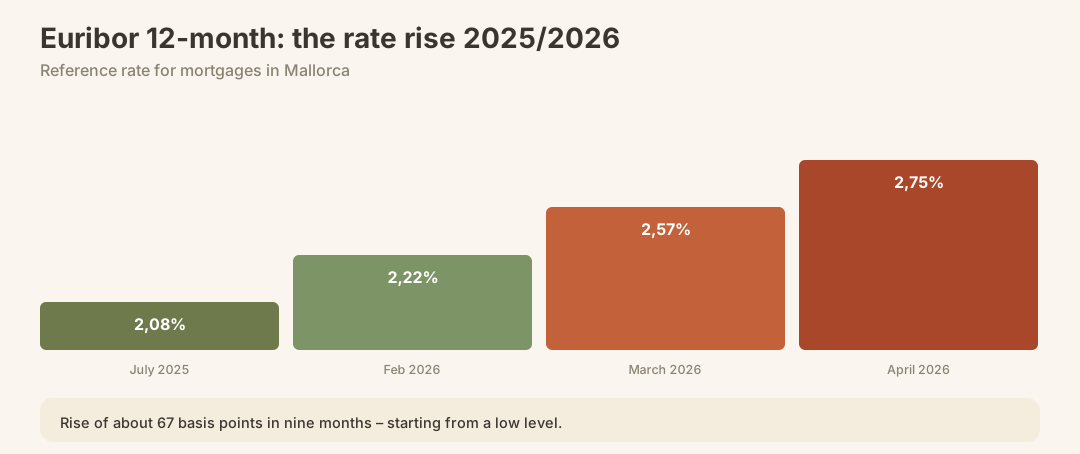
| Period | 12-Month Euribor |
|---|---|
| July 2025 | 2,079% |
| February 2026 | 2,221% |
| March 2026 | 2,565% |
| April 2026 | 2,747% |
For comparison: the Spanish mortgage reference rate (IRPH) stood at 2.84 percent in March 2026 – meaning the effective bank margin over Euribor remains historically moderate.
| Affordability Indicator (Balearics, Q4 2025) | Value |
|---|---|
| Monthly Mortgage Instalment (Median) | 1,298.30 EUR |
| Total Monthly Debt Burden | 2,675 EUR |
| Debt-to-Income Ratio | 55% |
A debt-to-income ratio of 55 percent is well above the historically accepted affordability threshold of around 35 percent. Local buyers tend to hold back here or wait for interest rate movements, while more capital-strong international buyers largely act independently of interest rates and support the price level in premium locations.
For the specific financing structure as a non-resident, it is worth looking at Mortgage Non-Resident Spain, Mortgage fixed or variable as well as – when relocating your residence to Spain – Hipoteca Residentes España and for younger buyers Hipoteca Joven Mallorca.
Mallorca in European comparison
Spain shows house price growth in the reporting period that is significantly higher than Italy and France.
| Quarter | Spain YoY | France YoY | Italy YoY |
|---|---|---|---|
| Q1 2024 | +6.4% | −4.8% | +1.6% |
| Q4 2024 | +11.4% | −1.9% | +4.4% |
| Q2 2025 | +12.8% | +0.7% | +3.9% |
| Q4 2025 | +12.9% | +1.0% | +4.1% |
A similar picture emerges for hotel arrivals: in 2024, the Balearic Islands, with 12.40 million arrivals (+17.2 percent vs. 2019), are the only one of the three premium Mediterranean regions with documented post-pandemic volume growth; Tuscany in 2024, with 8.98 million, remains below pre-pandemic levels (−4.7 percent), and Provence-Alpes-Côte d'Azur has not published comparable regional figures since 2017.
Historical context: The Spanish house price index reached a peak of +14.6 percent YoY in Q4 2006, followed by a downward path until Q3 2012 (−16.1 percent). The current Q4 2025 figure of +12.9 percent sits at a level only reached in 2006/2007 over the past twenty years – though today with a structurally different buyer and credit mix: a higher share of foreign buyers (31.5 percent instead of under 20 percent), regulated lending (instead of very soft standards), significantly lower new-build volume and an Euribor of 2.75 percent instead of over 4 percent.
Connectivity and location quality
Palma Airport recorded 33.81 million passenger movements in 2025, the third-highest figure in Spain. The Spanish airport operator is investing around €559 million by the end of 2026 in modernisation, including a long-haul-capable expansion of the international terminals.
| Route | 2024 | 2025 | Summer 2026 |
|---|---|---|---|
| New York/Newark (United) | ✓ (4 months) | ✓ (+50% seats, 6 months) | ✓ expanded |
| Montreal (Air Canada) | — | — | ✓ new, from 17 June, 4×/week |
| Abu Dhabi (Etihad) | — | — | ✓ new, from 12 June, 3×/week |
These three routes are the first genuine premium long-haul direct connections from Mallorca to North America and the Gulf region – a signal that international carriers increasingly regard the Balearic premium market as a destination in its own right. From the DACH region, Lufthansa, Eurowings, Swiss and Austrian serve the island year-round with dense daily frequency from Frankfurt, Munich, Zurich and Vienna – a weekend accessibility that is a key location argument for buyers with their main residence in the DACH region.
Most common mistakes when buying property in 2026
Anyone entering the Mallorca market in 2026 often underestimates the following points:
- Confusing price sources. The Notary Association, Land Registry and portal prices measure different things – a direct comparison without context leads to misjudgements during price negotiations.
- Taking a holiday rental licence for granted. Since April 2025, new licences for apartments have essentially been halted; the transferability of an existing licence is a case-by-case matter and must be checked before reservation.
- Equating regional tourism density with rental yield. High tourist numbers (13.58 million in 2025) do not automatically mean high rental income – location, licence status and property condition are decisive.
- Underestimating the interest rate environment. The Euribor has risen by around 67 basis points since July 2025; a realistic affordability calculation is essential, see Mallorca property financing.
- Ignoring tax conditions in the home country. Exit taxation, double taxation agreements and AWV reporting obligations apply in parallel with Spanish tax law.
- Signing a reservation contract without legal review. Details on this can be found in the guide to the Reservation contract Spain and at the Lawyer for property purchase Spain.
What comes next? Outlook 2026/2027
The market in 2026 will be shaped by several parallel dynamics: a structurally high foreign-buyer share, substantially expanded international flight connectivity, a tightened holiday rental licence scarcity, and a regionally adjusted tax situation. At the same time, local affordability remains strained with a debt-to-income ratio of 55 percent, which may slow the B and C segments for Spanish buyers. Rental regulation remains politically in flux – anyone planning a rental component should continuously monitor municipality-specific developments, for instance via the Ley Vivienda Balearics and the Zonas Tensionadas Mallorca.
For sellers wanting to take advantage of the current price cycle, it's worth looking at the structured sales process under Selling property Mallorca as well as the tax aspects under Taxes on property sale.
Checklist: Buying property Mallorca 2026
- Clarify price source and region – use local market data rather than pure portal prices.
- Realistically calculate budget including purchase-related costs (ITP, notary, land registry).
- If rental intent exists: check licence status and transferability before making a reservation.
- Clarify financing structure – equity, non-resident mortgage, exchange-rate risk on transfer.
- Legal review of the reservation contract by an independent lawyer in Spain.
- Prepare the notary appointment and land registry entry with a timely power of attorney if needed.
- Coordinate the tax situation in the home country (exit tax, double taxation agreement) in parallel.
You can find the complete process from the reservation contract to the transfer of ownership under Property purchase: the legal process and Notary for property purchase Spain.
Conclusion
The Mallorca property market in 2026 is characterised by structural supply scarcity, an internationally capitalised buyer base, and a more regulatorily mature rental landscape than ten years ago. The pace of price growth is reminiscent of the acceleration seen in 2006/2007, but differs fundamentally in the buyer and credit mix – a higher foreign share, regulated lending, and significantly lower new-build volume. For buyers from Germany, Austria and Switzerland, this means: good connectivity, growing year-round infrastructure, and a market window that is structured more favourably in tax terms (inheritance, wealth tax) than the Spanish standard – but also an environment that requires careful review of licence status, financing and the legal process.
Official sources
- Spanish Statistical Institute (INE) – House Price Index, transaction and mortgage statistics: https://www.ine.es
- Spanish Notary Association (Consejo General del Notariado) – Average sale prices: https://www.notariado.org
- Spanish Land Registry (Colegio de Registradores) – existing and new-build prices, share of foreign buyers, mortgage-to-price ratio: https://www.registradores.org
- Eurostat – house price index Spain/France/Italy, hotel arrivals: https://ec.europa.eu/eurostat
- Balearic Statistics Office (IBESTAT) – tourist arrivals, regional aggregates: https://ibestat.caib.es
- AENA – passenger movements at Palma Airport: https://www.aena.es
- Banco de España – Euribor, mortgage reference rate: https://www.bde.es
- Govern de les Illes Balears – tax law, holiday rental register: https://www.caib.es
Gross rental yield by municipality
An Idealista analysis compares purchase and rental prices for the second quarter of 2026 to calculate the gross yield from buying to let. It puts Llucmajor at 5.5 per cent, Palma at 4.4 per cent and Calvià at 4.0 per cent. The figure for the Balearic Islands as a whole is 4.2 per cent. Llucmajor leads the Mallorcan municipalities examined, but none reaches the Spanish average of 5.7 per cent.
Gross yield compares annual rent with the purchase price. It does not show what remains after purchase costs, maintenance, possible vacancies and ongoing expenses. To compare specific properties, set the purchase price against a realistically achievable rent in the same location and deduct the expected costs individually. A higher published yield for a municipality is not a yield guarantee for a particular flat.