
Selling a VPO or VPL in Mallorca: price caps and descalification
Selling a VPO or VPL in Mallorca is no ordinary property sale – and simply descalificating it (i.e. removing it from the protected regime) has been impossible for newly qualified properties since the Ley 5/2018 de la Vivienda de les Illes Balears came into force on 19 June 2018. At the same time, many owners of older subsidised properties still governed by the old legislation are unsure exactly which rules apply to them, what the difference is between a sale with and without Descalificación, and where they even need to submit the application. This guide explains the Balearic special approach within the broader Spanish context, sets out the key deadlines and authorities involved, and shows which steps are genuinely necessary when selling a protected property in Mallorca.

What is a VPO/VPL – and what does the protected regime actually mean?
A Vivienda de Protección Oficial (VPO) – or, as it is commonly known in the Balearic Islands, a Vivienda de Protección Pública de régimen general oder especial (VPL/VPP) – is a state-subsidised property that was built with price subsidies and low-interest loans. In return, it is subject to a number of conditions governing its use and sale:
| Condition | Details |
|---|---|
| Price cap on sale | Maximum sale price is set by the authorities |
| Obligation to occupy | The owner must use the property as their primary residence |
| Pre-emption right of the administration | The Conselleria de Vivienda has the right of first refusal on any resale |
| Buyer profile | Buyers must meet certain income thresholds |
| Approval requirement | Every resale requires official authorisation |
The VPO status is registered in the Land Registry (Registro de la Propiedad) and is visible to any prospective buyer. It transfers automatically to the buyer – anyone who purchases a VPO thereby takes on all conditions that are still in force.
Please note: The Registro de la Propiedad shows whether a property is subject to the protected regime and, if so, until when. Our guide Checking the Land Registry in Spain.
The critical turning point: when was your VPO qualified?
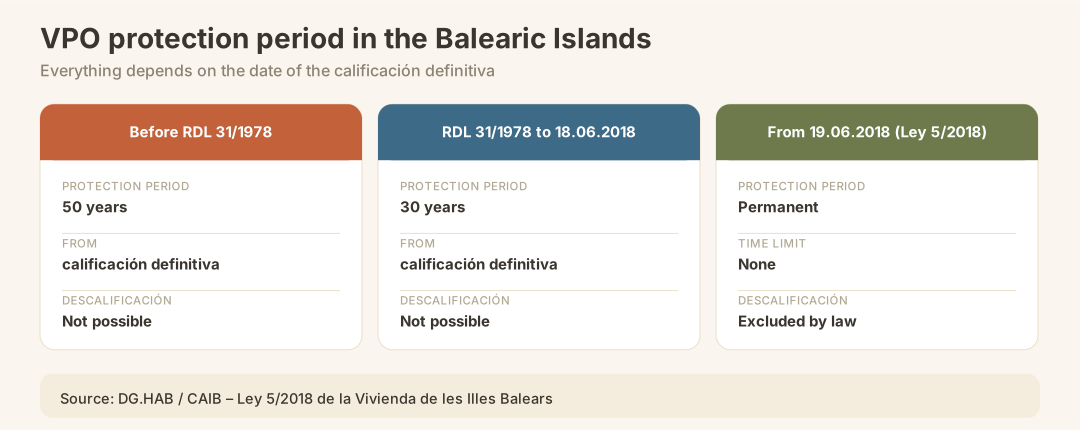
In the Balearic Islands, everything depends on the date of the calificación definitiva (final grant of protected status). The legal framework is divided into three clearly defined periods:
| Date of qualification | Duration of protection | Descalificación possible? |
|---|---|---|
| Before Real Decreto-Ley 31/1978 | 50 years from calificación definitiva | No (no voluntary Descalificación in the Balearic Islands) |
| From RDL 31/1978 to 18.06.2018 | 30 years from calificación definitiva | No (no voluntary Descalificación in the Balearic Islands) |
| From the entry into force of Ley 5/2018 (19.06.2018) | Permanent – unlimited | No – excluded by law |
The competent authority in the Balearic Islands is the Direcció General d'Habitatge i Arquitectura (DG.HAB) of the Conselleria de Territori, Energia i Mobilitat. Their official information page on the duration of protection explicitly confirms: properties qualified under Ley 5/2018 have permanent protected status with no possibility of voluntary Descalificación.
Please note: This Balearic-specific approach differs significantly from other Spanish autonomous regions such as Madrid, where a voluntary Descalificación is possible once certain time limits have elapsed. Advice from other regions or general Spanish guides does not.
The Balearic special case: Why Descalificar does not work here
In many Spanish regions, Descalificación is a routine administrative procedure: submit an application, repay any subsidies, and protected status is removed. In the Balearic Islands, this route is closed to all VPO owners – regardless of when the property was granted protected status.
The Spanish Ministry of Housing (Ministerio de Vivienda y Agenda Urbana, MIVAU) explicitly refers the Descalificación process in the Balearic Islands to the regional government — that is, to the DG.HAB of the CAIB. And this very authority confirms: there is no procedure for voluntary Descalificación at the request of owners.
What does this mean in practice?
- The property remains under the protection regime for as long as the statutory period runs — or permanently (for properties classified from 2018 onwards).
- You cannot cannot convert the property into a free-market dwelling on your own initiative.
- A sale at a free-market price is not legal for as long as the protected status applies.
- What you can do: sell the property within the protection regime — with authorisation, a price cap, and the administration's right of first refusal.
Selling a VPO property on Mallorca: how the process works
Even without a Descalificación, you can sell your protected property. However, the sale is not a free-market transaction but a procedure accompanied by the authorities. The individual steps are:
- Check the remaining protection period — Have the DG.HAB confirm how long the protection regime still runs (for older properties falling under the 30- or 50-year rule).
- Determining the maximum sale price — The Conselleria sets a precio máximo de venta that you must not exceed under any circumstances.
- Application for sale authorisation — You submit an application to the DG.HAB. You will generally need: DNI/NIE, title deed, purchase contract (original), proof of any government subsidies received, and a current land registry extract.
- The administration's right of first refusal — Following your application, the Conselleria has the right to purchase the property itself at the established maximum price before you are permitted to sell to a private buyer.
- Finding a suitable buyer — The buyer must meet the income thresholds for VPO purchasers and must use the property themselves as their primary residence.
- Notarial purchase contract and registration — The notary certifies the sale, and the new owner assumes the protection regime until it expires.
Please note: Anyone who owns an older VPO property (calificación prior to 2018) whose 30-year protection period has already expired can investigate whether the protected status needs to be formally removed from the land registry — however, this is not a Descalificación by application, but simply a correction of the register following the expiry of the statutory period.
Price controls: what can you charge for your VPO?
The price ceiling for reselling a VPO is calculated according to official guidelines that vary depending on the subsidy scheme, year of construction, and property type. The DG.HAB will provide the maximum permitted price on request. Key points to be aware of:
| Factor | Effect on price |
|---|---|
| Original subsidy scheme | Determines the applicable calculation formula |
| Years since first sale | May allow moderate uplifts |
| Property size (m² útiles) | Price is calculated per m² |
| Any subsidies received | May need to be partially repaid |
| Market price | Irrelevant – the price ceiling applies absolutely |
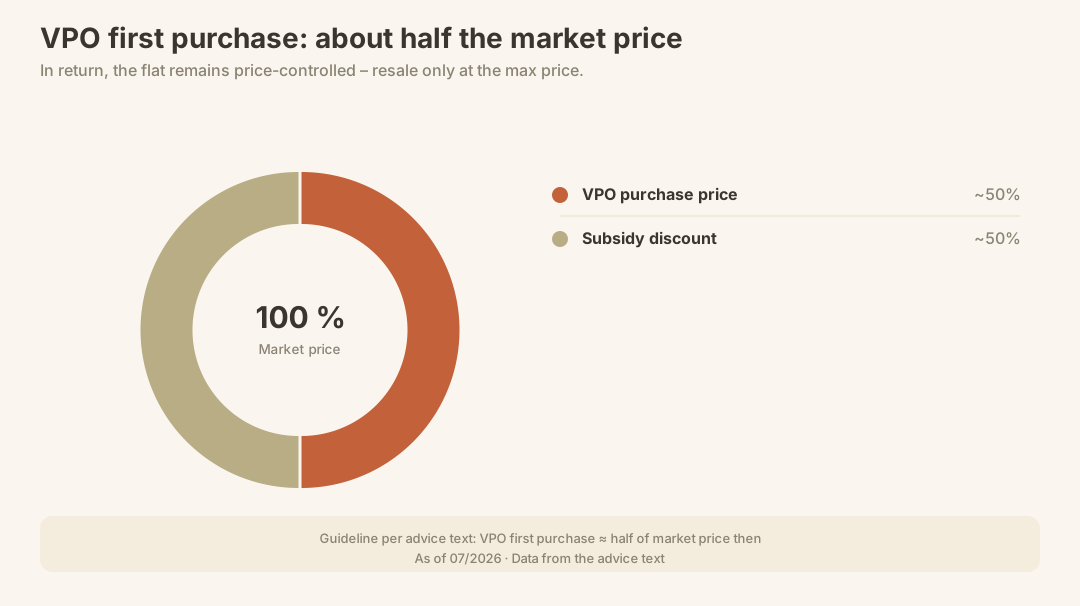
In practical terms: with an island-wide average price of around 7.370 €/m² on Mallorca (according to the Steinbeis Transfer Institut, 2026 study, published March 2026), the VPO sale price falls considerably below this. This difference is the trade-off for the fact that the property could originally be purchased at a significantly lower price – VPOs typically cost only around half the prevailing market price at the time of first purchase.
Tax implications when selling a VPO
The sale of a VPO is not treated as a special case for tax purposes – the standard Spanish tax rules for property disposals apply:
| Tax | Who pays | Note |
|---|---|---|
| IRPF (income tax on gain) | Seller | Difference between purchase and sale price; exemption may be available if primary residence |
| Plusvalía Municipal | Seller | Increase in land value since acquisition |
| ITP (transfer tax) | Buyer | Balearic progressive tax rates; VPO buyers may benefit from a reduced rate |
Note: If the VPO was your primary residence, an IRPF exemption may apply on sale under certain conditions – for example, when reinvesting in a new primary residence. Full details can be found in the guide IRPF Exemption Primary Residence Sale. The general taxes on property sales in Spain are explained in our guide Taxes on Property Sales in Spain.
For ITP, VPO buyers in the Balearic Islands are generally subject to a reduced tax rate. The exact Balearic progressive rates for 2026 can be found in the guide ITP Balearic Islands 2026.
Renting out a VPO instead of selling: is that possible?
Renting out a VPO is also subject to restrictions. In principle, it is designed as the owner's primary residence. Long-term letting is possible under certain conditions – for example, when relocating for work – but likewise requires official authorisation. The following applies:
- The rent level is tied to an officially set precio máximo de alquiler.
- Holiday letting (ETV licence) is fundamentally excluded for VPO/VPL properties.
- The owner must not own a second subsidised property.
For all questions relating to long-term letting of a standard property in Mallorca – as a point of reference – our guide Long-Term Rental Mallorca.
What happens once the protection period expires?
For older properties (calificación before 19.06.2018), the protected status ends after 30 years (or 50 years for designations predating RDL 31/1978). Once this period has elapsed:
- the price controls and the administration's right of first refusal lapse automatically;
- the property can be sold as a free-market property;
- the VPO entry in the Registro de la Propiedad should be formally removed – this is done by submitting an application to the relevant land registry (Registro) with proof that the period has expired.
Caution: The expiry of the protected status does not mean that the entry in the land registry changes automatically. Anyone wishing to sell at market price after the period has elapsed should apply for the removal of the entry before placing the property on the market – otherwise uncertainty may arise for the buyer and their mortgage lender.
Most common mistakes when selling a VPO in Mallorca
1. Assuming that descalificación is possible Many owners apply for the Descalificación by analogy with experiences from other regions or based on general guidance. In the Balearics, this application is rejected – time and money are lost.
2. Selling without official approval A notary can certify a purchase contract without actively checking whether the VPO approval requirement has been met. A sale without approval is unlawful and can be reversed.
3. Ignoring the price cap Demanding a price above the officially set maximum – even informally or as a "furnishing supplement" – is an administrative offence and can result in fines.
4. Buyer without VPO eligibility The buyer must meet the requirements for purchasing a protected property. If that is not the case, the Conselleria can reject the purchase or exercise its right of pre-emption.
5. Poor tax planning Anyone who assumes that the low sale price will result in no taxable gain overlooks the fact that the original VPO purchase price was also low. The taxable gain can nonetheless be considerable.
6. Forgetting to have the land registry entry removed after the protection period has expired Anyone who sells directly after the end of the protection period without first correcting the land registry entry risks delays and complications in the purchase process.
Checklist: selling a VPO property on Mallorca
- Determine the date of the calificación definitiva (found in the purchase contract or at DG.HAB)
- Calculate the protection period: 30 years (standard), 50 years (before RDL 31/1978), permanent (from 19.06.2018)
- Check whether the protection period has already expired
- If expired: apply for removal of the VPO note in the Registro de la Propiedad
- If still running: submit an application for a sales authorisation to DG.HAB
- Precio máximo de venta confirmed in writing by DG.HAB
- Await the Conselleria's right of pre-emption (as a rule: written waiver)
- Check buyer's VPO eligibility (income limits, primary residence requirement)
- Involve a tax adviser for IRPF (capital gains tax) and Plusvalía
- Notary appointment with complete documentation
- New entry in the land registry in the buyer's name (protected status continues)
What comes next? Options for the proceeds
Due to the price cap, the proceeds from a VPO sale are considerably below the open market value. Anyone wishing to purchase again on Mallorca with these proceeds should be well acquainted with current market prices, purchase ancillary costs, and financing options:
- Purchase ancillary costs (ITP, notary, land registry): details in the guide Purchase Ancillary Costs Mallorca
- Mortgage options: Property Financing Mallorca
- First-buyer programmes: Purchase Assistance First-Time Buyers Balearic Islands
- General overview of the purchase process: Legal Process Property Purchase
Conclusion
On Mallorca, a particularly strict rule applies when it comes to selling VPO/VPL properties and descalificar: voluntary Descalificación on the Balearic Islands is excluded for all owners – not only since the Ley 5/2018, which introduced permanent protection with no opt-out whatsoever, but also as established administrative practice before that. What remains is the sale within the protection regime – with official approval, a fixed maximum price, and the Conselleria's right of first refusal. Those who own an older VPO where the 30- or 50-year period has already expired have more flexibility: once the period has lapsed, the land registry entry can be removed and the property marketed as a free-market property. In all cases, professional legal advice from a solicitor specialising in Balearic property law is essential – the differences from other regions are too significant for general Spanish guides to be relied upon.
Official sources
- DG.HAB – Vigencia del régimen de protección oficial (CAIB): https://www.caib.es/sites/habitatgesprotegits/es/vigencia_del_regimen_de_proteccion_oficial/
- Ley 5/2018, de 19 de junio, de la vivienda de les Illes Balears – BOE and BOIB
- Ministerio de Vivienda y Agenda Urbana (MIVAU) – Descalificación de viviendas protegidas: https://www.mivau.gob.es/areas-de-actividad/arquitectura-vivienda-y-suelo/programas-de-ayudas-a-la-vivienda/guia-descalificacion-vpo
- Real Decreto-Ley 31/1978 – Relevant for calculating the 50-year protection period
- Conselleria de Territori, Energia i Mobilitat – Govern de les Illes Balears: https://www.caib.es
- Agencia Tributaria (AEAT) – IRPF property sale: sede.agenciatributaria.gob.es