
Importing & Registering Your Car in Spain (Matriculación)
Anyone who moves permanently to Mallorca or the Spanish mainland and brings their German car along will sooner or later need to take action. The persistent rumour that you may drive on German plates for six months applies exclusively to tourists — not to residents. Once you establish your primary residence in Spain, you are legally obliged to re-register your vehicle. Ignoring this risks seizure of the vehicle and substantial fines. This guide explains which deadlines apply, which documents you need, how the Spanish registration tax (Impuesto de Matriculación) is calculated, which steps must be completed in which order — and when re-registration is actually worthwhile.

Would you like the re-registration handled quickly and without errors?
- 📩 Submit a personal enquiry — We connect you with experienced gestorías on Mallorca
- Everything about residencia in Spain — A prerequisite for tax-free importation
The legal position: When are you actually obliged to re-register?
The basic rule is clearly set out in law: persons with permanent residence in Spain may not drive a vehicle with foreign number plates within the country. The legal basis is Article 68 of Real Decreto Legislativo 6/2015 of 30 October 2015.
What matters here is not the formal criterion — that is, not merely the police registration or the residencia card — but rather the actual circumstances: Where do you actually live? Anyone who has genuinely moved the centre of their life to Spain is subject to this obligation, regardless of whether they are still going through the residencia process.
| Residency status | Re-registration obligation |
|---|---|
| Tourist (no residence in Spain) | No obligation, provided the 90/180-day rule is observed |
| Secondary residence, no centre of life | Generally no obligation — however, assessment on a case-by-case basis |
| Resident (primary residence in Spain) | Immediate obligation from the moment residence is established |
| Companies with registered office in Spain | Obligation; driving vehicles with foreign number plates is prohibited |
Please note: Even owners of holiday homes who leave their German car permanently on Mallorca are not automatically in the clear. The authorities examine actual usage. If in doubt, seizure and fines may follow.
The 90/180-day rule is the decisive framework for non-residents — anyone who exceeds it must in any case reconsider their status.
The golden window: Tax-free importation as removal goods
Anyone who officially transfers their residence to Spain has the option of importing their vehicle within 60 days of the official residence registration (residencia) tax-free as removal goods. This means the registration tax (Impuesto Especial sobre Determinados Medios de Transporte) does not apply in this case.
This exemption is strictly time-limited. Anyone who misses the 60-day deadline must pay the full registration tax — depending on the vehicle and CO₂ emissions, this can amount to a considerable sum.
Note: You should clarify the precise conditions for the removal-goods exemption in advance with a gestoría or the relevant tax office (Hacienda), as it may be subject to further conditions. It is worth coordinating the arrival of the vehicle and the official residence registration as closely together in time as possible.
Before entry: What you should sort out in Germany
The German Foreign Office recommends taking the vehicle out of service at a German registration authority before transferring it to Spain, or re-registering it on export plates. This has a practical advantage: once registration in Spain has been completed, the vehicle no longer needs to be separately deregistered in Germany.
Furthermore, you should check before entering the country whether your vehicle, with all its technical specifications, can actually be registered in Spain. It is entirely possible that a model is homologated for German roads but not for Spanish ones. Your authorised dealer or the manufacturer's general representative can help you with this and obtain the necessary Certificado de Características (COC document).
| Step | Where | When |
|---|---|---|
| Re-register vehicle with export plates | German vehicle registration authority | Before departure |
| Obtain COC document | Authorised dealer / manufacturer | Before departure |
| Ensure Vehicle Registration Certificate Parts I & II are available | Vehicle owner | Before departure |
| Check homologation eligibility in Spain | Manufacturer's general representative | Before departure |
An overview of the required documents
Without the correct paperwork, the DGT will not process anything. The following documents are required for the re-registration:
| Document | Explanation |
|---|---|
| Vehicle Registration Certificate Part I (vehicle registration document) | Proof of German registration |
| Vehicle Registration Certificate Part II (vehicle title document) | Proof of ownership |
| COC document (Certificado de Características / Ficha Técnica) | Technical data for Spanish authorities |
| ITV certificate | Passed Spanish vehicle roadworthiness inspection |
| NIE number | Spanish tax identification number |
| Residencia proof / Empadronamiento | Proof of residence in Spain |
| Tax declaration for vehicle registration tax | Tax declaration with the Hacienda |
| Proof of insurance | Valid Spanish motor insurance |
All original vehicle documents — Part I and Part II — are absolutely required. Without these, nothing can proceed. Anyone who does not have their paperwork in full should not begin the process.
The NIE number is a prerequisite for virtually every administrative procedure in Spain — without it, vehicle registration is also impossible.
Step by Step: The Registration Process in Spain
Re-registration is not a single administrative procedure, but a sequence of steps involving different authorities. Here is the correct order:
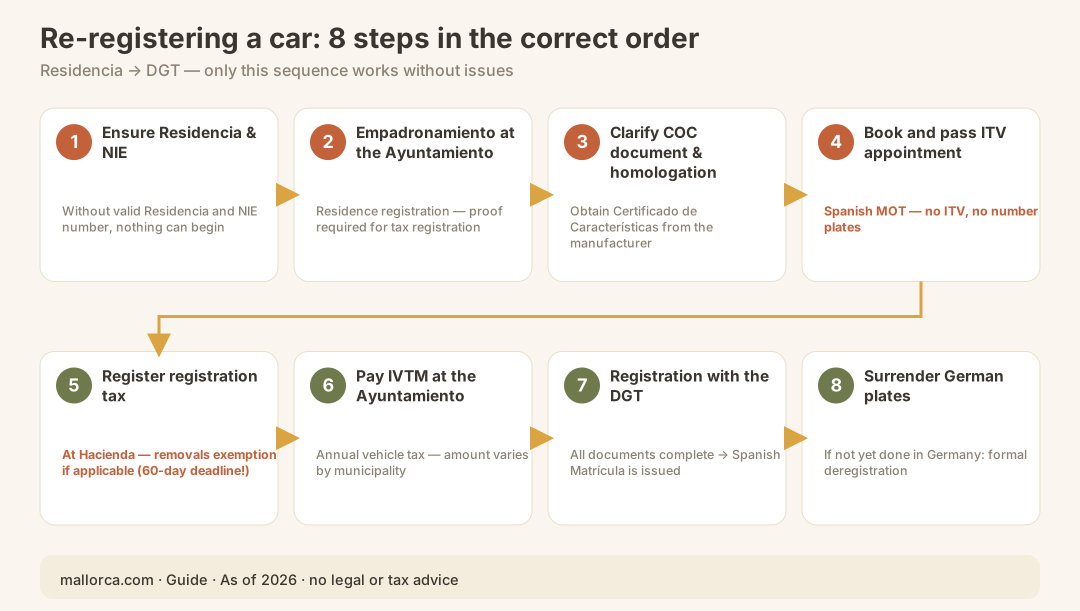
Secure Residencia & NIE — Nothing can begin without a valid Residencia and NIE number. If not yet completed, submit the Residencia application first.
Empadronamiento (Municipal Registration) — Register with the Ayuntamiento of your place of residence. The Empadronamiento certificate is required for the tax registration.
Clarify COC Document & Homologation — Ensure that the vehicle is eligible for registration in Spain and that all technical data are available.
Book and Pass the ITV Appointment — The Spanish vehicle inspection must be passed before final registration. More on this in the ITV guide for Mallorca.
Declare and Pay Registration Tax — Submit the tax declaration to the Hacienda (tax authority). If importing as removal goods within the 60-day deadline: apply for exemption.
Pay IVTM (Impuesto sobre Vehículos de Tracción Mecánica) — The annual vehicle tax is paid at the responsible Ayuntamiento.
Registration with the DGT — Attend the Dirección General de Tráfico with all documents. The Spanish number plates (Matrícula) are issued here.
Surrender German Number Plates — If not already done in Germany, the German number plates must be formally deregistered.
Note: On Mallorca, it is strongly advisable to engage an experienced Gestoría to handle the process. The administrative procedures are time-consuming, and errors in the documentation can significantly delay the entire process.
The Registration Tax (Impuesto de Matriculación)
The registration tax is a one-off charge that becomes due when a vehicle is first registered in Spain. It is governed by the Ley del Impuesto Especial sobre Determinados Medios de Transporte and is calculated on the basis of CO₂ emissions and the vehicle's value.
The tax rates are determined by CO₂ emissions — the higher the emissions, the higher the tax rate. Vehicles with very low or zero CO₂ emissions (e.g. pure electric vehicles) may under certain circumstances be exempt from the tax.
| CO₂ emissions (g/km) | Tax rate (indicative) |
|---|---|
| Very low / 0 g/km (electric) | 0 % (generally exempt) |
| Low (threshold defined by law) | Reduced rate |
| Average | Mid-rate |
| High (above threshold) | Highest rate |
Note: The specific thresholds and tax rates may change annually. You can find the current figures at the Agencia Tributaria (AEAT). If the vehicle is imported as a removal good within the 60-day period, this tax is waived entirely.
For vehicles with high CO₂ emissions or a high market value, the immatriculation tax can be considerable. This is also why re-registering older vehicles with a low residual value simply does not make financial sense in certain cases — the re-registration costs can exceed the vehicle's value.
Cost overview: what re-registration actually costs
The total costs consist of several components. The pure administrative fees (excluding taxes) are, according to various sources, around 200 to 500 euros. Depending on the vehicle and individual circumstances, the immatriculation tax and gestoría fees are added on top.
| Cost item | Indicative figure |
|---|---|
| Administrative fees | approx. 200–500 € |
| Immatriculation tax (Impuesto de Matriculación) | 0 % with removal-goods exemption; otherwise depending on CO₂ |
| ITV inspection fee | depending on vehicle type and station |
| IVTM (annual vehicle tax, pro rata) | depending on municipality and vehicle type |
| Gestoría fee | depending on provider and complexity |
| COC document (if not already available) | depending on manufacturer |
The car insurance in Spain must also be in place before the registration process is completed. A German insurance policy is not sufficient for permanent registration in Spain.
ITV: the Spanish vehicle roadworthiness test
The ITV (Inspección Técnica de Vehículos) is the Spanish equivalent of the German TÜV and is a mandatory part of the registration process. Without a passed ITV, the DGT will not issue Spanish number plates.
For vehicles imported from Germany, the ITV station also checks whether the vehicle meets Spanish technical requirements. Vehicles that were registered in Germany but are not homologated in Spain may fail at this stage.
Note: There are several ITV stations on Mallorca. Appointment availability can vary depending on the season and waiting times. Allow plenty of lead time. For everything you need to know, see the ITV guide for Mallorca.
Your driving licence is, incidentally, a separate matter: as a resident, you are required to exchange your German driving licence for a Spanish one after a certain period. For details, see the driving licence exchange guide.
Is re-registration worth it? The cost-benefit analysis
This question arises above all with older vehicles. As a rough guide:
- New or nearly new vehicles: Re-registration is generally worthwhile, especially when the exemption from the registration tax applies under the removal goods regulation.
- Used mid-range vehicles: Calculate carefully. The total costs (gestoría + ITV + registration tax if applicable) can represent a significant percentage depending on the vehicle's value.
- Older vehicles with low residual value: It is often more cost-effective to sell the vehicle in Germany and buy a used car in Spain. The re-registration costs can exceed the vehicle's value.
| Vehicle category | Assessment |
|---|---|
| New car / nearly new, high value | Re-registration is worthwhile |
| Mid-range, a few years old | Individual calculation required |
| Older vehicle, low residual value | Often not worthwhile |
| Electric vehicle (0 g/km CO₂) | Re-registration particularly attractive (tax exemption) |
Most common mistakes when re-registering a car
Many Germans who bring their vehicle to Spain make the same avoidable mistakes:
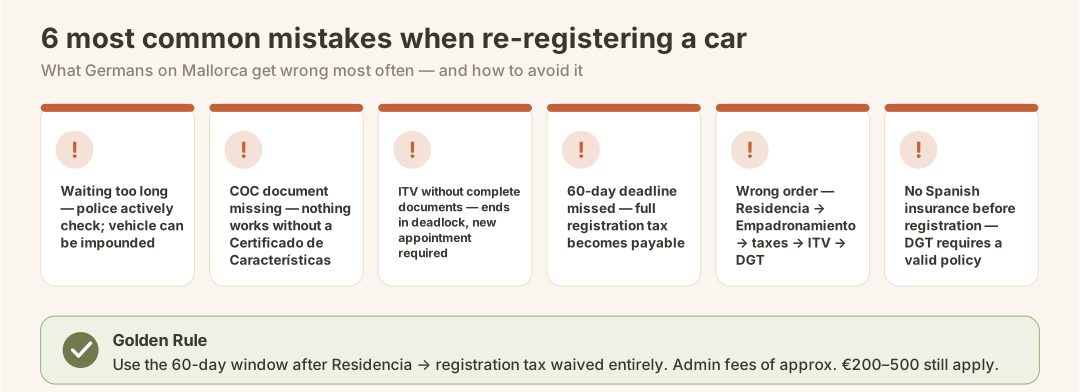
Waiting too long — In the hope that nobody will notice. The police carry out checks; vehicles with foreign number plates in the hands of residents can be impounded.
Missing COC documents — The Certificado de Características is essential. Anyone who does not have it must go to considerable lengths to obtain it from the manufacturer.
ITV before the type-approval inspection — Some people attempt to attend an ITV appointment without having all the required documents. This invariably leads to a wasted trip.
Missing the 60-day deadline — The tax-free import as removal goods is strictly time-limited. Anyone who misses the deadline pays the full registration tax.
Wrong order of official procedures — Residencia, Empadronamiento, taxes, ITV, DGT — the sequence is crucial. Anyone who proceeds in the wrong order will have to make multiple visits.
No Spanish insurance before registration — The DGT requires a valid Spanish motor insurance policy.
Going to the authorities without a gestoría — Especially on Mallorca, where bureaucratic processes and language barriers are considerable, professional support from a gestoría is not a sign of weakness but of efficiency.
What comes next? Tax obligations as a vehicle owner in Spain
After successfully re-registering your vehicle, you are a Spanish vehicle owner with all the associated tax implications:
- IVTM (Impuesto sobre Vehículos de Tracción Mecánica): The annual vehicle tax is payable to your local municipality. The amount depends on the type of vehicle and the municipality.
- Tax residency: As a resident in Spain, you are liable to pay tax here. This also applies to the vehicle as part of your assets. More on this in the Tax Guide for Residents.
- Subsequent ITV Inspections: Regular ITV inspections are required depending on the age of the vehicle.
- Insurance Requirement: The Spanish motor insurance must be renewed annually.
Anyone who also holds assets abroad (e.g. a German bank account) should find out about the Modelo 720 reporting obligation.
Checklist: Importing & Re-registering Your Car in Spain
Use this checklist before you begin the process:
- NIE number obtained
- Residencia applied for / received
- Empadronamiento completed
- Vehicle registration certificate Parts I & II (originals) available
- COC document / Certificado de Características available
- Type approval eligibility in Spain confirmed with the manufacturer
- In Germany: vehicle registered on export plates or deregistered
- 60-day deadline for removal-goods exemption kept in mind
- ITV appointment booked
- Spanish motor insurance taken out
- Registration tax prepared
- IVTM (vehicle tax) registered with the local authority
- DGT appointment booked for Matrícula issue
- Gestoría appointed (recommended)
Conclusion
Importing and re-registering your car in Spain is no black art — but it is a multi-stage process that requires preparation, the right documents, and the right timing. The critical turning point is the 60-day deadline after obtaining Residencia: those who make use of it avoid the registration tax entirely. Those who miss it end up paying a considerable sum on top, depending on the vehicle.
As a resident, re-registration is not optional but obligatory — with a clear legal basis and real consequences for non-compliance. Anyone wanting to complete the process in Mallorca would do well to involve a locally experienced gestoría. The savings in time, stress, and potential errors will, as a rule, far outweigh the costs.
Official Sources
- Real Decreto Legislativo 6/2015, Art. 68 (Ley sobre Tráfico, Circulación de Vehículos a Motor y Seguridad Vial): https://www.boe.es/buscar/act.php?id=BOE-A-2015-11722
- DGT – Dirección General de Tráfico (vehicle registration in Spain): https://www.dgt.es
- AEAT – Agencia Estatal de Administración Tributaria (registration tax): https://www.agenciatributaria.es
- German Consulate Palma / Federal Foreign Office – Vehicle Registration in Spain: https://spanien.diplo.de/es-de/service/2551510-2551510
- ATIB – Agència Tributària de les Illes Balears (Balearic tax authority): https://www.atib.es