
How to buy bank-owned property in Mallorca
If you’re looking to buy a bank-repossessed property on Mallorca, you’re probably hoping to pay less. That makes it all the more important to take a clear-eyed look: there may be few properties explicitly labelled as bank repossessions, and an eye-catching listing is no guarantee of a good deal. Much the same applies to abandoned country houses. A property that looks unoccupied may need extensive work, have legal complications or simply not be for sale.
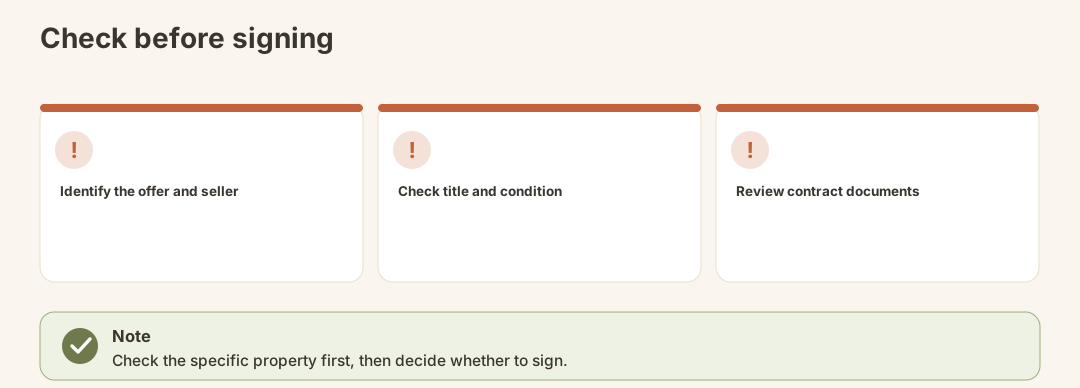
This guide shows you where to look for these properties and how to assess a listing. You’ll learn why the label ‘bank repossession’ is no substitute for proof of ownership, which inconsistencies in listings are worth querying, and what else you should check with older houses and fincas. The approach is straightforward: identify the specific property and seller first, then check the documents and condition — and only then decide on a price or whether to sign anything.

What’s different about buying a bank-repossessed property on Mallorca?
‘Bank repossession’ describes the background to a listing, not necessarily who owns the property today or what the contract terms are. A property may be listed through a property services company, an estate agent or a general property portal. The key question, therefore, is who is authorised to act in the sale and what exactly is being sold.

The price is no guarantee of quality, either. Compare the property not only with other bank repossessions, but also with houses or flats in similar locations, with similar uses and in similar condition. The same basic questions apply when checking any resale property: do the ownership details, charges, building information and actual condition all match up? Read more in our guide to buying a resale property on Mallorca.
Where can you find bank-repossessed properties on Mallorca?
A bank repossession search filter is a starting point, not a complete picture of the market. The ‘Bank repossession’ filter on idealista listed two properties on Mallorca. Above all, the examples show how different the results can be:
| Listing under the ‘Bank repossession’ filter | Asking price | Listing details |
|---|---|---|
| Detached house in Portopetro, Santanyí | €1,200,000 | 7 bedrooms, 311 m² |
| Property described as a flat in Felanitx | €525,000 | 1 bedroom, 718 m²; description mentions a former bank branch and flats |
This is not a price range for bank-repossessed properties on the island. Listings change, and a filter only captures properties labelled accordingly. The Felanitx result also shows why you should read the heading alongside the description: behind the label ‘flat’, there appears to be a building with several different uses.
You can also ask property services companies and estate agents about repossessed properties. Providers handling such properties in Spain include Aliseda-Anticipa, Altamira, Solvia, Casaktua and Servihabitat. You’ll need to check each listing to establish whether a particular Mallorca property is currently available and who is selling it.
A note about this guide: mallorca.com also lists properties on Mallorca. mallorca.com operates this guide. A listing there alone proves neither that a property is being sold by a bank nor its legal status.
Are there bank-owned flats in Palma for less than 70,000 euros?
None of the filtered results mentioned was a property in Palma at that price. The lower-priced of the two results was in Felanitx and was listed at 525,000 euros. That does not mean a cheaper property cannot exist, but you should not base your plans on an unverified search result.
If you are looking for Sareb as the seller, start with the specific property listing: Who is named as the seller, who receives offers, and who can prove they are entitled to sell? Likewise, if you are looking for properties owned by a particular bank, its name in an advert is not proof of ownership. The ownership details need to be checked against the property documents and the land registry.
Finding abandoned country houses: searching is not the same as finding one for sale
A house that looks abandoned is not necessarily ownerless or for sale. Look for renovation properties that are explicitly advertised, rather than assuming an empty building is on the market. Listings for fincas and country houses can provide a starting point; whether they are being sold by a bank is a separate question.
| Country house listed for sale | Asking price | Details in the listing |
|---|---|---|
| Renovation project in Bunyola | €2,300,000 | 881 m² built area |
| Finca in S’Alqueria Blanca | €3,150,000 | 703 m² built area, 17,943 m² plot |
| Finca in Pollença | €2,150,000 | 370 m² constructed area, 12,500 m² plot |
These examples are neither bank-owned properties nor market statistics. They show that ‘in need of renovation’, ‘rural’ and ‘cheap’ do not mean the same thing. With a country house, there is another consideration: the visible buildings, extensions and their permitted uses must be checked from a legal standpoint. The guide to a finca on rural land explains why the land itself is particularly important.
Why you should check listing details before viewing a property
The Felanitx listing is a good example of due diligence that starts before you reserve a property. The listing describes it as a one-bedroom flat of 718 m². Yet the description also mentions a basement, a ground floor with a former bank branch, and upper floors containing flats.
| Details in the Felanitx listing | Area stated | Question to clarify |
|---|---|---|
| Basement with storage room | 95 m² | Is this area included in the sale? |
| Ground floor with former bank branch | 213 m² | What use is recorded for these premises? |
| Upper floors with flats | 410 m² | How are the flats and their areas documented? |
Together, these areas add up to the advertised 718 m². But that still does not establish which rooms are legally classified as living accommodation or how the property is described in the official documents. If you find discrepancies like these, ask for an unambiguous description of the property before concluding that the price per square metre is a bargain. A viewing checklist can then help you check the details systematically during your visit.
Check ownership, encumbrances and planning status
Before making a binding decision, you need to know exactly which land and buildings are being sold. An up-to-date land registry extract is an essential starting point, but it does not replace an inspection of the building’s condition or a check of its permits.
- Identify the property precisely: Ask for the details used to identify the land and buildings on offer in the official documents.
- Check ownership and encumbrances: Compare the seller’s details with the land register. Clarify any registered rights or charges before accepting contractual terms. The guide Checking the land register in Spain is also useful here.
- Check the buildings and extensions: Do what you saw during the viewing, the sales documents and the recorded building details match? Outbuildings, particularly at older properties, may need to be checked separately.
- Clarify permitted use: A former commercial premises does not automatically count as living accommodation just because it is in the same building as flats. With a finca, too, you should not infer its permitted use from photographs.
Warning: A low purchase price does not resolve problems with unauthorised extensions. Check these issues before signing; the guide to buying a house with an unauthorised extension explores the topic in more detail.
Technical condition: especially important for a vacant property
If a building has been unused for a long time or is older, you should have its condition assessed independently of the listing. For older houses, the roof, façade and services in particular should be checked. An expert report before signing the contract can help you assess both visible and hidden work. You can find out more in the guide to property inspections on Mallorca.
For older buildings, an Informe de Evaluación de Edificio (IEE) may also be relevant, for example for buildings that are more than 50 years old. Whether this document is required for the property you are considering should be checked as part of the paperwork review. Nor should you assume that a planned renovation or extension is possible without further checks. For country houses, building permits on Mallorca are a separate issue.
From finding a property to buying it: a sensible sequence
- Save the listing and note down questions: Record what the listing claims about the property's use, areas and parts of the building.
- Identify the seller and what is being sold: Ask for the property documents and establish who is legally authorised to handle the sale.
- Carry out legal and technical checks: Compare the land register, the building details and the condition on site. Bring in independent experts if any questions remain.
- Work out the total costs: As well as the asking price, factor in any necessary work and the additional costs of buying a property on Mallorca.
- Only then review the contract documents: Clarify the contents and implications of a Reservation agreement, before you sign it or pay any money.
Not legal or tax advice: The appropriate checks and contract terms depend on the specific property and your circumstances.
Most common mistakes
- Assuming a “bank-owned property” is a “bargain”. How a property is sold tells you little about its condition or a fair price.
- Mistaking a property portal category for proof of ownership. The seller and the property must be verified against the documentation.
- Looking only at the large floor-area figure. The Felanitx listing shows how residential space and other uses can be combined in a single advert.
- Assuming an abandoned house is available to buy. An empty property does not mean the owner intends to sell.
- Estimating renovation costs from photos alone. In older buildings, the roof, façade and services warrant inspection before you sign a contract.
Checklist for bank-owned properties and country houses
- Is it clear which plot of land, including which parts of the buildings, is being sold?
- Has the seller’s identity and authority to sell been established?
- Have ownership and any charges been checked in the land register?
- Do the listing, documents and viewing agree on the areas and permitted uses?
- Have the buildings and extensions been checked for planning compliance?
- Has the building’s condition been assessed independently?
- Have you factored necessary work and additional purchase costs into your decision?
- Have any outstanding questions been answered before you reserve the property or sign anything?
What happens next?
If the checks leave no outstanding issues, attention turns to the contract terms and signing the deed before a notary. The guide to the notary’s role when buying property takes you through this stage. After the purchase, you should plan for the property’s ongoing upkeep – especially for a country house if work needs doing first or you will not be there full-time.
Conclusion
You won’t find bank-owned properties and abandoned country houses on a single reliable list of bargains. Search filters, service providers and property listings can help you look, but the decision to buy depends on the individual property. First, check who is selling what. Then compare the land registry records, permitted use of the buildings and their condition. A seemingly low asking price only means something once these questions have been answered.
Official sources
- Colegio de Registradores – information on the land register.
- Sede Electrónica del Catastro – official cadastral information.
- Govern de les Illes Balears – official information from the Balearic authorities on regional procedures.
- Boletín Oficial del Estado – Spanish legislation in the official gazette.