
Mallorca Second Home for Mainland Spaniards: Taxes, Law & Costs 2026
As a Spaniard from the mainland, you belong to an often-overlooked group of buyers on Mallorca: you know the language, the legal system and the culture – and for that very reason it is all too easy to underestimate how much the Balearic Islands differ from Madrid, Barcelona or Valencia when it comes to tax and legal matters. The Balearic Islands have their own tax authority (ATIB), their own ITP rates, a holiday-rental regime that is being phased out, and a wealth tax with a notably different allowance. This guide walks you through, step by step, which taxes are due on purchase, how your Mallorca property is taxed on an ongoing basis, what the rules on holiday rentals will be in 2026, which mistakes mainland Spaniards make most frequently – and how to get everything set up correctly from the outset.

Are you currently planning to buy a second home on Mallorca and want to structure the tax side of things properly from day one?
- 📩 Submit a personal enquiry — we connect you with vetted tax advisers and lawyers on Mallorca
- All purchase ancillary costs on Mallorca in detail
Resident or non-resident? The crucial fork in the road
Before we get to the individual taxes, one question needs to be clarified: are you a residente or a no residente in the eyes of the Spanish tax authority? This is not a question of nationality, but of where you reside.
The 183-day rule: Anyone who spends more than 183 days per calendar year in Spain is considered an unlimited taxpayer (residente fiscal) and declares their worldwide income in Spain via IRPF. Anyone who spends fewer than 183 days in Spain – that is, who retains their actual primary residence on the mainland and uses Mallorca as a second home – is treated as a tax non-resident and is subject to IRNR (Impuesto sobre la Renta de No Residentes).
A special point for mainland Spaniards: As a Spanish national you are already subject to tax in Spain, but it makes a considerable difference whether your tax domicile is in Madrid or on Mallorca. Anyone who moves their primary residence to Mallorca (Empadronamiento + Residencia in the Balearic Islands) falls fully under Balearic tax law – including more favourable inheritance tax rules, but also the local tax obligations. Anyone who uses Mallorca as a genuine second home and remains registered on the mainland stays subject to IRNR in respect of their Mallorcan property.
| Status | Tax liability – Mallorca property | Wealth tax | IRPF/IRNR |
|---|---|---|---|
| Tax resident on the mainland | IRNR (Spanish-source income/assets only) | Yes, from €3 Mio. (Balearic Islands) | IRNR Modelo 210 |
| Tax resident in the Balearic Islands | IRPF (worldwide income) | Yes, Balearic rules apply | IRPF |
| Mainland resident, >183 days in the Balearic Islands | Change of domicile theoretically possible | Complex – professional advice required | IRPF Balearic Islands |
Please note:The 183-day rule refers to total time spent in Spain, not just on Mallorca. If you are already a resident in Madrid and buy a second home on Mallorca, your tax status does not change initially — however, you will have additional declaration and payment obligations in respect of the Mallorca property.
ITP Baleares 2026: What You Actually Pay When Buying
The Impuesto sobre Transmisiones Patrimoniales (ITP) is the single largest cost item when purchasing a resale property. The Balearic Islands apply their own progressively tiered rates — and these are higher than the mainland rates in many Autonomous Communities.
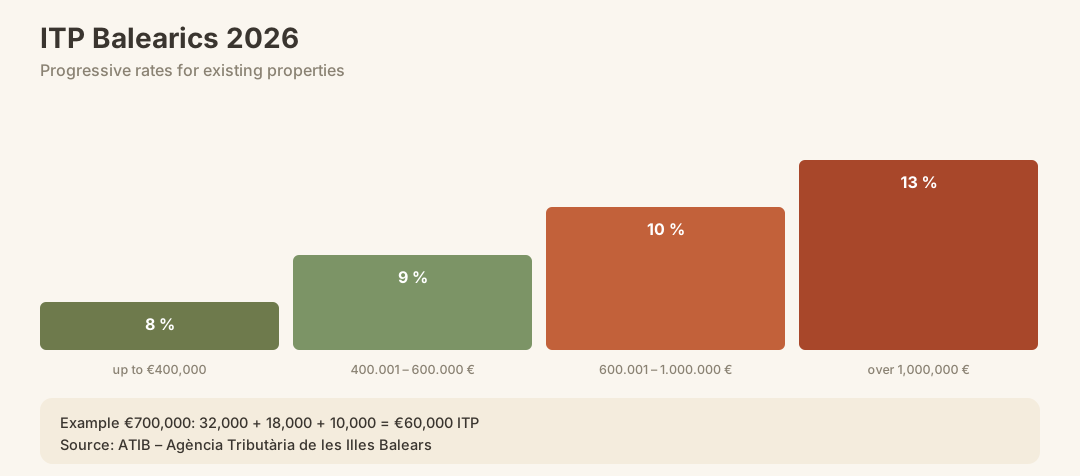
Balearic ITP Standard Rates (Resale Properties)
| Purchase Price (tramos) | ITP Rate Baleares |
|---|---|
| Up to 400,000 € | 8 % |
| 400.001 € – 600.000 € | 9 % |
| 600.001 € – 1.000.000 € | 10 % |
| Above 1,000,000 € | 13 % |
These rates apply progressively to each tramo — much like income tax brackets. On a purchase price of 700,000 €, you would therefore pay: 8 % on the first 400,000 € (32,000 €), 9 % on the next 200,000 € (18,000 €), and 10 % on the final 100,000 € (10,000 €) — a total ITP of 60,000 €.
Reduced ITP Rates: Who Qualifies?
Significantly lower rates — including full exemption — are available for first-time buyers under 30, people with disabilities, or buyers of protected housing (VPO/VPL). As a mainland Spaniard purchasing a second home, you will generally not qualify for these reductions — as you are buying neither your first property nor your primary residence on Mallorca.
Please note: For new-build properties, VAT (IVA) applies instead of ITP: 10 % for residential properties, plus Actos Jurídicos Documentados (AJD). In the Balearic Islands, the AJD rate is generally 1.5 %.
For a detailed breakdown of all purchase ancillary costs, take a look at our guide to purchase costs on Mallorca, where you will also find notary and land registry fees listed.
Ongoing Tax Obligations as a Second-Home Owner
The purchase is complete — now the annual obligations begin. As a non-resident with a second home on Mallorca, you have at least three ongoing tax positions to manage.
1. IRNR: The Deemed-Use Tax (Modelo 210)
Spain taxes the mere availability of a property — even if you do not rent it out a single time during the year. The principle: the tax authorities impute a notional use.
The basis for calculation is the cadastral value (valor catastral). As a rule, 1.1 % of this is deemed notional income (for older, non-updated cadastral values it may be 2 %). IRNR of 19 % is then applied to this amount — this rate applies to EU residents, and therefore also to mainland Spaniards who are not tax-resident in the Balearic Islands.
Worked example: Cadastral value 200,000 €, not updated → 2 % = 4,000 € taxable base → 19 % IRNR = 760 € annual tax
The Modelo 210 for the deemed-use tax must be filed once a year, generally by 31 December for the current year. Filing and payment are the taxpayer's own responsibility in Spain (autoliquidación) – you will not receive a tax assessment notice.
2. IBI – Property Tax
The Impuesto sobre Bienes Inmuebles (IBI) is a municipal tax that applies regardless of your tax status. The amount is determined by the cadastral value and the tax rate (tipo impositivo) of the relevant municipality. More on this in the guide to IBI-Steuer Spanien.
3. Wealth Tax (Impuesto sobre el Patrimonio)
In the Balearic Islands, a tax-free allowance of 3.000.000 € has applied to non-residents since 1 January 2024. This means: if the value of your Mallorca property (minus any mortgages) falls below this threshold, there is a declaration obligation but no actual tax liability. If the threshold is exceeded, progressive rates of between 0,28 % and 3,45 % apply.
Please note: The increased tax-free allowance of 3 Mio. € has been in effect since 1 January 2024. It could theoretically be reduced again in the event of a future change of government in the Balearic Islands – experts recommend structuring your assets in such a way that you are not caught off guard even if the allowance is lowered (previously 700.000 €).
| Tax | Due date | Basis | Rate |
|---|---|---|---|
| IRNR owner-occupation (Modelo 210) | Annually, by 31 Dec. | 1,1–2 % of the cadastral value | 19 % |
| IBI | Annually (municipality) | Cadastral value × tax rate | depending on municipality |
| Wealth Tax | Annually (approx. June/July) | Net assets in Spain | 0,28–3,45 % (from 3 Mio. €) |
Holiday Rentals 2026: ETV Licence Freeze and What It Means for You
Many mainland Spaniards buy property on Mallorca with the idea of renting it out via platforms such as Airbnb or Booking.com during the months when they are not using it themselves. This situation changed fundamentally in 2025/2026.
Decreto 4/2025: The Balearic Islands government has used this decree to halt the issuing of new ETV licences (Estancias Turísticas en Viviendas). New tourist rental licences for residential properties are currently not being granted. Anyone buying a property without an existing ETV licence will therefore not be able to legally let it out for tourist purposes in the short term.
Existing ETV licences, on the other hand, are a valuable asset — and priced accordingly. Properties offered with a valid licence command a significant premium on the market.
What is still permitted? Long-term letting (more than 31 days) requires no licence and remains possible. If you wish to let the property for longer periods, it is worth consulting our guide to long-term rental on Mallorca.
Tax treatment for holiday letting (where still possible)
If you purchase a property with an existing ETV licence and let it out, the following rules apply to non-residents:
- Rental income is subject to IRNR at 19 % (EU residents)
- As a non-resident, you may deduct EU-recognised costs on a pro-rata basis (mortgage interest, depreciation, management costs — apportioned according to days let)
- A separate Modelo 210 must be submitted for each quarter in which rental income was received
- Periods during which the property is not let continue to be taxed as owner-occupation (on a pro-rata basis)
More information on available tax deductions can be found in the guide to IRPF deductions for landlords in the Balearen.
The purchasing process: what mainland Spaniards underestimate
You are familiar with escritura, Notario and Registro de la Propiedad — but certain particularities on Mallorca come as a surprise even to Spaniards from the mainland.
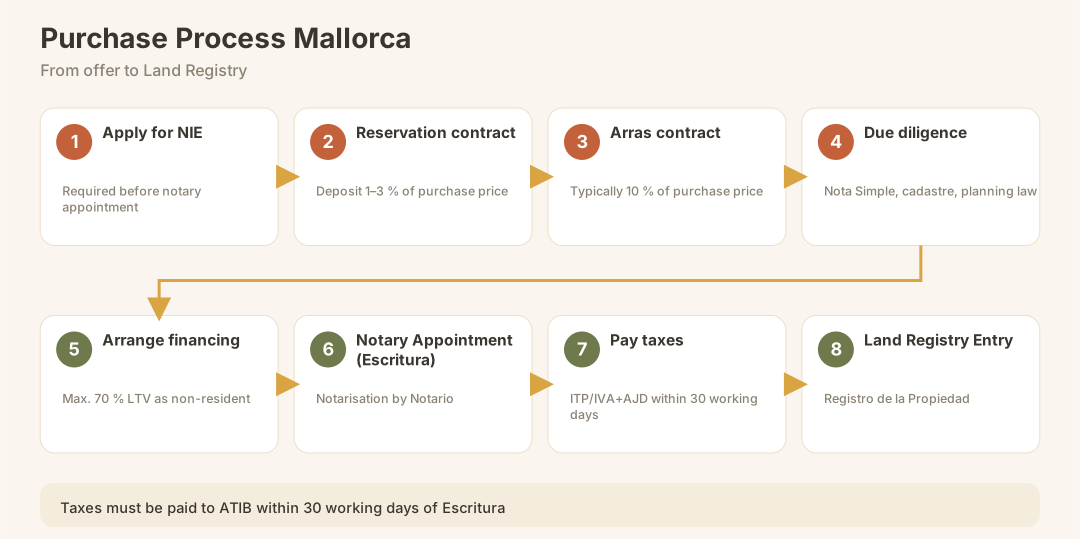
Step by step: from offer to land registry
- Applying for a NIE — Even as a Spanish national holding a DNI, you will need the Número de Identificación de Extranjero (NIE) for a property on Mallorca if you are not registered for tax purposes in the Balearen. In practice, many mainland Spaniards use their DNI, but a local tax adviser should clarify this for each individual case.
- Reservation contract (Contrato de Reserva) — typically with a deposit of 1–3 % of the purchase price. For more details: reservation contract in Spain.
- Arras contract (Contrato de Arras) — usually 10 % of the purchase price. The private contract is binding under Spanish law; if the buyer withdraws, the deposit is forfeited.
- Due diligence — Check the land registry extract (Nota Simple), cadastral extract, town-planning status and any outstanding debts on the property. See our guide checking the land registry in Spain.
- Arranging finance — As a non-resident on Mallorca, you will generally receive a maximum of 70 % of the lending value. For more details: mortgage on Mallorca.
- Notarial appointment (Escritura Pública) — The Spanish notary certifies the purchase but does not not the interests of the parties and does not provide advice. The responsibility for due diligence lies with you and your lawyer.
- Pay taxes – ITP or IVA+AJD must be paid to the ATIB within 30 working days of the escritura.
- Land Registry entry – The entry in the Registro de la Propiedad only takes place after tax payment.
Important: The Spanish notary differs from a German notary: they notarise the deed but do not check for hidden charges, outstanding municipal fees, or illegal extensions. An independent lawyer (abogado) is not a luxury — it is essential.
Mortgage as a non-resident: what Balearic banks require
Spanish banks do grant mortgages to non-residents, but apply different criteria than they do to resident customers.
| Criterion | Resident (mainland) | Non-resident (second home) |
|---|---|---|
| Max. loan-to-value (LTV) | up to 80 % | typically max. 70 % |
| Proof of income | Spanish nómina or IRPF | Foreign proof of income + translation |
| Debt-to-income ratio | max. 35–40 % of income | similar, but assessed more strictly |
| Term | up to 30 years | often max. 25 years |
A helpful comparison between fixed and variable interest rates can be found in the guide Fixed or variable mortgage in Spain. For transferring the purchase price from Spain or abroad: Transferring money to Spain for a property purchase.
Structuring wealth tax efficiently
For property values close to or above €3 million, it is worth thinking through the ownership structure at the point of purchase.
Possible approaches (always to be reviewed with tax advice):
- Co-ownership with a spouse or children: Each co-owner has their own tax-free allowance. If the share per person is below €3 million, there is no tax liability. This approach is explicitly recognised according to research.
- Mortgage as a deductible item: The outstanding loan amount reduces the net assets relevant for tax purposes. A Spanish mortgage can therefore make sense from a tax perspective even when sufficient liquidity is available.
- SL structure: Under certain conditions, purchasing through a Spanish SL (Sociedad Limitada) can offer advantages. However, this is complex and not suitable for every second residence. More on this: Buying property through an SL in Spain.
Note: The €3 million tax-free allowance has applied in the Balearen since 1 January 2024 for non-residents. It is not politically set in stone — under the previous allowance of €700,000, significantly more properties would have been affected.
Inheritance and gifts: understanding Balearic law
Anyone who owns a property on Mallorca will sooner or later need to address the question of inheritance. The good news: the Balearen have one of the most favourable inheritance tax regimes in Spain for direct relatives (children, parents, spouses). The bad news: for more distant relatives or non-relatives, the tax burden can be considerable.
Pacto Sucesorio: Balearic law permits special succession agreements between living parties, which can be more tax-advantageous than a conventional will. This is an instrument that does not exist on the mainland. More on this: Pacto Sucesorio in the Balearen and Inheritance & gifts in the Balearen.
Note: Even if you are a Spaniard from the mainland who is well acquainted with national inheritance law — the Balearic special inheritance law (Derecho Civil Balear) differs from the Código Civil in significant respects. A Balearic notary or inheritance lawyer is essential here.
Most common mistakes made by mainland Spaniards when buying property on Mallorca
Mainland Spaniards often make different mistakes when buying on Mallorca to those made by foreign buyers — because they believe they already know the system.
Underestimating ITP: Many calculate using the rates from their home region. The Balearic rates (up to 13 %) are in some cases considerably higher than what people are used to in certain other regions.
No due diligence on Balearic planning law specifics: Suelo rústico, the Tramuntana protection zone, illegal extensions — Mallorca has specific restrictions that differ from the mainland. A property that would be perfectly legal on the mainland can present serious problems on Mallorca. More on this: Finca on Suelo Rústico and Legalising an Unauthorised Structure on Mallorca.
Assuming an ETV Licence is a Given: Anyone who buys with the intention of letting and is banking on a licence they plan to apply for later is mistaken. Since Decreto 4/2025, no new ETV licences are being granted.
Forgetting Modelo 210: The deemed-use tax must be filed even if you never let the property. Many mainland Spaniards are not used to submitting a tax return for a self-used second home – but as an IRNR taxpayer in Spain, it is required.
Ignoring the Owners' Community Rules: Every residential complex has its own statutes. Short-term letting may be prohibited internally, even if an ETV licence were to exist. More on this: Owners' Community in Spain.
Not Checking Tax Residency: Anyone who spends too many days on Mallorca risks inadvertently becoming tax resident in the Balearic Islands – with all the tax consequences for worldwide income.
What Comes Next? Ongoing Obligations at a Glance
After the purchase, the real administrative work begins. Here is an overview of the recurring obligations:
| Task | When | Responsible Party |
|---|---|---|
| Pay IBI | Annually (deadline varies by municipality) | Municipality (Recaudación) |
| IRNR Modelo 210 (deemed personal use) | Annually, by 31 Dec. | ATIB / self-assessment |
| IRNR Modelo 210 (rental income) | Quarterly | ATIB / self-assessment |
| Wealth Tax | Annually (approx. June/July) | ATIB |
| IEE/ITE (building survey) | Every 10 years from a certain age | Owner/Community |
| Energy certificate for rental | With each new tenancy | Owner |
| Home contents insurance | Renew annually | Owner |
On building inspection: IEE/ITE obligation on Mallorca. On Home contents insurance in Spain.
Checklist: Second residence in Mallorca for mainland Spaniards
- Clarify tax residency status (mainland resident vs. Balearic)
- Check NIE status for Mallorca transaction
- Calculate ITP amount for the planned purchase price (Balearic sliding scale)
- Determine the catastral value of the property (basis for IRNR)
- Check ETV licence if holiday rental is planned
- Obtain land registry extract (Nota Simple) and catastral extract
- Check planning law situation (Suelo rústico? Tramuntana? Extensions?)
- Clarify financing structure (LTV, mortgage as wealth tax lever)
- Think through ownership structure for inheritance planning (Pacto Sucesorio?)
- Check owners' community statutes for rental restrictions
- Enter Modelo 210 obligation after purchase in the calendar
- Engage a local tax adviser and abogado on Mallorca
Conclusion
Mallorca as a second residence is an attractive but by no means straightforward proposition for mainland Spaniards. The Balearic Islands operate under their own tax and legal rules: progressively high ITP rates, a dedicated tax authority (ATIB), a unique inheritance law, and a de facto closed holiday rental regime since Decreto 4/2025. Those who understand these particularities, take a structured approach before purchasing, and bring on board locally based professionals can still make an excellent decision. The island remains one of the most value-stable property markets in the Mediterranean — provided the fundamentals are right.
Official sources
- ATIB – Agència Tributària de les Illes Balears (ITP, AJD, wealth tax): https://www.atib.es
- AEAT – Agencia Estatal de Administración Tributaria (IRNR Modelo 210, IRPF): https://www.aeat.es
- Govern de les Illes Balears – BOIB (Decreto 4/2025 ETV licence freeze): https://www.caib.es/govern/sac/fitxa.do?lang=ca&codi=3596428
- Registro de la Propiedad España (Land Registry entry): https://www.registradores.org
- BOE – Boletín Oficial del Estado (Real Decreto 240/2007, IRNR Act LIRNR): https://www.boe.es
- Catastro España (Cadastral values, property search): https://www.sedecatastro.gob.es