
Which taxes apply to Mallorca second homes for mainland Spaniards?
As a Spaniard from the mainland, you belong to an often-overlooked group of buyers on Mallorca: you know the language, the legal system and the culture – which makes it all the easier to underestimate what is different in the Balearic Islands. The most common misconception is fundamental: many people believe that owning a second home on Mallorca makes them a non-resident there for tax purposes. The opposite is true. If your main home remains in Madrid, Barcelona or Valencia, you remain a Spanish tax resident – and the non-resident rules you find in many guides do not apply to you. This guide explains which taxes you pay when buying, how your Mallorca property is taxed on an ongoing basis, which rules come from your own region and which from the Balearic Islands – and where the costly misunderstandings arise.

The crucial distinction: two levels, not one
Before looking at individual taxes, we need to clear up a misconception. In Spain, the question ‘Where will I be taxed?’ is answered on two separate levels – and they are constantly confused.
Level 1 – the state. This determines whether you are subject to resident income tax (IRPF) or non-resident income tax (IRNR). Under Art. 9.1 Ley 35/2006, you are a Spanish tax resident if you spend more than 183 days in a calendar year in Spain or if the centre of your economic interests is in Spain. What matters is the country, not the island. Someone who lives in Madrid and spends a few weeks a year at their house near Pollença will clearly spend more than 183 days in Spain – and remains a resident.
Level 2 – the autonomous community. This determines which regional law applies to taxes devolved to the regions. The connecting factor is set out in Art. 28 Ley 22/2009 and differs by tax: for income tax and wealth tax, it is the autonomous community where you spent the most days during the tax year; for inheritance tax, it is the autonomous community where the deceased spent the most days in the five years before their death. Property transfer tax works quite differently – only the location of the property matters (Art. 33.2 Ley 22/2009).
In a nutshell: Buying a second home on Mallorca does not change your tax status. You remain a resident, you remain subject to IRPF, and the law of your own autonomous community continues to govern wealth tax and inheritance tax. Only taxes tied to the property itself are governed by the Balearic Islands.
Which rules apply where?
| Tax | Rules come from | Legal basis |
|---|---|---|
| ITP / AJD on purchase | Balearic Islands – the property is located there | Art. 33.2 Ley 22/2009 |
| IBI (property tax) | the municipality in Mallorca | Art. 72 RDLeg 2/2004 |
| IRPF, including owner-occupation | the state plus your own Comunidad | Art. 28.1 Ley 22/2009 |
| Wealth tax (IP) | your own Comunidad | Art. 31.2 Ley 22/2009 |
| Inheritance tax | the deceased’s Comunidad | Art. 32.2 a) Ley 22/2009 |
| Gift of the property | Balearen – the property is located there | Art. 32.2 b) Ley 22/2009 |
This table is the thread running through the entire guide. Almost every costly mistake made by this group of buyers comes from confusing one row with another. For a detailed explanation of how tax residency is determined, see the guide to tax residency in Spain and the 183-day rule.
If you live abroad: This guide is for Spaniards whose main home remains on the mainland. If you have moved your centre of life abroad, you are a non-resident, are subject to IRNR and must file Modelo 210 – see the separate guide to non-resident tax in Spain. The rules in this article do not apply to you.
ITP Balearen 2026: What you actually pay when buying
Transfer tax (ITP)
Explanation
The taxable base (base imponible) is the value used to calculate the tax: the price stated in the deed or the higher cadastral reference value. Enter the higher value.
Explanation
A main home (vivienda habitual) is the home you normally occupy under Spanish income tax rules. Select a profile only if you meet all its conditions; the calculator checks the value threshold and transaction date.
The general tariff applies without personal tax relief, for example when buying a second home.
- Property transfer tax (ITP) payable
- €25,600.00
Legal status: 14 June 2026
This calculation is provided for guidance only and is not a substitute for tax or legal advice in specific cases.
Impuesto sobre Transmisiones Patrimoniales (ITP) is the largest single expense when buying a resale property. Balearic law does apply here – but not because you own a second home. It applies because the property is in Mallorca. A buyer from Madrid and a resident of Palma pay the same ITP amount for the same house.
What is taxed: not necessarily your purchase price
Since 2022, the taxable base has not automatically been the agreed price, but the valor de referencia recorded by the cadastre. If the agreed price is higher, the higher value applies (Art. 10.2 RDLeg 1/1993). That means you may pay tax on a figure you never negotiated. Check the value before your notary appointment – the guide to Valor de Referencia in Spain explains how.
Balearic ITP rates (resale properties)
| Taxable base (tramos) | Balearic ITP rate |
|---|---|
| Up to €400,000 | 8% |
| €400,000 – €600,000 | 9% |
| €600,000 – €1,000,000 | 10% |
| €1,000,000 – €2,000,000 | 12% |
| Over €2,000,000 | 13% |
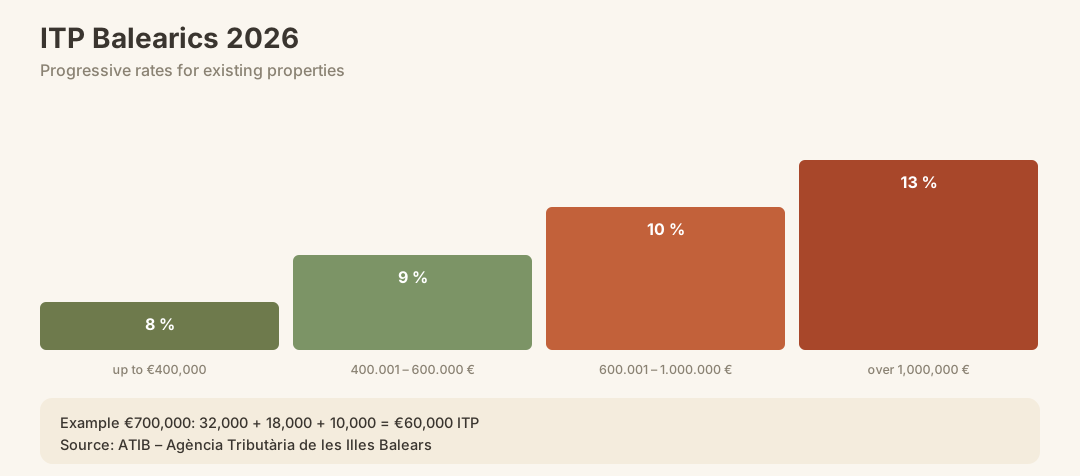
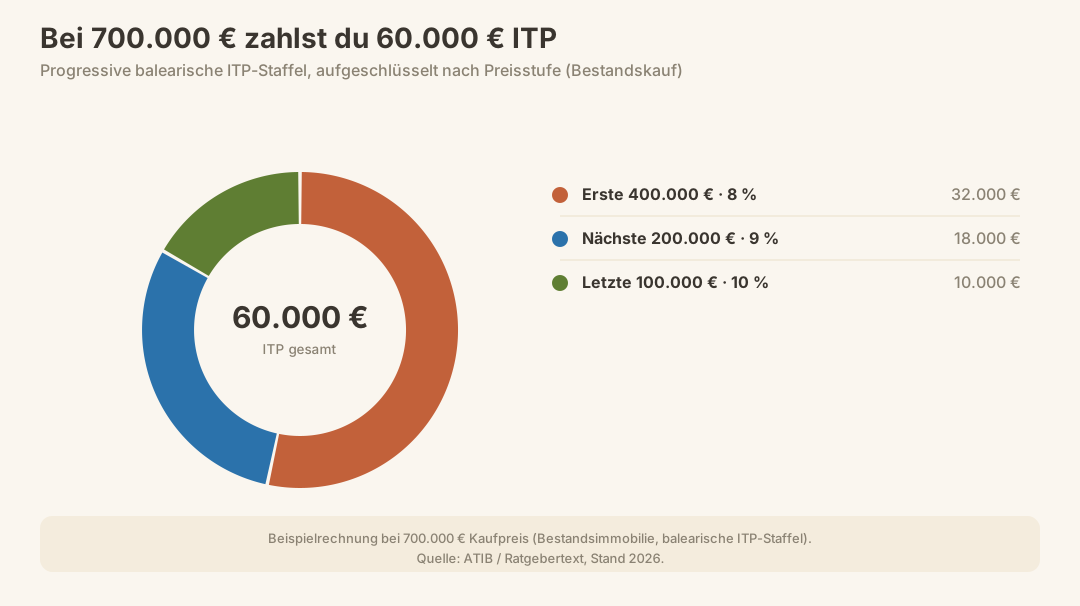
The rates apply progressively across the bands, much like income tax bands. On a taxable base of €700,000, you would therefore pay: 8% on the first €400,000 (€32,000), 9% on the next €200,000 (€18,000) and 10% on the final €100,000 (€10,000) – a total of €60,000 in ITP.
Reduced rates: generally not available to you
The Balearic Islands offer substantial tax relief – a 4% rate for a main home, 2% for certain first-time buyers and a full exemption for buyers under 30. All of these depend on the property becoming your vivienda habitual, and the exemption for buyers under 30 also requires you to have been habitually resident in the Balearic Islands for the three years before the purchase. If you buy a second home while remaining registered as resident on the mainland, you will not meet these conditions. Budget for the standard rates.
Note: New-build properties are subject to VAT (IVA) instead of ITP – 10% for residential properties (Art. 91.Uno.1.7.º Ley 37/1992) – plus Actos Jurídicos Documentados. The standard Balearic AJD rate is 1.5%.
ITP must be paid to the ATIB within one month of signing the deed before a notary. For a detailed breakdown of all additional costs, see the guide to property purchase costs in Mallorca; it also covers notary and land registry fees.
Ongoing taxes: all through IRPF, no Modelo 210
This is the biggest difference from what people from mainland Spain often read about property in Mallorca – most of it is written for foreign buyers. As a resident, you do not need to file Modelo 210. Everything goes through your usual annual tax return.
1. Owner-occupation: imputación de rentas inmobiliarias
Spain taxes the mere availability of a second home, even if you never rent it out. For residents, this is set out in Art. 85 Ley 35/2006: for urban properties that are not your main home, are not used for a business activity and generate no rental income, an amount of imputed income is assessed – 2% of the cadastral value, calculated pro rata by day.
The reduced rate of 1.1% applies only if the municipality’s cadastral values were revised as part of a general reassessment that took effect in the tax year or in one of the ten preceding years. If in doubt, check which rule applies in your municipality – the guide to Valor Catastral explains where to find the value.
The crucial point comes next: under Art. 45 Ley 35/2006, this amount forms part of your renta general. It is therefore not taxed at a flat rate, but at your personal marginal tax rate – combining the state rate and the rate in your own autonomous community. The 19% you often see quoted is the rate for EU-resident non-residents, and is simply the wrong figure for you.
Example calculation: cadastral value €200,000, no reassessment in the past ten years, owned throughout the year. Imputed income: 2% of €200,000 = €4,000. This €4,000 is added to your other income; the tax on it is the amount multiplied by your personal marginal tax rate. There is deliberately no one-size-fits-all figure here – it depends on your income and the tax rates in your autonomous community. The guide to IRPF for residents explains how those rates are determined.
2. IBI – property tax
Impuesto sobre Bienes Inmuebles (IBI) is a municipal tax payable regardless of where you live. The amount depends on the cadastral value and the municipality’s tax rate; for urban properties, the statutory range is 0.4% to 1.1% (Art. 72 RDLeg 2/2004). Municipalities may also impose a surcharge of up to 50% on homes that remain permanently unoccupied – something second-home owners should bear in mind. For more, see the guide to IBI tax in Spain.
3. Wealth tax – under the rules of your region
And here lies the second major misconception. In the Balearic Islands, a €3,000,000 tax-free allowance has applied since 1 January 2024. Non-residents can opt to claim this allowance if the majority of their Spanish assets are in the Balearic Islands – the legal basis is Disposición adicional cuarta of Ley 19/1991, as amended by Ley 11/2021, and its wording makes it available exclusively to non-residents.
You are a resident. Under Art. 31.2 Ley 22/2009, the rules of the autonomous community where you habitually reside apply to you – and under Art. 5.Uno a) Ley 19/1991, you are taxed on your worldwide net worth assessed, not just on the Mallorca property. What this means in practice depends on where you are registered: the Comunidades differ more on this than on any other tax, ranging from the full tax burden to substantial reductions.
Three national rules apply if your region has not set its own rules, or as fallback provisions:
- Tax-free allowance of €700,000 (Art. 28.Dos and Tres Ley 19/1991)
- Main residence exemption of up to €300,000 (Art. 4.Nueve Ley 19/1991) – this applies to your home on the mainland, not to a second property on Mallorca
- Filing requirement even if no tax is payable, if your assets and rights exceed €2,000,000 (Art. 37 Ley 19/1991)
There is also a tax many people overlook: the national Impuesto Temporal de Solidaridad de las Grandes Fortunas (Ley 38/2022). It has its own tax-free allowance of €700,000, starts at 1.7% on a taxable base of €3,000,000 and rises to 3.5%. Its purpose is specifically to offset regional wealth tax reductions – so even if you rely on generous rules in your Comunidad, you may still have to pay this tax. The details are in the guide to wealth tax in Spain.
| Tax | Filing | Basis | Tax burden |
|---|---|---|---|
| Personal use (Imputación) | in IRPF, annually | 1.1–2% of the cadastral value | personal marginal tax rate |
| IBI | municipal, annually | cadastral value × tax rate | 0.4–1.1% (urban) |
| Wealth tax | annually, alongside IRPF | worldwide net worth | rules in your Comunidad |
| Solidarity tax (ITSGF) | annual, national | net wealth from €3,000,000 | 1.7–3.5% |
How and when to file the returns is explained in our guide to filing a tax return in Spain.
Holiday rentals: tighter rules, different tax treatment
Many Spaniards from the mainland buy with the idea of renting out the property during the months they do not use it. Care is needed with the legal rules, while your residency status also affects the tax treatment.
The licensing rules in brief
Short-term tourist rentals in Mallorca require an ETV licence. A moratorium on new tourist accommodation places has been in force since February 2022; Decreto-ley 4/2025, issued in April 2025, prohibits new places in apartment buildings throughout the archipelago, and no new places have been provided for in Palma since February 2026. In March 2026, the Consell de Mallorca allocated a limited quota by lottery for the first time since the moratorium. Existing licences remain valid and are priced into properties accordingly. As the situation changes quickly, we cover it in one place: our guide to the ETV licence for holiday rentals in Mallorca and, if you are buying a property with an existing licence, our guide to transferring an ETV licence.
What remains possible without a licence: Tenancy agreements under the LAU tenancy law – residential lets or seasonal lets with a demonstrably non-tourist purpose – do not require an ETV licence. If this is an option for you, take a look at our guide to long-term rentals in Mallorca.
How your rental income is taxed
For you, rental income is classed as rendimientos del capital inmobiliario under IRPF – not IRNR, and taxed not at 19% but at your personal rate. The deductions available are considerably more generous than for non-residents (Art. 23.1 Ley 35/2006):
- interest on borrowing, together with maintenance and repair costs, capped at the amount of gross rental income; any excess can be deducted over the following four years
- non-state taxes and charges on the property, such as IBI
- depreciation of up to 3% of the higher of the acquisition cost and cadastral value, excluding the value of the land in each case
- third-party management and service costs
For periods when the property is vacant and available for your use, the imputed income described in the previous section applies on a pro-rata basis.
Important: The well-known 50–90% reduction in net rental income under Art. 23.2 Ley 35/2006 expressly applies only to the letting of for residential purposes. It does not apply to short-term tourist lets. Anyone who factors it in will systematically overestimate the return on an ETV.
The guide to the IRPF deduction for landlords in the Balearic Islands explains which regional deductions may also be available in the Balearic Islands.
The buying process: What Spaniards from the mainland underestimate
Check your arras contract
Explanation
The purchase price is the property price agreed in the contract. The preset is an example; enter your agreed price.
Explanation
The type determines what happens if either party pulls out. Check your contract; the word arras alone is not enough to select a type here.
- Balance payable at the notary
- €585,000.00
- Total purchase price
- €650,000.00
- Deposit (arras)
- €65,000.00
If you pull out
Select the type stated in your contract above so the consequences of pulling out can be explained.
Legal status: 16 August 1889
This calculation is provided for guidance only and is not a substitute for tax or legal advice in specific cases.
You know Escritura, Notario and Registro de la Propiedad. Even so, some things are different on Mallorca.
Step by step from offer to Land Registry
- No NIE required – as a Spanish citizen, your tax identification number is your DNI number, including its check letter (Art. 18 RD 1065/2007). The NIE is an identification number for foreign nationals; you do not need one, even to buy a property in the Balearic Islands. What you should check instead is whether your registered details and tax domicile are up to date with the AEAT.
- Look up the Valor de referencia – before negotiating the price, as it can increase the taxable value.
- Sign a reservation agreement (Contrato de Reserva) – usually with a deposit of 1–3% of the purchase price. Read more: Reservation agreements in Spain.
- Sign an arras agreement (Contrato de Arras) – usually for 10% of the purchase price. This private agreement is binding; if the buyer withdraws, they forfeit the deposit.
- Due diligence – check the Nota Simple, cadastral extract, planning status and any outstanding charges on the property. Read How to check the Spanish Land Registry.
- Arrange financing – more on that shortly.
- Notary appointment (Escritura Pública) – the Spanish notary authenticates the deed but does not safeguard the parties’ interests or provide advice. The checks are up to you and your lawyer.
- Pay the taxes – pay ITP or IVA plus AJD to the ATIB within one month of notarisation.
- Land Registry entry – the property is entered in the Registro de la Propiedad only after the taxes have been paid.
Important: A Spanish notary does not check for hidden charges, unpaid local authority fees or unauthorised extensions. When buying on an island with its own planning laws, an independent lawyer is not a luxury.
Financing: As a resident, you’re in a better position than you might think
Many guides to financing a property in Mallorca are written for overseas buyers and therefore cite restrictive loan-to-value limits. Those limits do not apply to you: Spanish banks treat you as a resident and generally lend up to 80% of the valuation, with less paperwork and more favourable interest rates. The details – how much deposit you need, the costs and the process – are in the guide to Mortgages for residents in Spain.
Two restrictions remain, and they relate to the property, not your passport. First, a second home is not a vivienda habitual; banks assess the risk more conservatively and more often require a larger deposit than they would for a primary home. Second, the loan-to-value limit is always based on the valuation, not the purchase price – and in Mallorca, the two often differ. For a comparison of interest rate options: Fixed or variable-rate mortgages in Spain. For arranging payment of the purchase price: Transferring money to Spain when buying property.
Wealth tax: what you can structure and what you cannot
If you have substantial assets, it is worth considering how to structure ownership before you buy. First, two points that buyers in this group regularly misunderstand:
- The Balearic tax-free allowance of €3,000,000 is not available to you – it applies through the election for non-residents (Disposición adicional cuarta Ley 19/1991).
- Moving to Mallorca does not change your wealth tax position immediately or only in relation to one property: it shifts the assessment of your entire wealth, not just the property on the island.
Options that can make a difference (each should be reviewed with a tax adviser):
- Co-ownership: Wealth tax is a personal tax. Each co-owner is assessed on their share and has their own tax-free allowance – for spouses, the attributable tax base is divided according to their ownership shares.
- Financing: The outstanding loan balance reduces your net wealth. A mortgage can therefore have a tax effect even if you have sufficient cash available.
- Company ownership: Buying through a Spanish SL can make sense in certain circumstances, but it is complex and rarely the right approach for an ordinary second home. More on this: Buying property through an SL in Spain.
Note: Anyone considering regional tax rebates must also factor in the state solidarity tax. It is designed precisely to recapture wealth tax on assets above €3,000,000 that a regional rebate would otherwise eliminate.
Inheritance and gifts: the part most often misunderstood
The Balearic Islands have one of Spain’s most favourable inheritance tax regimes – since July 2023, a 100% rebate on the tax for spouses, children and parents. This often leads people to assume that a Mallorca property will be inherited under Balearic law. That is not correct, and the distinction can be very costly.
Inheritance: the deceased’s residence is what matters
Under Art. 32.2 a) Ley 22/2009, inheritance tax is governed by the Comunidad in which the deceased was habitually resident – specifically, under Art. 28.1, the one in which they spent the most days during the five years before their death. This applies to the entire estate, including any Mallorca property. Someone who remains registered as resident in Madrid passes on their house near Sóller under Madrid’s tax rules, not the Balearic Islands’ rules. The five-year rule also means that a late move to the island does not take effect for tax purposes immediately.
Lifetime gifts: the property’s location matters here
For a gift of property, the determining factor is different: under Art. 32.2 b) Ley 22/2009, it is the property’s location that counts. Balearic law therefore applies to a Mallorca property – including the 100% reduction in tax liability for gifts to spouses, children and parents. This is the one situation in which the favourable Balearic rules are actually available to you. Read more: Inheritance and gifts in the Balearic Islands.
And civil law? It follows vecindad civil
Which substantive inheritance law applies depends neither on the tax rules nor on the property’s location, but on a person’s vecindad civil – their civil-law affiliation to a particular region. Art. 9.8 Código Civil expressly states that succession is governed by the deceased’s personal law, “cualesquiera que sean la naturaleza de los bienes y el país donde se encuentren”, and Art. 16.1 makes vecindad civil that personal law.
In practical terms, this means that the Pacto Sucesorio, the Balearic instrument for making a lifetime inheritance agreement, requires Balearic vecindad civil. Under Art. 14.5 Código Civil, you acquire it after two years of uninterrupted residence with an express declaration to the civil registry, or after ten years without a declaration to the contrary. Buying a property does not confer it. Read more: Pacto Sucesorio in the Balearic Islands, inheritance tax for residents and Spanish wills.
The most common mistakes made by Spaniards from the mainland
Thinking you are a non-resident. This is the costliest mistake of all. It leads to an unnecessary Modelo 210, the wrong type of tax and plans based on rules that never applied to you.
Factor in the Balearic wealth tax allowance. The €3,000,000 allowance is available to non-residents who choose to apply Balearic rules. Your own Comunidad’s rules apply to you, alongside the national solidarity tax.
Assume the island’s inheritance rules apply. Neither tax nor civil law depends on where the property is. Both depend on the person: inheritance tax on where they lived during the previous five years, and civil law on their vecindad civil.
Calculate ITP using the rates in your home region. The Balearic rates go up to 13%, and the taxable value is the higher of the price and the valor de referencia.
Count on getting an ETV licence that does not yet exist. If you buy to let, the licence must come with the property – otherwise, you do not have one. No new tourist rental places are being allocated to flats in apartment buildings.
Overlook the Balearic Islands’ planning rules. Suelo rústico, the Tramuntana protected area, unauthorised extensions: a house that would raise no concerns on the mainland can be a problem here. More on this: Finca on Suelo Rústico and Legalising unauthorised building work on Mallorca.
Fail to read the owners’ association rules. They may prohibit short-term lets even if the property has a valid licence. More on this: Owners’ associations in Spain.
Underestimate the implications of changing your tax residence. If you actually move to the island, your entire tax position changes – income tax, wealth tax and, in time, inheritance tax. That could leave you better or worse off; it should not happen by accident. The starting point is Empadronamiento on Mallorca.
If you do move to the island
Changing your habitual residence to the Balearic Islands reverses the table at the start: wealth tax and – after five years – inheritance tax will then be governed by Balearic rules, as will the regional portion of your IRPF. ITP and IBI do not change; they were tied to the property anyway. Two points deserve attention: the change is not retrospective, and for inheritance tax it takes effect only after a significant delay. It also affects all your assets, not just those on Mallorca. If you are considering the move, work out the figures before registering it – not the other way around. The regional IRPF deductions are a good place to start: IRPF deductions in the Balearic Islands.
What remains to be done after the purchase
| Task | When | Who is responsible |
|---|---|---|
| Pay ITP | within one month of signing the deed | ATIB |
| Pay IBI | annually, on a date set by each municipality | Municipality (Recaudación) |
| Declare personal use | annually in your IRPF tax return | AEAT |
| Declare rental income | annually in your IRPF tax return | AEAT |
| Wealth tax | annually, if tax is due or assets exceed €2,000,000 | your Comunidad |
| IEE/ITE (building inspection report) | every ten years once the building reaches a specified age | Owner/owners’ association |
| Energy performance certificate | for every new tenancy | Owner |
On building inspections: IEE/ITE requirements in Mallorca. On household contents insurance in Spain.
Checklist: a second home in Mallorca for Spaniards from mainland Spain
- Be clear about your tax status: resident in Spain, with your main residence in its Comunidad
- Check the property’s valor de referencia before negotiating the price
- Calculate ITP using the Balearic tax brackets and the correct taxable base
- Determine the cadastral value and check whether the municipality has reassessed it in the last ten years
- Calculate imputed income using your own marginal tax rate, not 19 %
- Check the wealth tax rules in your own Comunidad, as well as the state solidarity tax
- Check the ETV licence if you plan to offer tourist lets
- Obtain a Nota Simple and a cadastral extract
- Check the planning situation: Suelo rústico, Tramuntana, extensions
- Enquire about financing as a resident, with the loan-to-value ratio based on the appraised value
- Plan succession: inheritance tax according to residence, civil law according to vecindad civil
- Check the owners’ association rules for restrictions on letting
- Consult a tax adviser with experience in Balearic tax matters
Conclusion
For Spaniards from the mainland, a second home in Mallorca is less unfamiliar than many guides suggest – and more demanding in one respect. You are not moving into a different tax system: you remain a resident, declare everything through IRPF and do not need Modelo 210. What changes is which authority handles certain taxes, under different rules. The property falls under Balearic rules for ITP, IBI and gifts; your own Comunidad retains responsibility for wealth and inheritance tax. Once you have worked through that division, you can buy with more confidence than someone relying on rules written for foreign buyers. The island remains one of the property markets that best retain their value in the Mediterranean – provided the fundamentals are right.
Official sources
- ATIB – Agència Tributària de les Illes Balears (ITP, AJD, wealth tax in the Balearic Islands): https://www.atib.es
- AEAT – Agencia Estatal de Administración Tributaria (IRPF, imputed property income): sede.agenciatributaria.gob.es
- BOE – Boletín Oficial del Estado (Ley 35/2006 IRPF, Ley 19/1991 IP, Ley 22/2009 financing system, Código Civil): https://www.boe.es
- Catastro España (cadastral value and Valor de Referencia): https://www.sedecatastro.gob.es
- Govern de les Illes Balears (tourism and letting law): https://www.caib.es
- Spain’s Registro de la Propiedad (Land Registry entry): https://www.registradores.org
How much savings do you need for a second home?
The purchase price alone does not answer this question. What matters is how much you must pay yourself and when the money must be available. Before committing, calculate these separately:
- Purchase price not covered by the mortgage: Subtract the mortgage amount the bank has formally committed to lend from the purchase price. A preliminary assessment by the bank is not yet a mortgage offer.
- Additional purchase costs: Budget separately for applicable taxes, notary and land registry fees, and any advisory costs. Tax may be calculated using a valor de referencia higher than the agreed price.
- Payments before signing before the notary: Any agreed reservation or arras payment must be available on time, even if the mortgage funds are released later.
- Cash available after purchase: Allow for ongoing costs for both homes and possible repairs, rather than putting all your savings into the purchase.
If you are financing the second home, ask the bank to confirm in writing how much it will actually lend and on what conditions. Only then can you reliably calculate how much of your own money you need. This is not legal or tax advice.