
Buying or renting in Mallorca 2026: The honest financial decision matrix
Whether you should buy or rent a property on Mallorca in 2026 is no longer a lifestyle question – it's a financial decision with considerable risk potential in both directions. According to Engel & Völkers surveys, current prices per square metre stand at around 4.704 € for houses and 5.384 € for apartments, with a continuing upward trend – albeit more moderate than during the preceding boom years. At the same time, the latest notarial statistics show that transaction volumes have recently fallen noticeably. This guide provides you with an honest, data-driven matrix: What does buying actually cost (including taxes, financing, and ongoing obligations)? What does renting cost in the long run? And at what point does the calculation tip? You'll get to know the decisive levers – from the ITP to rental yields and the capital gains tax exemption on sale.

Buy or rent – or perhaps both? Let's work through the numbers for your personal situation.
- 📩 Submit a personal enquiry — individual assessment for your case
- All purchase ancillary costs in detail
The market in 2026: What you pay when you buy today
Before you run any calculation, you need realistic baseline figures. Price developments over recent years point clearly in one direction:
House price trends on Mallorca (asking prices)
| Year | Ø €/m² Houses | Change |
|---|---|---|
| 2022 | 3.689 € | — |
| 2023 | 3.932 € | +6,6 % |
| 2024 | 4.113 € | +4,6 % |
| 2025 | 4.489 € | +9,2 % |
| 2026 | 4.704 € | +4,8 % |
Source: Engel & Völkers, asking prices on property portals, as of June 2026
Apartment price trends on Mallorca (asking prices)
| Year | Ø €/m² Apartments | Change |
|---|---|---|
| 2023 | 4.009 € | — |
| 2024 | 4.537 € | +13,2 % |
| 2025 | 5.095 € | +12,3 % |
| 2026 | 5.384 € | +5,7 % |
Source: Engel & Völkers, as of June 2026
What these figures mean: A 90-m² apartment in a good location in Palma is currently listed at around 485.000 €. In tourist hotspot areas, individual market reports cite significantly higher prices per square metre in the holiday property segment. At the same time, the latest notarial statistics show: in November 2025, transactions on the Balearen fell by 13,9 % year-on-year – one of the sharpest declines anywhere in Spain. The high price level is visibly dampening demand.
Please note: Asking prices and actual purchase prices can differ considerably on Mallorca. For your personal calculations, you should always use the final negotiated notarial price as your basis.
The true cost of buying: What comes on top
The purchase price is only the beginning. In Mallorca – and the Balearic Islands generally – the buyer bears a considerable tax burden and additional ancillary costs. For an honest calculation, you need to factor in the following items:
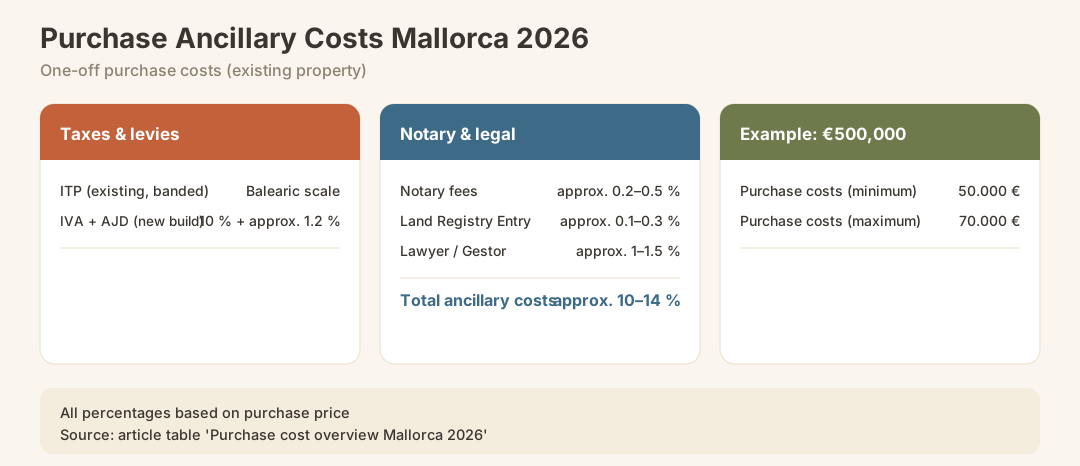
Overview of Purchase Ancillary Costs Mallorca 2026
| Type of cost | Amount / Basis | Note |
|---|---|---|
| ITP (Impuesto Transmisiones Patrimoniales) | Graduated rate, Balearic scale | Applies to existing properties; details → ITP Balearen 2026 |
| IVA + AJD (New build) | 10 % IVA + approx. 1,2 % AJD | Only on first sale from the developer |
| Notary fees | approx. 0,2–0,5 % of the purchase price | Nationally regulated fee schedule |
| Land registry entry | approx. 0,1–0,3 % of the purchase price | Required for legal certainty |
| Solicitor / Gestor | approx. 1–1,5 % of the purchase price | Strongly recommended |
| Total ancillary costs | approx. 10–14 % of the purchase price | Depending on property type and value |
On a purchase price of 500.000 €, ancillary costs of around 50.000–70.000 € are therefore incurred, which you must have available as liquid funds in addition. A detailed breakdown can be found in the guide Purchase Ancillary Costs Mallorca.
In addition, there are ongoing ownership costs that do not apply when renting:
Ongoing costs as an owner (annual overview, example 90-m² flat)
| Type of cost | Estimated annual costs |
|---|---|
| IBI (property tax) | depending on the municipality and cadastral value, typically several hundred to over 1,000 € |
| Comunidad de Propietarios (service charge) | depending on the development, often 1,200–4,800 € p.a. |
| Contents insurance / buildings insurance | approx. 400–1,200 € p.a. |
| Maintenance reserve (recommended) | approx. 1–2 % of the property value p.a. |
| Wealth tax (Patrimonio) | above certain thresholds; Wealth tax details |
Note: Exact IBI amounts vary considerably depending on the municipality and cadastral value. Possible reductions: IBI reduction Mallorca.
The true cost of renting: what you actually pay
Renting in Mallorca is expensive – the market leaves no doubt about that. However, the rental market in 2026 is somewhat different in character from the sales market:
According to market reports, rental prices are showing signs of stabilisation or weaker growth, while purchase prices continue to rise. This is a relevant distinction for long-term financial planning.
Mallorca rental market 2026: assessment by segment
| Segment | Price level | Trend |
|---|---|---|
| Long-term rental Palma, 2–3 room flat | tight, supply limited | Stabilisation |
| Long-term rental outlying areas / municipalities | varies by region | slight easing possible |
| seasonal rental (3–11 months) | significantly above long-term rental | persistently high |
| holiday rental (< 1 month) | tourism-driven, very high | regulatory pressure |
Note: Tenants under 35 years of age in the Balearic Islands can benefit from government support through the Bono Alquiler Joven. You can also find up-to-date information on rental agreement types and protection against eviction in our long-term rental guide.
What is cheaper when renting:
- No purchase ancillary costs (no ITP, no notary, no solicitor)
- No IBI, no service charges, no maintenance reserve
- No concentration risk in a single asset class
- Maximum flexibility when moving away
What is more expensive when renting:
- No capital accumulation; rent is "money down the drain" from an equity perspective
- No participation in further price increases
- No planning certainty in the event of termination for personal use or rent increases
The decision matrix: buying vs. renting in direct comparison
Here is the crux of the matter: a structured comparison by life situation and time horizon.
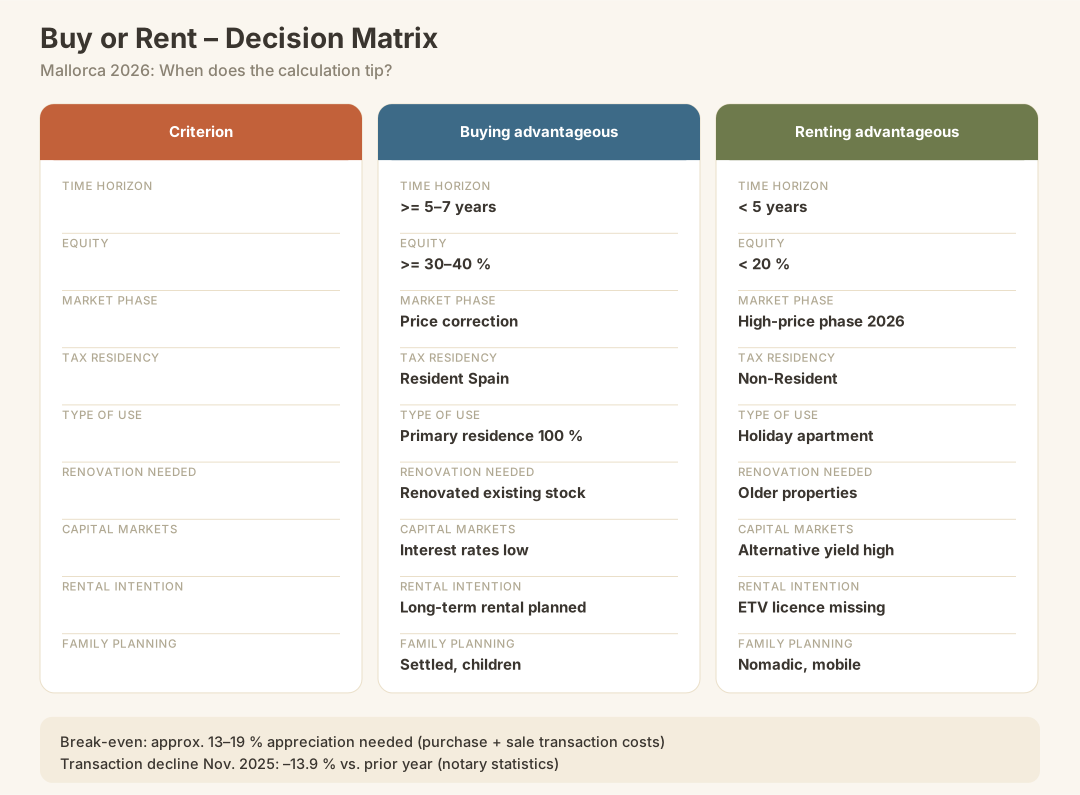
Buy-or-Rent Matrix Mallorca 2026
| Criterion | Buying advantageous | Renting advantageous |
|---|---|---|
| Time horizon | ≥ 5–7 years planned stay | < 5 years, uncertain planning |
| Equity | ≥ 30–40 % of the purchase price available | Equity below 20 % |
| Market phase | Price correction / buyer's market | High-price phase as currently in 2026 |
| Tax residency | Resident in Spain (IRPF advantages, exemptions) | Non-resident or short period of stay |
| Type of use | Primary residence with 100 % owner-occupation | Holiday home with low utilisation |
| Renovation requirement | Refurbished existing property or new build | Older properties with unknown condition |
| Capital market alternative | Interest rate environment makes bonds unattractive | Alternative yield > property yield |
| Letting intention | Long-term letting planned | ETV licence not available |
| Family planning | Settled lifestyle, children, schools | Nomadic lifestyle, professional mobility |
Break-even framework (simplified)
The central question is: from what point does the increase in the property's value exceed the one-off transaction costs (purchase + subsequent sale)?
At 10–14 % purchase ancillary costs and again approx. 3–5 % purchasing transaction costs (agent fees, taxes) — you need a total appreciation of around 13–19 % just to cover these transaction costs — before you make a single euro of profit.
Assuming a moderate rate of appreciation of 4–5 % p.a. (as has been demonstrable for properties in recent years), this break-even point would theoretically be reached after approx. 3–4 years. However: these are asking prices, not guaranteed sale prices. Anyone who buys during a peak pricing phase and is forced to sell in the short term may incur a loss.
Please note: This simplified calculation does not account for financing costs (mortgage interest), ongoing ownership costs, or individual tax circumstances. An individual calculation is essential for any well-founded decision.
Financing: what a mortgage really costs
Anyone who does not purchase entirely with equity must factor financing costs into their calculations. In Spain, non-residents can generally finance up to 60–70 % of the purchase price, and residents up to 80 %.
The precise terms depend on the interest rate environment, the bank, creditworthiness, and residency status. You can find details on financing in the guides Property Financing Mallorca and Fixed vs. Variable Rate Mortgage.
Important for the buy-or-rent calculation: With mortgage financing, you are exposed to interest rate risk (if variable). In addition, the monthly repayment ties up liquidity that could alternatively be invested or used to pay rent — the classic opportunity cost comparison.
Rule of thumb: mortgage repayment vs. rent
If the monthly mortgage repayment (including principal repayment) plus the ongoing ownership costs (IBI, service charges, maintenance, proportionate share) are significantly higher than a comparable rental, this initially points towards renting — unless the difference is more than offset by the expected accumulation of capital and property appreciation.
At current price levels on Mallorca, this threshold has been reached or exceeded in many locations.
The tax dimension: what distinguishes residents from non-residents
The tax treatment is an often-underestimated factor in the buy-or-rent decision.
Tax comparison for purchasing: resident vs. non-resident
| Tax aspect | Tax resident in Spain | Non-resident |
|---|---|---|
| ITP on purchase | Same | Same |
| Ongoing IRPF imputed income (imputación) | Does not apply to primary residence | 1.1–2 % of the cadastral value as notional income |
| Capital gain on sale (IRPF) | 19–28 %; exemption for primary residence + reinvestment possible | 19 % IRNR; no primary residence exemption |
| Wealth tax (Patrimonio) | From certain tax-free allowances | Applies from the first euro (lower personal allowances) |
| Plus-Valía Municipal | Paid by the seller | Paid by the seller |
Details on the IRPF exemption on the sale of a primary residence (reinvestment in a new primary residence, age-related exemption, etc.): IRPF exemption on primary residence sale.
Anyone who purchases as a non-resident and does not let the property pays an annual notional income tax on a proportion of the cadastral value – a genuine ongoing cost factor that does not arise when renting.
Holiday letting as a yield booster? The reality in 2026
Many buyers factor in holiday rental income to justify their purchase decision. Particular caution is warranted here in 2026:
The Balearic Government has sharply restricted the issue of new ETV licences (Licencias de Estancia Turística en Viviendas). New licences for flats in multi-family buildings are no longer available across large parts of Mallorca. Existing licences retain their value – which is pushing the price of licensed properties even higher.
Please note: Anyone who factors holiday rental income into their purchase calculations must check before signing the purchase contract whether the property holds a valid ETV licence or whether a new one can be applied for. Buying without a secured licence while counting on holiday rental income represents a considerable financial risk. Details: ETV licence Mallorca. The legislature stipulates fines of at least 20.001 € for letting without the appropriate licence.
The long-term rental option, on the other hand, remains available – with the advantage that residents in Spain can claim an IRPF deduction on net rental income for long-term let properties. The exact level of this deduction is governed by law and should be reviewed with a tax adviser. More on this: IRPF deduction landlords Balearen.
Yield expectations compared (indicative figures)
| Rental type | Gross rental yield (indicative) | Effort / Risk |
|---|---|---|
| Long-term rental | typically 3–5 % p.a. | Low; note tenant protection rules |
| Seasonal rental (3–11 months) | higher depending on location | Medium; no tourism legislation applies |
| Holiday rental with ETV licence | potentially higher | High; licence is a prerequisite |
These figures are indicative values drawn from market reports; individual results may vary considerably.
Specific buyer groups: who should decide what?
First-time buyers / primary residence buyers
If you want to live in Mallorca and register your primary residence, there may be tax advantages: depending on the applicable rules, reduced ITP rates for the first purchase of a primary residence as well as state guarantee schemes for young buyers (Hipoteca Joven Mallorca), and potentially a full exemption from capital gains tax on a future sale with reinvestment. More: Buying your first property.
Investors / second-home buyers
Here the calculation is more clear-eyed. Without an ETV licence, returns are capped at long-term rental levels. The purchase decision must then be based primarily on the expected capital appreciation and personal benefit. For those thinking mainly as investors: Investing in Mallorca and Yield Mallorca 2026.
German buyers / EU nationals
Around 30 % of all purchases on Mallorca are made by foreigners, with Germans among the largest buyer groups. Important: non-EU citizens require investment approval for purchases above certain thresholds. For Germans, this does not apply. However, the AWV reporting obligation when transferring money to Spain must be observed.
Retirees / pension-age buyers
Those who buy at retirement age and regard the property as a pension provision benefit, under certain conditions, from the IRPF exemption on sale for persons over 65. However: liquidity is tied up. Inheritance planning (Inheritance & gift tax Balearic Islands) and the Pacto Sucesorio should be considered at an early stage.
Most common mistakes when deciding whether to buy or rent
Underestimating purchase ancillary costs: 10–14 % on top are regularly forgotten or played down. These costs are gone – regardless of what the property does afterwards.
Calculating too short a time horizon: Anyone who has to sell after 2–3 years almost always loses – transaction costs eat up any appreciation in value.
Failing to check the ETV licence situation: Buying on the assumption that letting is possible without prior licence verification. The severely restricted issue of licences makes this a genuine pitfall.
Not factoring in ongoing costs: IBI, community charges, maintenance, and insurance can amount to considerable sums per year depending on the property – and are often left out when comparing with renting.
Ignoring tax residency: Non-residents are subject to an annual notional income tax on the property, which does not apply when renting.
Equating the asking price with market value: In a market phase with declining transaction numbers (–13,9 % in Nov. 2025) there is room to negotiate. Anyone who pays the asking price without negotiating is giving away margin.
No prior legal assessment: Hidden charges in the Grundbuch, illegal extensions (Schwarzbau Mallorca) or unresolved planning status (Finca Suelo Rústico) can turn the purchase into a costly trap.
What comes next? Looking ahead to resale
Buying a property on Mallorca and selling it again later is a complete cycle – and you should factor it in from the very beginning.
When selling, the following costs arise:
- Capital gains tax (IRPF for residents, IRNR for non-residents): typically 19–28 % on the profit
- Plus-Valía Municipal (municipal land value increment tax)
- Estate agent commission (typically 3–6 % of the sale price)
More: Taxes on property sales in Spain and Selling property on Mallorca.
The IRPF exemption for the primary residence (reinvestment or age > 65) can significantly reduce the tax burden on sale – a substantial advantage that should be factored into the long-term cost calculation when buying: IRPF exemption primary residence sale.
Checklist: Are you ready to buy?
Go through these points before making a decision:
- Equity: At least 30–40 % of the purchase price available in liquid funds (including ancillary costs)?
- Time horizon: Planning to stay on Mallorca for at least 5–7 years?
- Tax residency: Residency status clarified and tax implications assessed?
- Licence situation: If intending to let: ETV licence in place, or long-term rental as an alternative strategy?
- Legal due diligence: Land registry, planning status, outstanding debts checked?
- Ongoing costs: IBI, community charges, insurance, and maintenance specifically calculated?
- Notary appointment prepared: NIE number, Spanish bank account, if applicable a notarial power of attorney for remote purchases?
- Mortgage (if required): Financing offer obtained, type of interest rate decided?
- Comparison: At least three comparable rental properties drawn up as an alternative calculation?
- Tax adviser / solicitor: Engaged a legal expert based in Mallorca?
Conclusion: Buy or rent – what makes sense in 2026?
There is no universal answer – but there are clear patterns. Buying makes sense in Mallorca if you have a long time horizon, bring sufficient equity, are becoming (or already are) a tax resident in Spain, and the ongoing costs fit your budget. Particularly for primary-residence buyers with the intention to reinvest, purchasing is often the better long-term decision – the potential exemption from capital gains tax on sale is an argument that has no equivalent on the rental side.
Renting is the smarter choice if you are staying for fewer than five years, are unsure how your life will develop, lack the equity, or would have to buy during a high-price phase and would rather wait for a market correction. The current declines in transaction figures (–13.9 % in November 2025) suggest: the market could be taking a breather. This is not a crash forecast, but patience can pay off.
In the current market phase of 2026 – historically high prices, falling transactions, limited ETV licence availability – the quality of individual decision-making preparation is more important than ever. The matrix helps you structure your thinking; the right conclusion comes from an experienced adviser who knows your specific situation.
📩 Submit a personal enquiry — We will help you work out your individual buy-or-rent calculation.
Official sources
- Agencia Tributaria (AEAT) – IRPF, IRNR, capital gains tax: https://www.agenciatributaria.es
- ATIB – Agència Tributària de les Illes Balears (ITP, AJD, Balearic Islands): https://www.atib.es
- Spanish notarial statistics (Consejo General del Notariado): https://www.notariado.org
- Govern de les Illes Balears – Tourism and ETV licences: https://www.caib.es
- Registradores de España – Land Registry and property statistics: https://www.registradores.org
- Boletín Oficial del Estado (BOE) – National legislation: https://www.boe.es
- BOIB – Boletí Oficial de les Illes Balears (Balearic legal regulations): https://www.boib.caib.es