
Mallorca Real Estate Investment: Market, Top Locations & Value Growth 2026
Anyone thinking today about the Mallorca real estate investment market will find a market that has undergone structural change: no more post-pandemic boom, but stable growth at historically high levels. The market study by the Steinbeis Transfer Institute Center for Real Estate Studies (CRES) — conducted twelve times in succession, with around 5,293 properties evaluated and approximately 95% market coverage — points to an island-wide price increase of 9.8% for 2026, reaching an average of €7,370 per square metre. At the same time, the market is becoming more selective: affordable entry-level locations are shrinking, luxury properties are growing and now account for 4% of total supply. In this guide, you'll find out where the strongest value drivers lie, which locations suit which investment strategy, which regulatory pitfalls you need to be aware of — and what you should do before you sign.

Want to know whether your desired property truly stacks up as an investment — or whether you're about to buy an expensive trap?
- 📩 Submit a personal enquiry — We analyse the location, yield type and legal risks of your property
- All purchase ancillary costs at a glance
The Mallorca property market in 2026: an overview
The Mallorca market has left the post-pandemic phase behind and has evolved into a mature market with low volatility. Transaction figures are moving close to the ten-year average of around 10,500 purchases per year; in 2025, according to available data, they were approximately 6.5% above 2024 and around 3% above the long-term average. A short-term decline in certain months (notary data for November 2025 showed a drop in residential property transactions in the Balearic Islands of 13.9% year-on-year) indicates that high prices are increasingly running into financing constraints — but does not signal a structural reversal of the trend.
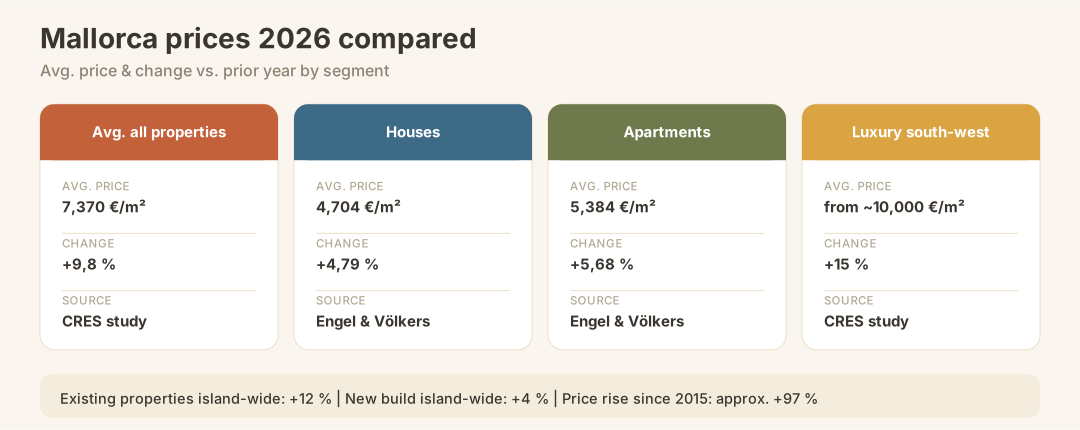
Price trends at a glance
| Segment | Avg. price 2026 | Change vs. 2025 |
|---|---|---|
| Avg. all properties (CRES study) | €7,370/m² | +9.8% |
| Houses (Engel & Völkers) | €4,704/m² | +4.79% |
| Apartments (Engel & Völkers) | €5,384/m² | +5.68% |
| South-west Mallorca (premium) | ~€10,000/m² | Luxury segment +84% increase in supply |
| Palma apartments (market range) | €5,000–10,000/m² | – |
Please note: Different studies use different data sets. The CRES study captures listing prices from twelve property companies and covers regions with a strong tourism presence. Engel & Völkers data is based on listing prices across all property portals. Both are measuring the same phenomenon from different angles.
The long-term upward trend remains intact: since 2015, prices per square metre in Mallorca have risen by around 97%. Over five years, prices across the Balearic Islands as a whole have increased by approximately 55%.
Top Investment Locations for 2026 Compared
Not every location on Mallorca suits every investment strategy. The table below shows where the strongest demand, greatest potential, and most stable markets are to be found – based on verified sources.
| Location | Strengths as an Investment | Typical Buyer Profile | Special Feature |
|---|---|---|---|
| Son Vida (Palma) | Ultra-premium, stable liquidity, high degree of privacy | High-net-worth, international | Most limited supply on the island |
| Port Andratx / Andratx | Waterfront/sea-view setting, very little new build land available | Germans, British, Scandinavians | Andratx borders ANEI – check planning permission |
| Bendinat | Direct Palma connections, established luxury neighbourhood | Families, year-round residents | High owner-occupier rate |
| Pollença / Port de Pollença | Strong long-term rental demand, Nordic buyers | Year-round living + rental | Sustainable growth without hype |
| Palma (Old Town & well-connected neighbourhoods) | Greatest liquidity, strongest rental demand hub | Diverse international buyers | Zonas Tensionadas possible – check tenancy law |
| Calvià / Santa Ponsa | Year-round suitability, international school provision | Families, expats | Infrastructure for year-round letting |
| Santanyí / South-east | Supply increase +24%, catch-up potential | Island connoisseurs, budget-conscious buyers | Less liquid than the north-west/south-west |
| North-east (general) | Supply increase +21%, more affordable entry prices | Budget-conscious investors | Seasonally dependent market |
Note: The areas of Andratx, Tramuntana, and many coastal strips are subject to strict planning and environmental protection regulations. Before purchasing, be sure to check the Ley de Costas, the ANEI status (protected natural land) and the Tramuntana building regulations.
Which investment strategy suits you?
Capital preservation and appreciation (Buy & Hold)
The combination of limited building land, regulated new construction, and persistently high international demand makes Mallorca one of the most stable capital preservation markets in the Mediterranean region. Significant price corrections have historically been absent; the gain since 2015 amounts to around 97%. This approach is particularly well suited to premium locations that hold their value independently of rental regulation.
Renovation and value enhancement (Value-Add)
The CRES study shows: existing properties have become around 12% more expensive in 2026, whilst new builds increased by only 4% — even though new builds cost on average around 24% more than existing properties. This means the market rewards high-quality renovated period properties with a premium. Renovation projects featuring natural materials, energy-efficient fittings, and Mediterranean aesthetic standards are considered the properties with the strongest return expectations.
Bear in mind the regulatory framework: unauthorised constructions and illegal extensions are commonplace on Mallorca. Check every renovation property for illegal extensions and clarify legalisation potential in advance. Full renovations require, depending on the scope of work, a building permit.
Long-term letting (Yield)
With the near-complete halt on holiday letting licences, many investors are deliberately shifting towards long-term letting. Demand is particularly strong in Palma, Calvià, Marratxí, Pollença, Sa Pobla, and Inca. New builds and fully renovated properties achieve the highest rents there. Important: under Balearic housing policy, rent caps apply in certain areas (Zonas Tensionadas) – check whether your target property is affected.
Supply and Demand: The Structural Drivers
Why Supply Remains Permanently Scarce
Mallorca's price stability is fed by three factors that cannot change in the short term:
- Protected Land: Large portions of the island are under nature protection (ANEI, Tramuntana World Heritage, Ley de Costas protection zones). New building plots are effectively scarce.
- Strict Development Planning: Municipalities and the Balearic regional government have further restricted new-build permits through tightened regulations.
- Holiday Rental Licence Freeze: A far-reaching freeze on new ETV licences (tourist rental licences) is in force. Properties with existing licences are gaining considerably in value as a result. More on this in the guideETV-Lizenz Mallorca.
What Is Driving Demand
- Around one third of all buyers (approx. 34 % in 2025) are international, predominantly: Germans, Britons, Swiss, Scandinavians
- Growing markets: buyers from the USA, the Middle East and Eastern Europe
- Trend towards year-round living: more buyers are looking for primary residences rather than pure holiday properties; demand for larger floor plans, home offices and energy efficiency is rising
- New-build share: new-build activity rose by around 34 % in 2025 – from an absolutely low base, given the shortage of building land
Prices by Property Type and Region
| Property Type / Region | Price Range (approx.) | Source / Basis |
|---|---|---|
| Palma Apartments | 5.000–10.000 €/m² | Palma Markets 2026 |
| Luxury Villas South-West (Port Andratx, Son Vida) | from ~10.000 €/m², properties >5 Mio. € | CRES-Studie, Marcel Remus RE |
| Existing properties island-wide | Ø +12 % price increase 2026 | CRES/Porta Mallorquina |
| New-build island-wide | Avg. +4% price increase in 2026, approx. +24% vs. existing stock | CRES/Porta Mallorquina |
| South-east (Santanyí region) | Supply increase +24%, catch-up potential | CRES/Porta Mallorquina |
| North-east | Supply increase +21%, more affordable entry prices | CRES/Porta Mallorquina |
| Sea-view properties | ~2% of total supply, sharply reduced availability | CRES/Porta Mallorquina |
| Premium pool properties | ~2% of total supply | CRES/Porta Mallorquina |
| Affordable entry-level properties | Share fallen to around 6% of supply (-16%) | CRES/Porta Mallorquina |
Costs and taxes: what you need to budget for as an investor
The investment doesn't end at the purchase price. As a foreign buyer of a property in Mallorca, you will incur substantial ancillary and ongoing costs. Factor these into your return calculations from the outset.
One-off purchase ancillary costs
| Cost item | Order of magnitude |
|---|---|
| Property transfer tax (ITP) on existing properties | Progressive based on purchase price (Balearic rates, tiered) |
| VAT (IVA) on new builds | 10% of the purchase price |
| Notary fees | Dependent on purchase price |
| Land registry entry | Dependent on purchase price |
| Solicitor (recommended) | Typically approx. 1% of the purchase price, plus VAT |
| NIE number, dealings with authorities | Minimal, but obligatory |
Detailed breakdowns and current Balearic ITP rates can be found in the guidePurchasing costs Mallorca.
Please note: When transferring the purchase price from abroad, the AWV reporting obligation applies. Above certain amounts, the transaction must be reported. Details:AWV reporting obligation when purchasing property in Spain.
Ongoing tax and cost items
| Item | Explanation | Guide |
|---|---|---|
| IBI (property tax) | Annual municipal tax based on the cadastral value | IBI tax Spain |
| Wealth tax (Patrimonio) | Annual, progressive, applies to non-residents and residents | Wealth tax Spain |
| Income tax for non-residents (IRNR) | On deemed rental income or actual rental income | Taxes & legal |
| Comunidad de Propietarios | Ongoing community charges for owners' associations | Eigentümergemeinschaft Spanien |
| Insurance | Buildings and contents insurance | Home contents insurance Spain |
Upon a later sale, Plusvalía Municipal (the municipal capital gains tax) will also be payable, as well as, where applicable, Spanish income tax on the gain from the sale. More on this:Taxes on property sales in Spain.
Legal Due Diligence Requirements Before Purchase
Buying a property on Mallorca is complex. These steps are not optional – they determine whether the purchase is legally secure.
Step by Step: Legal Due Diligence
- Apply for a NIE Number – no purchase is possible without a Número de Identificación de Extranjero. Apply at the consulate or in person on the island.
- Check the Land Registry (Registro de la Propiedad) – encumbrances, mortgages, easements, owner identity. Guide: Checking the Spanish Land Registry.
- Check the Cadastre and Planning Permissions – verify consistency between the land registry, cadastre, and the actual physical condition of the property. Identify unauthorised constructions and illegal extensions.
- Clarify the Urban Planning Status – Suelo urbano, suelo rústico, or ANEI? Special rules apply to fincas in rural land: Finca Suelo Rústico.
- Check Coastal Protection Regulations – Is the property located within a protected zone under the Ley de Costas? Ley de Costas Mallorca.
- Obtain an Energy Certificate – Mandatory upon sale. Energy Certificate Spain.
- Reservation Contract and Deposit – Legally binding; review the terms and withdrawal clauses carefully. Reservation Contract Spain.
- Notary Appointment – The notary certifies the deed but does not act exclusively in either party's interest. Having your own solicitor is essential. Property Purchase Solicitor Spain.
Please note: If you are unable to be present in person, a notarially certified power of attorney is the appropriate solution. Power of Attorney Spain Notary.
Regulatory Environment 2026: What Investors Need to Know
Holiday Letting (ETV): A Restricted Market
A sweeping moratorium on new tourist rental licences (ETV) is in force across the Balearic Islands. Buying a property with an active ETV licence means acquiring a rare and valuable asset advantage. The transferability of ETV licences is subject to strict conditions – examine this carefully before signing any contract.Transferring an ETV licence.
Long-term rentals: Growing regulation
The Balearic housing law and national rental regulations can trigger rent caps in certain zones. Zonas Tensionadas can significantly affect rental yields.Zonas Tensionadas Mallorca.
The so-called 11-month tenancy agreement is a commonly used arrangement on Mallorca – with its own distinct legal consequences.11-month tenancy agreement Spain.
Buying property through a Spanish S.L.
For larger portfolios or tax optimisation purposes, some investors purchase through a Spanish company (Sociedad Limitada). This is perfectly possible in principle, but carries significant tax and legal implications.Buying property via an SL.
Exit tax
Anyone who gives up their German tax residence after investing in Mallorca should keep the exit tax in mind.Exit tax Spain.
The most common mistakes when investing in property on Mallorca
Based on practical experience, the following mistakes can be identified as recurring ones that frequently prove costly:
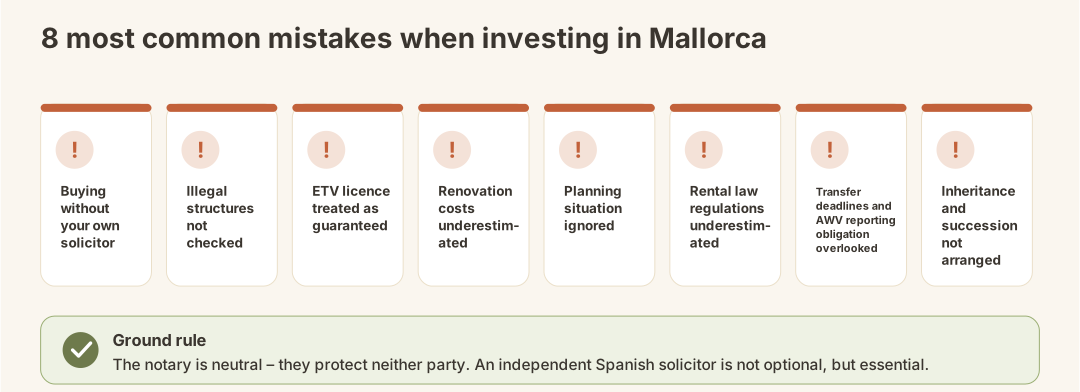
- Buying without your own lawyer: The notary is neutral – they do not protect either party. An independent Spanish solicitor is not optional; it is essential.
- Unauthorised structures not checked: Particularly with older fincas and existing properties, unlicensed extensions are common. They can neither be sold nor rented out.Identifying illegal extensions.
- ETV licence treated as guaranteed: Without written confirmation of transferability prior to the notary appointment, the value of the licence is not secured.
- Renovation costs underestimated: Mallorca tradespeople are fully booked and materials prices are high. Budget generously.Full renovation Mallorca costs.
- Planning status ignored: Suelo rústico carries different building rights from suelo urbano – in some cases, construction is not permitted at all, or only with special dispensation.
- Rental law regulation underestimated: Zonas Tensionadas can trigger rent caps and curtail yield expectations.
- Transfer deadlines and AWV reporting obligations overlooked: Large money transfers from Germany to Spain are subject to reporting requirements. Transferring money to Spain.
- Inheritance and succession not arranged: Spanish inheritance law and Balearic particularities can make succession costly. Inheritance & gift tax Balearic Islands.
What comes next? Administration and ongoing obligations
A purchase is the beginning, not the end. Good investments are actively managed.
- Property management: For non-residents or buyers without an on-site presence, professional property management is essential. Property management Mallorca holiday property.
- Long-term letting: Steady income without a holiday rental licence, but subject to tenancy law regulations. Long-term rental Mallorca.
- Sale: Anyone selling later should factor in Plusvalía, IRNR withholding (for non-residents: typically 3% of the purchase price, withheld by the buyer) and capital gains tax. Selling property Mallorca.
- Energy refurbishment and photovoltaics: Anyone seeking to protect long-term value invests in energy efficiency. Registering photovoltaics Mallorca, Refurbishment grants Mallorca.
- Mortgage: Non-residents can also take out mortgages, though typically with a lower loan-to-value ratio than residents. Mortgage Mallorca.
Checklist: Before signing
- NIE number applied for and in hand
- Independent Spanish solicitor instructed
- Land registry checked (encumbrances, mortgages, ownership)
- Cadastre–land registry reconciliation carried out
- Planning situation checked (Suelo, protected zone, building rights)
- Building permits for all parts of the structure in place or legalisation status clarified
- Ley de Costas zone checked (if near the coast)
- ETV licence status and transferability confirmed in writing (if relevant)
- Energy performance certificate in place
- Reservation contract signed with clear withdrawal clauses
- Purchase ancillary costs included in the financing calculation
- AWV reporting obligation checked
- Inheritance and succession planning initiated
- Property management or after-purchase care arranged
Conclusion
The Mallorca property market in 2026 is no longer an insider tip — it is a mature, internationally established premium market with stable structural growth drivers. Average prices of around €7,370 per m², a rise of around 97% since 2015, and a persistently tight supply speak for themselves. Those who invest are buying into a market that is becoming ever more complex in regulatory terms: the ETV licence freeze, potential rent controls, strict planning law, coastal protection rules, and the risks posed by illegal construction all demand genuine due diligence.
The strongest investment arguments remain: limited building land, high international demand, tax planning opportunities (particularly through the right ownership structure), and — with the right location and property choice — excellent capital value growth. Anyone who buys without their own solicitor, without due diligence, and without a clear strategy risks costly trouble. Those who buy prepared are acquiring one of the most stable stores of value in the European property market.
Official Sources
- Steinbeis Transfer Institute / Center for Real Estate Studies (CRES): Market study "Holiday Property Market in Mallorca 2026", carried out on behalf of Porta Mallorquina, published March 2026 — https://www.portamallorquina.com/blog/mallorca-real-estate-market-study-2026
- Engel & Völkers – Mallorca Property Prices 2026: Listing price survey, updated June 2026 — https://www.engelvoelkers.com/es/de/immobilienpreise/balearische-inseln/mallorca
- Govern de les Illes Balears – ETV Licence Regulations: https://www.caib.es
- Agencia Tributaria de les Illes Balears (ATIB) – ITP Rates Balearic Islands: https://www.atib.es
- Notariado.org – Statistical portal data from Spanish notaries: https://www.notariado.org/liferay/web/cien/sala-de-prensa/noticias/detalle
- Registro de la Propiedad (Land Registry Spain): https://www.registradores.org
- Boletín Oficial del Estado (BOE) – Ley de Costas and environmental law: https://www.boe.es