
Sa Pobla, Mallorca: Travel Guide to the Town and Local Life

Places to stay in Sa Pobla
AdTo load the accommodation map by our partner Stay22, we need your consent for marketing cookies. Your consent applies to all marketing content on mallorca.com.
Sa Pobla lies in northern Mallorca between the island’s central plain, the Bay of Alcúdia and the foothills of the Serra de Tramuntana. The town is not a traditional holiday resort but a lively rural town whose rhythm is still shaped by fields, trade, gastronomy and a strong sense of community. Potatoes, rice and the wetlands of sa Marjal are not tourist motifs here but part of the local economy and identity.
For visitors, Sa Pobla is particularly worthwhile as a contrast to seafront promenades and picture-perfect mountain villages. Around the Plaça Major, you will find the parish church, traditional houses, bars and the Can Planes museum. The weekly market, major festivals and gastronomic events noticeably transform the atmosphere in the centre and provide the best opportunities to experience the town in full swing.
Sa Pobla also has a distinct value as a place to live. Grocery shops, supermarkets, restaurants, workshops, construction and repair businesses, as well as other everyday services, cater not only to seasonal visitors. Its location between Inca, Alcúdia, Pollença and the north coast provides a good base for work, daily life and leisure.
Sa Pobla suits travellers who do not confuse local culture with scenery, as well as people looking for a year-round town in the north. Those primarily expecting sea views, a beachfront promenade or a dense programme of monumental sights will find more choice elsewhere. Those who want to understand agriculture, food, festivals and everyday Mallorcan life, however, will gain an unusually clear insight here.
History of Sa Pobla
The official founding of Sa Pobla dates back to 1300 and the reign of Jaume II. The town’s roots therefore lie in the medieval reorganisation of Mallorca after the Catalan conquest. An agricultural settlement developed into a local centre for the fertile plains in the north of the island. Even today, this heritage is reflected less in individual ruins than in the town’s layout, its central square and the close relationship between the town and its fields.
The parish church of Sant Antoni Abat was built over a long period between the 14th and 17th centuries. The town’s most important festival also has a long history: the Sant Antoni celebrations have been documented since 1365. Religious rites, animal blessings, fire, singing and appearances by the dimonis have been linked across generations. The festival is therefore not merely an event on the calendar but a living part of Sa Pobla’s historical memory.
Agriculture and sa Marjal
Agriculture in sa Marjal, the plain extending towards the wetlands of s’Albufera, was crucial to the town’s development. The soil and available water resources made the surrounding area an important farming region. Sa Pobla is particularly closely associated with potatoes, some of which are exported to European countries. Traditional arroz pobler has also been cultivated more extensively again and embraced by local chefs.
Agriculture shapes more than the surrounding countryside. It explains the importance of the market, the hearty local cuisine, the early-morning life in the bars and the position of farmers in festival traditions. Even modern events such as the nighttime potato fair are not based on an arbitrary regional product but on an industry that sustained the town for a long time.
From farming settlement to rural town
Today, Sa Pobla is neither an open-air museum nor a purely agricultural community. A compact rural town with shops, restaurants, workshops and specialist businesses developed around the historic centre. Agriculture remains visible, but it stands alongside construction, repairs, logistics and services. This development explains why the town does not shrink to a minimal tourist function in winter.
Its historical heritage is also presented in a contemporary way. Can Planes uses an old manor house to display modern and folk art and also explores the dimonis. History therefore appears not only in church architecture but also in masks, festival figures, local stories and changing exhibitions.
Things to See in Sa Pobla
Sa Pobla is best explored on foot around the Plaça Major. Its sights do not stand side by side as isolated monuments but form part of the actively used town centre. The church, town hall area, market streets, cafés and traditional façades create a walking route in which everyday life is as important as the individual buildings.
Església de Sant Antoni Abat
The parish church of Sant Antoni Abat is Sa Pobla’s most important historic building. Its construction history, spanning several centuries, links medieval origins with later extensions. The church interior is the town’s religious focal point and plays a central role during the Sant Antoni celebrations, particularly at Completas on the eve of the feast day.
Even outside the festival period, the church’s location in the centre is worth noting. It does not stand in isolation but opens onto the urban life around the Plaça Major. First-time visitors to Sa Pobla should begin their walk here and then explore the adjoining streets.
Plaça Major
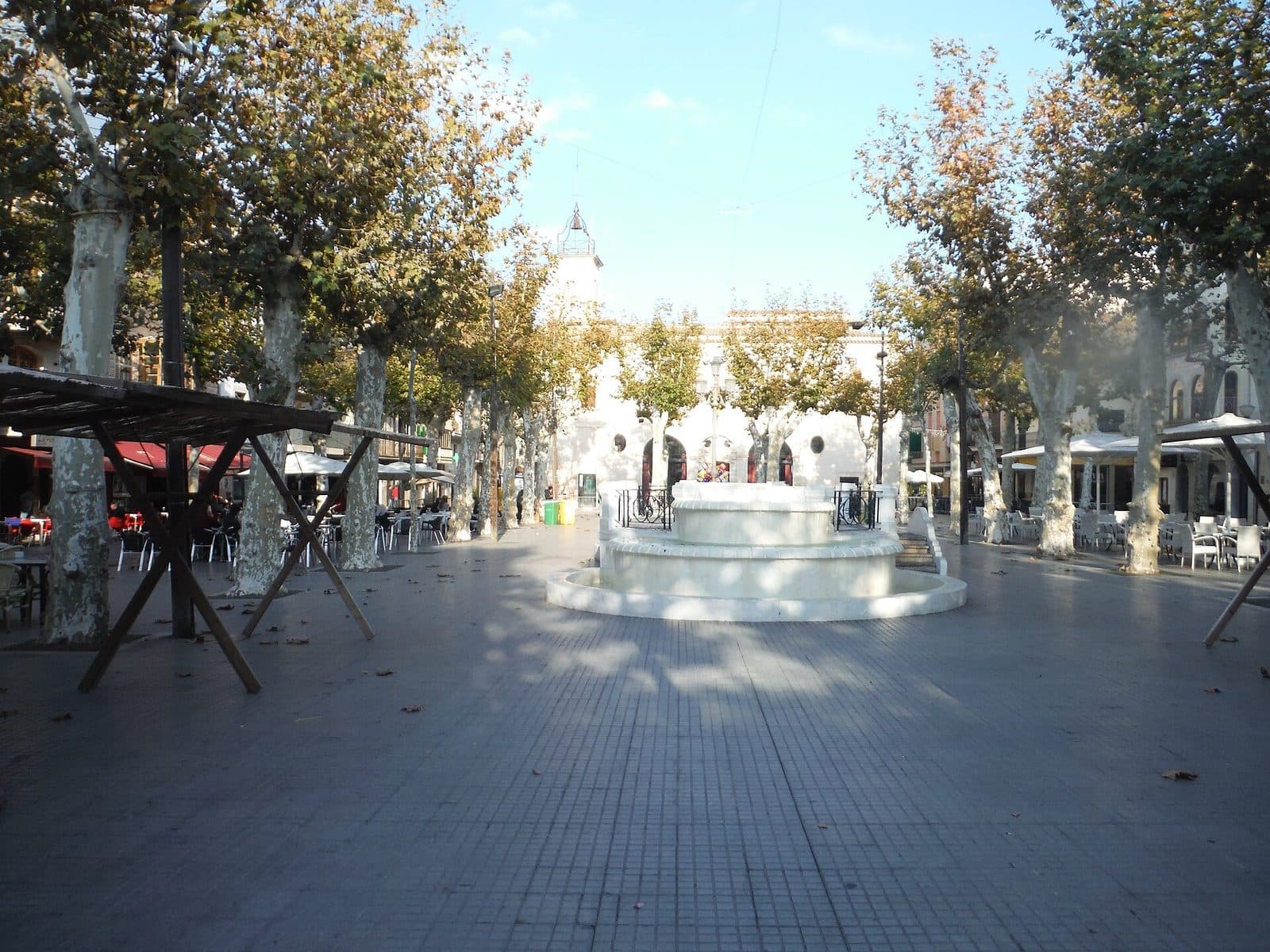
The Plaça Major is the social heart of Sa Pobla. In the morning, farmers and other residents sit here over breakfast; later, shopping, conversations and the terraces of the bars define the square. During the weekly market, the potato fair, the jazz festival and the Sant Antoni celebrations, it becomes the town’s main stage.
The square is therefore interesting less for any single façade than for its changing uses. On an ordinary weekday, it conveys the rhythm of a northern Mallorcan rural town; during major events, it becomes a densely packed festival venue. This contrast is one of the strongest impressions Sa Pobla offers.
Museu Can Planes
Can Planes is housed in a historic manor house and combines the building’s architecture with modern and folk art. Changing exhibitions look beyond the town’s history without losing their local connection. The museum is therefore the main cultural destination for visitors who want to discover more of Sa Pobla than its church and agriculture.
Its collection relating to the dimonis of Sa Pobla is particularly distinctive. The demon figures are central participants in the Sant Antoni festival and are removed here from the fleeting context of the celebrations. Masks, figures and visual representations help visitors understand a tradition that can easily seem overwhelming to outsiders during the loud and crowded festival night.
Historic town centre
The streets around the church and main square retain traditional townhouses and a compact, small-scale layout. Sa Pobla does not, however, have a completely museum-like old town. Modern shops, bars, homes and service businesses stand between older façades, making the walk less uniform but more closely connected to everyday life.
The transition from the square into Carrer Mercat and onwards towards Plaça del Mercat is particularly revealing. It shows how trade and public space shape the town centre. On market days, this area becomes a continuous pedestrian and sales zone; outside those times, it is quieter and allows a closer look at the houses and shopfronts.
Sa Marjal
The plain of sa Marjal is not a traditional viewpoint but the cultural landscape from which Sa Pobla derives a substantial part of its identity. Fields and agricultural tracks extend towards s’Albufera. Different stages of cultivation are visible depending on the season, while the Tramuntana mountains frame the flat landscape on the horizon.
A detour into the farmland often explains the town better than another walk through the centre. Here, the close physical relationship between agriculture and wetlands, as well as the importance of potato and rice cultivation, becomes immediately clear. Agricultural traffic should be expected on the narrower tracks; these are working routes, not exclusively tourist paths.
Sights in Sa Pobla
The Weekly Market
The weekly market is concentrated in the centre and links the Plaça Major with the Plaça del Mercat. Stalls also extend along Carrer Mercat, turning several streets and squares into one continuous market area. For a first visit, this is the liveliest opportunity to experience Sa Pobla simultaneously as a trading centre, meeting place and agricultural town.
Fruit, vegetables and produce from the surrounding area play an important role in the food section. Local farmers offer products from the fields around Sa Pobla, while the wider range includes organic produce, plants, flowers and other everyday goods. Clothing, accessories and gifts make the market broader than a farmers’ market alone. Livestock is also offered in some sections, underlining its rural character.
Residents of Sa Pobla and the surrounding towns use the market for their regular shopping. Visitors should therefore not regard it merely as a photo opportunity. The close relationship between the town and its farming area is particularly visible at the vegetable stalls. The bars around the main square are part of the market experience: shopping, breakfast and conversation flow into one another.
Orientation in the centre changes on market day. Streets normally used by regular local traffic become part of the sales area, and the squares are considerably busier. Those wishing to see the church, Can Planes and the façades in peace should combine their market visit with a later walk or return on another day. Those primarily seeking atmosphere should spend the morning in the centre and allow enough time for breakfast or a snack.
Food and Drink
Sa Pobla’s cuisine is closely linked to work in the fields and the produce of sa Marjal. Potatoes and arroz pobler are the best-known ingredients, but equally important is the local habit of starting the day with savoury food in the bars around the Plaça Major. Food here is not merely evening entertainment for visitors but part of working and community life.
Highlighting individual restaurants by name would quickly become outdated. The dishes and eating habits that recur at festivals, on menus and at bar counters have greater staying power. Anyone wishing to understand Sa Pobla through its food should therefore look less for internationally known establishments and more for variat, espinagada, potato dishes and preparations using local rice.
Variat mallorquí
Variat is a mixed plate of different Mallorcan bar dishes. Its exact composition may vary, and that is precisely part of its character. Several savoury preparations are not served as strictly separate courses but eaten together. In Sa Pobla, variat is particularly associated with breakfast and early visits to the bars around the main square.
For visitors, it is a good introduction to local bar culture because it combines several flavours on one plate. At the same time, it should not be understood as a tasting platter specifically arranged for travellers. Variat is an established, practical meal and represents a food culture in which a hearty breakfast and social gatherings are closely connected.
Espinagada
Espinagada is particularly associated with the Sant Antoni celebrations. It is eaten with wine during the festival, when neighbours and groups of friends gather around the foguerons. It therefore belongs both to the cuisine and to the social rhythm of the festival.
Its significance is best understood in connection with fires, singing and communal eating, rather than as an isolated speciality on an arbitrary menu.
Potatoes from Sa Pobla
The potato is the town’s best-known agricultural product and is exported to markets across Europe. In local cuisine, it appears both in familiar, rustic preparations and in more creative dishes. Its special status becomes apparent during the Fira Nocturna de la Patata, when bars and restaurants on the Plaça Major serve sweet and savoury variations.
The fair demonstrates that the potato is not marketed merely as a symbol in Sa Pobla. It links agriculture, trade and gastronomy. For visitors interested in food, the event in June is therefore one of the most revealing dates of the year: many local businesses work with the same basic product at the same time and demonstrate how differently it can be used.
Arroz pobler
Arroz pobler reflects rice cultivation on the wet plains around Sa Pobla. After traditional cultivation had declined in importance, some farmers revived it. Local chefs value the rice as a regional ingredient directly connected with sa Marjal and the proximity of s’Albufera.
Dishes made with arroz pobler therefore tell a different story from that of the better-known potato. They lead back to the waterscape and older forms of cultivation. Anyone who finds it on a menu gains more than a local variation of a rice dish: it offers a direct connection to the landscape between the town, fields and wetlands.
Bars on the Plaça Major
The terraces and bar counters around the main square are the most reliable places to observe Sa Pobla’s eating habits. Mornings are particularly revealing: breakfast is not limited to coffee and pastries but may be considerably heartier, with variat and other savoury dishes.
On market and festival days, the bars become a more prominent part of public life; on ordinary days, they feel more local and quieter. Different times therefore suit different interests. Markets and festivals provide energy and choice, while a normal morning leaves more room to observe the town’s everyday life.
Eating, drinking and staying in Sa Pobla
The best-rated businesses from our directory, ordered by Google rating — not by advertising.
Restaurants
- Dos Trazos Mallorca Espacio Gastronomico5.0· 20 reviews
- La Poblana4.9· 365 reviews
- E Cosi4.8· 604 reviews
- Mare Nostrum Rest4.8· 472 reviews
- IL Postino ( SA POBLA)4.8· 107 reviews
- Sa Fortalesa4.7· 668 reviews
- Restaurante Sant Antoni4.7· 71 reviews
- Ca's Maonès Catering4.7· 64 reviews
- Restaurant Marina4.6· 606 reviews
- Bar Can Ponset4.6· 278 reviews
- Ali Baba Kebab Pizzeria4.6· 109 reviews
- Bar des Tren4.5· 591 reviews
Cafés and bakeries
- Forn i Pastisseria "Que Bo"4.8· 51 reviews
- Panaderia Forn Can Felip4.8· 13 reviews
- Forn Can Paco4.7· 57 reviews
- Forn de Can Felip4.7· 46 reviews
- Sweet and sour restaurant4.7· 31 reviews
- Forn Antic Cas Cero4.7· 24 reviews
- Cafeteria Croisanteria Àgora 164.4· 202 reviews
- Cafeteria de Pas4.3· 101 reviews
- 🥇Panadería y pastelería en Mallorca⎜Forn Ca'n Simó4.3· 50 reviews
- Panord forn Sa Pobla4.1· 233 reviews
Bars
- Bar es molí4.9· 24 reviews
- Bar Es Caçadors4.8· 17 reviews
- Taverneta4.8· 10 reviews
- Bar Casa Miss4.6· 1354 reviews
- Bar Toni Cotxer (Cas Cotxer)4.3· 564 reviews
- Bar Sa Placeta4.3· 385 reviews
- Cafeteria Dos Mil 134.3· 171 reviews
- Bar Fami4.3· 131 reviews
- Bar Ca'n Jesús4.3· 21 reviews
- Cafè Plaça4.2· 127 reviews
- Bar Sa Picada4.0· 182 reviews
- Dos Caires4.0· 45 reviews
Activities and Day Trips
Sa Pobla is a suitable base for excursions between the plain, wetlands, north coast and Tramuntana. The town itself does not require an athletic sightseeing programme; the most interesting activities begin in the fields or lead into the nearby surroundings. Cyclists particularly benefit from routes through the agricultural landscape, while nature watchers can reach s’Albufera, one of the Balearic Islands’ most important wetlands.
Nature park s’Albufera
S’Albufera is the largest protected natural area in the Balearic Islands and consists of lagoons, canals, reed beds and other wetland habitats. Birds that can be observed include herons, cormorants, ospreys and, at certain times, flamingos. Binoculars are worthwhile because many animals can only be observed properly from a greater distance.
The park’s regulations must be followed when entering; after arrival, the required permit must be obtained from the information centre. Sa Pobla provides an agricultural counterpoint to the protected area: combining a town walk with sa Marjal and s’Albufera reveals how fields, water management and nature conservation meet on the same plain.
Cycling through sa Marjal
The flat surroundings are suitable for rides between fields, irrigation structures and small country roads. Camí Vell de Pollença is a well-known route for cyclists and passes through the agricultural landscape. Some sections are narrow and may be uneven, so cautious riding and consideration for agricultural vehicles are important.
Sa Pobla provides a practical starting point, with places to eat in the centre before or after the ride. More demanding road cycling routes begin further west at the approaches to the Serra de Tramuntana, for example towards Caimari and Coll de sa Batalla.
Playa de Muro and the Bay of Alcúdia
The Bay of Alcúdia is close enough to combine a beach day with Sa Pobla. Playa de Muro offers a long sandy beach, clear water and extensive tourist infrastructure. The contrast with the agricultural town centre is striking: within one day trip, visitors can experience everyday Mallorcan life inland and a heavily visited stretch of coast.
This combination is particularly suitable if a walk around the town alone would be too short. A sensible plan is to combine the market or culture in the morning with the beach or nature park later in the day. While Sa Pobla continues to function outside the holiday season, life on the coast changes much more dramatically with tourist demand.
Coves de Campanet
The Coves de Campanet are located on the mountain Sant Miquel and offer a subtly illuminated limestone cave with guided tours through chambers and passages. They combine well with Sa Pobla because they provide a change of landscape from the flat agricultural zone to the first elevations on the edge of the Tramuntana.
For families and on hot or unsettled days, the caves are a useful addition to a visit to the town. As visits are guided, the current schedule should be checked before setting out. Combining them with Sa Pobla works better as a shared day plan than as part of a walking or cycling circuit.
Festivals and Events
The events calendar is one of the strongest reasons to visit Sa Pobla deliberately. Several events focus on agriculture, religion, trade and music. The Plaça Major is repeatedly transformed: into a fire-lit festival venue, a gastronomic stage, a concert setting or an open-air market. During these days, the town displays an intensity that is barely imaginable in normal daily life.
Festes de Sant Antoni
Sant Antoni is Sa Pobla’s oldest and most important festival. It has been documented since 1365 and reaches its climax on the night of 16 January. Foguerons burn in the streets, ximbombes accompany the gloses, and dimonis and caparrots dance on the Plaça Major. A pyromusical spectacle is also part of the main programme.
The religious aspect is expressed through Completas and the veneration of the saint as the patron of animals and farmers. Animal blessings recall this connection. Visitors should not treat Sant Antoni as an ordinary winter party: many customs are maintained by families, neighbourhoods and local groups that have prepared for the festival over a long period.
Fira Nocturna de la Patata
On the first Friday and Saturday in June, the potato takes centre stage on the Plaça Major. Bars and restaurants from Sa Pobla create traditional and modern dishes, including savoury and sweet preparations. Because numerous local kitchens participate at the same time, the event feels less like a conventional product fair and more like a large gastronomic trail.
The nighttime format suits the season and turns the square into the town’s communal dining room. Those who want not only to order regional food but also to experience its connection with agriculture will find this an especially suitable occasion. Large crowds and a considerably livelier centre than on ordinary evenings should be expected.
Mallorca Jazz Sa Pobla
The jazz festival brings concerts, exhibitions and other cultural events to Sa Pobla in midsummer. Venues include the central square and the park Can Cirera Prim. Alongside established programme items, the Jazzdara series provides a stage for young and experimental groups.
The festival broadens the image of the town beyond agriculture and folk culture. Its appeal lies particularly in the combination of international music, summer evenings and an actively used rural town centre. The current programme and venues should be checked before visiting, as they change from one edition to the next.
Fira d’Oportunitats
In April and October, the Plaça Major becomes a large sales area for local shops. Items on offer include clothing, shoes, accessories, jewellery, household goods, books, school supplies and toys. The fair is strongly geared towards residents of the municipality and demonstrates the range of local retail businesses.
For visitors, it is less folkloric than the autumn fair or Sant Antoni. Precisely for that reason, it provides a good impression of Sa Pobla as a shopping and service centre. On these days, the square does not serve as a historic backdrop but as an open extension of the shops.
Fira de Tardor
The autumn fair combines agricultural produce, regional food and Mallorcan crafts. Ceramics, jewellery and textiles appear alongside seasonal fruit and vegetables, while demonstrations, competitions, music and traditional dances highlight the municipality’s rural heritage.
Families will find children’s activities, creative workshops and games. The Fira de Tardor is therefore well suited to a multigenerational visit. The exact date changes, so the current events calendar should be consulted.
Upcoming dates
Getting to Sa Pobla and Getting Around
Sa Pobla is conveniently located in the northern interior of the island. From Palma, the usual route passes through the island’s central area and Inca before continuing north. The town is also easy to reach from the holiday areas around the Bay of Alcúdia, from Pollença and from Can Picafort. The final sections pass through flat agricultural land, making arrival feel considerably less tourist-oriented than on the coast.
By bus
Sa Pobla has the bus stops Estació Sa Pobla 2, Sa Pobla Estació, Estació Sa Pobla 1 and Ronda nord 1.
By car
Sa Pobla can easily be included in a driving tour of the north. Inca lies on the route towards Palma, while Alcúdia, Pollença, Muro and Campanet are sensible next destinations. Travellers arriving from a coastal resort quickly reach a very different environment in Sa Pobla, characterised by fields, workshops, residential streets and a year-round town centre.
On market and festival days, drivers should not attempt to reach the immediate vicinity of the Plaça Major. Parts of the centre are then used for stalls, stages or crowds of visitors. It is more practical to begin looking for parking outside the event area and walk the remaining distance.
On foot and by bicycle
The town centre is compact enough to connect the main destinations on foot. The character of the town is best appreciated without a vehicle between the Plaça Major, parish church, Carrer Mercat and Can Planes. In the outer residential and commercial areas, distances are longer and routes are more heavily influenced by regular road traffic.
A bicycle is particularly suitable for the flat plain around Sa Pobla. Within the centre, however, dense pedestrian traffic should be expected on market and festival days. On farm tracks and narrow country roads, agriculture and local access traffic take priority over tourism.
Bus lines to Sa Pobla at a glance
| Line | Route | Departures/day | First | Last |
|---|---|---|---|---|
| T2 | Palma - sa Pobla | 73 | 06:02 | 22:35 |
| 315 | Sa Pobla - Badia d'Alcúdia | 42 | 00:15 | 23:25 |
| 302 | Can Picafort - Palma | 28 | 00:05 | 23:20 |
| A32 | Can Picafort - Aeroport | 22 | 04:25 | 21:20 |
| 301 | Port de Pollença - Palma | 18 | 07:25 | 22:15 |
From the official GTFS feeds (TIB/SFM), no real-time data. The figures cover all stops in the town; weekend and holiday services differ — check with the operator before travelling.
Getting there by bus
Estació Sa Pobla 2 (44012) · 1.3 km as the crow flies
- 315Sa Pobla - Badia d'Alcúdia · Daily
Sa Pobla Estació (219) · 1.4 km as the crow flies
- T2Palma - sa Pobla · Daily
Estació Sa Pobla 1 (44013) · 1.4 km as the crow flies
- 315Sa Pobla - Badia d'Alcúdia · Daily
Ronda nord 1 (44011) · 1.7 km as the crow flies
- 301Port de Pollença - Palma · Daily
- 302Can Picafort - Palma · Daily
- A32Can Picafort - Aeroport · Daily
Timetable data: official GTFS feeds (TIB/EMT), no real-time — check with the operator before travelling.
Living in Sa Pobla
In everyday life, Sa Pobla is an independent rural town rather than a seasonal suburb of the coast. The strong presence of supermarkets and grocery shops provides regular local supplies, while restaurants and bars are also supported by local residents throughout the year. Hairdressers, beauty businesses, garages and construction, renovation and repair services demonstrate that a large part of the economy is geared towards permanent living and working.
Everyday life and amenities
The most important everyday journeys are concentrated in the town centre and adjoining streets. Regular shopping can be done locally, while the weekly market expands the selection with agricultural produce, plants and other goods. Local garages are practical for car owners, while construction and renovation businesses reflect the importance of the local housing stock and surrounding country homes.
Courier and logistics companies also have a noticeable presence. This fits the town’s location between Palma, Inca, the north and the coastal resorts, as well as its agricultural production. Living in Sa Pobla therefore does not mean living in an isolated village but in a regional centre for work and everyday services.
Getting around without a car
Sa Pobla has the bus stops Estació Sa Pobla 2, Sa Pobla Estació, Estació Sa Pobla 1 and Ronda nord 1. Within the compact centre, many everyday journeys can be made on foot or by bicycle.
Living entirely without a car nevertheless depends heavily on personal routines. A car provides considerably more flexibility for workplaces beyond the bus connections, larger shopping trips in neighbouring towns, remote fincas and spontaneous visits to beaches and natural areas. Within the compact centre, by contrast, many everyday journeys can be made on foot or by bicycle.
Living in the centre and on the outskirts
In the historic centre, traditional townhouses, shops, bars and public spaces are close together. Residents benefit from short distances and directly experience the market, festivals and evening activity. During Sant Antoni, the potato fair and other major events, however, noise, road closures and large numbers of visitors become part of daily residential life.
On the outskirts, development becomes less dense and the transition to fields, commercial areas and transport routes more apparent. The rural surroundings should not be confused with complete seclusion: agricultural machinery, delivery traffic, workshops and seasonal fieldwork are all part of the environment. When choosing a location, whether short distances or greater separation from the centre is preferred matters more than any blanket division into better and less attractive neighbourhoods.
Sa Pobla in winter
Sa Pobla remains inhabited and economically active in winter. Food retailers, services, workshops and restaurants do not depend solely on beach holidaymakers. The town feels quieter outside major events but does not lose its essential functions. Sant Antoni in January demonstrates especially clearly that the strongest local festival culture is not tied to the summer high season.
The contrast with the coast becomes particularly clear at this time of year. While some tourist areas around the Bay of Alcúdia reduce their activity noticeably, Sa Pobla remains a place for work, shopping and residential life. For people who want to live permanently in Mallorca, this year-round character is a major practical advantage.
Long-established residents and newcomers
Agriculture, local shops, religious traditions and festivals are strongly supported by poblers whose families and social networks have long been connected with the municipality. Newcomers therefore encounter a town with a pronounced identity of its own, not an international settlement primarily made up of recent arrivals.
Integration occurs especially through repeated everyday contact: shopping, bars, clubs, neighbourhoods and community festivals provide more access than tourist meeting places. Those who remain throughout the year and show an interest in local traditions experience Sa Pobla differently from those who merely commute between their accommodation and the coast.
Practical Information for Your Visit
A visit should be planned according to the impression you want to gain. A market morning shows Sa Pobla as lively, crowded and trade-oriented; an ordinary weekday offers more peace for the church, Can Planes and the streets around the Plaça Major. During Sant Antoni, the potato fair or the jazz festival, the centre itself becomes the destination but requires more deliberate planning for arrival and the return journey.
Planning time for the town centre
A full day trip is not required for the church, main square, market streets and Can Planes. Greater depth comes from stopping for food and combining the centre with the landscape of sa Marjal. Those who only photograph façades may quickly find Sa Pobla unspectacular; those who consider the market, museum, food and fields together will understand the town much better.
Possible day-trip combinations include s’Albufera and Playa de Muro to the east or Campanet and the edge of the Tramuntana to the west. A tightly scheduled circuit through many villages is less worthwhile because breakfast, the market and the museum require time for observation rather than mere attendance.
Market and festival days
The use of the town centre changes on event days. The Plaça Major, Carrer Mercat and adjoining areas may be filled with stalls, stages and pedestrians. Visitors arriving by car should look for parking outside this area.
For Sant Antoni, it is advisable to review the programme in advance rather than arriving at the main square without orientation only at the climax. Fires, dimonis, music and large crowds create an intense atmosphere that differs significantly from an ordinary village festival. Families should choose parts of the programme that suit their children’s tolerance for noise and crowds.
What to Expect from Sa Pobla
Sa Pobla has neither a beach nor a harbour promenade and does not present itself as a uniformly restored picture-book village. The centre contains ordinary residential and commercial buildings, traffic and modern uses. This is precisely where its value lies: the town reveals how a Mallorcan community functions beyond the holiday scenery.
For a day focused purely on monumental sightseeing, Alcúdia or Pollença are more obvious destinations. Sa Pobla is more compelling through its connections—between church and festival, fields and food, market and everyday amenities, and year-round life. Those who visit with this perspective will find more than a brief stop on the way to the coast.
Local businesses and services
The best-covered sectors in our directory for Sa Pobla — each with address, contact details and opening hours.
- Restaurant / Gastronomy40 listings
- Hairdresser / Beauty33 listings
- Supermarket26 listings
- Construction & Renovation21 listings
- Car Repair & Workshop21 listings
- Courier & Logistics21 listings
Run a business here? Add it to the directory for free and be found on this page. Add your business
Latest news from Sa Pobla
- Mallorca trains: August cuts hit 700,000 users
- 27 Mallorca towns lack Alcover and La Balanguera
- Mallorca electric cars and fire demo fill Palma
- Palma gives free bus, train and Metro rides on 22 September