
Mallorca October Weather: Average Temperatures & Activities Guide
Palma normals as an island-wide approximation: In October, the average daytime high is 23.2 °C and the sea is 22 °C, with 7 rain days and 6.4 hours of sunshine per day.
October shows Mallorca in transition: still-warm days, a sea that has stored up the summer heat, but also the first powerful autumn rain showers. Anyone planning a trip this month gets a mix of late-summer swimming, an autumnal landscape, and the first dense cloud banks that can roll in from the Atlantic. This article sets out what Mallorca's weather in October actually means – beyond blanket travel-brochure promises.
The weather in October at a glance
October marks Mallorca's transition from late summer into autumn. During the day the thermometer still climbs to 23.2 °C, while at night it cools to 13.4 °C – a difference that explains the month's mild, yet already noticeably autumnal, character. As in every autumn, the sea lags behind the air: after months of warming it still holds at 22.0 °C, remaining pleasant for swimming even as the air is already getting cooler. This lag is really the defining feature of the month – the water has stored up the summer warmth and only releases it slowly.
With an average of 6.4 h, October remains a sunny month, though noticeably shorter than in high summer, partly because the days are getting shorter: the sun is above the horizon for only 10.9 h. At the same time, October is the wettest month of the year overall – a total of 67 mm falls, spread across 7 rainy days. That sounds like more than it feels like: it usually comes down to individual, often intense showers or thunderstorms rather than days of continuous rain. Between these events there is plenty of room for sunshine and dry days.
In the landscape, October is the time of the grape and almond harvests – the fields inland take on warm autumn colours, while swimming is still perfectly possible along the coast. This combination of Mediterranean late summer and incipient autumn makes the month one of the most interesting of the year for many travellers: you get both, without having to endure the heat of July or the coolness of November. Anyone seeking calm before the high season while still wanting a warm sea will find October one of the most balanced months of the Mallorcan year.
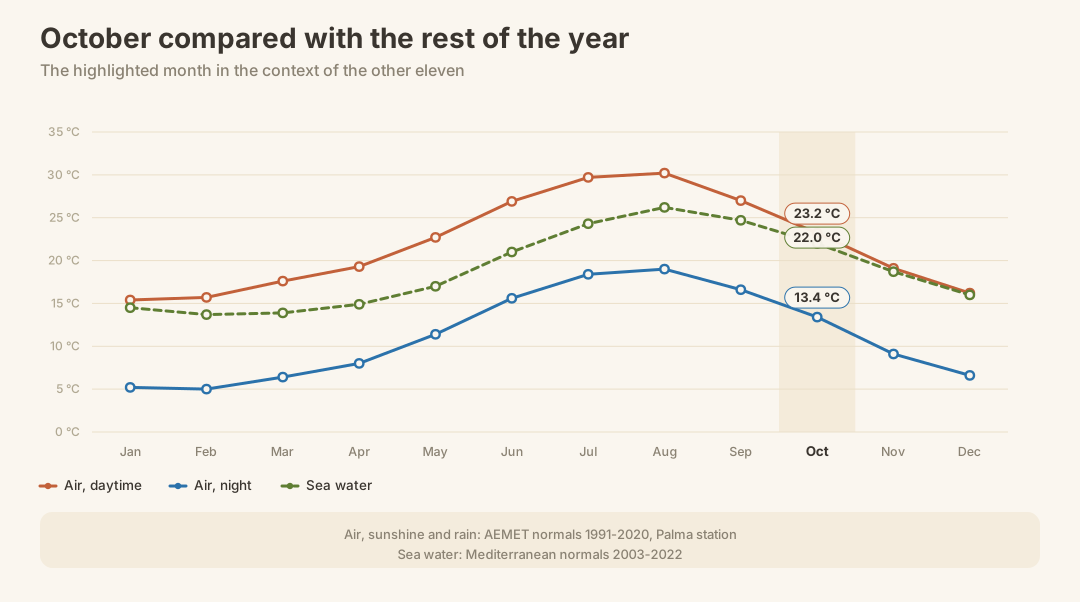
Water, sun and rain in October
Three factors determine what a day in October on Mallorca feels like: air temperature, water temperature, and the distribution of rainfall. They are more closely linked than they first appear, and understanding them helps in planning the month well.
Air temperature reacts quickly to sun, wind and cloud – 23.2 °C during the day, 13.4 °C at night. The sea, by contrast, reacts sluggishly. Water stores heat far longer than air, which is why the water temperature in October still sits at 22.0 °C, close to summer levels, even though the air has already become noticeably cooler. This lag of several weeks between air and water temperature is the reason October remains a good month for swimming despite shorter, cooler days – the sea has stored up the summer warmth and only releases it gradually, while the air is already turning towards autumn.
The sun remains a reliable companion with 6.4 h, though no longer at high-summer levels. Clouds pass through more often, frequently in connection with the rain events that give the month its reputation as the wettest of the year. Rain falls on 7 rainy days, with a total of 67 mm – making October the wettest month of the year in comparison, a result of the first major autumn depressions moving in from the Atlantic or the Mediterranean, which can build into powerful showers and thunderstorms against the Tramuntana or over the still-warm sea.
What matters here is the distribution: rain in October on Mallorca as a rule does not mean several grey days in a row, but individual, often short and intense events – an afternoon thunderstorm, a shower overnight, followed by several dry, often sunny days. For trip planning this means: a cloudy or rainy day is more likely in October than in summer, but rarely means a lost week. Humidity stands at 74 %, which, together with an average wind of 12 km/h, keeps the climate feeling pleasantly fresh rather than muggy despite occasional showers.
What is possible in October – and what is not
Swimming remains a good option in October, especially in the first half of the month, when the sea still sits at 22.0 °C and the air rises to 23.2 °C on sunny days. Visitors from more northern countries will generally still find the water pleasantly warm, even if it no longer reaches high-summer temperatures. Towards the end of the month, and especially after heavier rainfall, the sea cools noticeably, and nights become autumn-fresh at 13.4 °C – an evening dip is then less appealing than it was in September.
Hiking and cycling, on the other hand, benefit clearly from October. The heat of summer is over, and temperatures fall into a range that is comfortable even for longer tours inland or in the Tramuntana. Anyone who keeps an eye on the number of rainy days and checks the short-term forecast will generally find enough dry days for outings – it's just worth having weatherproof clothing on hand in case of a shower, since rain in October can arrive suddenly and heavily.
City tourism and culture work excellently in October: Palma, the monasteries, the markets and the grape-harvest festivals in the villages can be explored in mild temperatures without the oppressive summer heat. Museums, cathedrals and historic centres are weather-independent anyway, and they offer a good alternative to the beach on one of the rarer rainy days.
What October does not offer is the reliability of July or August: anyone planning a week at the beach with guaranteed sunshine takes on a certain risk, since one or two days of heavy rain are more likely in this month than in high season. Those counting on balmy evenings by the sea will also find it cooler towards the end of the month than many expect – the evenings are better suited to a restaurant with a sea view than to a long beach evening in a T-shirt. Anyone who values a warm sea combined with reliable sunshine is better served in high summer; October, on the other hand, rewards those who seek calm, moderate temperatures and a mix of activity and rest, rather than insisting on figures and guarantees.
Where you are best off in October
Our measurement series comes from the Palma station and therefore reflects conditions in the Bay of Palma. We have no verified figures of our own for other parts of the island – the following assessments should therefore be understood as qualitative, though they are based on the island's well-known climatic patterns.
Along the coast, especially in the south-west and south around Palma, the sea stays mild longest in October, because the largest bodies of water have warmed up the most over summer and the bays are often sheltered from the wind. These regions are best suited to swimming and beach days in October, since less wind and the sea's more stable warmth enhance the overall experience.
The north and north-west, where the Tramuntana falls to the sea, tends to be more changeable in October: the first autumn depressions often hit land here first, and the mountains capture moisture that is released in more intense, locally confined showers. Anyone wanting to hike will find the island's most impressive landscape here, but should plan for weatherproof clothing and adjust day trips flexibly to the forecast.
The interior, such as the plain around Sa Pobla or the hill country around Binissalem, benefits in October from the grape harvest and shows its best side on calm, often clear autumn days – though nights here cool noticeably more than on the coast, since the sea no longer has a moderating effect. Anyone sensitive to cool evenings is therefore better off on the coast than inland.
Exposed locations, such as high-lying villages in the Tramuntana or coastal stretches without a sheltering bay, feel wind and rain in October more strongly than sheltered bays in the south-east. For a stay built on reliability, the wind-sheltered coastal towns in the south and south-east are therefore the safest choice, while the north and the interior offer more scenic variety, but also more changeable weather.
What to pack for October
Clothing for October should cover the range between 23.2 °C during the day and 13.4 °C at night – a difference that makes light layers more sensible than a single outfit for the whole day. A thin jumper or a light jacket for the evening therefore belongs in the suitcase just as much as short-sleeved clothing for the warmer hours.
Because the sea still sits at 22.0 °C, swimwear remains worthwhile, especially in the first half of the month. A quick-drying towel is practical, since humidity stands at 74 % and fabrics no longer dry quite as fast as in high summer.
October records 7 rainy days and is thus the wettest month of the year; a light, waterproof rain layer – jacket or a compact umbrella – therefore definitely belongs in the luggage. The total rainfall of 67 mm tends to fall in short, intense bursts, but that is precisely what makes a spontaneous shower more likely than an announced spell of steady rain – anyone prepared need not cancel an activity because of it.
For hikes inland or in the Tramuntana, sturdy, ideally water-resistant footwear is recommended, since paths can quickly become muddy after rain, as well as an extra layer for cooler altitudes. Sun protection remains sensible despite the autumnal season: with 6.4 h, the sun still shines strongly enough to be underestimated on windy, apparently overcast days.
Anyone wanting to sit by the sea in the evening should plan for a warmer jacket, since after sunset the difference between daytime and night-time temperature becomes especially noticeable. Overall, a suitcase that recalls a changeable late summer rather than a stable high summer is worthwhile: layers rather than extremes.
October compared with the neighbouring months
September is considered by many to be a continuation of summer, and indeed, with daytime highs of 27.0 °C and a water temperature of 24.7 °C, it remains closer to high summer than October with its 23.2 °C and 22.0 °C. The difference also shows clearly in the number of rainy days: September comes in at 4 rainy days, while October counts 7 rainy days, making it noticeably wetter. Anyone seeking maximum swimming reliability and the lowest chance of rain is somewhat better off in September.
November, in turn, shows where autumn is heading: with daytime highs of 19.1 °C and a water temperature of 18.7 °C, it lies noticeably below October's level, while sunshine hours drop to 5.4 h. Swimming is no longer the obvious choice for most travellers in November, and the days become markedly shorter too.
October therefore sits exactly between its two neighbouring months: warmer and drier than November, but with noticeably more rain and slightly cooler temperatures than September. Choosing this month means consciously giving up September's highest swimming reliability in favour of a mix of a still-warm sea, mild air, grape-harvest atmosphere inland, and the certainty that one more rainy day should be planned for than the month before. Compared with November, however, October gains considerably in swimming and sunny days, and remains overall the milder, brighter of the two neighbouring months.
For anyone seeking a balance between summery swimming and autumnal calm, without the hectic pace of high season, October is often the more convincing compromise – provided one accepts that the month is statistically the wettest of the year, and plans in a few spare days accordingly.
Frequently asked questions
Is October the rainiest month in Mallorca?
Is October still a good time to visit Mallorca despite the rain?
How busy is Mallorca in October compared to summer?
How many hours of sunshine does Mallorca get in October?
Is October a good month for the wine harvest on Mallorca?
What's on in Mallorca in October
Events
- Fira B!
- eDNI and passport processing in CamposCampos
- 5th Manacor Family Theatre Festival: Despierta al Rinoceronte - Sala La FornalManacor
- FITZ ThursdayPalma
- MovicantoDeià
- SECRETS NIGHT 🤫Calvià
Worth doing now
- Time a visit to the Tramuntana wineries around the peak of the grape harvest.
- Hike the mountains while the countryside is cooler and greener than in summer.